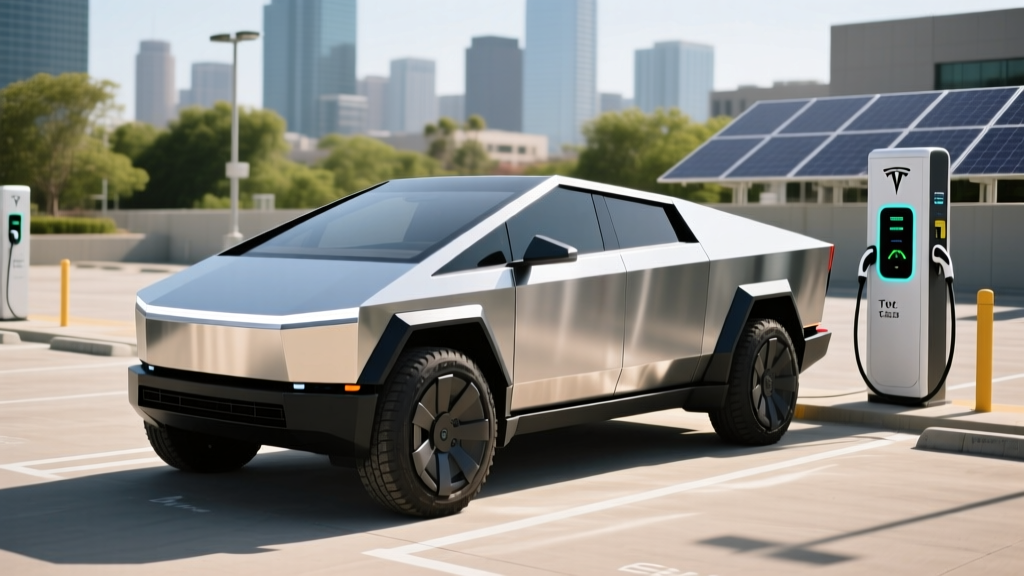
Search for "Tesla Cybertruck SUV" and you'll find a tangled mix of rumors, renderings, and genuine curiosity. Here's the ground truth as of the 2026 model year: Tesla does not sell a Cybertruck SUV. The Cybertruck exists only as a four-door, five-seat stainless-steel pickup. What buyers often mean when they search for a "Cybertruck SUV" is one of three things: (1) the Cybertruck's enclosed, SUV-like cabin and frunk space, (2) whether Tesla plans an SUV variant, or (3) which Tesla SUV — the Model X or a potential next-gen vehicle — delivers a similarly bold experience. This review runs the numbers on the actual 2026 Cybertruck lineup, maps its utility against the Model X, and gives you a clear buy-or-wait framework.
2026 Tesla Cybertruck: Trims, Pricing, and the Tax Credit Question
The 2026 Cybertruck is sold in three trims. Tesla reshuffled pricing after the controversial 2024 "Luxe" packages, returning closer to originally announced figures while adding AWD as the volume trim.
| Trim | Drivetrain | 0-60 mph | HP | EPA Range | Base MSRP |
|---|---|---|---|---|---|
| Rear-Wheel Drive | RWD (single motor) | ~6.5 s (est.) | ~350 | 250 mi | $60,990 |
| All-Wheel Drive | Dual-motor AWD | 4.1 s | 600 | 340 mi | $79,990 |
| Cyberbeast | Tri-motor AWD | 2.6 s | 845 | 320 mi | $99,990 |
Does it qualify for the federal EV tax credit? The short answer for most buyers: no. IRS §30D rules cap eligibility at $80,000 MSRP for pickups, vans, and SUVs — which technically puts the $79,990 AWD trim under the ceiling. However, the Cybertruck's battery pack is manufactured in Texas using predominantly NMC cells, and the critical-minerals and battery-component sourcing requirements under the Inflation Reduction Act have tightened each year. As of 2026, the Cybertruck does not meet the combined sourcing thresholds, so the $7,500 credit is unavailable at point of sale. Buyers must also satisfy income caps ($150K single / $300K joint) and cannot claim the credit for vehicles exceeding the MSRP cap. Always verify current eligibility on IRS.gov §30D before signing — rules shift annually.
Real-World Range: What the EPA Sticker Doesn't Tell You
EPA sticker: 340 miles.
Real-world highway (70-75 mph, 70°F): ~275-295 miles.
Cold weather (20-30°F, mixed driving): ~220-250 miles.
Towing a 5,000-lb trailer: ~160-180 miles.
The Cybertruck's angular stainless-steel exoskeleton looks dramatic but creates a high drag coefficient — estimated around 0.39 Cd, well above the Model X's ~0.24. That aero penalty shows up most at highway speeds. On the EPA test cycle, which mixes low-speed city and moderate highway, the AWD's ~123 kWh usable battery delivers 340 miles. But on sustained Interstate runs at 75 mph, expect to use 400-440 Wh/mile rather than the sticker's ~362 Wh/mile, which is why real-world highway range drops into the high 200s.
Cold weather compounds this. The 4680 cells warm slowly, and despite Tesla's heat pump and octovalve thermal system, preconditioning the pack in sub-freezing temps still costs 5-8% of capacity before you even leave the driveway. Owners in northern climates routinely report 25-30% range reduction in deep winter. If your commute is under 60 miles round-trip, this is a non-issue; if you're planning 500-mile road trips through Montana in January, plan your Supercharger stops accordingly.
Charging Speed: 800V Architecture in a 400V World
The Cybertruck runs on an 800-volt electrical architecture, which gives it a meaningful edge on Tesla's latest V4 Superchargers. Here's what the charge curve actually looks like — because peak kW numbers alone are misleading.
| Charging Method | Power / Rate | Miles Added | Notes |
|---|---|---|---|
| Level 1 (120V / 12A) | ~1.4 kW | ~3 mi/hr | Emergency/trickle only |
| Level 2 (240V / 48A) | 11.5 kW | ~31 mi/hr | Home Wall Connector; ~10 hrs 10-100% |
| DC Fast (V3 Supercharger) | Peak 250 kW | ~175 mi in 15 min | 400V stall, throttled by architecture |
| DC Fast (V4 Supercharger) | Peak 350 kW | ~200 mi in 15 min | 800V native; 10-80% in ~22 min |
The critical insight: 10-80% in roughly 22 minutes on a V4 Supercharger, with the curve tapering sharply above 80%. You'll add ~150 miles in the first 10 minutes, then spend another 12 minutes squeezing out the next 100. For road-trip planning, target 15-20% arrival SoC and charge to 75-80% — going higher wastes time. On older V3 stalls (400V), the 800V pack can still accept 250 kW but can't exploit the full voltage advantage, so expect 10-80% closer to 28-30 minutes.
At home, the 11.5 kW Level 2 rate is adequate but not class-leading. A full overnight charge (10 hours) restores about 310 miles — plenty for daily use. Budget $800-$1,500 for a professional Wall Connector install on an existing 60A circuit; older homes may need a panel upgrade ($1,500-$3,000 additional).
Battery Chemistry, Warranty, and Long-Term Degradation
The Cybertruck uses Tesla's 4680-format cells with NMC (nickel manganese cobalt) chemistry — not LFP. This choice prioritizes energy density and cold-weather performance over cycle life. The structural battery pack is a stressed member of the chassis, contributing to rigidity but making out-of-warranty replacement complex.
Tesla's battery and drive unit warranty covers 8 years / 120,000 miles (AWD and Cyberbeast), with a guaranteed minimum 70% capacity retention over that period. Real-world data from early 2024-delivery trucks shows roughly 5-7% degradation at 30,000 miles, which is in line with NMC expectations. The RWD trim, when it ships, is expected to use the same chemistry but with a smaller pack.
Out-of-warranty replacement cost for a 4680 structural pack is currently estimated at $18,000-$25,000 including labor — a figure worth factoring into 10-year ownership projections. Tesla's owner's manual recommends keeping daily charge limits at 80% for NMC longevity and only charging to 100% before long trips.
Performance, Cargo, and the SUV Comparison
The Cyberbeast's 2.6-second 0-60 time is supercar territory in a 6,800-lb vehicle — genuinely startling the first time you floor it. The AWD's 4.1 seconds is more than adequate for merging and passing. Steering is rear-wheel-steered (up to 10°), giving the truck a surprisingly tight 35-foot turning circle, tighter than a Model X.
Cargo and passenger dimensions:
- Front legroom: 41.5 in | Rear legroom: 38.2 in
- Bed volume: 67 cu ft (with tonneau closed)
- Frunk (front trunk): ~7 cu ft — lockable, useful for groceries or charging cables
- Towing capacity: 11,000 lbs (AWD/Cyberbeast)
- Bed length: 6 ft (with tailgate down: 8 ft)
Here's where the "Cybertruck SUV" question gets practical. The Cybertruck's enclosed, climate-controlled cabin with a power-operated tonneau cover gives it SUV-like secure storage for daily use. But if you need three rows of seating, the Cybertruck cannot deliver — it's strictly five passengers. The Model X (starting ~$79,990, EPA 335 mi Long Range) seats up to seven, offers 88 cu ft of cargo with seats folded, and achieves 2.5 s 0-60 in Plaid trim. If "Cybertruck SUV" means "bold Tesla with family utility," the Model X is the actual answer today.
Tech, Driver Assists, and the Autopilot Reality
The Cybertruck's cabin centers on an 18.5-inch front touchscreen and a 9.4-inch rear display. Tesla removed ultrasonic sensors and relies entirely on its Tesla Vision camera suite for parking aids — an approach that has drawn criticism for inconsistent obstacle detection at low speeds. Steer-by-wire (no mechanical linkage) is standard, which feels alien for the first 20 minutes and intuitive thereafter.
Tesla Autopilot and Full Self-Driving (Supervised) are Level 2 driver-assist systems, not self-driving. You must keep your hands on the yoke and eyes on the road at all times. Only Level 4 services like Waymo operate without a human driver in geofenced areas. FSD (Supervised) costs $8,000 one-time or $99/month in 2026 and handles highway interchanges and city streets with increasing competence — but it still makes errors at unprotected left turns, construction zones, and faded lane markings.
Other standout tech: 48-volt electrical architecture (reducing wiring harness weight), Powershare vehicle-to-load (V2L) capability delivering up to 11.5 kW to tools or a home during outages, and an adaptive air suspension with 16 inches of ground clearance in Extract mode for off-road use.
Pros, Cons, and the Verdict
- Tri-motor Cyberbeast performance is unmatched in any production truck
- Stainless-steel exoskeleton is dent- and corrosion-resistant
- 11,000-lb towing + V2L makes it a legitimate work site / backup-power tool
- 800V architecture + V4 Supercharger = top-tier road-trip charging
- Rear-wheel steering gives a compact turning radius
- High drag coefficient kills highway range vs. EPA sticker
- No federal tax credit due to battery-sourcing rules
- Five seats only — not a true family SUV replacement
- Tesla Vision-only parking aids are inconsistent
- Stainless panels show fingerprints; repair complexity is high
- Price creep since 2019 announcement erodes value proposition
Is the Cybertruck worth buying vs. competitors? Against the Ford F-150 Lightning (from ~$54,990, EPA 320 mi, tax-credit eligible on some trims), the Cybertruck is pricier and less practical as a conventional truck, but faster and more tech-forward. Against the Rivian R1T (from ~$69,900, EPA 352 mi Max Pack), the R1T offers a more refined interior, better off-road articulation, and a quad-motor option — but no Supercharger network access (though NACS adapters now work). If you want a statement vehicle with supercar acceleration and don't need three rows, the Cybertruck delivers. If you need family SUV utility, buy the Model X or wait for Tesla's next-gen platform announcements.
Frequently Asked Questions
Is there a Tesla Cybertruck SUV coming out?
As of 2026, Tesla has not announced a Cybertruck SUV variant. Elon Musk has occasionally referenced future body styles, but no production timeline, specs, or pricing exist. Tesla's current SUV lineup consists of the Model X and Model Y. Treat any "Cybertruck SUV" rendering online as speculative fan art.
What is the real-world range of the Cybertruck AWD?
The EPA rates it at 340 miles, but expect 275-295 miles on highway road trips at 70-75 mph, and 220-250 miles in sub-freezing winter conditions. Towing cuts range nearly in half — plan for 160-180 miles with a 5,000-lb trailer.
How fast does the Cybertruck charge at home and on the road?
At home on a Level 2 Wall Connector (11.5 kW), it adds about 31 miles of range per hour, taking roughly 10 hours from 10-100%. On a V4 Supercharger (350 kW peak), 10-80% takes about 22 minutes; on older V3 stalls, expect 28-30 minutes.
Does the 2026 Cybertruck qualify for the $7,500 federal tax credit?
Generally, no. While the AWD trim's $79,990 MSRP falls under the §30D truck/SUV cap, the battery's critical-mineral and component sourcing does not meet 2026 IRA thresholds. Income-eligible buyers should verify on IRS.gov, but plan your purchase without assuming the credit. The used-EV credit (§25E, up to $4,000) may apply to pre-owned examples once they enter the resale market.
Should I buy a Cybertruck or a Model X?
Choose the Cybertruck if you want a five-seat pickup with supercar acceleration, 11,000-lb towing, V2L backup power, and don't mind range compromises at highway speed. Choose the Model X if you need three-row seating (up to 7 passengers), falcon-wing rear doors for tight parking, better highway efficiency (~335 mi EPA), and a more mature interior. Both share Tesla's Supercharger network and software ecosystem.
Sources: EPA fueleconomy.gov, Tesla Cybertruck specs, IRS §30D clean vehicle credits.