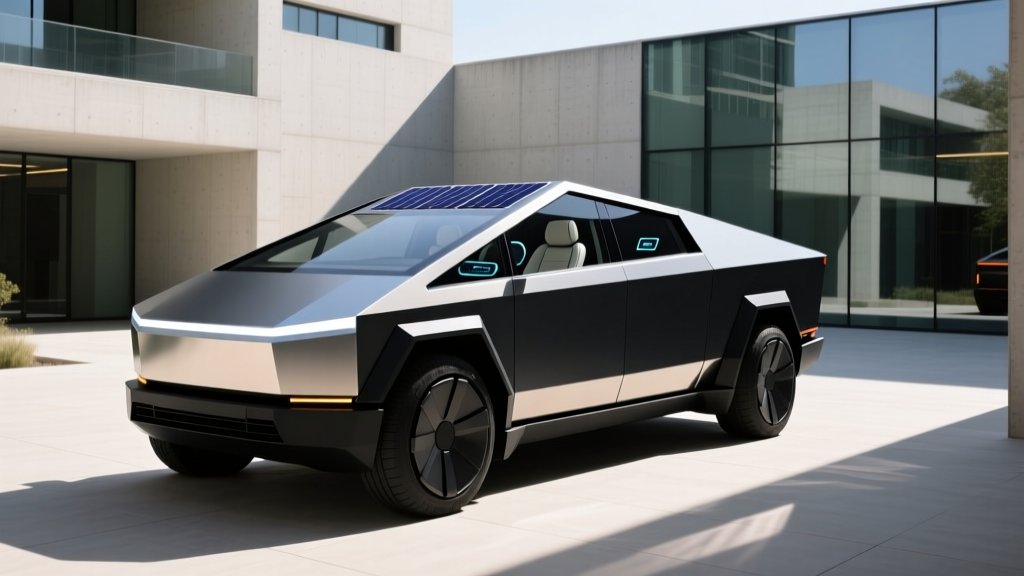
If you have been browsing EV forums or Tesla fan communities lately, you have likely encountered the phrase cybertruck suv concept — a rumored three-row, seven-passenger electric SUV that would borrow the Cybertruck's stainless-steel exoskeleton and angular design language but wrap it around a more traditional SUV body style. The idea is compelling: the polarizing utility of the Cybertruck paired with the family practicality of a Model X successor. But as of early 2026, Tesla has not officially announced, previewed, or confirmed any such vehicle.
What follows is a thorough analysis of what we know, what is speculative, and whether a Cybertruck-based SUV would actually make sense for Tesla's lineup and for buyers weighing options against the Rivian R1S, Kia EV9, and Tesla's own Model X.
Where the Cybertruck SUV Rumors Started
The concept of a Cybertruck SUV is not entirely baseless. Tesla CEO Elon Musk has, at various points, floated the idea of expanding the Cybertruck platform beyond the pickup segment. In a 2023 earnings call, Musk mentioned that Tesla could potentially build "other vehicles" on the Cybertruck's 48-volt architecture and stainless-steel manufacturing processes. Fan renderings proliferated after the Cybertruck's November 2023 delivery event, imagining a squared-off, three-row SUV variant.
However, there is a critical distinction: Tesla has not filed any trademark, submitted NHTSA documentation, or published any official teaser for a Cybertruck SUV. The vehicle discussed in this article is entirely speculative and based on community concepts, supply-chain whispers, and logical platform extensions. We will clearly separate confirmed Cybertruck specs (which inform what an SUV variant might share) from pure estimation.
Estimated Specs: What a Cybertruck SUV Could Look Like
If Tesla were to build a three-row SUV on the Cybertruck platform, it would likely share the 48V electrical architecture, stainless-steel body panels, and steer-by-wire system. Below is an estimated specification table based on the current Cybertruck lineup and logical SUV adaptations. Again, these are projections, not confirmed figures.
| Spec | AWD (Estimated) | Cyberbeast (Estimated) |
|---|---|---|
| Battery Capacity | ~123 kWh usable (NMC) | ~123 kWh usable (NMC) |
| EPA Range (Est.) | ~320–340 mi | ~300–320 mi |
| 0–60 mph | ~4.1 sec | ~2.6 sec |
| Horsepower | ~600 hp (dual-motor) | ~845 hp (tri-motor) |
| Drivetrain | AWD (dual-motor) | AWD (tri-motor) |
| Max DC Fast Charge | ~250 kW (est.) | ~250 kW (est.) |
| 10–80% DC Charge Time | ~30 min (est.) | ~30 min (est.) |
| Level 2 Home Charge | ~11.5 kW / ~30 mi/hr | ~11.5 kW / ~30 mi/hr |
| Seating | 7-passenger (3-row) | 7-passenger (3-row) |
| Est. Base MSRP | ~$85,000–$95,000 | ~$105,000–$115,000 |
For context, the current 2025 Tesla Cybertruck AWD carries an EPA-estimated 340 miles of range with a ~123 kWh NMC battery pack, a dual-motor setup producing 600 horsepower, and a 0–60 time of 4.1 seconds. A heavier, less aerodynamic SUV body would likely reduce range by 5–10% compared to the truck.
Real-World Range Expectations
EPA Estimated (projected): ~320–340 miles (AWD), ~300–320 miles (Cyberbeast)
Highway driving at 75 mph: Expect ~260–290 miles
Cold weather (below 32°F): Expect 20–30% reduction → ~220–270 miles
Combined mixed driving (realistic): ~280–310 miles
The current Cybertruck has already drawn attention for its real-world range falling short of early projections — fueleconomy.gov lists the AWD variant at 340 miles EPA, but independent highway tests at sustained 70–75 mph speeds have shown results closer to 270–290 miles. The Cybertruck's flat, angular shape creates substantial aerodynamic drag, and an SUV variant with a taller roofline and larger frontal area would likely face similar or worse efficiency penalties.
Cold-weather range loss is another factor Tesla buyers must plan for. NMC chemistry (which the Cybertruck uses and a hypothetical SUV would almost certainly carry) loses roughly 20–30% of usable capacity in sub-freezing temperatures. Tesla's heat pump system mitigates cabin-heating energy draw, but battery chemistry limitations remain. If you live in the upper Midwest or Northeast, plan your road trips around ~230–250 miles of usable winter range.
Charging Speed and Infrastructure
Charging speed is where the Cybertruck platform shows its age relative to newer competitors. The current Cybertruck peaks at approximately 250 kW on a V3 Supercharger, but like most EVs, it does not sustain that rate. The charging curve tapers significantly above 50% state of charge (SoC), and the 10–80% charge takes roughly 28–32 minutes under optimal conditions (preconditioned battery, warm ambient temperature, V3 or V4 Supercharger).
| Charging Level | Power (kW) | Miles Added per Hour | Notes |
|---|---|---|---|
| Level 1 (120V) | ~1.4 kW | ~3–4 mi/hr | Emergency only |
| Level 2 (240V, 48A) | ~11.5 kW | ~28–32 mi/hr | Home Wall Connector |
| DC Fast (V3 Supercharger) | Peak ~250 kW | ~700+ mi/hr (peak) | 10–80% in ~30 min |
| DC Fast (V4 Supercharger) | Peak ~250–350 kW | Variable | Depends on vehicle acceptance rate |
A key consideration: the Cybertruck uses the NACS (North American Charging Standard) connector natively, which is now the industry standard adopted by Ford, GM, Rivian, and most major automakers for 2025+ models. A Cybertruck SUV would carry the same NACS port, giving it seamless access to the entire Tesla Supercharger network — currently over 6,000 stations and 60,000+ connectors in North America. This remains a significant infrastructure advantage over CCS-equipped competitors relying on Electrify America or EVgo.
However, the ~250 kW peak charge rate is falling behind. The Hyundai Ioniq 5 and Kia EV9 can accept up to 350 kW on compatible chargers, and the 800V architecture in those vehicles enables faster sustained charging curves. If Tesla does not upgrade to an 800V+ architecture for a next-generation SUV platform, charging speed could be a competitive weakness.
Performance, Drivetrain, and What Carries Over
The current Cybertruck's performance figures are genuinely impressive, and an SUV variant sharing the same powertrain would inherit them. The dual-motor AWD produces 600 horsepower and hits 0–60 mph in 4.1 seconds. The tri-motor Cyberbeast pushes 845 horsepower and a 2.6-second 0–60 — numbers that would make a three-row family SUV one of the quickest vehicles on the road, rivaling the Model X Plaid.
The Cybertruck's 48-volt electrical architecture is a significant engineering differentiator. Most vehicles still use 12V systems; the 48V setup allows thinner wiring harnesses (reducing weight), more precise control of accessories, and better integration with steer-by-wire and four-wheel steering. An SUV built on this platform would inherit these advantages, potentially offering a tighter turning radius than the Model X despite similar dimensions.
Towing capacity is another question. The current Cybertruck is rated at 11,000 pounds. An SUV variant would likely see that reduced — the Rivian R1S (quad-motor) is rated at 7,700 pounds, and the Model X maxes out at 5,000 pounds. Expect a Cybertruck SUV to land somewhere in the 6,000–8,000 pound range, adequate for most boat and camper trailers but not heavy-duty hauling.
Pricing, Tax Credits, and Ownership Cost
Pricing is pure speculation, but we can anchor estimates to the current Cybertruck lineup and Tesla's positioning strategy:
| Trim | Est. MSRP | §30D Tax Credit Eligible? | Est. Net Price |
|---|---|---|---|
| AWD (base) | ~$85,000–$95,000 | No — exceeds $80,000 SUV MSRP cap | ~$85,000–$95,000 |
| Cyberbeast | ~$105,000–$115,000 | No — exceeds $80,000 SUV MSRP cap | ~$105,000–$115,000 |
Here is the critical tax credit issue: under current IRS §30D rules, the federal EV tax credit for new clean vehicles caps at $80,000 MSRP for SUVs (and $55,000 for sedans). A Cybertruck SUV with an estimated starting price of $85,000+ would almost certainly exceed this cap, making it ineligible for the $7,500 federal credit. This is the same problem the current Cybertruck faces — it is classified as a pickup truck with a $80,000 cap, and even the base AWD at ~$79,990 barely squeaks under it depending on options and destination charges.
Additionally, §30D has buyer income limits ($300,000 joint / $150,000 single modified AGI) and strict battery-component and critical-mineral sourcing requirements that change annually. Even if Tesla priced a base SUV under $80,000, battery sourcing rules could disqualify it. Always verify eligibility with a tax professional before assuming credit availability.
Interior Space, Tech, and Daily Practicality
The Cybertruck's interior has drawn both praise and criticism. The minimalist approach — a single 18.5-inch front touchscreen, a rear 9.4-inch display, no traditional instrument cluster, and a yoke-style steering wheel — would likely carry over to an SUV variant. The stainless-steel dashboard and sparse physical controls are polarizing; some owners love the futuristic simplicity, while others find it frustrating for quick climate or media adjustments.
A three-row SUV configuration would need to address the Cybertruck's biggest interior weakness: rear-seat comfort. The truck's rear bench is relatively flat and firm, with limited legroom by full-size pickup standards. An SUV variant would need to offer at least 36–38 inches of second-row legroom and a usable third row (30+ inches) to compete with the Rivian R1S (38.2 inches second-row) and Kia EV9 (32.0 inches third-row).
Expected cargo volume behind the third row: roughly 18–22 cubic feet (comparable to the Model X's 15 cu ft with all rows up, but improved). Fold the third row, and you might see 45–55 cu ft. Fold both rear rows, and 80–90 cu ft is plausible. A front trunk (frunk) would likely offer 5–7 cu ft of additional sealed storage.
On the tech front, Tesla's Autopilot and FSD (Supervised) would be standard or available. To be clear: FSD is an SAE Level 2 driver-assistance system, meaning the driver must remain fully attentive with hands on the wheel at all times. It is not autonomous driving. Tesla's camera-only vision system has improved significantly, but it remains a supervised system — not a replacement for an engaged driver.
Competitive Landscape: What Would It Face?
If Tesla launches a Cybertruck-based SUV, it enters one of the most competitive segments in the EV market. Here is how the key rivals stack up:
| Vehicle | EPA Range | Base MSRP | Max DC Charge | Seating |
|---|---|---|---|---|
| Rivian R1S (Dual-Motor) | ~330 mi | ~$79,900 | ~220 kW | 7 |
| Kia EV9 (GT-Line AWD) | ~270 mi | ~$59,900 | ~350 kW (peak) | 6–7 |
| Tesla Model X (Long Range) | ~335 mi | ~$81,630 | ~250 kW | 5–7 |
| Hyundai Ioniq 9 (est.) | ~300+ mi (est.) | ~$55,000 (est.) | ~350 kW (peak) | 6–7 |
The Kia EV9 and upcoming Hyundai Ioniq 9 represent a serious value threat — offering three rows, 800V fast charging, and competitive range at $20,000–$30,000 less than a Cybertruck SUV would likely cost. The Rivian R1S matches the rugged-adventure positioning and offers genuine off-road capability. And the Model X, while aging, already fills the premium Tesla SUV role.
A Cybertruck SUV would need to differentiate on design (the stainless-steel exoskeleton is undeniably unique), performance (tri-motor Cyberbeast acceleration is unmatched in the segment), and Supercharger network access (though this advantage is eroding as competitors gain NACS access).
Pros, Cons, and Who This EV Would Suit
- Unmistakable design — no other 3-row SUV looks like this
- Tri-motor Cyberbeast performance (845 hp, ~2.6 sec 0–60)
- Native NACS / full Supercharger network access
- 48V architecture and four-wheel steering
- Stainless-steel body panels (dent-resistant, no paint needed)
- Strong towing capacity (est. 6,000–8,000 lbs)
- Likely exceeds $80K MSRP cap → no federal tax credit
- Aerodynamic drag hurts highway range
- ~250 kW peak charge rate trails 800V competitors
- Polarizing minimalist interior may not suit family buyers
- Stainless-steel panels could complicate collision repair
- Tesla build-quality concerns persist
- Not confirmed — could be years away or never happen
Who would this suit? A Cybertruck SUV would appeal to buyers who want the Cybertruck's radical design and performance but need three rows for family duty. Think: tech-forward parents who tow a camper on weekends, want Supercharger road-trip capability, and are willing to pay a premium for exclusivity. It would not suit budget-conscious buyers (the EV9 or Ioniq 9 are far more practical), those who prioritize maximum range (aerodynamics work against it), or anyone who needs a vehicle in the near term — this is, at best, a 2027–2028 product if it materializes at all.
Frequently Asked Questions
Is the Cybertruck SUV concept a real Tesla vehicle I can buy?
No. As of early 2026, Tesla has not announced, confirmed, or opened reservations for any Cybertruck-based SUV. The "cybertruck suv concept" exists only as fan renderings, community speculation, and logical platform-extension analysis. Do not expect to purchase one in the near term.
What would a Cybertruck SUV cost?
Based on the current Cybertruck pricing structure ($79,990 AWD / $99,990 Cyberbeast for the pickup), a three-row SUV variant would likely start between $85,000 and $95,000, with a Cyberbeast version reaching $105,000–$115,000. These are estimates only.
Would a Cybertruck SUV qualify for the $7,500 federal EV tax credit?
Almost certainly not. Under current IRS §30D rules, SUVs must have an MSRP at or below $80,000 to qualify. A Cybertruck SUV would likely exceed that cap at every trim level. Additionally, buyer income limits and battery-sourcing requirements further restrict eligibility. Consult a tax professional for your specific situation.
How does it compare to the Tesla Model X?
A Cybertruck SUV would likely be more rugged, more angular, and potentially more capable off-road and for towing than the Model X. However, the Model X already offers three rows, falcon-wing rear doors, up to 335 miles of EPA range, and a starting price around $81,630. If Tesla launches a Cybertruck SUV, it may eventually replace or complement the aging Model X in the lineup.
When could a Cybertruck SUV be available?
There is no timeline. Tesla typically requires 2–3 years from official announcement to first deliveries (the Cybertruck itself was announced in 2019 and delivered in late 2023). Even if Tesla announced a Cybertruck SUV in 2026, first deliveries would not be expected before late 2028 at the earliest.
What is the best 3-row electric SUV I can actually buy right now?
For value and fast charging: the Kia EV9 (starting ~$54,900, 350 kW peak charging, up to 304 mi range). For adventure and off-road capability: the Rivian R1S (starting ~$79,900, up to 410 mi with Max Pack). For Tesla ecosystem loyalty: the Model X remains the only current three-row Tesla option.