The Tesla Cybertruck's steering wheel has sparked more debate than almost any other design element on the truck. Is the flat-top, flat-bottom "yoke" a futuristic triumph or an ergonomic misstep? Beyond the polarizing wheel, the Cybertruck itself remains one of the most spec-dense, capability-heavy electric pickups on the market. This review covers the steering-wheel experience in depth — and pairs it with every number you need to decide whether the Cybertruck earns a spot in your driveway.
The Cybertruck Steering Wheel: Yoke vs. Round Debate
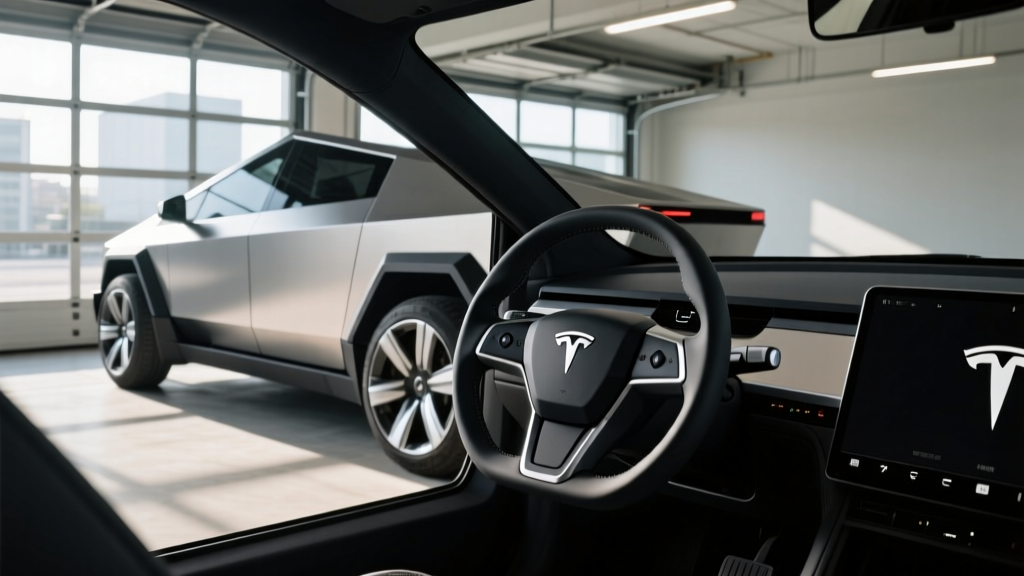
Tesla began delivering the Cybertruck in late 2023 with its signature yoke-style steering wheel as standard equipment. The design removes the upper arc of a traditional round wheel, ostensibly to improve forward sightlines to the dashboard screen and the road ahead. In practice, the yoke forces a fundamental change in how you execute hand-over-hand maneuvers — particularly tight parking-lot turns, three-point turns, and low-speed trail crawling where the front wheels are cranked to full lock.
By mid-2024, Tesla responded to owner feedback by offering a conventional round steering wheel as a no-cost option at the time of order. As of the 2026 model year, both configurations remain available, though the yoke continues to ship as the default on Foundation Series and higher trims. Here's what each option delivers in real-world driving:
Yoke Steering — Pros
- Unobstructed view of the 18.5-inch center display and instrument readouts
- Forces consistent 9-and-3 hand placement, ideal for highway cruising
- Distinctive aesthetic that matches the Cybertruck's angular interior
- Easier to slide in and out of the driver's seat without the upper arc catching
Yoke Steering — Cons
- Hand-over-hand turns require relearning; no continuous rim to grab at full lock
- Low-speed maneuvers (parking, U-turns) demand more steering input effort
- Not ideal for off-road situations requiring rapid wheel shuffle
- Steering ratio is fixed — no variable-rack compensation like the Model S Plaid yoke
The Cybertruck uses a conventional variable-ratio rack rather than the steer-by-wire system Tesla introduced on the refreshed Model S/X with yoke. That means the Cybertruck yoke requires approximately 2.0 turns lock-to-lock — more input than a true steer-by-wire setup but fewer than a typical truck's 3.0+ turns. Most owners report a two-to-three-week adaptation period before the yoke feels natural, though a vocal minority never acclimates and swaps to the round wheel via aftermarket or Tesla's own option.
Spec Table: 2026 Tesla Cybertruck at a Glance
| Specification | AWD (Dual-Motor) | Cyberbeast (Tri-Motor) |
|---|---|---|
| EPA Range | 340 miles | 320 miles |
| Battery (usable) | ~123 kWh (NMC) | ~123 kWh (NMC) |
| Horsepower | 600 hp | 845 hp |
| 0–60 mph | 4.1 seconds | 2.6 seconds |
| Drivetrain | Dual-motor AWD | Tri-motor AWD |
| Max DC Fast Charge | 250 kW | 250 kW |
| 10–80% DC Time | ~28 minutes | ~28 minutes |
| Level 2 Home Charging | 11.5 kW (~34 mi/hr) | 11.5 kW (~34 mi/hr) |
| Towing Capacity | 11,000 lbs | 11,000 lbs |
| Payload Capacity | 2,500 lbs | 2,500 lbs |
| Cargo Bed Length | 6 ft (72 in) | 6 ft (72 in) |
| Cargo Volume (bed) | ~67 cu ft | ~67 cu ft |
| Frunk Volume | ~7 cu ft | ~7 cu ft |
| Rear Legroom | ~38.2 inches | ~38.2 inches |
| Base MSRP | $79,990 | $99,990 |
| EPA Efficiency | ~58 MPGe / ~58 kWh/100mi | ~56 MPGe / ~60 kWh/100mi |
Real-World Range: What the EPA Number Doesn't Tell You
Range Reality Check
EPA Estimated: 340 miles (AWD) / 320 miles (Cyberbeast)
Real-World Highway (70 mph, mild weather): ~270–295 miles
Real-World Highway (cold weather, below 30°F): ~220–250 miles
City / Suburban Mixed: ~300–330 miles
The Cybertruck's angular stainless-steel exoskeleton creates substantially more aerodynamic drag than a rounded-body EV like the Rivian R1T or the Ford F-150 Lightning. At highway speeds above 65 mph, that brick-wall drag coefficient (estimated ~0.34 Cd) eats into range aggressively. In controlled highway testing at 70 mph in 72°F conditions, the AWD dual-motor variant typically delivers between 270 and 295 miles before reaching a 5% state of charge — roughly 13–20% below the EPA sticker.
Cold weather compounds the issue. Below freezing, battery chemistry slows and cabin heating draws significant energy. Expect a 25–35% range reduction on winter highway drives, landing around 220–250 real-world miles on a full charge. The Cybertruck's heat pump helps mitigate cabin-heating losses compared to resistive heaters, but the sheer mass of the vehicle (~6,700 lbs curb weight for the AWD) means more energy is spent simply moving the truck.
If your typical driving is suburban and city mixed at speeds under 55 mph, you'll get much closer to the EPA number — regenerative braking recaptures energy effectively in stop-and-go conditions, and aero drag matters far less at lower speeds.
Charging Speed: DC Fast, Home Level 2, and the Charge Curve
| Charging Level | Power / Rate | Miles Added per Hour | Notes |
|---|---|---|---|
| Level 1 (120V) | ~1.4 kW | ~4 mi/hr | Emergency/trickle only; full charge takes 80+ hours |
| Level 2 (240V, 48A) | 11.5 kW | ~34 mi/hr | Full charge in ~11–12 hours; ideal overnight home setup |
| DC Fast Charge (peak) | 250 kW | ~650 mi/hr (peak) | 10–80% in ~28 min; tapers sharply above 80% |
| DC Fast Charge (sustained avg) | ~140–160 kW | ~400 mi/hr (avg) | Average rate across the 10–80% session |
The Cybertruck peaks at 250 kW on a V3 Tesla Supercharger or equivalent CCS/NACS DC fast charger. However, as with all EVs, peak rate is not sustained rate. The truck holds near 250 kW only between roughly 10–30% state of charge, then progressively tapers. By 60% SoC, the rate drops to approximately 150 kW, and above 80%, it falls below 60 kW. This charge-curve taper means the advertised 10–80% time of approximately 28 minutes is realistic only with proper battery preconditioning — navigate to a Supercharger using the truck's built-in routing, and the battery management system will warm the pack to optimal temperature before you arrive.
Without preconditioning (for example, pulling into a non-routed charger on a cold morning), expect that 10–80% session to stretch to 35–40 minutes. For home charging, a 48-amp Level 2 wall connector on a 60-amp circuit delivers 11.5 kW, replenishing roughly 34 miles of range per hour — enough to fully recharge overnight for even heavy daily use.
The Cybertruck uses the NACS (North American Charging Standard) connector natively, giving it full access to Tesla's Supercharger network — the most reliable and extensive DC fast-charging network in North America. It also supports CCS1 adapters for Electrify America and other third-party networks.
Performance, Capability, and What 845 Horsepower Feels Like
The tri-motor Cyberbeast is, by the numbers, one of the quickest production vehicles ever sold. A 2.6-second 0–60 mph time in a 6,700-pound stainless-steel pickup defies physics expectations. The dual-motor AWD variant, at 4.1 seconds, is hardly slow — it outpaces most sports cars from a decade ago.
But raw acceleration is only part of the performance story. The Cybertruck's steer-by-wire–adjacent feel (it uses a conventional rack but with aggressive variable-ratio tuning) makes the truck surprisingly nimble at parking-lot speeds, where the rear-wheel steering system (available on newer builds) shaves the turning circle to approximately 40 feet — comparable to a midsize sedan. The air suspension provides up to 12 inches of ground clearance in Extract Mode for off-road use, and the 11,000-pound tow rating is competitive with heavy-duty ICE pickups.
Where the Cybertruck shows limitations is in sustained high-speed efficiency and ride refinement. The stainless-steel body panels transmit more road and wind noise than aluminum or composite bodies, and the sheer mass means tire wear is accelerated — expect to replace the 35-inch all-terrain tires every 25,000–35,000 miles under normal use.
Pricing, Tax Credit Eligibility, and Total Cost
As of the 2026 model year, Tesla prices the Cybertruck in two primary configurations:
| Trim | Base MSRP | Destination | As-Tested (typical) | Federal §30D Credit |
|---|---|---|---|---|
| AWD (Dual-Motor) | $79,990 | $1,995 | $84,000–$88,000 | See eligibility notes below |
| Cyberbeast (Tri-Motor) | $99,990 | $1,995 | $104,000–$115,000 | See eligibility notes below |
Federal tax credit (§30D) eligibility is complex for the Cybertruck. Under current IRS rules, the $7,500 federal EV tax credit requires that the vehicle meet battery-component and critical-mineral sourcing thresholds, that the buyer's adjusted gross income fall below caps ($150,000 single / $300,000 joint), and that the vehicle's MSRP not exceed $80,000 for pickup trucks. The Cybertruck AWD at $79,990 base MSRP sits at the absolute threshold — adding any options pushes it above the cap, disqualifying it. The Cyberbeast, at $99,990, exceeds the truck MSRP cap entirely and does not qualify regardless of buyer income.
Additionally, battery-sourcing requirements under the Inflation Reduction Act have tightened each year. As of 2026, vehicles must demonstrate that an increasing percentage of critical minerals are sourced from the U.S. or free-trade-agreement partners. Tesla has not publicly confirmed full §30D compliance for the Cybertruck's specific battery supply chain. Always verify current eligibility at fueleconomy.gov and consult a tax professional before relying on the credit. Point-of-sale transfer is available for qualifying vehicles under IRS rules.
Interior, Tech, and the Cybertruck Driving Experience
The Cybertruck's cabin is unmistakably Tesla: minimalist, screen-dominant, and built around an 18.5-inch center touchscreen running Tesla's latest vehicle software. There are no physical buttons for climate, media, or vehicle controls — everything routes through the display or voice commands. A rear 9.4-inch touchscreen serves second-row passengers for climate and entertainment.
Tech highlights include:
- Autopilot (standard): SAE Level 2 driver assistance with adaptive cruise control, lane centering, and automatic emergency braking. The driver must remain fully engaged — this is not self-driving.
- Full Self-Driving Supervised ($8,000 option or $99/mo): Enhanced Level 2 system with automatic lane changes, traffic-light recognition, and city-street navigation. Still requires active driver supervision at all times.
- Powershare V2L / V2H: Up to 11.5 kW of bidirectional power export, enough to run power tools at a job site or provide emergency home backup during outages.
- Armor glass: Ultra-hard stainless-steel exterior with "armor glass" windows — though real-world reports indicate susceptibility to cracking under extreme impact (a known warranty consideration).
- Powered tonneau cover: Motorized bed cover that integrates with the bed camera system and lockable storage.
⚠️ Autopilot & FSD Supervised — Level 2 Only
Tesla's Autopilot and Full Self-Driving (Supervised) are SAE Level 2 driver-assistance systems. They do not make the Cybertruck self-driving. The driver must keep hands on the steering wheel (or yoke), eyes on the road, and be prepared to take over instantly. Tesla's cabin camera monitors driver attention and will issue escalating warnings if engagement lapses.
Who Should Buy the Cybertruck — And Who Shouldn't
Decision Framework
Choose the Cybertruck if:
- You need a full-size electric pickup with 11,000-lb towing and genuine off-road capability
- You want access to the Tesla Supercharger network for long-distance towing and road trips
- You value bidirectional power (V2L/V2H) for job-site or emergency use
- You enjoy being an early adopter and can tolerate software-evolution quirks
Look at competitors (Rivian R1T, Ford F-150 Lightning, Chevy Silverado EV) if:
- You prioritize a conventional steering wheel and proven ergonomics
- You need a longer bed (the Cybertruck's 6-foot bed is shorter than most full-size trucks)
- You want a more traditional truck interior with physical controls
- Federal tax credit eligibility is a deciding factor — the Rivian R1T and some F-150 Lightning trims may qualify more readily
Warranty, Longevity, and Battery Degradation
Tesla covers the Cybertruck with the following warranty terms:
- Basic Vehicle: 4 years / 50,000 miles
- Battery & Drive Units: 8 years / 150,000 miles (whichever comes first), with a minimum 70% capacity retention guarantee over the warranty period
The Cybertruck's battery pack uses NMC (nickel-manganese-cobalt) chemistry, chosen for its high energy density — necessary to push 340 EPA miles in a vehicle this heavy. NMC packs historically show 10–15% degradation over 100,000 miles based on Tesla fleet data from Model S/X/3/Y, though the Cybertruck's larger pack means it operates at lower average C-rates, which should moderate degradation. For maximum longevity, Tesla recommends daily charging to 80–90% and avoiding prolonged storage at 100% SoC.
Replacement cost for the Cybertruck battery pack is not yet widely documented (the vehicle is still relatively new), but based on comparable Tesla packs, expect estimates in the $18,000–$25,000 range out of warranty — though failure within the 8-year window is covered.
Frequently Asked Questions
What is the real-world range of the Tesla Cybertruck?
The EPA rates the dual-motor AWD Cybertruck at 340 miles and the Cyberbeast at 320 miles. In real-world highway driving at 70 mph in mild weather, expect 270–295 miles. In cold weather (below 30°F), highway range drops to approximately 220–250 miles. City and suburban driving gets you closer to the EPA sticker thanks to regenerative braking.
How fast does the Cybertruck charge at home and on the road?
On a 250 kW DC fast charger, the Cybertruck charges from 10–80% in approximately 28 minutes with proper battery preconditioning, though the sustained average rate is closer to 140–160 kW due to charge-curve taper. At home on a 48-amp Level 2 charger (11.5 kW), it adds roughly 34 miles of range per hour, fully recharging overnight in 11–12 hours.
Does the Cybertruck qualify for the $7,500 federal EV tax credit?
Eligibility is limited and uncertain. The AWD trim at $79,990 base MSRP sits exactly at the IRS §30D truck MSRP cap — any options push it over, disqualifying it. The Cyberbeast at $99,990 exceeds the cap entirely. Additionally, battery-sourcing and buyer income requirements apply. Check fueleconomy.gov for the latest qualifying-vehicle list and consult a tax professional. Rules are subject to change.
Is the yoke steering wheel worth it, or should I get the round wheel?
If you do mostly highway driving and value the unobstructed screen view, the yoke works well after a 2–3 week adaptation period. If you frequently navigate tight parking structures, do off-road driving, or prefer traditional hand-over-hand turning, the round wheel is the more practical choice. Tesla offers both as options at order time.
Is the Cybertruck worth buying vs. the Rivian R1T or F-150 Lightning?
The Cybertruck wins on Supercharger network access, bidirectional power capability, and sheer acceleration (especially the Cyberbeast). The Rivian R1T offers a longer bed, more conventional ergonomics, a quad-motor option, and potentially easier tax-credit eligibility. The F-150 Lightning provides a familiar truck experience, a larger frunk, and broader dealer service coverage. Your choice depends on whether Supercharger access and Tesla's software ecosystem outweigh the Cybertruck's ergonomic compromises and higher price point.
What are the biggest pros and cons of the Cybertruck?
Pros: Supercharger network access, 11,000-lb tow rating, V2L/V2H power export, tri-motor Cyberbeast performance (2.6s 0–60), stainless-steel durability, air suspension with Extract Mode. Cons: High MSRP (credit eligibility unlikely for most buyers), yoke steering adaptation curve, short 6-foot bed, significant highway range loss due to aerodynamics, limited service-center availability, armor-glass fragility reports, above-average insurance premiums.
Sources: fueleconomy.gov (EPA range and efficiency data), Tesla.com Cybertruck specifications, IRS.gov §30D Clean Vehicle Credit guidelines.