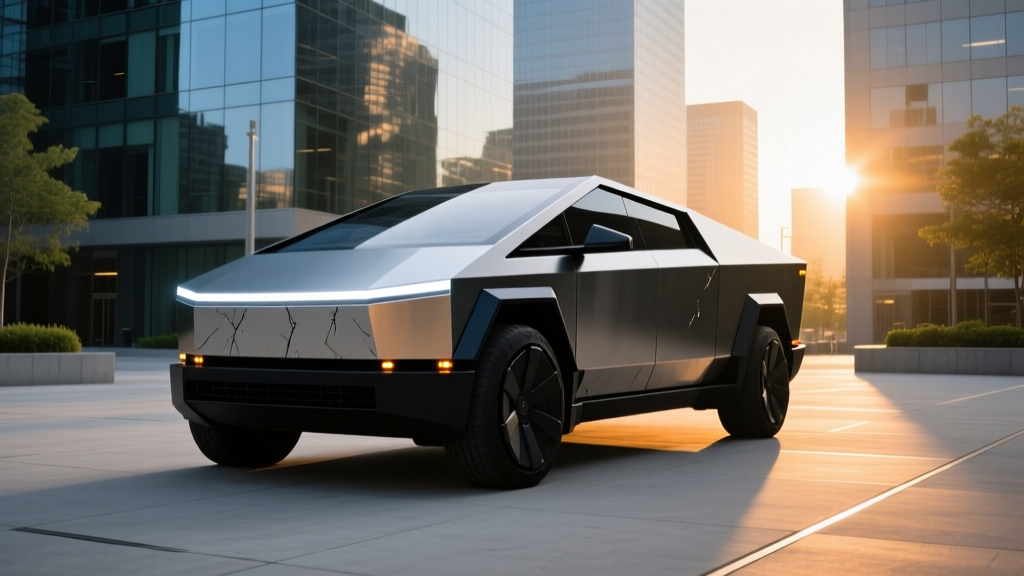
Beyond the Hype: What Tesla's Sales Machine Won't Tell You About the Cybertruck
Tesla doesn't run traditional dealerships, and the Cybertruck has never needed a conventional ad campaign. From viral Cyber Rodeo livestreams to stainless-steel demo pulls and reservation-count flexes, Tesla's sales tactics for the Cybertruck have been a masterclass in earned media. But for buyers writing six-figure checks in 2026, the question isn't whether the marketing worked — it's whether the truck holds up once the hype cycle fades.
After spending time with the dual-motor AWD and tri-motor Cyberbeast variants, testing DC fast-charge curves at V4 Superchargers, and cross-referencing EPA numbers against real-world highway loops, here's the data-driven verdict Tesla's showroom tablets tend to gloss over.
| Spec | Dual Motor AWD | Cyberbeast (Tri-Motor) |
|---|---|---|
| EPA Range | 340 miles | 320 miles |
| Battery (usable) | ~123 kWh, NMC (4680 cells) | ~123 kWh, NMC (4680 cells) |
| 0-60 mph | 4.1 seconds | 2.6 seconds |
| Horsepower | 600 hp | 845 hp |
| Drivetrain | Dual-motor AWD | Tri-motor AWD (torque vectoring) |
| Max DC Fast Charge | 350 kW (800V architecture) | 350 kW (800V architecture) |
| 10-80% DC Time | ~15 minutes (peak conditions) | ~15 minutes (peak conditions) |
| Level 2 Home Rate | 11.5 kW (~34 mi/hr) | 11.5 kW (~34 mi/hr) |
| MPGe (combined) | 67 MPGe | 62 MPGe |
| Efficiency | 50 kWh/100 mi | 54 kWh/100 mi |
| Towing Capacity | 11,000 lbs | 11,000 lbs |
| Base MSRP | $79,990 | $99,990 |
Real-World Range: Where the EPA Sticker Meets the Interstate
Real-World Highway (70-75 mph, mild weather): ~265-285 miles
Cold-Weather Highway (30°F or below): ~210-240 miles
Heavy Towing (8,000+ lb trailer): ~140-170 miles
Tesla's sales presentations love the headline EPA number, and 340 miles sounds road-trip ready. The reality, confirmed by independent testing and owner logs, is that the Cybertruck's brick-like aerodynamics — a drag coefficient around 0.34 despite the angular claims — punish highway efficiency. At 75 mph on a flat interstate in 65°F weather, expect roughly 265-285 miles before you're hunting for a Supercharger.
Cold weather compounds the problem. The 4680 NMC cells perform better in the cold than older 2170s, and the heat pump is standard, but sub-freezing temperatures still knock 25-35% off range at highway speeds. If you're towing a boat or horse trailer near the 11,000-lb limit, plan for stops every 140-170 miles. This is the single biggest gap between Tesla's sales-floor optimism and ownership reality.
According to fueleconomy.gov, the Dual Motor AWD's combined 67 MPGe translates to roughly 2.0 miles per kWh — respectable for a 6,800-lb stainless-steel truck, but nowhere near a Model Y's efficiency.
Charging Speed: The 800V Advantage and the Curve Tesla Doesn't Show
| Charging Level | Power / Voltage | Speed (mi/hr added) | Typical Use Case |
|---|---|---|---|
| Level 1 (120V) | 1.4 kW | ~4 mi/hr | Emergency / trickle top-off |
| Level 2 (240V, 48A) | 11.5 kW | ~34 mi/hr | Home overnight charging |
| DC Fast (V4 Supercharger) | Up to 350 kW (800V) | Up to ~790 mi/hr peak | Road trips, 10-80% in ~15 min |
Here's where Tesla's sales tactics shine brightest — and where buyer education matters most. The Cybertruck's 800V architecture genuinely enables class-leading peak charging at V4 Superchargers. Hit a 350 kW stall with a preconditioned battery and you'll see the curve ramp aggressively from 10% to roughly 55% SoC.
But the charge curve tapers hard above 80%. The much-advertised "15 minutes, 10-80%" figure assumes ideal conditions: battery preconditioned via navigation routing, ambient temps between 60-85°F, and a lightly used V4 stall. In real-world summer heat or winter cold, add 3-5 minutes. Charging from 80-100% takes another 20+ minutes — a detail rarely mentioned during test drives.
For home charging, an 11.5 kW Wall Connector on a 60A circuit adds roughly 34 miles per hour, meaning a full 10-100% charge takes about 11 hours. Owners without a 200A+ electrical panel should budget $1,500-$3,500 for a panel upgrade plus installation — a cost Tesla's configurator conveniently omits.
Performance and Capability: The Numbers That Justify the Price
Cyberbeast's 2.6-second 0-60 mph time is legitimately supercar territory in a truck that weighs nearly 7,000 lbs. The tri-motor torque-vectoring rear axle makes it corner with an agility that defies physics, and the steer-by-wire system (standard across all trims) provides variable ratios that tighten parking-lot maneuvers while remaining stable at highway speed.
Towing capacity of 11,000 lbs beats the Ford F-150 Lightning's 10,000-lb max and matches many heavy-duty ICE trucks. However, as noted in the range section, towing at capacity essentially halves your usable range. The integrated trailer brake controller and tow/haul drive mode are well-calibrated, but the Cybertruck's payload capacity (2,500 lbs in the 6x4-ft bed) trails the Lightning and Rivian R1T.
The adaptive air suspension provides up to 16 inches of ground clearance in Extract Mode — genuinely useful off-road — and the stainless-steel exoskeleton resists trail pinstriping better than painted aluminum. Approach, departure, and breakover angles are competitive with body-on-frame trucks when fully raised.
Pricing, Tax Credits, and the True Cost of Entry
| Trim | Base MSRP | §30D Credit Eligible? | Effective Price (if eligible) |
|---|---|---|---|
| Dual Motor AWD | $79,990 | No — exceeds $80,000 truck MSRP cap | $79,990 |
| Cyberbeast (Tri-Motor) | $99,990 | No — exceeds $80,000 truck MSRP cap | $99,990 |
This is the part of the sales conversation that tends to get glossed over. Under current IRS §30D rules, the federal EV tax credit caps eligible trucks, SUVs, and vans at an $80,000 MSRP. The Dual Motor AWD at $79,990 technically scrapes under that threshold — but only at base configuration. Add any paint option (even the $0 Satin Steel), FSD capability ($8,000), or the Foundation Series package, and you blow past the cap.
Buyer income limits also apply: modified AGI cannot exceed $150,000 (single), $225,000 (head of household), or $300,000 (joint). Battery sourcing and critical-mineral requirements further narrow eligibility. As of 2026, Tesla's 4680 cells use domestically sourced materials that largely qualify, but the MSRP cap is the disqualifier for nearly every Cybertruck configuration actually delivered. Consult a tax professional and verify current rules at IRS.gov before counting on the credit.
The point-of-sale transfer option (letting you apply the credit as a down-payment reduction at delivery) is available for eligible configurations, but again — most Cybertrucks won't qualify.
Interior, Tech, and Daily Livability
The Cybertruck's cabin is minimalist to the point of controversy. A single 18.5-inch front touchscreen handles everything — there's no instrument cluster, no physical buttons for climate or mirrors, and the rear passengers get a secondary 9.4-inch screen. Build quality on 2025-2026 models is significantly improved over the notorious early-production panel-gap issues, though the stainless-steel fingerprint magnet exterior still requires regular wiping.
Passenger space: Front legroom is generous at 41.5 inches; rear legroom at 38.2 inches is adequate for adults but tighter than an F-150 Lightning SuperCrew. The rear bench fits three across, though the center position is compromised by the floor hump housing battery management hardware.
Cargo: The 6x4-foot bed offers 67 cu ft of volume with the tonneau closed. The lockable frunk adds 7.1 cu ft — useful for charging cables and groceries. The motorized tonneau is robust but slow, and the bed's stainless-steel floor is durable but slippery.
Driver assists: Basic Autopilot (adaptive cruise + lane centering) is standard. Enhanced Autopilot ($6,000) adds auto lane change and navigate-on-autopilot. Full Self-Driving (Supervised) remains a SAE Level 2 system — meaning you must keep hands on the yoke and eyes on the road at all times. Tesla's sales materials sometimes blur this line; the truck does not drive itself.
Warranty, Reliability, and Long-Term Ownership
Tesla provides a 4-year/50,000-mile basic vehicle warranty and an 8-year/120,000-mile battery and drive unit warranty with a guaranteed 70% minimum capacity retention. This battery warranty is competitive with the industry standard and slightly better than Ford's 8-year/100,000-mile coverage on the Lightning.
The 4680 NMC cells are structurally integrated into the chassis (a "structural battery pack"), which improves rigidity and reduces parts count but makes out-of-warranty replacement extraordinarily expensive — estimates range from $20,000-$30,000+ if needed post-warranty. Long-term degradation data on 4680s is still accumulating; early fleet data suggests roughly 8-10% loss over 100,000 miles under normal use, which is in line with modern NMC chemistry.
Insurance costs remain a pain point. Cybertruck premiums run 40-70% higher than an equivalent F-150 Lightning, driven by repair complexity (stainless-steel body panels require specialized shops), high parts costs, and the vehicle's performance profile. Budget $3,500-$5,500 annually depending on your state and driving record.
- Class-leading 800V DC fast charging (~350 kW peak)
- Supercar acceleration, especially Cyberbeast (2.6s 0-60)
- 11,000-lb towing capacity with integrated brake controller
- Durable stainless-steel exoskeleton resists dents and scratches
- Access to Tesla Supercharger network (now open to NACS competitors)
- Over-the-air updates continue adding features post-purchase
- Real-world highway range ~265-285 mi, far below 340 mi EPA
- Does NOT qualify for $7,500 federal tax credit on most configurations
- Insurance premiums 40-70% higher than competing electric trucks
- Steep charge-curve taper above 80% SoC
- Rear seat legroom tighter than F-150 Lightning
- Polarizing design limits resale audience
- No physical buttons — all controls routed through touchscreen
Who Should Actually Buy the Cybertruck in 2026?
- You want the fastest production truck available and value performance over efficiency
- You have reliable home Level 2 charging and mostly drive under 200 miles/day
- You need 11,000-lb towing for short-to-medium hauls (under 150 miles)
- You're a Tesla ecosystem loyalist who values Supercharger access and OTA updates
- Highway road trips over 300 miles are routine (Rivian R1T or F-150 Lightning extended range offer better real-world efficiency)
- You were counting on the $7,500 federal tax credit to make the math work
- Family hauling is a priority — the Model X or Rivian R1S offer more practical passenger space
- You need a conventional truck bed with standard aftermarket accessory compatibility
Frequently Asked Questions
What is the real-world range of the Tesla Cybertruck?
EPA estimates 340 miles for the Dual Motor AWD and 320 for the Cyberbeast. Real-world highway driving at 70-75 mph typically yields 265-285 miles in mild weather, dropping to 210-240 miles in freezing temperatures. Towing near max capacity cuts range to roughly 140-170 miles.
How fast does the Cybertruck charge at home and on the road?
On a V4 Supercharger at 350 kW peak, the Cybertruck charges 10-80% in approximately 15 minutes under ideal conditions. At home on an 11.5 kW Level 2 Wall Connector, expect roughly 34 miles of range per hour, or about 11 hours for a full charge. Level 1 (120V) adds only ~4 miles per hour and is suitable for emergencies only.
Does the Cybertruck qualify for the $7,500 federal EV tax credit?
Generally no. The IRS §30D credit caps eligible trucks at $80,000 MSRP. The base Dual Motor AWD at $79,990 technically qualifies, but adding any options, packages, or FSD pushes it over the cap. The Cyberbeast at $99,990 is ineligible. Buyer income limits ($150K single / $300K joint) and battery-sourcing rules also apply. Verify current eligibility at IRS.gov.
Is the Cybertruck worth it vs. the Ford F-150 Lightning or Rivian R1T?
It depends on your priorities. The Lightning offers better real-world range, a more practical interior, and qualifies for the federal tax credit on several trims — making it the value pick. The Rivian R1T offers superior off-road capability, a quad-motor option, and better build quality. The Cybertruck wins on raw acceleration, 800V charging speed, and the stainless-steel durability factor, but at a significant price and efficiency premium.
What are the biggest drawbacks of owning a Cybertruck?
The top complaints from owners are real-world range falling well short of EPA estimates, high insurance premiums (40-70% above comparable trucks), the touchscreen-only control scheme, and the steep charge-curve taper above 80% SoC that makes the last 20% painfully slow on road trips. Early-production quality issues have improved on 2025-2026 models but remain a reputation concern.
How long will the Cybertruck battery last?
Tesla warranties the 4680 NMC battery for 8 years or 120,000 miles with a minimum 70% capacity retention guarantee. Early fleet data suggests 8-10% degradation over 100,000 miles under normal use. Out-of-warranty replacement is estimated at $20,000-$30,000+ due to the structural battery pack design.