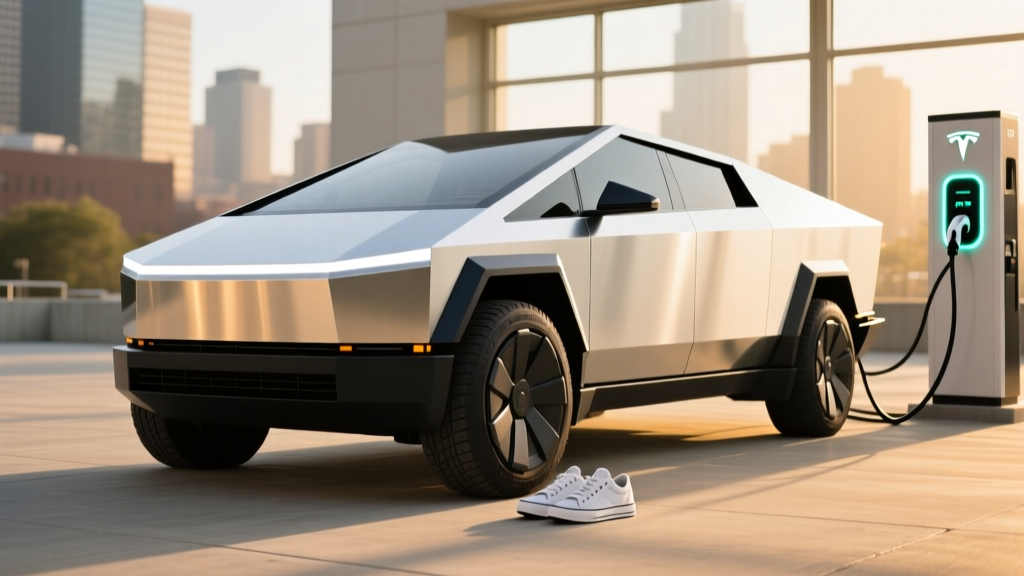
The Tesla Cybertruck finally ramped past early-production growing pains and into meaningful delivery volumes by early 2026, shifting the conversation from "will it sell?" to "who is actually buying it, and are they happy?" Tesla Cybertruck sales have settled into a steady cadence as Tesla expanded trims beyond the initial Foundation Series, added the dual-motor AWD model, and began addressing the long list of reservations. But sales volume only tells half the story. The other half — range reality, charging behavior, towing efficiency, and tax-credit eligibility — determines whether the Cybertruck is a smart buy or a high-profile science experiment in your driveway.
This review dissects the 2026 Tesla Cybertruck lineup with the exact numbers buyers need: EPA range versus highway reality, peak versus sustained DC fast-charging rates, battery chemistry, trim pricing after the §30D federal tax credit, and a direct comparison to the Ford F-150 Lightning and Rivian R1T. If you are cross-shopping an electric pickup, this is the spec-driven breakdown you will not find in marketing materials.
2026 Tesla Cybertruck Trims, Pricing, and Tax-Credit Reality
Tesla simplified the Cybertruck lineup for the 2026 model year after sunsetting the price-inflated Foundation Series packages that accompanied the late-2023 launch. Three trims now anchor the range: the Dual Motor All-Wheel Drive, the tri-motor Cyberbeast, and the single-motor Rear-Wheel Drive (finally reaching customers after a prolonged delay).
| Trim | Drivetrain | HP (est.) | 0-60 mph | EPA Range | Base MSRP |
|---|---|---|---|---|---|
| Rear-Wheel Drive | RWD (single motor) | ~315 hp | 6.5 sec | ~250 mi | $59,990 |
| Dual Motor AWD | AWD (dual motor) | ~600 hp | 3.9 sec | 340 mi | $79,990 |
| Cyberbeast | AWD (tri-motor) | 845 hp | 2.6 sec | 320 mi | $99,990 |
Destination adds $1,990. Tesla's FSD (Supervised) remains a $8,000 add-on or $99/month subscription; basic Autopilot is standard. Paint options (beyond the bare stainless exoskeleton look) and 20-inch wheel upgrades push as-tested prices $3,000–$6,000 higher.
Federal §30D Tax Credit: The $80,000 MSRP Wall
The Cybertruck hits a hard structural problem under current IRS §30D rules: new clean vehicle credits cap eligibility at an MSRP of $80,000 for pickup trucks. That means:
- Rear-Wheel Drive ($59,990) — MSRP-eligible, but buyer income caps ($150k single / $300k joint) and critical-mineral/battery-component sourcing rules apply. Expect up to $7,500 if sourcing requirements are met for 2026.
- Dual Motor AWD ($79,990) — just under the cap at base MSRP, but any factory option that pushes the transaction MSRP above $80,000 disqualifies it. Buyers must be disciplined on configuration.
- Cyberbeast ($99,990) — MSRP-disqualified. No federal credit available regardless of income or sourcing.
The point-of-sale transfer remains available for eligible trims, letting buyers apply the credit as a down-payment reduction at delivery. State incentives (California CVRP, Colorado's $5,000 credit, etc.) stack on top but vary by jurisdiction — check your state energy office before assuming a number.
| Trim | MSRP | Max §30D Credit | Net Best-Case | Credit Caveat |
|---|---|---|---|---|
| RWD | $59,990 | $7,500 | ~$52,490 | Income + sourcing rules apply |
| Dual Motor AWD | $79,990 | $7,500 | ~$72,490 | Options can push over $80k cap |
| Cyberbeast | $99,990 | $0 | $99,990 | Over MSRP cap — ineligible |
Range and Efficiency: EPA Sticker Versus the Highway
Tesla's EPA range claims are historically optimistic in real-world highway driving, and the Cybertruck — with the aerodynamic profile of a doorstop and a curb weight approaching 6,800 pounds on the Cyberbeast — is no exception. The angular stainless-steel body and large frontal area punish efficiency above 70 mph.
- Dual Motor AWD (340 mi EPA): expect ~270–290 mi mixed driving; ~240–260 mi sustained 75-mph highway; ~200–220 mi in sub-freezing winter conditions.
- Cyberbeast (320 mi EPA): expect ~255–275 mi mixed; ~225–245 mi highway; ~185–205 mi cold-weather.
- RWD (~250 mi EPA): expect ~200–220 mi mixed; ~175–195 mi highway.
Towing cuts range roughly in half — a 7,500-lb trailer drops effective range to 130–160 miles regardless of trim. Plan charging stops accordingly.
Efficiency readings on fueleconomy.gov land the Dual Motor AWD around 67 MPGe combined, translating to roughly 50–55 kWh per 100 miles — competitive with the F-150 Lightning Extended Range (66 MPGe) but thirstier than the Rivian R1T Dual Large (~70 MPGe). The Cybertruck's weight and aero work against it at highway speeds, where regen braking cannot recover energy.
Battery, Chemistry, and the 4680 Cell Story
The Cybertruck runs on Tesla's in-house 4680-format lithium-ion cells in a structural battery pack that doubles as a stressed chassis member. Usable capacity sits at approximately 123 kWh on the AWD and Cyberbeast trims, with a smaller pack on the RWD. Chemistry is NMC (nickel-manganese-cobalt), chosen for energy density — the Cybertruck's weight and aero demand every kilowatt-hour.
Tesla does not publish an official LFP variant for the Cybertruck, unlike the Model 3 RWD. The 4680 cells use a dry-cathode manufacturing process Tesla has been refining since 2022, and by 2026 yields have stabilized enough to support higher production volumes. Long-term degradation data on 4680 packs is still maturing compared to the decade-plus track record of 2170 cells, but Tesla's 8-year / 120,000-mile battery and drive-unit warranty (with a 70% capacity retention threshold) provides a meaningful backstop.
Charging Speed: Peak kW, Sustained Curve, and Home Setup
The Cybertruck's 800-volt-class electrical architecture unlocks some of the fastest DC fast-charging in the pickup segment, but peak numbers are not sustained numbers — the charge curve tapers hard past 60% state of charge to protect the cells.
| Charging Level | Rate | Practical Output |
|---|---|---|
| DC Fast Charge (V4 Supercharger) | Peak 325 kW | 10–80% in ~18–22 min; taper above 60% SoC |
| DC Fast Charge (third-party 150 kW) | ~150 kW sustained | 10–80% in ~40–45 min |
| Level 2 home (Tesla Wall Connector, 48A / 11.5 kW) | 11.5 kW | ~34 mi/hr; full 0–100% in ~12 hr |
| Level 2 home (32A / 7.7 kW mobile connector) | 7.7 kW | ~23 mi/hr; full 0–100% in ~17 hr |
| Level 1 (120V / 12A) | 1.4 kW | ~4 mi/hr — emergency only |
Two ownership notes that spec sheets omit. First, preconditioning the battery (via navigation to a Supercharger) is mandatory for peak charge rates — arrive cold and you will see 50–80 kW until the pack warms. Second, the Cybertruck uses the Tesla NACS connector natively, giving it the widest access to the Supercharger network. CCS adapters are available but add friction at Electrify America and EVgo stations.
Home charging installation for a 60A/48A circuit typically runs $1,200–$3,500 including the Wall Connector, wiring, and permits — but older homes with 100A service panels may need a $2,000–$4,500 panel upgrade. Get a licensed electrician's quote before committing to a purchase.
Performance, Towing, and Payload: Numbers That Matter for Truck Work
The Cyberbeast's 2.6-second 0-60 time is a party trick; the dual motor's 3.9-second run is the more usable daily figure. Where the Cybertruck genuinely differentiates itself from conventional trucks is instantaneous torque delivery — no spool-up, no gear hunting on grades. The steer-by-wire system (no mechanical link between wheel and rack) takes roughly 30 minutes of driving to internalize, then becomes a non-issue; the variable ratio makes parking-lot maneuvering surprisingly easy given the truck's 223.7-inch length.
- Max towing: 11,000 lb (AWD and Cyberbeast, properly equipped)
- Payload: ~2,500 lb
- Bed volume: ~67 cu ft (6-ft vault with closed tonneau); ~121 cu ft with midgate folded into the cabin
- Front trunk (frunk): ~7 cu ft — useful for charging cables and groceries, not sheet rock
- Ground clearance: up to 17.4 in (adaptive air suspension in Extraction mode)
- Approach/departure angles: 35°/30° in off-road trim height
Towing 10,000+ pounds is where physics collects its tax: expect range to drop to 130–150 miles and efficiency to crater to 85–100 kWh/100 mi. The integrated trailer brake controller and camera stitching (a dedicated trailer-rear-view feed) are genuinely useful, but long-distance towing in a Cybertruck requires meticulous Supercharger routing.
Tech, Driver Assist, and Interior Practicality
The Cybertruck's cabin is minimalist to a fault. A 18.5-inch landscape touchscreen dominates the dash; rear passengers get their own 9.4-inch screen. There is no instrument cluster, no physical stalks (turn signals live on the yoke-style steering wheel, with a column-mounted backup), and no Apple CarPlay / Android Auto — Tesla's ecosystem is the ecosystem. Audio on the Cyberbeast uses a 15-speaker system that is legitimately excellent.
Autopilot is standard and competent for highway lane-keeping. Full Self-Driving (Supervised) remains an SAE Level 2 system — the driver must monitor the road and keep hands on the yoke at all times. Tesla's naming convention is aspirational, not regulatory; FSD does not make the Cybertruck a self-driving vehicle. The truck also qualifies for the new NHTSA AEB mandates, with strong automatic emergency braking and blind-spot intervention scores.
Interior space is adequate rather than generous. Rear legroom measures ~38.5 inches — enough for adults but tighter than the F-150 Lightning's back seat. The fixed glass roof (no shade) can bake the cabin in summer; many owners retrofit aftermarket tint or a magnetic shade. Build quality on 2026 trucks has improved meaningfully over the 2024 launch units, though panel-gap variance on the stainless exoskeleton is still a talking point at Cars & Coffee.
Cybertruck Sales Context: Who Is Actually Buying It?
Tesla Cybertruck sales have stabilized in the roughly 10,000–13,000 units per quarter range through late 2025 and into 2026, making it a meaningful but not dominant player in the electric-pickup segment. The F-150 Lightning still outsells it on volume, driven by fleet and commercial orders, while the Rivian R1T holds the premium-lifestyle lane. Cybertruck buyers skew toward three profiles:
- Tech-forward early adopters who value the design statement and Tesla's Supercharger ecosystem over traditional truck utility.
- Performance-truck cross-shoppers who would have considered an F-150 Raptor or RAM TRX and want electric torque with 845 hp.
- Commercial light-duty users (contractors, tradespeople) drawn by the stainless bed, onboard 120V/240V PowerShare outlets, and lower per-mile energy cost versus gas — though they remain wary of towing range.
The RWD trim, once it reaches meaningful delivery volume, is expected to broaden the buyer base considerably by pulling the entry price below $60,000 and into direct competition with mid-trim Lightning and Silverado EV territory.
Cybertruck vs. F-150 Lightning vs. Rivian R1T: Which Pickup Wins?
| Metric | Tesla Cybertruck AWD | Ford F-150 Lightning Ext. Range | Rivian R1T Dual Large |
|---|---|---|---|
| EPA Range | 340 mi | 320 mi | 352 mi |
| Real-World Highway | ~240–260 mi | ~255–275 mi | ~275–295 mi |
| Battery / Chemistry | ~123 kWh / NMC (4680) | ~131 kWh / NMC | ~129 kWh / NMC |
| Peak DC Charge | 325 kW | 150 kW | 220 kW |
| 10–80% Time | ~20 min | ~41 min | ~27 min |
| 0–60 mph | 3.9 sec | ~5.0 sec | ~4.5 sec |
| Max Tow | 11,000 lb | 10,000 lb | 11,000 lb |
| Base MSRP | $79,990 | ~$76,995 | ~$79,900 |
| Federal Credit | Up to $7,500 (sourcing dependent) | $7,500 | $7,500 |
Choose the Cybertruck if peak DC charging speed and Supercharger network access are top priorities, you want the tri-motor Cyberbeast's performance, and you accept the real-world range penalty of the angular body. Choose the Lightning if you need a conventional truck footprint, a huge frunk, better rear-seat space, and proven fleet support. Choose the R1T if you want the most refined interior, best real-world highway range, and best off-road capability in the segment.
Biggest Pros and Cons of the 2026 Cybertruck
- Class-leading DC fast-charge peak (325 kW) and 10–80% time
- Native NACS / Supercharger access without adapters
- Cyberbeast performance (845 hp, 2.6-sec 0-60) is unmatched in pickups
- Stainless exoskeleton resists dents, scratches, and corrosion
- Onboard 120V/240V power for job-site and tailgate use
- Strong over-the-air update cadence from Tesla
- Real-world highway range 20–25% below EPA sticker
- Towing cuts range roughly in half — painful for long hauls
- Steer-by-wire and yoke require meaningful driver adaptation
- No Apple CarPlay / Android Auto
- Cyberbeast ineligible for §30D federal credit (MSRP cap)
- Tight rear seat versus F-150 Lightning; no glass-roof shade
- Insurance premiums run 15–30% higher than comparable gas trucks
Who the Cybertruck Actually Suits (And Who Should Skip It)
The 2026 Cybertruck is a strong fit for tech-commuters who want a daily-driver pickup with Supercharger convenience, light-duty job-site users who value onboard power and a dent-resistant bed, and performance enthusiasts who want Raptor-class acceleration without the fuel bill. It is a poor fit for buyers who regularly tow more than 5,000 pounds over distance, families who prioritize rear-seat space and traditional ergonomics, and anyone whose budget depends on the full $7,500 federal credit — only the RWD and carefully configured AWD trims qualify, and only if 2026 battery-sourcing rules are met.
Frequently Asked Questions About Tesla Cybertruck Sales and Ownership
What is the real-world range of the Tesla Cybertruck?
The Dual Motor AWD is EPA-rated at 340 miles, but expect roughly 270–290 miles in mixed driving, 240–260 miles at sustained highway speeds, and 200–220 miles in freezing weather. Towing a 7,500-pound trailer drops effective range to about 130–160 miles.
How fast does the Cybertruck charge at home and on DC fast chargers?
On a V4 Supercharger, it peaks at 325 kW and reaches 10–80% in roughly 18–22 minutes, with taper above 60% SoC. On a home Level 2 Tesla Wall Connector at 11.5 kW, it adds about 34 miles of range per hour, filling from empty in around 12 hours.
Does the Cybertruck qualify for the $7,500 federal EV tax credit?
Only partially. The RWD and base Dual Motor AWD trims fall under the $80,000 MSRP cap for pickups, but the buyer must also meet income caps ($150k single / $300k joint) and the truck's battery must satisfy 2026 critical-mineral and component-sourcing rules per IRS §30D. The $99,990 Cyberbeast is MSRP-disqualified. Consult a tax professional before banking on the credit.
Is the Cybertruck worth buying versus the F-150 Lightning or Rivian R1T?
If Supercharger access and peak DC charging speed are your priorities, yes — the Cybertruck leads both categories. If you need maximum rear-seat space, conventional ergonomics, or proven fleet support, the F-150 Lightning is the stronger choice. If real-world highway range and interior refinement matter most, the Rivian R1T Dual Large edges it out.
What are the biggest ownership surprises with the Cybertruck?
Three things new owners consistently flag: the steep real-world range loss at highway speeds (aero is brutal), the adaptation curve of steer-by-wire and the yoke steering wheel, and higher-than-expected insurance premiums. On the upside, the stainless body shrugs off parking-lot dings, and OTA updates continue to add features months after delivery.
How is Tesla Cybertruck sales volume trending in 2026?
Tesla does not break out Cybertruck deliveries separately in its quarterly reports, but registration data and industry estimates place sales in the 10,000–13,000 units per quarter range, with the RWD trim expected to lift volumes once it reaches scale. It trails the F-150 Lightning in total units but outsells most other electric pickups.
The Cybertruck in 2026 is no longer a concept car with a VIN — it is a real, shipping, daily-drivable electric pickup with genuine strengths in charging speed, performance, and utility, and real compromises in highway efficiency, rear-seat packaging, and tax-credit accessibility. Buyers who run the numbers against their actual driving pattern — not the EPA sticker — will land on the right decision. Those who buy on aesthetics alone should budget for the range and insurance realities that follow.