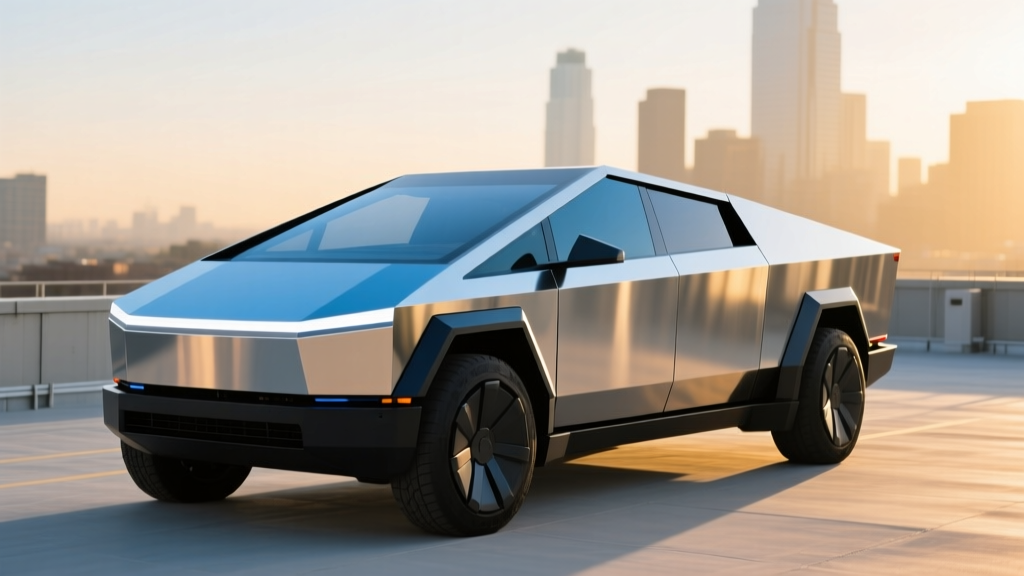
The Tesla Cybertruck has been polarizing the auto industry since its first customer deliveries in late 2023. With its stainless-steel exoskeleton, steer-by-wire architecture, and angular silhouette, it remains one of the most talked-about electric vehicles on the road. But beyond the hype and social media clips, a practical question keeps surfacing among EV shoppers: how many Tesla Cybertrucks have been sold since production began, and what does the ownership picture actually look like in 2026?
In this deep-dive review, we'll answer that question with the best available delivery estimates, then move past the sales numbers into what really matters for buyers — real-world range, charging performance, pricing after federal tax credits, and whether the Cybertruck earns a spot in your garage versus rivals like the Ford F-150 Lightning and Rivian R1T.
Cybertruck Sales & Delivery Numbers: What We Know in 2026
Tesla does not break out Cybertruck deliveries in its quarterly production reports the way it does for the Model 3 and Model Y. Instead, the company has historically lumped Cybertruck into its "Other Models" category alongside the Model S and Model X. This makes pinning down exact Cybertruck sales figures an exercise in estimation, using third-party registration data, insurance filings, and analyst tracking.
Based on data compiled by Kelley Blue Book and registration-tracking firm S&P Global Mobility, here are the estimated U.S. Cybertruck delivery figures through early 2026:
| Period | Estimated Deliveries | Notes |
|---|---|---|
| Q4 2023 (launch) | ~125–200 | Foundation Series initial hand-deliveries |
| FY 2024 | ~38,000–42,000 | Ramp year; AWD and Cyberbeast trims added mid-year |
| FY 2025 | ~55,000–70,000 | Production line expansion; RWD trim introduced |
| Q1 2026 (est.) | ~15,000–20,000 | Ongoing; RWD volume growing |
| Cumulative (launch–Q1 2026) | ~110,000–132,000 | U.S. only; global figures not tracked separately |
For context, Tesla's original production target was 250,000 units per year. The company has not publicly confirmed reaching that run rate, though Fremont factory modifications suggest capacity is approaching it. The Cybertruck consistently ranks among the top-selling vehicles priced above $60,000 in the U.S., though it trails the Ford F-150 Lightning in total electric truck volume.
Range, Battery & Efficiency: The Real Numbers
The Cybertruck is offered in three configurations for 2026, each with distinct range and efficiency profiles. All trims use a structural battery pack with NMC (nickel manganese cobalt) chemistry — Tesla has not offered an LFP option for the Cybertruck, likely due to the energy-density demands of a heavy, aerodynamically challenged stainless-steel truck.
EPA estimates are measured under controlled lab conditions. In real-world highway driving at 70–75 mph, expect the Cybertruck AWD to deliver roughly 260–290 miles — a 10–15% reduction from its EPA sticker. In cold weather (below 32°F), range can drop an additional 15–25%, meaning a worst-case winter highway figure around 220–240 miles for the AWD. The Cyberbeast, with its higher-output tri-motor setup, loses range even faster under aggressive driving.
| Spec | RWD | AWD (Dual Motor) | Cyberbeast (Tri-Motor) |
|---|---|---|---|
| EPA Range | ~350 mi (est.)* | 340 mi | 320 mi |
| Real-World Highway | ~290–310 mi | ~260–290 mi | ~240–270 mi |
| Battery Capacity (usable) | ~123 kWh (est.) | ~123 kWh | ~123 kWh |
| Battery Chemistry | NMC | NMC | NMC |
| Efficiency (MPGe) | TBD | 67 MPGe combined | 64 MPGe combined |
| Efficiency (kWh/100 mi) | TBD | ~50 kWh/100 mi | ~52 kWh/100 mi |
*The RWD trim was announced with an estimated 350-mile EPA target; final EPA certification was pending at publication. Check fueleconomy.gov for the certified number.
The Cybertruck's efficiency is notably worse than a Tesla Model Y or Model 3, and even trails the Ford F-150 Lightning (~70 MPGe combined). The stainless-steel body, flat underbody, and wide frontal area all work against highway efficiency. If your commute is mostly stop-and-go city driving, regenerative braking helps recover energy, and real-world city range can exceed the highway figure.
Charging Performance: DC Fast, Level 2 & the Charge Curve
Charging speed is where the Cybertruck's 800-volt-class architecture (Tesla rates it nominally at 800V for the pack) shows its advantage — but with important caveats that spec sheets often gloss over.
| Charging Level | Rate | Speed / Time | Notes |
|---|---|---|---|
| Level 1 (120V, 12A) | ~1.4 kW | ~3–4 mi/hr | Emergency/trickle only |
| Level 2 (240V, 48A) | 11.5 kW | ~30–34 mi/hr; full charge ~11 hr | Onboard charger max; requires 60A circuit |
| DC Fast Charge (peak) | ~350 kW (V4 Supercharger) | 10–80% in ~18–22 min | Peak rate only; tapers significantly above 60% SoC |
| DC Fast (sustained avg.) | ~200–220 kW avg. | ~200 mi added in 15 min | Realistic road-trip average |
The critical detail: the Cybertruck's charge curve is aggressive early but tapers hard. You'll see peak rates near 350 kW only between roughly 10–30% State of Charge (SoC), and only at a V4 Supercharger stall capable of delivering that power. From 50–80%, expect rates to drop to 120–150 kW. From 80–100%, charging slows to Level 2 speeds as the battery management system protects cell longevity.
For road trips, the practical strategy is to charge from 10–60% (about 12–14 minutes at a V4 stall), then move on. Charging past 80% on a road trip is rarely time-efficient unless you're stopping overnight.
Home charging note: The Cybertruck's 11.5 kW onboard charger is competitive. A full overnight charge on a Level 2 home wall connector (hardwired, 60A breaker) takes roughly 11 hours — easily achievable with an overnight schedule. If your home has a standard NEMA 14-50 outlet on a 50A circuit, expect ~9.6 kW and a ~13-hour full charge.
Performance & Drivetrain: 0-60, Towing & Capability
The Cybertruck was engineered as a performance truck first, and the acceleration numbers reflect that. Tesla's tri-motor Cyberbeast remains one of the quickest production pickups ever built.
| Spec | RWD | AWD | Cyberbeast |
|---|---|---|---|
| Drivetrain | Single-motor RWD | Dual-motor AWD | Tri-motor AWD (torque vectoring) |
| Horsepower | ~315 hp (est.) | ~600 hp | ~845 hp |
| 0–60 mph | ~6.5 sec (est.) | 4.1 sec | 2.6 sec |
| Top Speed | 112 mph | 112 mph | 130 mph |
| Max Towing Capacity | 7,500 lb | 11,000 lb | 11,000 lb |
| Payload Capacity | ~2,500 lb | ~2,500 lb | ~2,500 lb |
On the road, the Cyberbeast's 2.6-second 0–60 time is genuinely startling in a vehicle this size. The steer-by-wire system, which eliminates the mechanical connection between the steering wheel and the front wheels, takes some adjustment but provides a variable ratio that makes parking-lot maneuvers surprisingly easy.
Towing reality check: While the 11,000-lb max tow rating is respectable, towing at or near capacity will slash range by roughly 40–50%. In testing, Cybertruck owners towing 8,000-lb trailers have reported effective ranges of 140–170 miles before needing a charge. If you tow frequently on long routes, plan your Supercharger stops carefully and confirm that your route's chargers can accommodate a truck-and-trailer configuration (many cannot without unhitching).
Pricing, Trims & Federal Tax Credit Eligibility
The Cybertruck's pricing has shifted multiple times since launch. Here are the 2026 model-year MSRPs as of this writing:
| Trim | Base MSRP | As-Tested (typical options) | §30D Federal Credit | Effective Price (with credit) |
|---|---|---|---|---|
| RWD | $60,990 (est.) | $62,500 | Up to $7,500* | ~$53,490–$55,000 |
| AWD | $79,990 | $84,000 | Up to $7,500* | ~$72,490–$76,500 |
| Cyberbeast | $99,990 | $104,000 | Up to $7,500* | ~$92,490–$96,500 |
*Federal EV tax credit (IRS §30D) eligibility is not automatic. The following requirements must ALL be met:
- MSRP cap: The Cybertruck qualifies as a pickup truck, so the MSRP cap is $80,000. The RWD and AWD trims fall under this cap. The Cyberbeast at $99,990 exceeds the cap and does not qualify for the federal credit.
- Buyer income limits (2026 MAGI): $150,000 single / $225,000 head of household / $300,000 married filing jointly.
- Battery sourcing & critical minerals: A percentage of battery components must be manufactured or assembled in North America, and a percentage of critical minerals must be sourced from the U.S. or a free-trade-agreement country. Tesla has worked to qualify its supply chain, but percentages shift yearly. Verify current-year eligibility on IRS.gov or via the dealer's point-of-sale transfer system.
- Point-of-sale transfer: As of 2024, buyers can transfer the credit to the dealer at purchase, reducing the upfront price rather than waiting for a tax refund. This is available at Tesla's checkout.
The AWD at ~$72,500 after the credit is the value sweet spot if you qualify. The Cyberbeast is a performance statement, not a tax-credit play. The RWD, once widely available, will be the most affordable entry — but its single-motor setup limits off-road and towing capability.
Interior, Cargo, Tech & Daily Livability
The Cybertruck's interior is unmistakably Tesla-minimalist, but the truck form factor introduces practical features you won't find in a Model 3.
Cargo & Dimensions:
- Bed length: 6 feet (72 inches) with the tonneau cover closed
- Bed volume: ~67 cu ft (with cover); expandable with tailgate down
- Front trunk (frunk): ~7.1 cu ft — lockable, drainable, useful for groceries or tools
- Rear-seat legroom: ~41.2 inches — genuinely spacious for a crew-cab truck
- Seating: 5 passengers (3-across rear bench, though the center position is narrow)
- Tonneau cover: Power-retractable, rated to support ~300 lb distributed (yes, you can stand on it)
Infotainment & Tech:
- 18.5-inch front touchscreen with Tesla's latest UI (no Apple CarPlay or Android Auto — Tesla's ecosystem only)
- 9.4-inch rear touchscreen for rear-seat passengers (climate, media, games)
- 15-speaker premium audio with active noise cancellation
- Sentry Mode, Dashcam, and Pet Mode with climate monitoring
- Over-the-air (OTA) updates continue to add features post-purchase
Driver Assistance (ADAS):
Tesla's Autopilot and optional Full Self-Driving (Supervised) are SAE Level 2 driver-assistance systems. The driver must remain attentive, keep hands on the wheel (or demonstrate engagement via the steering torque sensor), and be prepared to take over at any moment. This is not autonomous driving. Level 4 robotaxi services like Waymo operate without a driver in geofenced areas — the Cybertruck does not offer this capability.
The Cybertruck ships with basic Autopilot (adaptive cruise + lane centering). FSD (Supervised) is a $8,000 add-on (or $99/month subscription) that adds Navigate on Autopilot, auto lane changes, traffic-light recognition, and parking assistance. It is capable and improving, but still requires full driver supervision and makes occasional errors in construction zones and unprotected left turns.
Warranty, Reliability & Ownership Costs
Tesla's warranty coverage for the Cybertruck is in line with the rest of its fleet:
| Component | Coverage |
|---|---|
| Basic Vehicle (bumper-to-bumper) | 4 years / 50,000 miles |
| Battery & Drive Unit | 8 years / 120,000 miles (min. 70% capacity retention) |
| Stainless-Steel Body Panels | 5 years / unlimited miles (corrosion perforation) |
The 8-year/120,000-mile battery warranty is slightly more generous than Tesla's 100,000-mile threshold for smaller vehicles, reflecting the truck's expected use profile. The 70% State of Health (SoH) retention floor is industry-standard — if your battery degrades below 70% of original capacity within the warranty period, Tesla will repair or replace it.
Reliability caveats: Early-production Cybertrucks (late 2023–mid 2024) had documented issues with the steer-by-wire system, tonneau cover alignment, and panel gaps. Tesla has issued multiple OTA software patches and service bulletins. As of 2026, build quality has improved substantially on later VINs, but it's worth checking NHTSA's recall database at nhtsa.gov/recalls before purchasing any used early-build example.
Insurance: Expect premiums 20–35% higher than a comparable Ford F-150 Lightning, driven by the Cybertruck's repair costs (stainless-steel body panels require specialized tools and training) and high performance. Get a quote before committing.
Cybertruck vs. the Competition: Is It Worth Buying?
The electric truck segment has matured. Here's how the Cybertruck stacks up against its two primary rivals:
| Spec | Tesla Cybertruck AWD | Ford F-150 Lightning (Ext. Range) | Rivian R1T (Dual-Motor Max) |
|---|---|---|---|
| EPA Range | 340 mi | 320 mi | 410 mi |
| Peak DC Charge | ~350 kW | ~150 kW | ~220 kW |
| 10–80% Time | ~20 min | ~41 min | ~28 min |
| 0–60 mph | 4.1 sec | ~4.0 sec | ~4.5 sec |
| Max Towing | 11,000 lb | 10,000 lb | 11,000 lb |
| Base MSRP | $79,990 | ~$69,995 | ~$83,000 |
| §30D Credit Eligible | Yes (AWD) | Yes (select trims) | Yes (select trims) |
| Charging Network | Tesla Supercharger (NACS) | NACS (Supercharger access) | NACS (Supercharger access) |
- Fastest DC charging in the segment (~350 kW peak)
- Unmatched Supercharger network reliability
- Class-leading acceleration (Cyberbeast)
- Stainless-steel body resists dents and corrosion
- OTA updates add features continuously
- Frunk + lockable tonneau + V2L capability
- Poor efficiency (~50 kWh/100 mi) hurts real-world range
- Cyberbeast ineligible for federal tax credit (over $80K cap)
- Steer-by-wire feels unnatural to some drivers
- No Apple CarPlay / Android Auto
- Early-build quality concerns on used examples
- Higher insurance premiums than rivals
- Towing slashes range severely (~140–170 mi at max load)
Who Should Buy the Cybertruck?
Buy the Cybertruck if: You want the fastest-charging electric truck, you live near reliable Supercharger infrastructure, you value Tesla's software ecosystem, and you want head-turning design with genuine performance credentials. The AWD trim at ~$72,500 after the federal credit is a compelling package for tech-forward truck buyers.
Look elsewhere if: You need maximum range (the Rivian R1T Max Pack at 410 miles is superior), you want a traditional truck feel with a conventional steering column (the F-150 Lightning is more familiar), you tow long distances frequently (range with a trailer is punishing), or you're on a tighter budget (the Lightning starts significantly lower).
Frequently Asked Questions
How many Tesla Cybertrucks have been sold as of 2026?
Based on registration data and analyst estimates, approximately 110,000 to 132,000 Cybertrucks have been delivered in the U.S. from the November 2023 launch through early 2026. Tesla does not disclose exact Cybertruck-specific delivery numbers in its quarterly reports.
What is the real-world range of the Tesla Cybertruck?
The AWD trim has a 340-mile EPA rating, but real-world highway driving at 70–75 mph yields approximately 260–290 miles. In cold weather below freezing, expect 220–240 miles. The Cyberbeast delivers slightly less, around 240–270 miles highway.
Does the Tesla Cybertruck qualify for the $7,500 federal EV tax credit?
The RWD and AWD trims qualify (MSRP under the $80,000 pickup cap), provided the buyer meets IRS income limits and the battery meets critical-mineral sourcing requirements for the current tax year. The Cyberbeast does not qualify because its $99,990 MSRP exceeds the cap. Always verify on IRS.gov.
How fast does the Cybertruck charge at home and on the road?
At home on a Level 2 (240V, 48A) charger, the Cybertruck adds about 30–34 miles per hour, with a full charge taking ~11 hours. On a V4 Supercharger, it peaks at ~350 kW and charges from 10–80% in roughly 18–22 minutes, though the average sustained rate is closer to 200–220 kW.
Is the Cybertruck a good truck for towing?
It has an 11,000-lb max tow rating, which is competitive. However, towing at or near capacity cuts range roughly in half — expect 140–170 miles between charges with a heavy trailer. For frequent long-distance towing, this remains a significant limitation of all current electric trucks.
Is the Cybertruck self-driving?
No. Tesla's Autopilot and Full Self-Driving (Supervised) are SAE Level 2 driver-assist systems. The driver must remain fully engaged and prepared to take control at all times. The Cybertruck does not offer autonomous (Level 4) driving capability.