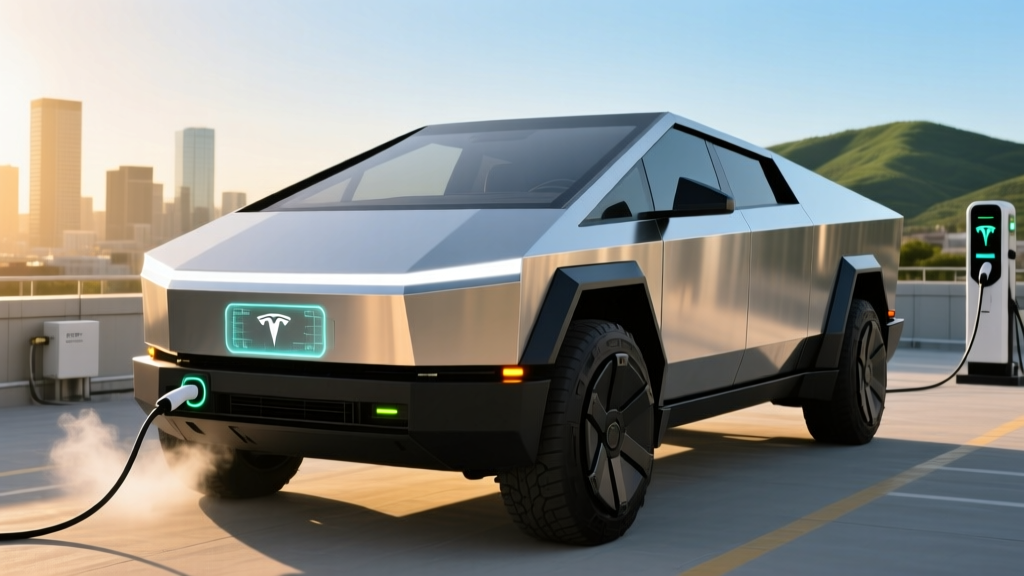
The Tesla Cybertruck remains one of the most polarizing vehicles on the road. Its angular stainless-steel exoskeleton and 6,600-pound curb weight raise legitimate questions that go far beyond aesthetics. For buyers researching Cybertruck safety, the answers are more nuanced than either the hype or the headlines suggest — and they intersect directly with range, charging practicality, and total cost of ownership in ways every prospective buyer needs to understand.
This review covers the 2026 Cybertruck lineup — the Dual Motor AWD, the tri-motor Cyberbeast, and the long-awaited Rear-Wheel Drive — with exact EPA figures, real-world range reconciliation, 800V charging data, and the current IRS §30D tax-credit picture.
Crash-Test Ratings and Structural Safety
The Cybertruck's cold-rolled stainless-steel body panels are up to 3mm thick — substantially heavier than conventional aluminum or mild-steel truck bodies. That mass, combined with a rigid unibody architecture and a large frontal crush zone, contributes to strong crash energy management. However, the NHTSA rating picture for the 2026 model year remains incomplete.
As of early 2026, NHTSA has published partial ratings for the Dual Motor AWD variant. The IIHS has not yet released a full Top Safety Pick evaluation for the current model year. This is a common pattern for low-volume, unconventional-architecture vehicles, but it means buyers are working with incomplete federal data compared to, say, the Ford F-150 Lightning or Rivian R1T.
The low rollover risk is a direct function of the skateboard battery placement — the pack sits beneath the floor, giving the Cybertruck a center of gravity closer to a sedan than a traditional body-on-frame pickup. That's a genuine physics advantage shared with the F-150 Lightning and R1T.
Active Safety and Driver-Assist Systems
Every 2026 Cybertruck ships with Tesla's standard Autopilot suite: automatic emergency braking, forward collision warning, lane-departure warning, lane-keeping assist, and blind-spot monitoring. These are SAE Level 2 driver-assist features — the driver must remain engaged with hands on the wheel and eyes on the road at all times.
FSD (Supervised) is available as a $8,000 one-time purchase or $99/month subscription on the Cybertruck. It adds automatic lane changes, traffic-light recognition, and city-street navigation — but real-world performance varies significantly by geography and road-marking quality. The system has improved substantially since 2024's end-to-end neural-network rewrite, but it still requires active supervision and does not eliminate driver responsibility.
EPA Range, Real-World Efficiency, and Cold-Weather Impact
The Cybertruck's aerodynamic profile — angular but with a relatively low drag coefficient for a truck — and its 800V architecture produce competitive efficiency numbers. Here's how the EPA estimates translate to real-world driving.
| Trim | Drivetrain | Battery (usable kWh) | Chemistry | EPA Range | MPGe (Combined) | kWh/100 mi |
|---|---|---|---|---|---|---|
| Rear-Wheel Drive | RWD / Single Motor | ~123 kWh | NMC (4680 cells) | ~320 mi | ~68 MPGe | ~48 |
| Dual Motor AWD | AWD / Dual Motor | ~123 kWh | NMC (4680 cells) | 340 mi | 66 MPGe | ~50 |
| Cyberbeast | AWD / Tri-Motor | ~123 kWh | NMC (4680 cells) | 320 mi | ~62 MPGe | ~54 |
The 4680 NMC cells offer high energy density suited to the Cybertruck's heavy curb weight (roughly 6,600–6,800 lbs depending on trim). Tesla has not offered an LFP option for the Cybertruck — the weight and towing demands make NMC the necessary chemistry trade-off here.
Charging Speed: 800V Architecture in Practice
The Cybertruck's 800-volt electrical architecture is its most underappreciated practical advantage. On a V4 Supercharger (now widely deployed across the US network), the truck can accept peak charge rates that meaningfully cut road-trip downtime.
| Charging Level | Power / Rate | Time / Miles Added | Connector |
|---|---|---|---|
| Level 1 (120V household) | ~1.4 kW | ~3 mi/hr | NACS (native) |
| Level 2 (240V / 48A home) | 11.5 kW | ~23 mi/hr; full charge in ~12 hrs | NACS (native) |
| DC Fast Charge (V4 Supercharger) | Peak ~250 kW | 10–80% in ~25 min | NACS (native) |
| DC Fast (CCS adapter, 350-kW station) | ~200–250 kW (station dependent) | 10–80% in ~28 min | NACS with CCS adapter |
A critical ownership note: the Cybertruck's charge curve tapers significantly above 80% State of Charge. The 10–80% sprint is impressively quick, but pushing from 80% to 100% can add another 25–35 minutes. For road trips, the practical strategy is to charge to 80% at each stop and drive roughly 200–220 miles between charges — this keeps you in the fast portion of the curve and minimizes total trip time.
Home charging at 11.5 kW (48A on a NACS Wall Connector) is the practical daily solution. A full overnight charge replenishes even a near-empty pack. Installation of a 60A circuit typically costs $800–$2,000 depending on panel proximity and local permitting — factor this into your purchase budget.
Performance, Towing, and Utility Specs
| Metric | RWD | Dual Motor AWD | Cyberbeast (Tri-Motor) |
|---|---|---|---|
| 0–60 mph | ~6.2 sec | 4.1 sec | 2.6 sec |
| Horsepower | ~400 hp | ~600 hp | 845 hp |
| Torque (lb-ft) | ~500 | ~740 | ~1,000 |
| Max Towing Capacity | 7,500 lbs | 11,000 lbs | 11,000 lbs |
| Payload Capacity | ~2,500 lbs | ~2,500 lbs | ~2,500 lbs |
| Bed Length | 6 ft (72 in) | 6 ft (72 in) | 6 ft (72 in) |
| Cargo Volume (bed + frunk) | ~67 cu ft bed + ~7 cu ft frunk | ~67 cu ft bed + ~7 cu ft frunk | ~67 cu ft bed + ~7 cu ft frunk |
| Rear Legroom | ~38.4 in | ~38.4 in | ~38.4 in |
The Cyberbeast's 2.6-second 0–60 time is a party trick, but the Dual Motor AWD's 4.1-second run is more relevant — it's quicker than any F-150 variant short of the Raptor R, and it delivers that performance with instant torque and no gear-shift lag. Towing at the 11,000-pound max will cut range roughly in half, so plan 150–170 miles between charges when pulling a heavy trailer.
Pricing, Trims, and Federal Tax Credit Eligibility
| Trim | Base MSRP | Federal §30D Credit | Effective Price (if eligible) | Notes |
|---|---|---|---|---|
| Rear-Wheel Drive | ~$60,990 | Up to $7,500 | ~$53,490 | MSRP under truck cap ($80k); income + sourcing rules apply |
| Dual Motor AWD | ~$79,990 | Up to $7,500 | ~$72,490 | Under $80k MSRP cap for trucks; eligibility varies |
| Cyberbeast (Foundation) | ~$99,990 | $0 | ~$99,990 | Exceeds $80,000 MSRP cap for trucks — ineligible |
The §30D credit is not automatic. Under current IRS rules, eligibility depends on:
- MSRP cap: Trucks/vans/SUVs must have an MSRP at or below $80,000. The Cyberbeast exceeds this.
- Buyer income limits: AGI must not exceed $300,000 (married filing jointly), $225,000 (head of household), or $150,000 (single).
- Battery sourcing: Critical minerals and battery components must meet escalating domestic-content thresholds. Tesla's 4680 cell supply chain has shifted significantly toward compliant sourcing, but verify current-year eligibility at purchase — rules tighten annually.
- Point-of-sale transfer: Eligible buyers can transfer the credit to the dealer at purchase, reducing the upfront cost rather than waiting for a tax refund.
Consult a tax professional before relying on credit eligibility — the rules are subject to change, and battery-sourcing compliance can shift mid-year as supply chains evolve.
Warranty, Battery Longevity, and Ownership Costs
| Component | Coverage |
|---|---|
| Basic Vehicle | 4 years / 50,000 miles |
| Battery & Drive Unit | 8 years / 120,000 miles (Dual Motor & Cyberbeast); 8 years / 100,000 miles (RWD) |
| Battery Retention Threshold | 70% of original capacity during warranty period |
Tesla's 4680 NMC cells have shown promising degradation curves in Model Y applications — early fleet data suggests roughly 8–12% capacity loss over 100,000 miles. The Cybertruck's larger pack and thermal management system should produce similar or slightly better longevity, but the truck's heavier weight and potential towing use will accelerate cycle wear compared to lighter vehicles.
Insurance costs remain a friction point. The Cybertruck's stainless-steel body panels are expensive to repair (panel replacement rather than dent repair is common), and early actuarial data has pushed premiums 20–35% above comparable F-150 Lightning policies. Get an insurance quote before purchasing — it materially affects total cost of ownership.
Pros and Cons
Pros
- Class-leading 800V fast-charging architecture
- Low rollover risk from skateboard battery placement
- 11,000-lb towing capacity (AWD/Beast)
- Stainless-steel body resists dents and corrosion
- Strong NHTSA frontal and side crash results (where rated)
- Excellent Supercharger network access (NACS native)
Cons
- Incomplete NHTSA/IIHS rating coverage vs. competitors
- Cyberbeast ineligible for §30D credit (MSRP over $80k)
- Insurance premiums significantly above segment average
- Stainless panels expensive to replace if damaged
- Heavy curb weight reduces efficiency vs. lighter trucks
- Real-world highway range drops notably in cold weather
Who Should Buy the Cybertruck?
Choose the Dual Motor AWD if you need a daily-driver truck with legitimate towing capability, access to the best fast-charging network in the US, and you want to stay under the $80k MSRP cap for potential tax-credit eligibility. This is the volume trim and the best value in the lineup.
Choose the Cyberbeast if performance is the priority and budget is flexible. You forfeit the federal credit and pay a premium for 845 hp — this is a lifestyle and performance choice, not a value play.
Choose the RWD if you want the lowest entry price, don't need AWD traction, and primarily drive in mild climates. It's the most efficient trim but sacrifices towing capacity and acceleration.
Look at the F-150 Lightning or Rivian R1T instead if complete NHTSA/IIHS safety ratings are a priority for your purchase decision, or if you need a more conventional truck bed layout with greater aftermarket accessory support.
Frequently Asked Questions
What is the real-world range of the Tesla Cybertruck?
The EPA rates the Dual Motor AWD at 340 miles. In mixed real-world driving at moderate temperatures, expect 290–310 miles. Sustained highway speeds above 70 mph reduce this to roughly 275–300 miles, and freezing temperatures can drop usable range to 230–260 miles.
How fast does the Cybertruck charge at home and on the road?
On a home Level 2 charger (240V/48A), the Cybertruck adds about 23 miles of range per hour, fully charging overnight in roughly 12 hours. On a V4 Tesla Supercharger, it peaks near 250 kW and charges from 10–80% in approximately 25 minutes.
Does the Cybertruck qualify for the $7,500 federal EV tax credit?
The RWD and Dual Motor AWD trims are potentially eligible — their MSRPs fall under the $80,000 truck cap. The Cyberbeast is not eligible due to its MSRP exceeding the cap. All trims require the buyer to meet IRS income limits and the vehicle to satisfy battery-sourcing requirements, which tighten annually. Verify eligibility at IRS.gov before purchase.
Is the Cybertruck safer than the Ford F-150 Lightning?
Direct comparison is difficult because the Cybertruck has not yet received a complete NHTSA overall rating or IIHS evaluation. The F-150 Lightning holds an IIHS Top Safety Pick+ rating and a 5-star NHTSA overall score. The Cybertruck's published NHTSA frontal and side crash results are strong (5 stars), but the full picture isn't available yet. Both benefit from low rollover risk due to battery placement.
What are the biggest Cybertruck ownership drawbacks?
Insurance costs run 20–35% above competitors due to expensive stainless-steel panel repairs. Charging from 80–100% is slow (plan road-trip stops around 80% charges). Cold-weather range loss is meaningful. And the Cyberbeast's price eliminates federal tax-credit assistance.
Can I tow a trailer with the Cybertruck?
Yes — the AWD and Cyberbeast trims are rated for 11,000 pounds of towing. However, towing at or near max capacity will roughly halve your range. Plan for 150–170 miles between charges when pulling a heavy load, and use the truck's built-in range estimator for route planning.