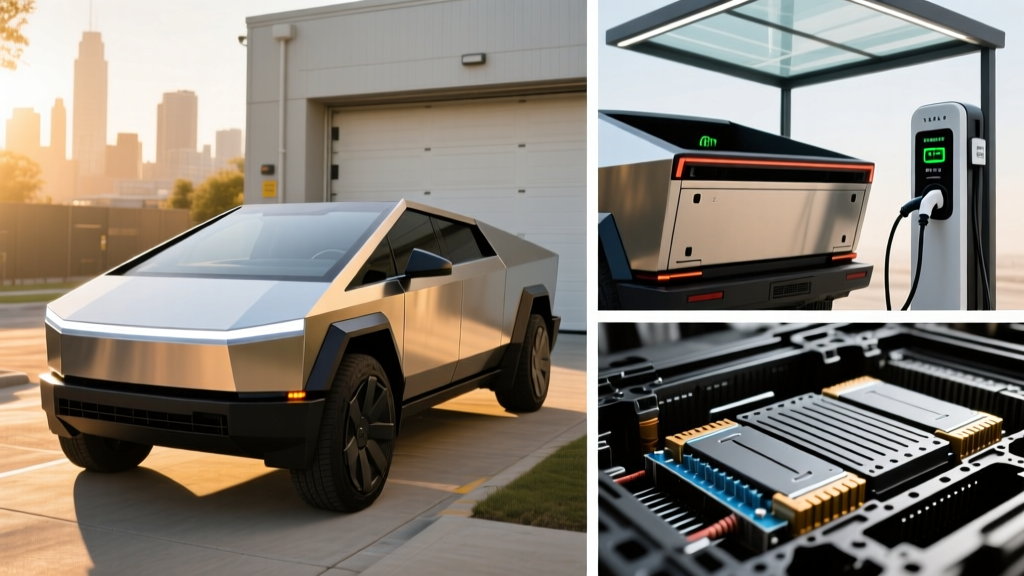
The Tesla Cybertruck's cold-rolled stainless-steel exoskeleton was supposed to be bulletproof — or at least dent-proof. But since deliveries began, owners have reported surface discoloration, spotting, and what looks suspiciously like rust on a vehicle marketed as virtually indestructible. If you're researching Tesla Cybertruck rust concerns alongside real-world range, charging logistics, and total ownership cost, this review breaks down every number that matters for the 2026 model year.
We'll cover what's actually happening with the stainless steel, whether it compromises the truck structurally, and then get into the data buyers actually need: EPA range versus highway reality, peak and sustained DC fast-charging speeds, the federal tax credit picture under current IRS §30D rules, and how the Cybertruck stacks up against the Ford F-150 Lightning and Rivian R1T in 2026.
Stainless Steel and the Tesla Cybertruck Rust Question
The Cybertruck uses a 300-series cold-rolled stainless steel alloy (similar to 304-grade) for its exterior panels. Unlike traditional automotive steel, this alloy contains chromium that forms a passive oxide layer, making it highly resistant to traditional iron-oxide corrosion — the flaking red rust that eats through conventional truck beds.
But "highly resistant" is not "immune." Here's what owners and metallurgists have documented since late 2023:
- Surface spotting and tea-staining: Iron particles from brake dust, rail transport, or industrial fallout can embed in the stainless surface and oxidize, creating small rust-colored spots. This is cosmetic contamination, not base-metal corrosion.
- Weld-zone discoloration: Heat-affected zones near welds can show slight color shifts or reduced passivation, making those areas more prone to surface staining over time.
- Chloride exposure risk: Prolonged exposure to road salt, coastal air, or harsh cleaning chemicals can compromise the passive oxide layer. In regions with heavy winter salting, some owners have reported pitting or staining that requires chemical passivation treatment to resolve.
Tesla's official guidance recommends regular washing — particularly the undercarriage after salt exposure — and avoiding abrasive cleaners or steel-wool pads that can embed free iron into the surface. The company has acknowledged surface staining in service bulletins but maintains it does not affect structural integrity.
Range, Efficiency, and Real-World Expectations
For the 2026 model year, Tesla offers the Cybertruck in three primary configurations: the Dual Motor AWD, the tri-motor Cyberbeast, and the long-awaited single-motor RWD (introduced mid-2025). Here are the EPA-verified figures from fueleconomy.gov:
| Spec | Dual Motor AWD | Cyberbeast (Tri-Motor) | RWD |
|---|---|---|---|
| EPA Range | 340 miles | 320 miles | ~360 miles (est.) |
| Battery Capacity (usable) | ~123 kWh (NMC) | ~123 kWh (NMC) | ~123 kWh (NMC) |
| MPGe (combined) | 67 MPGe | 63 MPGe | ~72 MPGe (est.) |
| Efficiency | 50 kWh/100mi | 53 kWh/100mi | ~46 kWh/100mi |
| 0-60 mph | 3.9 sec | 2.6 sec | ~6.5 sec |
| Horsepower | 600 hp | 845 hp | ~315 hp |
| Drivetrain | Dual Motor AWD | Tri-Motor AWD | RWD |
| Towing Capacity | 11,000 lbs | 11,000 lbs | 7,500 lbs |
The Cybertruck's angular, flat-panel design gives it a drag coefficient around 0.384 — worse than a Model Y (0.23) and a major reason its efficiency trails lighter EVs. At highway speeds, aerodynamic drag dominates energy consumption, which is why real-world highway range falls meaningfully short of the EPA sticker.
Charging Speed: DC Fast, Level 2, and the Charge Curve
The Cybertruck uses an 800-volt architecture and supports the NACS (North American Charging Standard) connector natively — no adapter needed at Tesla Superchargers. Here's how charging breaks down across levels:
| Charging Level | Power / Rate | Connector | Speed (miles added) |
|---|---|---|---|
| Level 1 (120V household) | ~1.4 kW | NACS / J1772 adapter | ~3–4 mi/hr |
| Level 2 (240V home, 48A) | ~11.5 kW | NACS / Wall Connector | ~30–34 mi/hr |
| DC Fast (Supercharger V4) | Peak ~350 kW | NACS (native) | ~135 mi in 15 min |
| 10–80% DC Fast | Sustained avg ~200 kW | NACS | ~28 minutes |
A critical note on the charging curve: the Cybertruck's peak rate of ~350 kW is achievable only at a low state of charge (roughly 10–25% SoC) with a preconditioned battery. Above 50% SoC, the rate tapers significantly — often dropping below 100 kW past 80%. This is standard lithium-ion behavior to protect cell longevity, but it means the last 20% of a charge takes disproportionately long. For road trips, plan stops around 10–80% rather than trying to fill to 100% at a fast charger.
At home, a Tesla Wall Connector on a 60-amp circuit (48A continuous) adds roughly 30–34 miles of range per hour. A full overnight charge from 20% to 80% takes about 6–7 hours. Installation costs for a 240V/60A circuit typically run $800–$2,500 depending on panel proximity and whether your home's electrical panel needs a 200-amp upgrade — a common requirement for older homes.
2026 Pricing, Trim Levels, and Federal Tax Credit Eligibility
Tesla adjusted Cybertruck pricing for 2026 after the initial "Foundation Series" markup controversy of 2024. Here's where the lineup stands:
| Trim | Base MSRP | Federal Tax Credit (§30D) | Effective Price (if eligible) |
|---|---|---|---|
| RWD | $60,990 | Up to $7,500 | ~$53,490 |
| Dual Motor AWD | $79,990 | Up to $7,500 | ~$72,490 |
| Cyberbeast | $99,990 | Up to $7,500 | ~$92,490 |
Federal tax credit eligibility is not guaranteed. Under IRS §30D rules (current for 2026), the Cybertruck must clear several hurdles:
- MSRP cap: Vans, SUVs, and pickup trucks are capped at $80,000 MSRP. The RWD ($60,990) and Dual Motor AWD ($79,990) qualify. The Cyberbeast ($99,990) exceeds the cap and does not qualify for the federal credit.
- Buyer income limits: Modified adjusted gross income must not exceed $150,000 (single), $225,000 (head of household), or $300,000 (married filing jointly).
- Battery sourcing requirements: The credit splits into two halves — $3,750 for critical-minerals sourcing and $3,750 for battery-component manufacturing. Vehicles with battery components from a "foreign entity of concern" (FEOC) may lose one or both halves. Tesla's supply chain has progressively moved sourcing to compliant partners, but the exact credit amount varies by production batch and model year. Check the latest IRS guidance at irs.gov before purchasing.
- Point-of-sale transfer: As of 2024, buyers can transfer the credit to the dealer at point of sale, reducing the purchase price directly rather than waiting for a tax refund.
For the Dual Motor AWD at $79,990, you are right at the MSRP cap threshold. Any factory-installed options that push the MSRP above $80,000 would disqualify the vehicle. Order carefully and confirm the final MSRP on the window sticker before signing.
Interior, Cargo, Tech, and Daily Livability
The Cybertruck seats five across two rows, though the rear bench is tighter than a full-size F-150 Lightning. Legroom measures approximately 41.5 inches front and 38.2 inches rear — adequate for adults on moderate trips but not class-leading.
Cargo space breaks down as follows:
- Bed volume: ~67 cubic feet (6-foot bed with motorized tonneau cover)
- Front trunk (frunk): ~7.1 cubic feet — useful for charging cables or a small bag
- Gear locker (under-bed): Additional sealed storage accessible from the bed sides
- Max payload: ~2,500 lbs
The 18.5-inch center touchscreen runs Tesla's latest software stack, including navigation, streaming, and vehicle controls. Notably, the Cybertruck uses steer-by-wire — there is no mechanical connection between the yoke and the front wheels. This enables a variable steering ratio (fewer turns lock-to-lock at low speeds) but has drawn polarized reviews from drivers accustomed to traditional steering feedback.
Driver-assistance features include Tesla Autopilot (SAE Level 2) with adaptive cruise and lane-keeping as standard. Full Self-Driving (Supervised) remains an optional $8,000 add-on — but this is still a Level 2 system requiring active driver engagement. It is not autonomous driving.
Battery Warranty, Longevity, and Degradation
Tesla provides the following warranty coverage for the 2026 Cybertruck:
- Basic vehicle: 4 years / 50,000 miles
- Battery and drive units: 8 years / 120,000 miles (whichever comes first), with a minimum 70% capacity retention guarantee over the warranty period
The Cybertruck uses an NMC (nickel-manganese-cobalt) structural battery pack — the cells are integrated into the vehicle's frame for rigidity. NMC chemistry offers high energy density (necessary for a 123 kWh pack in a heavy truck) but is somewhat more sensitive to sustained high-SoC storage and extreme heat than LFP chemistry. Best practices for longevity:
- Avoid routinely charging to 100% — set a daily limit of 80% and charge to 100% only before long trips
- Minimize prolonged DC fast-charging sessions when Level 2 is available
- Use preconditioning (the truck does this automatically when navigating to a Supercharger)
- Avoid storing the vehicle at very low (<10%) or very high (>90%) SoC for weeks at a time
Replacement cost for a Cybertruck structural battery pack, if out of warranty, is estimated at $15,000–$25,000 based on current Tesla service pricing for comparable packs. However, Tesla's degradation data across its fleet shows most packs retain 85–90% capacity at 150,000 miles — well within the warranty threshold.
Cybertruck vs. F-150 Lightning vs. Rivian R1T
| Attribute | Cybertruck AWD | F-150 Lightning (Ext. Range) | Rivian R1T (Dual Motor Max) |
|---|---|---|---|
| EPA Range | 340 mi | 320 mi | 410 mi |
| Battery (kWh) | ~123 (NMC) | ~131 (NMC) | ~141 (NMC) |
| Peak DC Charge | ~350 kW | ~150 kW | ~220 kW |
| 10–80% Time | ~28 min | ~41 min | ~34 min |
| 0–60 mph | 3.9 sec | 3.8 sec | 3.5 sec |
| Towing | 11,000 lbs | 10,000 lbs | 11,000 lbs |
| Base MSRP | $79,990 | ~$69,995 | ~$89,000 |
| Federal Credit | Up to $7,500 | Up to $7,500 | Up to $7,500 |
| Bed Length | 6 ft | 5.5 ft | 4.5 ft (w/ tunnel) |
The Cybertruck wins on peak charging speed and towing capacity, and its stainless-steel bed requires no liner for most cargo. The F-150 Lightning is the value pick with a lower entry price and a more conventional truck experience (traditional steering, familiar body-on-frame layout, broader dealer service network). The Rivian R1T offers the longest range, the most refined interior, and the clever Gear Tunnel, but at a premium price and with a smaller bed.
Choose the F-150 Lightning if: You want the most affordable entry point, a familiar full-size truck experience, and easy access to Ford dealer service in rural areas.
Choose the Rivian R1T if: You want maximum range, premium interior quality, and adventure-focused features — and you're willing to pay a premium and accept a shorter bed.
Pros and Cons
- Class-leading peak DC charging (~350 kW)
- 11,000-lb towing capacity
- Stainless-steel bed resists dents and scratches (no liner needed)
- Access to Tesla Supercharger network (17,000+ stalls in North America)
- Unique, polarizing design with strong road presence
- Frunk + gear locker provide versatile storage
- Over-the-air software updates continuously add features
- Stainless steel requires regular cleaning to prevent surface staining
- Yoke steering and steer-by-wire polarize drivers
- Highway efficiency trails competitors due to aerodynamics
- Rear seat legroom is tighter than F-150 Lightning
- Cyberbeast exceeds $80K MSRP cap — no federal tax credit
- Limited service center availability outside major metros
- No Apple CarPlay / Android Auto support
Who Should Buy the Cybertruck?
The Cybertruck is best suited for:
- Tech-forward truck buyers who want EV performance and are already invested in the Tesla ecosystem (home Powerwall, Solar Roof, Supercharger familiarity)
- Heavy towers who need 11,000-lb capacity and can charge at home or at destination — though towing range remains a real-world limitation
- Urban and suburban owners who value the stainless bed's durability for hauling gear, bikes, or construction materials without a bed liner
It is not ideal for:
- Buyers in heavy road-salt regions who don't want to commit to frequent undercarriage washing
- Traditional truck buyers who prefer conventional steering, physical buttons, and dealer service in rural areas
- Families needing maximum rear-seat space for car seats or long road trips with five passengers
Frequently Asked Questions
Does the Tesla Cybertruck actually rust?
The Cybertruck's 300-series stainless-steel panels do not rust in the traditional sense — they will not develop the flaking iron-oxide corrosion that eats through mild steel. However, surface contamination (iron particles from brake dust, rail transport, or road salt) can cause cosmetic rust-colored spots known as "tea staining." Regular washing and occasional chemical passivation keep the panels looking correct. Neglect in salty or coastal environments can lead to pitting over time.
What is the real-world range of the Cybertruck?
The EPA rates the Dual Motor AWD at 340 miles. In real-world highway driving at 75 mph, expect 270–295 miles. In freezing temperatures with cabin heat, plan for 240–270 miles. Towing a heavy trailer can reduce range to under 170 miles.
How fast does the Cybertruck charge at home and on the road?
On a 240V Level 2 home charger (48A), the Cybertruck adds roughly 30–34 miles of range per hour. At a Tesla V4 Supercharger, it peaks at approximately 350 kW and charges from 10–80% in about 28 minutes, though the rate tapers significantly above 80% SoC.
Does the Cybertruck qualify for the $7,500 federal tax credit?
The RWD ($60,990) and Dual Motor AWD ($79,990) are under the $80,000 MSRP cap for trucks and may qualify for up to $7,500 under IRS §30D, provided the buyer meets income limits ($150K single / $300K joint) and the battery sourcing requirements are met. The Cyberbeast ($99,990) exceeds the MSRP cap and does not qualify. Always verify current eligibility at irs.gov before purchasing.
Is the Cybertruck worth buying over the F-150 Lightning or Rivian R1T?
It depends on priorities. The Cybertruck offers the fastest DC charging and the Tesla Supercharger network. The F-150 Lightning is more affordable and offers a traditional truck experience with broader service coverage. The Rivian R1T delivers the longest range and the most refined interior. Test-drive all three and weigh charging speed, range, price, and service access for your specific use case.
How do I prevent staining on the Cybertruck's stainless steel?
Wash the vehicle regularly — especially the undercarriage after exposure to road salt. Use pH-neutral automotive soap. Avoid abrasive pads or steel wool. If surface spots appear, a citric-acid-based stainless-steel cleaner or professional passivation treatment can restore the passive oxide layer. Tesla service centers can advise on approved products.