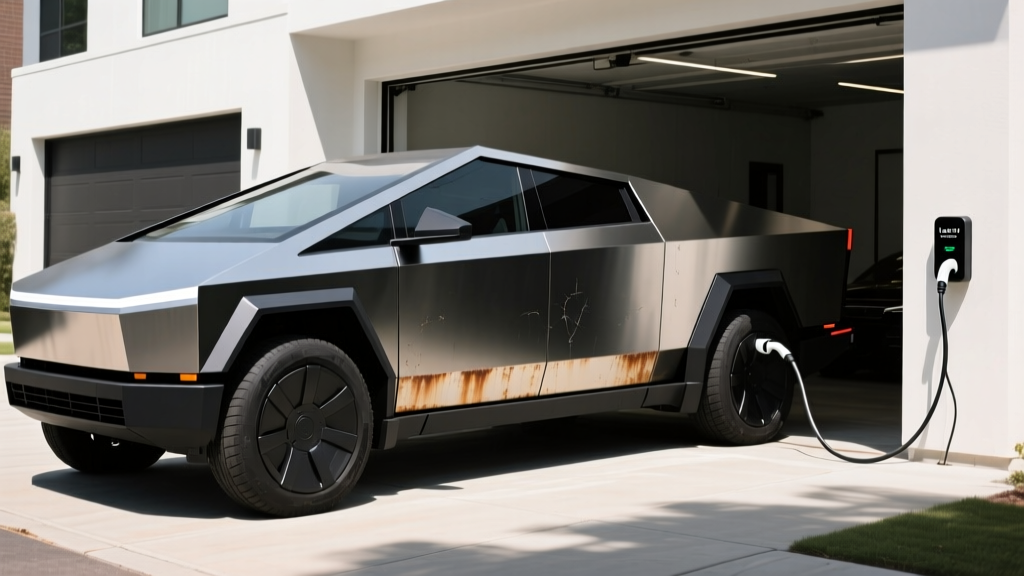
The Tesla Cybertruck's angular stainless-steel exoskeleton was designed to look indestructible, but a growing number of owners and prospective buyers are searching for answers about one very specific concern: rust on the Cybertruck. Since deliveries began in late 2023, social media has been flooded with images of brown spots, streaking, and surface discoloration on the truck's panels. In this comprehensive review, we separate metallurgical fact from internet fiction, then layer in the hard data every EV buyer needs — EPA range, charging speeds, pricing, tax-credit eligibility, and how the Cybertruck stacks up against the Ford F-150 Lightning and Rivian R1T in 2026.
Does the Tesla Cybertruck Actually Rust?
The short answer: the Cybertruck's stainless-steel body panels do not rust through in the way traditional mild-steel automotive panels do, but they are not immune to surface corrosion, staining, and discoloration. Here's why.
Tesla uses a 300-series austenitic stainless steel (widely reported as a variant of 304/301) for the Cybertruck's cold-rolled exterior panels. Unlike the galvanized mild steel used in conventional truck bodies, stainless steel contains chromium (typically 18% in 304-grade), which forms a thin, self-healing chromium-oxide layer on the surface. This passive layer is what gives stainless its corrosion resistance.
However, "stainless" does not mean "stain-proof." Several well-documented mechanisms can cause visible corrosion on the Cybertruck:
- Iron-particle contamination (rail dust): Tiny iron particles from brake dust, rail transport, or industrial fallout can embed in the stainless surface. These particles do rust, creating small brown spots that appear to be the panel itself corroding.
- Chloride exposure: Road salt (sodium chloride, calcium chloride) and coastal salt air can attack the passive chromium-oxide layer, leading to pitting corrosion over time if not rinsed away.
- Weld-zone sensitization: Where panels are welded, heat can deplete local chromium content, making those narrow zones more susceptible to intergranular corrosion.
- Surface water spotting: Hard water or sprinkler water evaporating on panels leaves mineral deposits that etch into the surface if not cleaned promptly.
Tesla addressed these concerns in a service bulletin recommending regular washing with mild detergent, avoiding harsh chlorine-based cleaners, and using a dedicated stainless-steel cleaner or Bar Keepers Friend for spot removal. The company also applied a factory ceramic coating on 2025+ models to improve hydrophobicity and reduce staining.
2026 Tesla Cybertruck: Full Specifications at a Glance
| Specification | AWD (Dual-Motor) | Cyberbeast (Tri-Motor) |
|---|---|---|
| EPA Est. Range | 340 miles | 320 miles |
| Battery (usable) | ~123 kWh (est., NMC) | ~123 kWh (est., NMC) |
| Battery Chemistry | NMC (Nickel Manganese Cobalt) | NMC |
| Drivetrain | Dual-Motor AWD | Tri-Motor AWD |
| Horsepower | 600 hp | 845 hp |
| 0–60 mph | 4.1 sec | 2.6 sec |
| Top Speed | 112 mph | 130 mph |
| Max DC Fast Charge | 250 kW (V3 Supercharger) | 250 kW |
| 10–80% DC Charge | ~28 min (est.) | ~28 min (est.) |
| Level 2 Charge Rate | 11.5 kW (~37 mi/hr) | 11.5 kW (~37 mi/hr) |
| MPGe (combined) | 72 MPGe | 69 MPGe |
| kWh / 100 mi | 47 kWh | 49 kWh |
| Towing Capacity | 11,000 lbs | 11,000 lbs |
| Payload Capacity | 2,500 lbs | 2,500 lbs |
| Cargo (bed + frunk) | ~67 cu ft (bed, est.) | ~67 cu ft (bed, est.) |
| Base MSRP (2026) | $79,990 | $99,990 |
| Battery / Drivetrain Warranty | 8 yr / 120,000 mi | 8 yr / 120,000 mi |
Note: Tesla does not publish official usable kWh figures. The ~123 kWh estimate is based on EPA range and efficiency data cross-referenced with third-party teardowns. Specs reflect the 2025/2026 model-year lineup after the discontinuation of the single-motor RWD variant.
Real-World Range: What the EPA Sticker Doesn't Tell You
EPA Sticker: 340 mi (AWD) / 320 mi (Cyberbeast)
Real-World Highway (70 mph, 72°F): ~260–290 mi
Real-World Highway (32°F, cold): ~210–240 mi
Towing (5,000-lb trailer, flat terrain): ~150–180 mi
The Cybertruck's angular, flat-panel design creates a drag coefficient (Cd) of approximately 0.384 — poor by EV standards. For comparison, the Ford F-150 Lightning achieves a Cd around 0.44 but has a smaller frontal area penalty at highway speeds, and the Rivian R1T sits around 0.39. The Cybertruck's massive frontal area (approximately 38 sq ft) means its total aerodynamic drag at 70 mph is substantial, which is the single biggest range killer on highway trips.
In independent real-world testing by outlets like Edmunds and Recurrent Auto, the Cybertruck AWD consistently delivers between 260 and 290 miles on a full charge at highway speeds in moderate temperatures. Cold weather (below freezing) reduces this by an additional 15–20% due to battery chemistry slowdown, cabin heating demands, and increased air density. The Cybertruck does include a heat pump as standard equipment, which mitigates some cold-weather cabin-heating losses compared to resistive heaters.
City and suburban driving with frequent regenerative braking opportunities yields results much closer to — and occasionally above — the EPA estimate. Owners who commute primarily in stop-and-go traffic at moderate speeds report 310–340 miles regularly.
Charging Speed: DC Fast Charge and Home Level 2
The Cybertruck uses the North American Charging Standard (NACS) connector natively — it is, after all, a Tesla product, and the NACS port originated from Tesla's proprietary connector. This gives it seamless access to the Tesla Supercharger network, which remains the most reliable and widely deployed DC fast-charging network in North America with over 6,000 stations and 60,000+ connectors in the U.S. as of early 2026.
| Charging Level | Power / Voltage | Speed (Miles Added per Hour) | Notes |
|---|---|---|---|
| Level 1 (120V household) | ~1.4 kW | ~4 mi/hr | Emergency/trickle only |
| Level 2 (240V, 48A) | 11.5 kW | ~37 mi/hr | Home Wall Connector; full charge ~10–11 hr |
| DC Fast (V3 Supercharger) | 250 kW peak | ~180 mi in 15 min (peak) | 10–80% in ~28 min; tapers sharply above 80% |
| DC Fast (V4 Supercharger) | Up to 350 kW (cable-limited for Cybertruck to ~250 kW) | Similar to V3 | Cybertruck architecture caps at ~250 kW |
A critical nuance many buyers miss: peak kW is not sustained kW. The Cybertruck hits its 250 kW peak only at a low state of charge (typically 10–20%) and with a preconditioned battery. As the battery fills, the charge rate tapers — by 60% SoC, you're likely seeing 150–170 kW, and above 80%, it drops below 50 kW. This is standard lithium-ion charge-curve behavior, not a Cybertruck-specific flaw, but it means the "10–80% in ~28 minutes" figure is the realistic benchmark, not "250 kW the entire time."
For home charging, Tesla's Wall Connector ($420 hardware, plus installation) delivers 11.5 kW on a 60A circuit (48A continuous). Expect a full overnight charge from near-empty in roughly 10–11 hours. Installation costs vary widely — a straightforward install near the panel on a 200A service runs $800–$1,500, while a panel upgrade to 200A+ can add $2,000–$4,000.
Pricing, Trims, and Federal Tax Credit Eligibility
As of the 2026 model year, Tesla offers the Cybertruck in two trims following the discontinuation of the previously announced single-motor RWD variant:
| Trim | Base MSRP | Destination Fee | Total Before Incentives | §30D Federal Credit | Effective Price (if eligible) |
|---|---|---|---|---|---|
| Cybertruck AWD (Dual-Motor) | $79,990 | $1,995 | $81,985 | $7,500 (see eligibility below) | ~$74,485 |
| Cybertruck Cyberbeast (Tri-Motor) | $99,990 | $1,995 | $101,985 | $0 (MSRP exceeds cap) | $101,985 |
- MSRP Cap: Trucks, vans, and SUVs must have an MSRP at or below $80,000. The Cybertruck AWD at $79,990 qualifies; the Cyberbeast at $99,990 does not.
- Buyer Income Cap: Modified adjusted gross income (MAGI) must not exceed $150,000 (single), $225,000 (head of household), or $300,000 (joint filers).
- Battery Sourcing: A percentage of critical minerals must be sourced from the U.S. or FTA partners, and battery components must meet North American manufacturing thresholds. Tesla sources NMC cells primarily from Panasonic at Gigafactory Nevada, but critical-mineral compliance varies by production batch.
- Point-of-Sale Transfer: Eligible buyers can transfer the credit to the dealer at purchase, reducing the purchase price directly rather than waiting for a tax refund.
- Verify before buying: Check the current eligibility status on fueleconomy.gov and consult a tax professional. Rules and eligible VIN lists are updated periodically by the IRS.
The Cyberbeast's MSRP of $99,990 puts it well above the $80,000 truck MSRP cap, making it ineligible for the §30D federal tax credit regardless of buyer income. Some states offer additional incentives that may partially offset the cost — check the AFDC state incentive database for your jurisdiction.
Performance, Cargo, and Technology
The Cybertruck Cyberbeast's 2.6-second 0–60 mph time makes it one of the quickest production pickup trucks ever sold, rivaling supercars from a decade ago. The dual-motor AWD is no slouch at 4.1 seconds. Both trims feature Tesla's adaptive air suspension with up to 16 inches of ground clearance in Extract Mode, a 6.5-foot bed with a motorized retractable tonneau cover, and a claimed 11,000-pound towing capacity.
Interior space is adequate rather than class-leading. The rear seat offers approximately 38 inches of legroom, which trails the F-150 Lightning (~43 inches) and Rivian R1T (~40 inches). The 6-foot bed with the tailgate down provides roughly 67 cu ft of cargo volume. There is no traditional frunk; instead, the Cybertruck has a small lockable "e-vault" compartment where the frunk would be, providing additional secure storage.
On the technology front, the Cybertruck features:
- 18.5-inch front touchscreen running Tesla's latest infotainment software with navigation, streaming, and gaming.
- 9.4-inch rear touchscreen for rear-seat passengers (climate, entertainment controls).
- Steer-by-wire — no mechanical connection between the yoke and the front wheels. This enables variable steering ratios (as little as 340 degrees lock-to-lock) but has drawn polarized reviews from drivers accustomed to traditional steering feel.
- Autopilot standard, with Full Self-Driving (Supervised) available as a $8,000 add-on. Both are SAE Level 2 systems requiring continuous driver attention — not autonomous driving.
- Powershare vehicle-to-load (V2L): Up to 11.5 kW of bidirectional power through bed and cabin outlets, enough to run power tools, campsite equipment, or provide limited home backup during outages.
Cybertruck vs. F-150 Lightning vs. Rivian R1T
| Attribute | Tesla Cybertruck AWD | Ford F-150 Lightning (Extended Range) | Rivian R1T (Dual-Motor Max) |
|---|---|---|---|
| EPA Range | 340 mi | 320 mi | 410 mi |
| Starting MSRP | $79,990 | $74,495 | $87,900 |
| 0–60 mph | 4.1 sec | 3.8 sec | 4.5 sec |
| Towing Capacity | 11,000 lbs | 10,000 lbs | 11,000 lbs |
| Rear Legroom | ~38 in | ~43 in | ~40 in |
| Charging Connector | NACS (native) | NACS (2025+ models) | NACS (adapter available) |
| Body Corrosion Risk | Low (stainless surface staining possible) | Moderate (galvanized steel, traditional paint) | Low (aluminum body panels) |
| §30D Credit Eligible | Yes (AWD only) | Yes (select trims) | Yes (select trims) |
Pros
- Stainless body resists structural rust far better than painted mild steel
- Class-leading towing (11,000 lbs) with tri-motor Cyberbeast performance
- Native NACS and full Supercharger network access
- 11.5 kW Powershare V2L capability
- Air suspension with Extract Mode for off-road clearance
- Heat pump standard for cold-climate efficiency
Cons
- Surface staining and spotting requires regular maintenance
- Poor aerodynamics severely limit highway range vs. EPA sticker
- Tight rear-seat legroom for a full-size truck
- Steer-by-wire polarizes drivers; no traditional steering option
- Cyberbeast ineligible for §30D credit ($80K MSRP cap)
- Build-quality inconsistency reported by early owners
- No conventional frunk; limited secure cabin storage
Who Should Buy the Cybertruck — and Who Shouldn't
- Choose the Cybertruck AWD if: You want a stainless-steel body that resists structural corrosion, need 11,000-lb towing, value Supercharger network access for road trips, and your budget is around $75K–$85K after the potential tax credit.
- Choose the Cybertruck Cyberbeast if: Performance is your priority, you accept the ~$102K price without federal credit, and you want the quickest truck on the market.
- Choose the F-150 Lightning instead if: Rear-seat space is critical (family hauling), you want a more traditional truck driving experience, or you prefer a dealer service network.
- Choose the Rivian R1T instead if: Maximum range is your top priority (410 mi Max pack), you value build quality and adventure-focused design, or you need a gear tunnel for secure storage.
The Cybertruck's stainless-steel body is a genuine advantage for owners in salt-heavy climates who are willing to wash regularly — it will outlast a painted mild-steel truck body in terms of structural integrity. But it demands a different maintenance mindset. If you want a truck you can neglect cosmetically for years and still look showroom-fresh, a traditional painted truck with regular wax and touch-up is arguably lower effort.
Frequently Asked Questions
Does the Cybertruck rust in winter and salt?
The stainless-steel panels resist structural rust-through far better than conventional painted steel, but road salt (chlorides) can cause surface pitting and staining over time if the truck isn't washed regularly. Tesla recommends frequent rinses in winter, especially of the undercarriage. Owners in the Rust Belt should plan on weekly or biweekly washes during salt season.
What is the real-world range of the Cybertruck on a road trip?
Expect 260–290 miles at 70 mph in moderate temperatures (65–80°F). In cold weather (below 32°F), plan for 210–240 miles. When towing a 5,000-pound trailer, range drops to approximately 150–180 miles. The EPA sticker of 340 miles (AWD) reflects a blended city/highway cycle that few road trips replicate.
How fast does the Cybertruck charge at home and on the road?
At home on a Level 2 Tesla Wall Connector (11.5 kW), expect about 37 miles of range added per hour, or a full charge from near-empty in 10–11 hours. On a V3 Supercharger, the Cybertruck peaks at 250 kW and charges from 10–80% in approximately 28 minutes, though the rate tapers significantly above 80% SoC.
Does the Cybertruck qualify for the $7,500 federal EV tax credit?
The Cybertruck AWD at $79,990 MSRP falls under the $80,000 truck MSRP cap and may qualify for the full $7,500 credit, subject to buyer income limits ($150K single / $300K joint MAGI) and battery critical-mineral sourcing requirements. The Cyberbeast at $99,990 exceeds the MSRP cap and is not eligible. Always verify current eligibility on fueleconomy.gov and consult a tax professional before relying on the credit.
Is the Cybertruck worth buying over the F-150 Lightning or R1T?
It depends on your priorities. The Cybertruck wins on towing capacity (tied with R1T at 11,000 lbs), Supercharger network access, and corrosion-resistant body material. The F-150 Lightning wins on rear-seat space, dealer service accessibility, and lower starting price. The Rivian R1T wins on maximum range (410 mi), build quality, and adventure utility. None of these trucks are objectively "best" — the right choice depends on your specific use case.
What is the Cybertruck's warranty coverage?
Tesla covers the Cybertruck's battery pack and drive unit for 8 years or 120,000 miles, whichever comes first, with a minimum 70% capacity retention threshold. The vehicle limited warranty covers 4 years or 50,000 miles. The stainless-steel body panels are covered under the standard warranty for manufacturing defects, but cosmetic staining from environmental exposure or lack of maintenance is not covered.