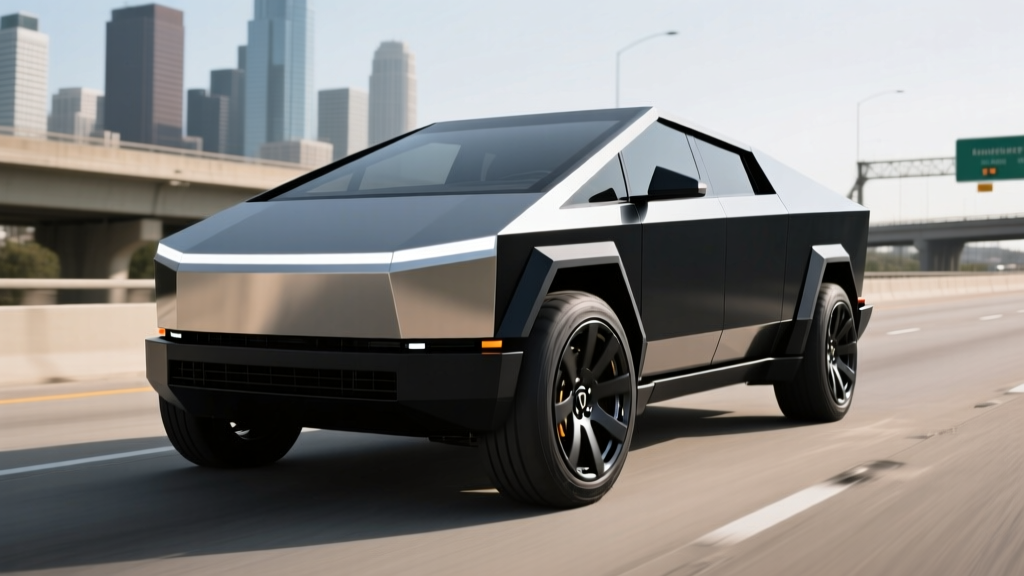
The Tesla Cybertruck remains one of the most polarizing electric vehicles on the road, and its wheel-and-tire packages are a big part of that conversation. Whether you're eyeing the standard 20-inch Aero wheels or the optional all-terrain setups that owners colloquially search for as a "Cybertruck with rims," the wheel configuration you choose directly affects EPA range, ride quality, charging efficiency, and off-road capability. This review breaks down every spec that matters for the 2026 model year — from real-world range to DC fast-charging curves — so you can decide which setup fits your driving life.
2026 Cybertruck Lineup: Trims, Rims, and Starting Prices
Tesla offers the Cybertruck in three core trims for 2026, each with distinct powertrain outputs and wheel options. The wheel-and-tire package (what most buyers mean when searching for a Cybertruck with rims) is either a 20-inch Aero wheel with all-season tires or an optional 20-inch all-terrain wheel with more aggressive rubber. The AWD and Cyberbeast trims can also be spec'd with 22-inch wheels through Tesla's accessory catalog, though these are aftermarket-style add-ons that reduce range.
| Trim | Drivetrain | 0-60 mph | Horsepower | Base MSRP | Standard Wheels |
|---|---|---|---|---|---|
| Rear-Wheel Drive (RWD) | Single Motor RWD | 6.5 sec | ~315 hp | $60,990 | 20" Aero |
| All-Wheel Drive (AWD) | Dual Motor AWD | 4.1 sec | ~600 hp | $79,990 | 20" Aero |
| Cyberbeast | Tri-Motor AWD | 2.6 sec | ~845 hp | $99,990 | 20" All-Terrain |
All prices exclude the $1,995 destination fee. The RWD trim, expected to begin deliveries in late 2025 and into 2026, serves as the volume play, while the Cyberbeast targets performance buyers who want supercar acceleration in a stainless-steel truck body.
Range, Efficiency, and the Wheel-Size Trade-Off
The single biggest reason buyers research a Cybertruck with rims is the impact that wheel and tire selection has on range. Larger, heavier wheels with aggressive tread patterns increase rolling resistance and reduce aerodynamic efficiency — the two forces that dominate energy consumption at highway speeds.
| Trim / Wheel Config | EPA Est. Range | Real-World Highway (~70 mph) | Cold Weather (20°F) |
|---|---|---|---|
| AWD w/ 20" Aero Wheels | 340 mi | ~275-295 mi | ~230-255 mi |
| AWD w/ 20" All-Terrain Tires | 318 mi | ~255-275 mi | ~210-235 mi |
| Cyberbeast w/ 20" All-Terrain | 320 mi | ~250-270 mi | ~210-230 mi |
| RWD w/ 20" Aero Wheels | ~350 mi (est.) | ~285-305 mi | ~240-260 mi |
Note: Cold-weather estimates assume no preconditioning and cabin heating active. Preconditioning the battery while plugged in can recover 5-10% of range loss. The Cybertruck's heat pump helps, but the stainless-steel body and large frontal area work against efficiency in freezing temps.
On the efficiency side, the AWD Cybertruck with 20-inch Aero wheels rates at approximately 70 MPGe combined (EPA), which translates to roughly 48 kWh per 100 miles. That's thirstier than a Rivian R1T Dual-Motor (~73 MPGe) and considerably less efficient than a Ford F-150 Lightning Extended Range (~70 MPGe combined, but with a larger battery). For a vehicle this heavy — curb weight exceeds 6,600 lbs for the AWD — those numbers are expected, but they mean your electricity cost per mile is higher than lighter EVs.
Battery Chemistry, Capacity, and Longevity
Tesla has not published the exact usable kWh figure for the Cybertruck battery pack, but teardown data and EPA consumption calculations place the AWD/Cyberbeast usable capacity at approximately 123 kWh. The pack uses Tesla's 4680-format cells with a nickel-based NMC-type chemistry — optimized for energy density and power delivery rather than the cycle-life focus of LFP (lithium iron phosphate) cells used in the Model 3 RWD.
The 4680 cells are structurally integrated into the vehicle's body (a "structural battery pack"), which reduces weight and increases torsional rigidity but makes out-of-warranty replacement more complex and expensive. Tesla's battery and drive unit warranty covers 8 years / 150,000 miles (whichever comes first) with a minimum 70% capacity retention threshold. This is competitive with Rivian's 8-year/175,000-mile battery warranty, though Rivian's retention threshold is also 70%.
For long-term ownership, expect approximately 8-12% degradation over the first 100,000 miles based on Tesla fleet data for NMC-type packs. The structural pack design means that a full replacement, if ever needed outside warranty, could exceed $20,000-$25,000 — a figure to factor into total cost of ownership if you plan to keep the truck beyond the warranty period.
Charging Speed: DC Fast Charging and Home Level 2
The Cybertruck uses an 800-volt electrical architecture, which enables higher charge power with lower current — reducing heat and cable weight. At a Tesla V4 Supercharger or compatible 800V DC fast charger, the Cybertruck can accept significant power, though the charge curve (the rate at which power tapers as the battery fills) is critical to understand.
| Charging Level | Max Power / Rate | Speed (Miles Added) | Notes |
|---|---|---|---|
| Level 1 (120V household) | ~1.4 kW | ~3-4 mi/hr | Emergency/trickle only — full charge in days |
| Level 2 (240V, 48A home) | 11.5 kW | ~29-33 mi/hr | Full charge in ~11-13 hours; recommended daily method |
| Level 2 (240V, 80A Wall Connector) | 19.2 kW | ~44-50 mi/hr | Requires 100A circuit; full charge in ~7-8 hours |
| DC Fast Charge (V4 Supercharger) | Peak ~250 kW | ~150+ mi in 15 min | 10-80% in ~28-32 min; tapers sharply above 80% |
Understanding the charge curve: The Cybertruck's peak ~250 kW rate is available only between roughly 10-30% state of charge (SoC) and only when the battery is preconditioned (warmed to optimal temperature via navigation to a Supercharger). From 50-80%, power tapers to roughly 100-130 kW. Above 80%, it drops further — which is why Tesla and virtually all EV makers recommend fast-charging only to 80% on road trips. A 10-80% session takes approximately 28-32 minutes under ideal conditions, but expect 35-40 minutes in cold weather without adequate preconditioning.
For home charging, a Tesla Wall Connector on a 60A circuit (48A continuous) delivers 11.5 kW, adding roughly 30 miles of range per hour. Overnight charging from 20% to 80% takes about 7 hours, which covers virtually all daily needs. Installation costs for a Level 2 home setup typically run $800-$2,500 depending on panel capacity and conduit length — though homes with older 100A electrical panels may need a $2,000-$4,000 panel upgrade to support a dedicated 60A EV circuit. Always consult a licensed electrician for final specifications.
Performance, Towing, and Payload
The Cybertruck's tri-motor Cyberbeast variant delivers absurd acceleration: 0-60 mph in 2.6 seconds, making it one of the quickest production pickups ever built. The dual-motor AWD achieves 0-60 in 4.1 seconds, which is still quicker than most sports sedans. The RWD model, with a single rear motor, targets efficiency and affordability at 6.5 seconds to 60.
For truck buyers, the functional specs matter more:
- Maximum towing capacity: 11,000 lbs (AWD and Cyberbeast)
- Payload capacity: Up to 2,500 lbs
- Vault (bed) length: 6 feet
- Cargo volume (vault): ~67 cu ft
- Frunk (front trunk): ~7 cu ft, lockable
- Ground clearance: Up to 17.4 inches (adaptive air suspension, Extract Mode)
- Approach/departure angles: 35°/30° (Extract Mode)
The air suspension offers adjustable ride height with roughly 12 inches of travel, which is useful for both off-road clearance and highway aerodynamics. However, towing at the 11,000-lb maximum will slash range by approximately 40-50%, bringing highway range down to roughly 140-170 miles between charges — a serious constraint for trailer-hauling road trips through areas with sparse Supercharger coverage.
Tax Credit Eligibility and True Ownership Cost
Federal EV tax credit eligibility under IRS §30D is a moving target for the Cybertruck. Here's what applies for 2026:
- MSRP cap: Trucks/vans/SUVs must have an MSRP at or below $80,000 to qualify
- Buyer income cap: Modified AGI must not exceed $150,000 (single), $225,000 (head of household), or $300,000 (joint)
- Battery sourcing: Critical minerals and battery components must meet phased-in domestic/FtA-sourcing thresholds (increasing annually through 2027)
- Point-of-sale transfer: Eligible buyers can transfer the credit to the dealer for an upfront price reduction
- Assembly: Vehicle must undergo final assembly in North America (Cybertruck is built in Austin, TX — qualifies)
Because the AWD Cybertruck starts at $79,990, it sits exactly at the $80,000 truck MSRP cap — meaning the base AWD trim may qualify for up to $7,500 if battery-sourcing requirements are met and buyer income is within limits. The Cyberbeast at $99,990 exceeds the cap and does not qualify. The RWD at $60,990 is well under the cap and is the most credit-friendly trim, assuming sourcing rules are satisfied.
| Trim | MSRP | Max §30D Credit | Est. Net Price | Credit Eligibility |
|---|---|---|---|---|
| RWD | $60,990 | Up to $7,500 | ~$53,490 | Likely eligible (if sourcing met) |
| AWD (base) | $79,990 | Up to $7,500 | ~$72,490 | At MSRP cap — verify eligibility |
| Cyberbeast | $99,990 | $0 | $99,990 | Exceeds MSRP cap |
Always verify current eligibility on fueleconomy.gov and consult a tax professional before relying on credit assumptions. State and local incentives vary and may stack on top of federal credits.
Interior, Tech, and Driver Assistance
The Cybertruck's interior is minimalist even by Tesla standards: a single 18.5-inch front touchscreen handles virtually all vehicle functions, climate, navigation, and media. Rear passengers get a 9.4-inch touchscreen for climate and entertainment. There are no physical stalks — turn signals are integrated into the steering wheel rim (a controversial choice), and gear selection is done via the touchscreen or a backup overhead panel.
Notable tech features include:
- Steer-by-wire: No mechanical connection between the yoke and the wheels; enables variable steering ratio (less turning at low speeds, more stability at highway speeds)
- 48-volt electrical architecture: First in a production vehicle; reduces wiring harness weight and enables higher-power accessories
- Adaptive air suspension: Automatically adjusts height based on speed and terrain
- Bioweapon Defense Mode: HEPA filtration system for cabin air
- Power frunk and vault: Both lockable, with the vault featuring a motorized tonneau cover
- V2L (Vehicle-to-Load): 120V and 240V outlets in the bed and cabin for powering tools, appliances, or campsite equipment
Driver assistance: The Cybertruck ships with Tesla's Enhanced Autopilot (adaptive cruise, lane centering, auto lane change). Full Self-Driving (Supervised) is available as an add-on. It is critical to understand that both systems are SAE Level 2 — meaning the driver must remain fully engaged, hands on the yoke, eyes on the road at all times. This is not autonomous driving. Tesla's FSD (Supervised) can navigate intersections and stop signs, but it makes errors and requires constant oversight. Only Level 4 services like Waymo operate without a driver.
Cybertruck With Rims: Which Wheel Package Should You Choose?
The "Cybertruck with rims" question ultimately comes down to your priority: maximum range, off-road capability, or visual impact.
Choose the 20" Aero Wheels if: You prioritize maximum EPA range (340 mi on AWD), lower road noise, better highway efficiency, and lower tire replacement costs (~$250-300/tire). Best for commuters and road-trippers who stick to pavement.
Choose the 20" All-Terrain Wheels if: You plan to take the Cybertruck off-road regularly, drive on gravel or dirt roads, or want more puncture-resistant sidewalls. You'll sacrifice ~22 miles of EPA range and accept more road noise. Tire replacement costs run ~$350-450/tire.
Consider 22" aftermarket-style wheels only if: Appearance is your top priority and you accept a meaningful range reduction (est. 20-30 mi loss vs. 20" Aero), harsher ride quality, and significantly higher tire costs ($400-500+/tire). Not recommended for towing or off-road use.
How the Cybertruck Compares to Rivals
The Cybertruck competes in the electric pickup segment against the Ford F-150 Lightning, Rivian R1T, and Chevrolet Silverado EV. Each has distinct trade-offs:
| Spec | Cybertruck AWD | F-150 Lightning Ext. Range | Rivian R1T Dual-Motor Max |
|---|---|---|---|
| EPA Range | 340 mi | 320 mi | 352 mi |
| Battery (usable, approx.) | ~123 kWh | ~131 kWh | ~141 kWh |
| Max DC Charge | ~250 kW | ~150 kW | ~220 kW |
| 0-60 mph | 4.1 sec | ~5.0 sec | ~3.5 sec |
| Max Towing | 11,000 lbs | 10,000 lbs | 11,000 lbs |
| Bed Length | 6 ft | 5.5 ft | 4.5 ft |
| Base MSRP | $79,990 | ~$71,990 | ~$82,900 |
| Tax Credit (§30D) | Possible (at cap) | Eligible | Eligible (at cap) |
The Cybertruck's advantages are its 800V charging architecture (faster peak charge rate), stainless-steel exoskeleton durability, steer-by-wire novelty, and V2L capability. Its disadvantages include the controversial yoke-only steering, limited rear-seat comfort compared to the F-150 Lightning, a shorter bed than traditional full-size trucks, and the polarizing design that may not suit commercial fleet buyers.
- Class-leading 800V DC fast-charging speed (~250 kW peak)
- Tri-motor Cyberbeast delivers 2.6-sec 0-60 — supercar territory
- Stainless-steel body resists dents and corrosion
- Adaptive air suspension with 12" of travel
- V2L outlets for job-site and camping use
- 6-foot vault with lockable motorized tonneau
- Range drops sharply when towing (est. 40-50% loss)
- Yoke-only steering with no stalks is a steep learning curve
- Cyberbeast exceeds $80K MSRP cap — no federal tax credit
- Real-world highway range well below EPA sticker (~80-85%)
- Limited service center capacity for body/panel repairs
- Large footprint and weight increase tire wear costs
Frequently Asked Questions
What is the real-world range of the Cybertruck?
The EPA rates the AWD Cybertruck at 340 miles with 20-inch Aero wheels. In real-world highway driving at 70 mph, expect approximately 275-295 miles. With all-terrain tires, that drops to roughly 255-275 miles. Cold weather (below 30°F) can reduce range by an additional 15-25% unless the battery is preconditioned while plugged in.
How fast does the Cybertruck charge at home and on the road?
At home on a Level 2 Tesla Wall Connector (48A / 11.5 kW), the Cybertruck gains approximately 30 miles of range per hour, with a full 0-100% charge taking about 12-13 hours. On a DC fast charger (V4 Supercharger), it peaks at ~250 kW and can add 150+ miles in 15 minutes, with a 10-80% session taking approximately 28-32 minutes under ideal conditions.
Does the Cybertruck qualify for the federal EV tax credit?
It depends on the trim and your income. The RWD ($60,990) and base AWD ($79,990 — at the $80,000 truck MSRP cap) may qualify for up to $7,500 under IRS §30D if battery-sourcing requirements are met and buyer income is below the threshold ($150K single / $300K joint). The Cyberbeast ($99,990) exceeds the MSRP cap and does not qualify. Verify current eligibility on fueleconomy.gov.
Is the Cybertruck worth buying over the F-150 Lightning or Rivian R1T?
The Cybertruck makes sense if you value fast DC charging (800V architecture), extreme acceleration (Cyberbeast), and the stainless-steel body's durability. Choose the F-150 Lightning if you want a more traditional truck experience, better rear-seat comfort, and broader dealer service coverage. The Rivian R1T is ideal if you prioritize off-road capability, a more refined interior, and access to Rivian's adventure network — though at a higher price point.
What wheel and rim option is best for the Cybertruck?
For maximum range and lowest operating cost, the 20-inch Aero wheels are the clear winner. For off-road driving and more durable sidewalls, the 20-inch all-terrain package is worth the ~22-mile range trade-off. Aftermarket 22-inch options exist but reduce range, increase tire costs, and worsen ride quality — recommended only for appearance-focused buyers who accept those compromises.
How much does it cost to replace Cybertruck tires?
Tire replacement costs vary by wheel package: 20-inch Aero all-season tires run approximately $250-$300 per tire, while all-terrain tires cost $350-$450 per tire. Given the Cybertruck's 6,600+ lb curb weight and instant torque, expect tire life of approximately 25,000-35,000 miles — shorter than a comparable gas truck. Budget $1,000-$1,800 for a full set replacement every 2-3 years depending on driving habits.