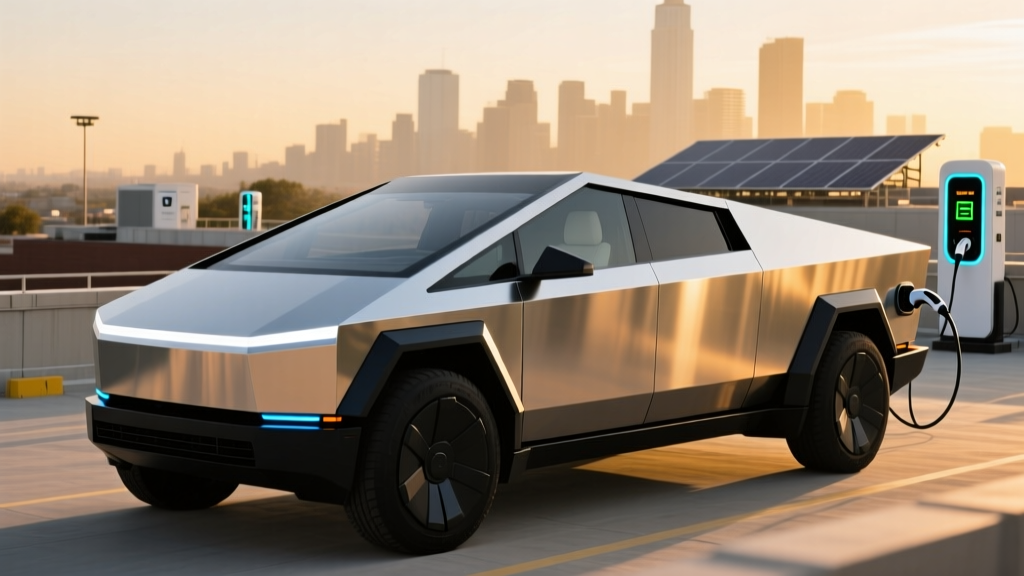
The Cybertruck in 2026: What Reservation Holders Need to Know
If you placed a Tesla Cybertruck reservation back when the concept debuted—or even during the 2023 launch event—you've been waiting a long time. As of early 2026, Tesla has ramped production significantly, clearing much of the backlog and opening new configurations. But the truck that's rolling off the Austin line today looks different from what was originally promised: trims have shifted, pricing has climbed, and the real-world efficiency picture is more nuanced than the spec sheet suggests.
This review breaks down the current Cybertruck lineup with the exact numbers that matter to buyers: EPA range versus what you'll actually see on the highway, 800V DC fast-charging behavior, federal tax credit eligibility under current IRS §30D rules, and whether this stainless-steel wedge still makes sense against rivals like the Ford F-150 Lightning and Rivian R1T.
Range, Battery, and Real-World Efficiency
The 2026 Cybertruck is offered in three configurations. The dual-motor AWD and the tri-motor Cyberbeast share the same battery pack, while the long-awaited rear-wheel-drive (RWD) model—finally entering volume production—uses a smaller, lighter pack. All current Cybertruck packs use NMC (nickel manganese cobalt) chemistry, prioritizing energy density over the LFP chemistry Tesla uses in some Model 3/Y variants.
| Spec | AWD (Dual-Motor) | Cyberbeast (Tri-Motor) | RWD (Base) |
|---|---|---|---|
| EPA Range | 340 mi | 320 mi | 250 mi (est.) |
| Battery (usable) | ~123 kWh (NMC) | ~123 kWh (NMC) | ~100 kWh (NMC, est.) |
| Drivetrain | Dual-motor AWD | Tri-motor AWD | Rear-wheel drive |
| Horsepower | 600 hp | 845 hp | ~315 hp (est.) |
| 0-60 mph | 3.9 sec | 2.6 sec | ~6.5 sec (est.) |
| EPA Efficiency | 58 MPGe / 58 kWh/100mi | 54 MPGe / 62 kWh/100mi | ~65 MPGe (est.) |
| Towing Capacity | 11,000 lbs | 11,000 lbs | 7,500 lbs (est.) |
| Base MSRP | $79,990 | $99,990 | $60,990 (est.) |
The AWD's EPA sticker says 340 miles, but plan for ~270-290 miles on highway road trips at 70-80 mph. The Cybertruck's angular stainless-steel body generates significant aerodynamic drag—its frontal area and boxy profile hurt efficiency above 65 mph more than a sleeker EV. In cold weather (below 32°F), expect a further 15-25% reduction, putting real winter highway range closer to 220-245 miles for the AWD. The Cyberbeast, with its higher power draw, typically nets 250-270 highway miles in mild conditions. If your commute is mostly city driving with regen braking, you'll land closer to the EPA figure.
Charging Speed: 800V Architecture in Practice
The Cybertruck uses an 800-volt electrical architecture, enabling some of the fastest DC fast-charging in Tesla's lineup. Here's what the numbers look like across charging levels:
| Charging Level | Power (kW) | Speed (miles/hr added) | Notes |
|---|---|---|---|
| Level 1 (120V household) | ~1.4 kW | ~3 mi/hr | Emergency/trickle only |
| Level 2 (240V, 48A Wall Connector) | 11.5 kW | ~25-28 mi/hr | Full charge in ~11-13 hrs |
| DC Fast Charge (V4 Supercharger) | Peak 350 kW | ~140 mi in 15 min | 10-80% in ~22 min |
| DC Fast Charge (250 kW V3) | Peak 250 kW | ~110 mi in 15 min | 10-80% in ~28 min |
Charging-curve reality: The Cybertruck peaks near 350 kW only between roughly 10-30% state of charge (SoC) on a V4 Supercharger. From 50-80%, power tapers to 100-150 kW as the battery management system protects cell longevity. That 10-80% time of ~22 minutes assumes you've preconditioned the battery by navigating to a Supercharger in the vehicle's navigation—if you arrive at a charger cold (without preconditioning), add 5-10 minutes to your stop, especially in cooler weather.
At home on a Level 2 Tesla Wall Connector (hardwired, 60A circuit), you'll add about 25-28 miles of range per hour. Overnight charging from 20% to 80% takes roughly 7-8 hours, which suits most daily routines. Note: the Cybertruck uses the NACS (North American Charging Standard) connector natively—no adapter needed at Tesla Superchargers, and increasingly compatible with non-Tesla networks as they adopt NACS.
Pricing, Trims, and Federal Tax Credit Eligibility
Tesla has restructured the Cybertruck lineup several times since launch. As of early 2026, the available and upcoming trims are:
- AWD (Dual-Motor): $79,990 MSRP — the volume model
- Cyberbeast (Tri-Motor): $99,990 MSRP — the performance flagship
- RWD (Base): ~$60,990 MSRP — entering production, limited availability
The "Foundation Series" packages that initially inflated prices by $20,000+ have been phased out in favor of standard option bundles.
Short answer: No. Under current IRS §30D rules, the federal tax credit for new clean vehicles has an MSRP cap of $80,000 for trucks, vans, and SUVs. The Cybertruck AWD at $79,990 technically squeaks under this cap, but it faces additional hurdles:
- Battery component sourcing: A percentage of battery components must be manufactured or assembled in North America, with thresholds increasing annually. Tesla's supply chain has been evolving, and Cybertruck eligibility has fluctuated.
- Critical minerals requirement: A percentage of critical minerals must be sourced from the US or free-trade-agreement countries.
- Buyer income caps: AGI must not exceed $150,000 (single) / $300,000 (joint).
As of this writing, the Cybertruck does not appear on the IRS-qualified vehicle list for the full $7,500 credit. The Cyberbeast at $99,990 exceeds the MSRP cap entirely. Always verify current eligibility at fueleconomy.gov before purchasing, as the list updates periodically.
Note: Some state and utility incentives may still apply regardless of federal eligibility. Check your local programs.
Performance, Cargo, and Daily Livability
The Cyberbeast's 2.6-second 0-60 mph time is genuinely supercar territory in a 6,800-pound truck. The dual-motor AWD's 3.9 seconds is also remarkably quick for a full-size pickup. But performance isn't just about straight-line speed—the Cybertruck's steer-by-wire system and four-wheel steering give it a surprisingly tight 34-foot turning circle, making it more maneuverable in parking lots than an F-150 Lightning.
Cargo and space:
- Bed: 6 feet long, 4 feet wide between wheel wells — roughly 67 cu ft of bed volume with the tonneau closed
- Front trunk (frunk): ~7 cu ft — enough for a charging cable bag and a small duffel, but smaller than the F-150 Lightning's massive frunk
- Interior: Front legroom is generous at ~41 inches; rear legroom is tighter at ~36 inches, which will feel cramped for taller passengers on long trips
- Towing: 11,000 lbs rated for AWD/Cyberbeast — competitive with the segment, though towing at max capacity will cut range by 40-50%
Standout tech:
- Steer-by-wire with variable ratio — fewer turns lock-to-lock than any conventional truck
- Adaptive air suspension with up to 16 inches of ground clearance in Extract mode
- Stainless steel exoskeleton — no paint to scratch, but fingerprints and smudges are constant
- 18.5-inch center touchscreen with Tesla's latest UI; rear-seat 9.4-inch screen
- Bioweapon Defense Mode (HEPA filtration)
- Autopilot (Level 2 driver assist) standard; FSD (Supervised) available as an add-on — neither system is self-driving; the driver must remain fully engaged
Notable drawbacks:
- Visibility is compromised by the thick A-pillars and angular rear window — the digital rearview camera is essential
- The tonneau cover, while lockable and sturdy, limits bed access for tall items compared to an open-bed truck
- Stainless steel panels show water spots, fingerprints, and can be difficult to repair after dents
- Rear-seat comfort and headroom are below what the Rivian R1T and F-150 Lightning offer
- No Apple CarPlay or Android Auto — Tesla's ecosystem only
Cybertruck vs. the Competition
| Spec | Tesla Cybertruck AWD | Ford F-150 Lightning (Ext. Range) | Rivian R1T (Dual-Motor Max) |
|---|---|---|---|
| EPA Range | 340 mi | 320 mi | 352 mi |
| Base MSRP | $79,990 | ~$69,995 | ~$83,000 |
| Max DC Charge | 350 kW | 150 kW | 220 kW |
| 10-80% DC Time | ~22 min | ~41 min | ~30 min |
| Towing | 11,000 lbs | 10,000 lbs | 11,000 lbs |
| Bed Length | 6 ft | 5.5 ft | 4.5 ft (+ Gear Tunnel) |
| Federal Tax Credit | Likely ineligible | Eligible (verify) | Eligible (verify) |
The Cybertruck's main advantages are charging speed (thanks to 800V architecture), acceleration, and the Supercharger network. The F-150 Lightning wins on traditional truck utility, frunk space, and likely tax-credit eligibility. The Rivian R1T offers the most refined interior, the best off-road capability, and creative storage with its Gear Tunnel, though at a higher price point.
Who Should Buy the Cybertruck?
- You rely on the Tesla Supercharger network for frequent long-distance travel
- You value acceleration and performance above traditional truck refinement
- You want the fastest DC charging in the electric truck segment
- You're drawn to the stainless-steel aesthetic and don't mind maintaining its appearance
- You already own a Tesla and want ecosystem continuity
- You need maximum rear-seat comfort for family road trips (consider the F-150 Lightning or R1T)
- Federal tax credit eligibility is essential to your budget
- You need a traditional truck bed for frequent hauling of tall or oversized items
- You prefer Apple CarPlay/Android Auto integration
Warranty and Long-Term Ownership
Tesla provides the following warranty coverage for the 2026 Cybertruck:
- Vehicle limited warranty: 4 years / 50,000 miles
- Battery and drive unit: 8 years / 120,000 miles (with minimum 70% capacity retention)
- Stainless steel body: 5 years / 60,000 miles against corrosion perforation
The 8-year battery warranty with a 70% retention threshold is competitive with the segment. However, NMC chemistry typically degrades faster than LFP in the first 2-3 years before leveling off. Based on Tesla's track record with Model S/X packs, expect roughly 8-12% degradation over the first 100,000 miles under normal use—meaning a 340-mile pack might deliver ~300-310 miles when new-equivalent after five years. Battery replacement costs, should you exceed the warranty period, are estimated at $15,000-$22,000 for a pack of this capacity, though prices are expected to decline.
Frequently Asked Questions
What is the real-world range of the Tesla Cybertruck?
The AWD is EPA-rated at 340 miles, but expect 270-290 miles on highway road trips and 220-245 miles in cold weather. The Cyberbeast nets about 250-270 miles in mixed highway driving. City-heavy commutes with regenerative braking will get you closer to the EPA number.
How fast does the Cybertruck charge at home and on the road?
On a V4 Supercharger, it peaks at 350 kW and charges 10-80% in approximately 22 minutes with battery preconditioning. At home on a Level 2 Wall Connector (11.5 kW), a full overnight charge takes about 11-13 hours. Level 1 (120V) is only practical for trickle maintenance at ~3 miles per hour.
Does the Cybertruck qualify for the $7,500 federal EV tax credit?
Likely not. The Cyberbeast at $99,990 exceeds the $80,000 MSRP cap for trucks. The AWD at $79,990 technically fits under the cap but has not consistently appeared on the IRS qualified-vehicle list due to battery component and critical-mineral sourcing requirements. Always check fueleconomy.gov before purchasing, and consult a tax professional about your specific eligibility.
Is the Cybertruck worth buying over the F-150 Lightning or Rivian R1T?
It depends on your priorities. The Cybertruck wins on DC charging speed, acceleration, and Supercharger access. The F-150 Lightning offers better value, tax credit eligibility, and a more traditional truck experience. The Rivian R1T has the best interior quality, off-road chops, and innovative storage. If road-trip charging speed and Tesla ecosystem integration matter most, the Cybertruck is compelling. If you need family comfort, tax incentives, or traditional truck utility, the alternatives may serve you better.
What are the biggest pros and cons of the Cybertruck?
Pros: Fastest DC charging in its class, Supercharger network, exceptional acceleration, steer-by-wire agility, stainless-steel durability, strong towing capacity. Cons: No federal tax credit, compromised rear-seat space, stainless steel maintenance, limited bed access with tonneau, no CarPlay/Android Auto, higher-than-expected real-world energy consumption at highway speeds.
Can I still use my Tesla Cybertruck reservation to order?
If you hold an existing reservation, Tesla has been inviting reservation holders to configure and order based on their place in the queue and selected trim. With production ramping through 2025-2026, many reservation holders are now receiving delivery windows. Log into your Tesla account to check your status. Note that pricing and configurations may differ from what was available when you originally reserved—Tesla has restructured trims and pricing multiple times since the initial $100 deposit.
How does towing affect Cybertruck range?
Towing near the 11,000-lb maximum will reduce range by approximately 40-50%, meaning a 340-mile AWD Cybertruck might deliver 170-200 miles while towing a heavy trailer. This is consistent with all electric trucks—plan charging stops accordingly, and note that not all Supercharger stalls are pull-through-friendly for trailers.