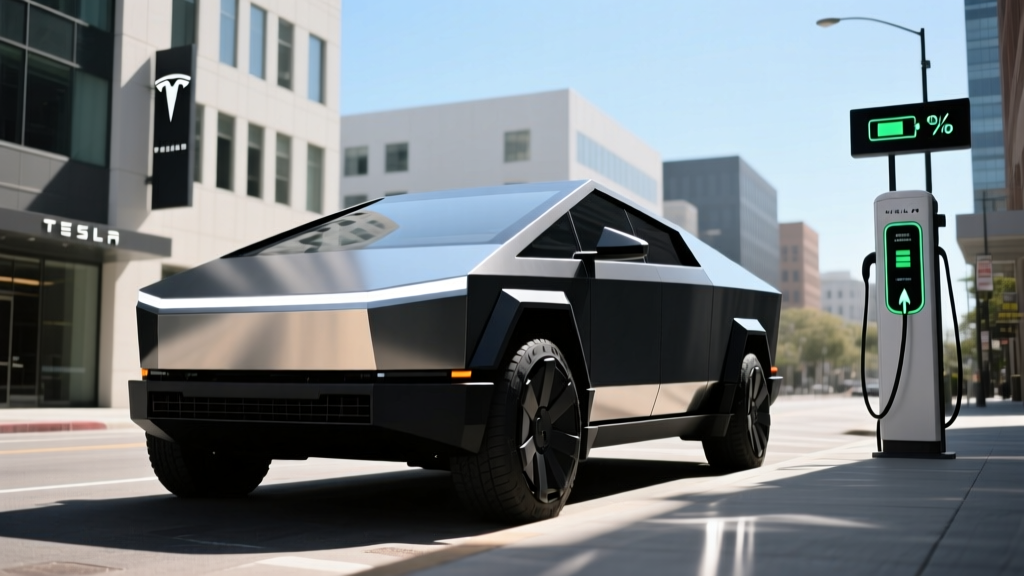
The Tesla Cybertruck arrived with more hype than almost any vehicle in modern history — and the used market has been a rollercoaster ever since. In 2026, with production stabilized and multiple trims on the road, buyers and owners alike are asking the same question: what is the Tesla Cybertruck's resale value actually doing, and does the math still work?
This review covers the Cybertruck's real-world capabilities alongside a deep look at depreciation trends, total cost of ownership, and whether buying new, certified pre-owned, or skipping it altogether makes the most financial sense this year.
2026 Cybertruck Specs: Range, Battery, and Efficiency
| Specification | AWD (Dual-Motor) | Cyberbeast (Tri-Motor) |
|---|---|---|
| EPA Range | 340 miles | 320 miles |
| Battery Capacity (usable) | ~123 kWh | ~123 kWh |
| Battery Chemistry | NMC (Nickel Manganese Cobalt) | NMC |
| Efficiency (MPGe) | 79 MPGe combined | 74 MPGe combined |
| Efficiency (kWh/100 mi) | 42 kWh/100 mi | 45 kWh/100 mi |
| 0–60 mph | 3.9 seconds | 2.6 seconds |
| Horsepower | 600 hp | 845 hp |
| Drivetrain | Dual-motor AWD | Tri-motor AWD |
| Towing Capacity | 11,000 lbs | 11,000 lbs |
The Cybertruck uses a 48-volt electrical architecture and a structural stainless-steel exoskeleton that doubles as body panels and crash structure. The ~123 kWh NMC battery pack is large by any standard — larger than the Ford F-150 Lightning Extended Range (131 kWh gross, ~122 usable) and significantly larger than the Rivian R1T Max pack (149 kWh). However, the Cybertruck's angular shape and heavy weight (~6,800 lbs curb) cut into efficiency compared to more aerodynamic EVs.
Real-World Range vs. EPA Sticker
EPA Estimate: 340 miles (AWD) / 320 miles (Cyberbeast)
Expect in practice: On highway trips at 70–75 mph, plan for 260–290 miles before needing a charge. In cold weather (below 32°F), range drops to approximately 220–250 miles due to battery chemistry limitations and cabin heating demands. The Cybertruck's heat pump helps mitigate losses compared to resistive heating, but the large frontal area and angular panels still push energy consumption higher at speed.
City driving with regen: You can approach or slightly exceed the EPA number in stop-and-go traffic where regenerative braking recovers energy.
Charging Speed: DC Fast, Level 2, and the Supercharger Advantage
| Charging Level | Power | Speed / Time | Connector |
|---|---|---|---|
| DC Fast Charge (peak) | 250 kW | 10–80% in ~30 minutes | NACS (native) |
| DC Fast Charge (sustained avg) | ~150–180 kW | 10–80% realistic: ~35 min | NACS |
| Level 2 (home, 48A) | 11.5 kW | ~30 miles of range per hour | NACS (Tesla Wall Connector) |
| Level 2 (home, 32A) | 7.7 kW | ~20 miles of range per hour | NACS |
| Level 1 (120V outlet) | 1.4 kW | ~3–4 miles per hour | NACS (Mobile Connector) |
The Cybertruck charges natively on the NACS (North American Charging Standard) connector, which is now the de facto standard across most new EVs sold in North America. The 250 kW peak DC fast-charge rate is solid but not class-leading — the Hyundai Ioniq 5 peaks at 350 kW on compatible chargers, and the Chevrolet Silverado EV hits 350 kW as well.
The charge curve matters more than peak numbers. The Cybertruck sustains strong charging speeds between 10% and 50% SoC, then tapers progressively. From 80% to 100%, expect very slow speeds — Tesla recommends daily charging to 80% for NMC batteries to preserve long-term health. Preconditioning the battery via the navigation system (setting a Supercharger as your destination) warms the pack and enables faster charging on arrival.
At home, a Tesla Wall Connector on a 60-amp circuit (48A continuous) delivers about 30 miles of range per hour — enough to fully replenish the Cybertruck overnight in roughly 10–12 hours. Installation typically costs $1,200–$2,500 depending on panel capacity and run length, assuming your home's electrical panel has sufficient headroom. A 200-amp panel is generally required for a 60-amp dedicated circuit.
Pricing, Trims, and Federal Tax Credit Eligibility
| Trim | Base MSRP | Federal §30D Credit | Effective Price (est.) |
|---|---|---|---|
| AWD (Dual-Motor) | $79,990 | $0 (exceeds MSRP cap) | $79,990 |
| Cyberbeast (Tri-Motor) | $99,990 | $0 (exceeds MSRP cap) | $99,990 |
Tax credit reality check: The IRS §30D federal tax credit caps eligible trucks at $80,000 MSRP. The Cybertruck AWD starts at $79,990 — technically under the cap — but Tesla's mandatory destination fee and common option additions push the transaction price above $80,000, which disqualifies it. The Cyberbeast at $99,990 is well above the threshold. Additionally, the buyer must meet income caps ($300,000 joint / $150,000 single for new vehicles) and the battery must meet critical-mineral and component-sourcing requirements. As of 2026, the Cybertruck's battery sourcing has not consistently met these requirements, making credit eligibility unlikely even on base trims.
As-tested pricing for a well-equipped AWD model with Full Self-Driving (Supervised), foundation series package, or accessories typically lands between $85,000 and $92,000 before taxes and fees.
Resale Value and Depreciation: What the Data Shows
This is where the Cybertruck story gets complicated. During 2024, resale prices for used Cybertrucks were wildly inflated — some listed above $150,000 due to limited supply and high demand. That bubble has fully burst. As of early 2026, used Cybertruck listings on platforms like AutoTrader and Cars.com show significant depreciation:
- 2024 Foundation Series AWD (originally ~$100,000+): Now listing between $65,000–$78,000 depending on mileage and condition — a 25–35% loss in under two years.
- 2024 Foundation Series Cyberbeast (originally ~$120,000+): Now listing between $78,000–$95,000 — a 20–35% loss.
- 2025 standard AWD trims (MSRP ~$79,990): Listing between $62,000–$72,000 with moderate mileage — roughly 10–22% depreciation in one year.
For context, the average new vehicle loses about 20% in its first year and 40% over three years, according to industry data. The Cybertruck's early depreciation has been steeper than average, driven by three factors:
- Supply normalization: Tesla ramped production significantly through 2025, eliminating scarcity premiums.
- Foundation Series pricing correction: Early buyers paid $20,000+ above MSRP for Foundation Series packages that are now available as standard or lower-priced options.
- Niche appeal: The polarizing design limits the used-car buyer pool compared to conventional trucks like the F-150 Lightning or Rivian R1T.
Looking forward, the Cybertruck's depreciation curve should flatten as prices reach equilibrium with comparable EV trucks. The stainless-steel body's resistance to dents and corrosion could support longer-term residual value, and Tesla's Supercharger network remains a meaningful ownership advantage.
Interior, Cargo, and Daily Usability
The Cybertruck seats five across two rows with a 6.5-foot bed. Interior dimensions are generous up front but the rear seat is tighter than a full-size truck — legroom measures approximately 38 inches rear, compared to 43+ inches in an F-150 Lightning. The minimalist interior centers on an 18.5-inch touchscreen that controls nearly all vehicle functions, including glove box release, mirror adjustment, and wiper settings. A rear 9.4-inch touchscreen serves back-seat passengers.
Cargo capacity includes the 6.5-foot bed (with a motorized tonneau cover) plus a front trunk (frunk) offering approximately 7 cubic feet of lockable storage. The bed can handle a 4x8 sheet of plywood with the tailgate lowered. Tesla's steer-by-wire system and four-wheel steering give the Cybertruck a surprisingly tight 37-foot turning circle — smaller than many midsize SUVs — making it manageable in urban environments despite its 231-inch overall length.
The stainless-steel panels require no paint (reducing repair costs for minor scuffs) but show fingerprints aggressively. Tesla offers a clear paint-protection film wrap as a dealer-installed option.
Driver Assistance, Safety, and Warranty
SAE Automation Level: Level 2
Tesla's Autopilot and Full Self-Driving (Supervised) are SAE Level 2 driver-assistance systems. The driver must remain fully attentive, keep hands on the yoke, and be prepared to take over at any moment. This is not autonomous driving. Tesla's FSD (Supervised) can handle complex urban and highway scenarios but requires constant supervision.
The Cybertruck comes standard with Tesla's Autopilot (adaptive cruise control, lane centering, automatic emergency braking). Full Self-Driving (Supervised) is an $8,000 one-time purchase or $99/month subscription that adds city-street navigation, traffic-light recognition, and more sophisticated path planning. FSD capability has improved substantially through 2025, but it remains a driver-assist tool, not a replacement for an engaged driver.
Tesla's warranty coverage includes:
- Vehicle limited warranty: 4 years / 50,000 miles
- Battery and drive unit warranty: 8 years / 120,000 miles (retains at least 70% capacity)
The 8-year/120,000-mile battery warranty is competitive with the industry standard and provides long-term peace of mind. Tesla guarantees the battery will retain at least 70% of its original capacity during the warranty period. Real-world NMC degradation data from Tesla's fleet suggests most packs lose 10–12% capacity in the first 100,000 miles, well within the warranty threshold.
Cybertruck vs. Key Competitors: Is It Worth Buying?
Choose the Cybertruck if:
- You want a distinctive design and the Tesla Supercharger network advantage
- You need 11,000-lb towing and value the stainless-steel durability
- Steer-by-wire and four-wheel steering appeal to you for tight urban maneuverability
- You accept steeper-than-average depreciation as the cost of a unique vehicle
Choose the Rivian R1T if:
- You prioritize off-road capability (quad-motor, tank turns, adjustable air suspension)
- You want a more conventional truck layout with a full-size rear seat
- Adventure-oriented features (gear tunnel, camp kitchen) match your use case
Choose the Ford F-150 Lightning if:
- You need maximum interior space and traditional truck ergonomics
- You want a proven fleet/commercial platform with broad dealer support
- Budget is a primary concern — base trims start significantly lower
Against the Rivian R1T (starting ~$74,800) and Ford F-150 Lightning (starting ~$54,995), the Cybertruck trades practicality for performance and presence. The F-150 Lightning remains the most practical electric truck for traditional truck buyers. The R1T offers superior off-road credentials. The Cybertruck wins on acceleration, turning radius, and Supercharger access — but its resale value remains the weakest point among the three.
Pros and Cons
Pros
- Exceptional acceleration (2.6s 0–60 Cyberbeast)
- Tight turning circle via four-wheel steering
- Native NACS + full Supercharger network access
- Stainless-steel body resists dents and corrosion
- 11,000-lb towing capacity
- 48V electrical architecture reduces wiring weight
Cons
- Significant depreciation — worse than EV truck average
- No federal tax credit (MSRP/sourcing barriers)
- Rear seat tighter than F-150 Lightning or R1T
- Efficiency suffers at highway speeds (angular aero)
- Steer-by-wire learning curve for some drivers
- Fingerprint-prone stainless panels
Frequently Asked Questions
What is the real-world range of the Tesla Cybertruck?
The EPA rates the AWD at 340 miles and the Cyberbeast at 320 miles. In real-world highway driving at 70–75 mph, expect 260–290 miles. Cold weather (below freezing) reduces that to roughly 220–250 miles. City driving with regenerative braking can approach or slightly exceed EPA estimates.
How fast does the Cybertruck charge?
On a DC fast charger, the Cybertruck peaks at 250 kW and charges from 10–80% in approximately 30–35 minutes (accounting for the charge-curve taper above 50% SoC). At home on a Level 2 Tesla Wall Connector (48A / 11.5 kW), you'll add about 30 miles of range per hour, fully recharging overnight.
Does the Cybertruck qualify for the federal EV tax credit?
Effectively, no. The IRS §30D credit caps eligible trucks at $80,000 MSRP. While the base AWD stickers at $79,990, destination fees and typical options push the transaction price above the cap. Battery critical-mineral and component-sourcing requirements further complicate eligibility. Consult a tax professional for your specific situation.
Is the Cybertruck's resale value stabilizing?
As of 2026, depreciation has normalized after the initial hype-driven pricing bubble of 2024. Expect 15–25% first-year depreciation on new purchases going forward, which is steeper than average for trucks but in line with luxury EVs. The stainless-steel body and Supercharger ecosystem may support better long-term residuals as the used market matures.
Is the Cybertruck worth buying in 2026?
It depends on your priorities. If you value performance, unique design, and the Supercharger network — and can accept steeper depreciation — the Cybertruck delivers a genuinely unique ownership experience. If maximum practicality, federal tax credit eligibility, or resale-value retention are your top concerns, the F-150 Lightning or Rivian R1T may be better choices.
What's the best way to buy a Cybertruck for the best value?
Given current depreciation trends, buying a lightly used 2024 or 2025 model can save $10,000–$25,000 compared to new. Look for non-Foundation Series models that were purchased at standard MSRP. Tesla's certified pre-owned program adds warranty coverage, though inventory is limited. Always check the battery State of Health (SoH) via the vehicle's service menu before purchasing used.
Sources: EPA Fuel Economy, IRS §30D Clean Vehicle Credits, Tesla Cybertruck Specifications.