Tesla Cybertruck Real-World Range & Utility: An In-Depth Review
The Tesla Cybertruck arrived with more hype than perhaps any vehicle in modern automotive history. Its angular stainless-steel exoskeleton, polarizing design, and bold promises from Tesla's CEO made it an instant conversation starter. But beyond the futuristic aesthetics and viral launch events, the Cybertruck must function as a practical electric pickup truck — one that delivers on range, utility, and everyday usability. In this comprehensive review, we put the Cybertruck through its paces, examining real-world range performance, charging capabilities, interior technology, driving dynamics, and total ownership costs to help you decide whether this electric truck earns a spot in your driveway.
If you're exploring the broader electric truck landscape, be sure to check out our best electric trucks roundup and our detailed EV comparison guide for side-by-side analysis of today's top contenders.
Vehicle Overview: What the Cybertruck Brings to the Table
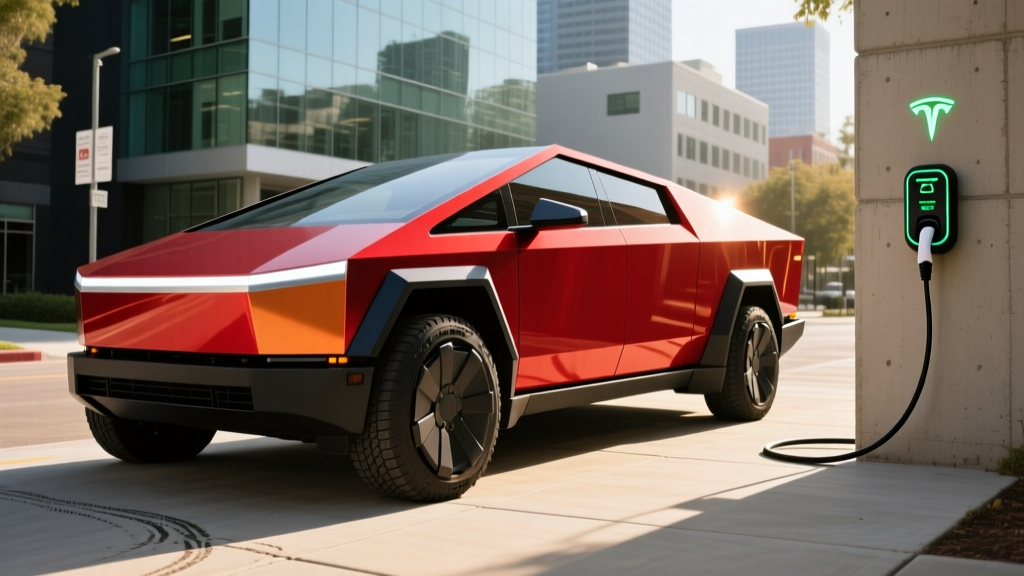
The Tesla Cybertruck is offered in multiple configurations, including the Dual Motor All-Wheel Drive and the tri-motor Cyberbeast variant. Tesla designed the truck around a stainless-steel exoskeleton that serves as both the body structure and the exterior paneling, eliminating traditional paint altogether. The result is a vehicle that looks like nothing else on the road — for better or worse.
Under the skin, the Cybertruck rides on a custom platform with a 48-volt electrical architecture, steer-by-wire steering, and four-wheel steering for improved maneuverability. The truck bed measures six feet long with a motorized retractable tonneau cover, and Tesla claims the composite bed liner is exceptionally durable. The vault-like frunk (front trunk) adds additional enclosed storage, and the sail pillars behind the cab create a distinctive silhouette while theoretically contributing to structural rigidity.
According to Tesla's official specifications, the Dual Motor AWD variant targets an EPA-estimated range of approximately 340 miles, while the Cyberbeast with its tri-motor setup targets around 320 miles. These are ambitious figures for a vehicle with the aerodynamic profile and curb weight of a full-size pickup, but as we'll explore, real-world results can tell a different story.
| Specification | Dual Motor AWD | Cyberbeast (Tri-Motor) |
|---|---|---|
| Drivetrain | Dual Motor AWD | Tri-Motor AWD |
| Horsepower | ~600 hp | ~845 hp |
| 0–60 mph | ~3.9 seconds | ~2.6 seconds |
| EPA Est. Range | ~340 miles | ~320 miles |
| Battery Capacity | ~123 kWh (usable) | ~123 kWh (usable) |
| Max Towing Capacity | 11,000 lbs | 11,000 lbs |
| Payload Capacity | ~2,500 lbs | ~2,500 lbs |
| Bed Length | 6 feet | 6 feet |
| Max Charging Speed | ~250 kW (DC fast) | ~250 kW (DC fast) |
| Curb Weight | ~6,600 lbs | ~6,800 lbs |
Real-World Range: How Far Can the Cybertruck Actually Go?
EPA range estimates provide a useful baseline, but real-world driving conditions rarely mirror laboratory testing perfectly. The Cybertruck's boxy shape, considerable weight, and large frontal area all work against efficiency — particularly at highway speeds where aerodynamic drag becomes the dominant force consuming energy.
Independent testing by outlets such as Edmunds and various EV-focused reviewers has revealed that the Cybertruck's real-world highway range can fall notably short of its EPA rating. At sustained speeds of 70–75 mph, some tests have recorded effective ranges between 250 and 300 miles depending on conditions. Factors like cold weather, elevation changes, headwinds, and cargo load can further reduce these numbers. When towing, range reductions of 40–50% have been observed, which is consistent with the experience of towing behind other electric trucks like the Ford F-150 Lightning and the Rivian R1T.
Around town and at lower speeds, the Cybertruck performs much closer to its rated efficiency. Regenerative braking recaptures energy during stop-and-go driving, and the truck's substantial battery pack provides a comfortable buffer for daily commutes. Most owners report that for typical mixed driving — a combination of city errands, suburban commuting, and occasional highway stretches — the Cybertruck delivers between 280 and 320 miles of usable range before requiring a charge.
It's worth noting that Tesla's energy consumption display, measured in watt-hours per mile (Wh/mi), typically reads between 400 and 500 Wh/mi in mixed driving. This is higher than more aerodynamic EVs but is competitive within the electric truck segment. For comparison, the GMC Hummer EV Pickup consumes well over 500 Wh/mi in similar conditions, while the Ford F-150 Lightning often lands in the 430–480 Wh/mi range.
The bottom line on range: the Cybertruck delivers adequate range for most daily tasks and moderate road trips, but buyers who regularly drive long highway distances or plan to tow frequently should plan their charging stops carefully. Our EV range comparison tool can help you see how the Cybertruck stacks up against other electric trucks and SUVs in real-world scenarios.
Charging Speed & Infrastructure: Getting Back on the Road Quickly
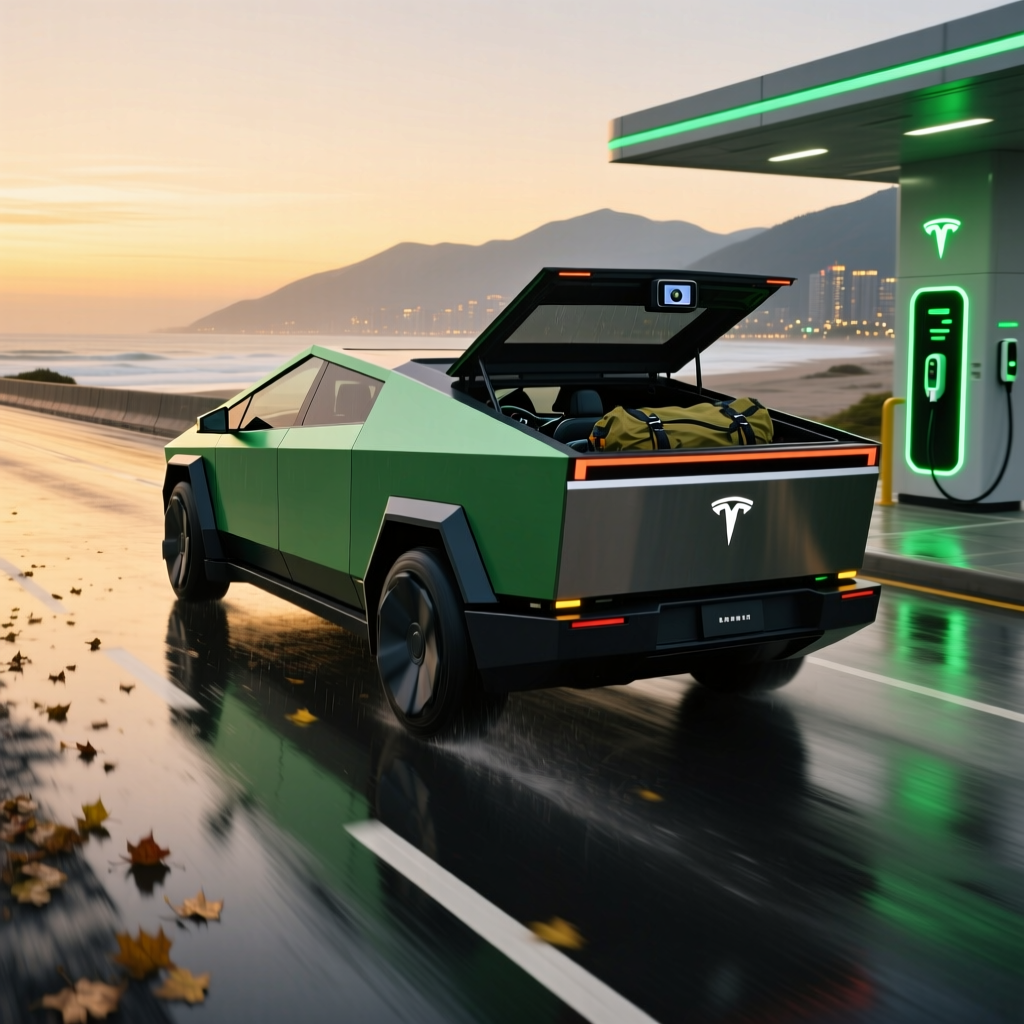
The Cybertruck supports DC fast charging at rates up to approximately 250 kW at Tesla Supercharger stations. In practice, charging speed follows the familiar lithium-ion curve: the battery accepts its maximum charge rate at lower states of charge and gradually tapers as the pack fills. Tesla claims the Cybertruck can recover up to 136 miles of range in approximately 15 minutes at a V3 or V4 Supercharger, though sustained peak rates are typically brief.
In real-world charging sessions, owners report that a 10–80% charge at a 250 kW Supercharger takes roughly 30–40 minutes, which is competitive with other large-battery EVs. The Cybertruck's 800-volt-class architecture (it uses a high-voltage battery configuration) helps maintain relatively strong charging speeds compared to 400-volt systems found in some competitors. However, it does not quite match the ultra-fast charging capabilities of vehicles built on dedicated 800V platforms like the Hyundai Ioniq 5 or the Porsche Taycan.
One of the Cybertruck's biggest charging advantages is seamless access to the Tesla Supercharger network, widely regarded as the most reliable and expansive DC fast-charging network available. Tesla owners benefit from plug-and-charge functionality, real-time stall availability displayed in the navigation system, and automatic billing — eliminating much of the friction associated with third-party charging networks.
For home charging, the Cybertruck supports Level 2 AC charging. Using a Tesla Wall Connector on a 60-amp circuit, owners can expect to add roughly 30–40 miles of range per hour of charging, easily replenishing a full day's driving overnight. A standard 240-volt outlet with a Mobile Connector will charge more slowly but remains practical for overnight top-ups.
The Cybertruck also features a NACS (North American Charging Standard) port natively, which means it can access non-Tesla charging networks that have adopted the standard without requiring an adapter. As the industry broadly transitions to NACS, this positions the Cybertruck well for long-term charging compatibility. For a deeper look at charging infrastructure across brands, see our guide to EV charging networks compared.
Interior & Technology: Minimalism Meets the Jobsite
Step inside the Cybertruck and you're greeted by an interior that is unmistakably Tesla — clean, minimalist, and dominated by a large central touchscreen. The 18.5-inch front display serves as the command center for virtually all vehicle functions, from climate control and navigation to media playback and vehicle settings. A smaller 9.4-inch rear touchscreen provides back-seat passengers with their own climate and entertainment controls.
The cabin materials represent a step up from earlier Tesla vehicles, with vegan leather upholstery, Alcantara-like accents on the headliner and door panels, and generally tighter build quality than what Tesla has historically delivered. That said, some reviewers and owners have noted that certain interior trim pieces and panel gaps still fall short of what you'd find in a comparably priced luxury truck from brands like Ram or GMC.
Technology highlights include:
- Autopilot & Full Self-Driving (FSD): The Cybertruck ships with Tesla's latest Autopilot hardware and supports the optional FSD package, which provides supervised autonomous driving capabilities on highways and city streets.
- Over-the-Air Updates: Like all Tesla vehicles, the Cybertruck receives regular software updates that can add features, improve performance, and refine the user interface without a dealership visit.
- Sentry Mode & Dashcam: Integrated cameras provide 360-degree recording for security and incident documentation.
- Phone-as-Key: Bluetooth-based phone connectivity replaces the traditional key fob, though a key card backup is provided.
- Integrated Navigation & Trip Planner: The onboard navigation automatically routes through Supercharger stations on longer trips, estimating arrival state of charge and recommended charging durations.
- Power Frunk & Vault: The powered front trunk and rear bed vault offer secure, weather-sealed storage accessible from the touchscreen or mobile app.
One area where the Cybertruck's interior draws criticism is rear-seat comfort. While legroom is adequate, the relatively upright seatback angle and firm cushioning make the rear bench less comfortable on long journeys compared to the plush rear seats in the Rivian R1T or the Ford F-150 Lightning. Cargo versatility is strong, however, with the six-foot bed, lockable tonneau cover, and front trunk combining to offer impressive total storage volume.
For buyers prioritizing cutting-edge cabin tech and a futuristic driving experience, the Cybertruck delivers. For those who value traditional luxury and rear-seat comfort, alternatives in our best electric trucks for families list may be worth considering.
Driving Dynamics: Performance That Defies Its Size
Despite tipping the scales at roughly 6,600 to 6,800 pounds, the Cybertruck moves with an urgency that belies its mass. The Dual Motor variant hits 60 mph in approximately 3.9 seconds — quick by any measure, and extraordinary for a pickup truck. The Cyberbeast, with its tri-motor powertrain producing around 845 horsepower, rockets to 60 mph in roughly 2.6 seconds, placing it in supercar territory.
Beyond straight-line acceleration, the Cybertruck's driving dynamics benefit from several innovative engineering choices. The steer-by-wire system eliminates the mechanical connection between the steering wheel and the front wheels, allowing for a variable steering ratio. At low speeds, the steering is extremely quick, requiring minimal hand movement for tight maneuvers — a genuine advantage in parking lots and urban environments. At highway speeds, the ratio lengthens for stability. The rear-wheel steering system further enhances agility, effectively reducing the truck's turning radius to that of a much smaller vehicle.
Ride quality is managed by an adaptive air suspension system that can raise or lower the vehicle by several inches. In its lowest setting, the Cybertruck hunkers down for improved aerodynamics and easier loading. In its highest setting, ground clearance increases for light off-road use. The air suspension generally does a commendable job of absorbing road imperfections, though the truck's sheer mass means that sharp impacts and expansion joints are felt more than they would be in a lighter vehicle.
Handling is where physics asserts itself. The Cybertruck carries its weight high and is not a vehicle that encourages spirited cornering. Body roll is well-controlled thanks to the low center of gravity provided by the underfloor battery pack, but the steering — while precise — lacks the tactile feedback that driving enthusiasts crave. The steer-by-wire system, in particular, has drawn mixed reviews: some drivers appreciate its quickness and novelty, while others find the lack of mechanical feedback disconcerting.
Off-road capability is present but not class-leading. The Cybertruck offers respectable ground clearance and approach/departure angles in its raised suspension setting, and the electric powertrain provides instant torque for crawling over obstacles. However, the stainless-steel body panels are prone to cosmetic scratches from brush and trail debris, and the truck's weight works against it in soft terrain like sand and mud. Dedicated off-road EVs like the Rivian R1T with its quad-motor tank turn capability remain better suited for serious trail use.
Ownership Costs: Purchase Price, Efficiency & Long-Term Value
The Cybertruck's pricing has been a moving target since its announcement, with Tesla adjusting configurations and pricing multiple times. As of its general availability period, the Dual Motor AWD variant starts in the range of approximately $80,000, while the Cyberbeast commands a premium, landing near or above $100,000 depending on options and packages. These prices place the Cybertruck firmly in the premium-to-luxury truck segment, competing with high-end trims of the Ford F-150 Lightning, the Rivian R1T, and the GMC Hummer EV.
Operating costs are where the Cybertruck begins to recoup its premium purchase price. Electricity costs significantly less per mile than gasoline, and the Cybertruck's efficiency — while not class-leading among EVs — still translates to meaningful savings over a comparable gas-powered truck. At an average electricity cost of $0.15 per kWh and an efficiency of roughly 450 Wh/mi, the Cybertruck costs approximately $0.067 per mile to fuel. A comparable gas truck averaging 18 mpg at $3.50 per gallon costs roughly $0.194 per mile — nearly three times as much.
Maintenance costs also favor the Cybertruck. Electric vehicles eliminate the need for oil changes, transmission fluid replacements, spark plugs, and many other routine services associated with internal combustion engines. Brake wear is significantly reduced thanks to regenerative braking. Tesla's warranty covers the battery and drive units for eight years or a specified mileage threshold, providing peace of mind for a component that represents a significant portion of the vehicle's value.
Insurance costs, however, tend to be higher than average for the Cybertruck. Its premium price, stainless-steel body construction (which can be costly to repair), and high performance all contribute to elevated insurance premiums. Prospective buyers should obtain insurance quotes before purchasing, as premiums can vary significantly by region and driver profile.
Depreciation remains a wildcard. Tesla vehicles have historically experienced more volatile resale values than vehicles from legacy automakers, influenced by factors including price cuts on new models, changes in federal tax incentives, and shifting consumer sentiment. The Cybertruck's polarizing design could also impact long-term demand in the used market — though early resale data has shown strong values driven by limited supply and sustained interest.
For a comprehensive look at how ownership costs compare across the EV truck segment, explore our total cost of ownership calculator and our best value EVs list.
Pros & Cons: The Cybertruck Verdict
Pros
- Exceptional performance: Both variants deliver sports-car-level acceleration that redefines what a pickup truck can do.
- Access to the Supercharger network: Seamless, reliable DC fast charging across an expansive network remains a significant Tesla advantage.
- Distinctive design & presence: The Cybertruck turns heads everywhere it goes and will never be mistaken for another vehicle.
- Advanced technology suite: Over-the-air updates, Autopilot, integrated trip planning, and a powerful infotainment system keep the truck current.
- Low operating costs: Electricity and reduced maintenance deliver meaningful savings over gas-powered trucks.
- Innovative steering & maneuverability: Steer-by-wire and rear-wheel steering make this large truck surprisingly easy to drive in tight spaces.
- Secure, versatile storage: The powered bed cover, lockable vault, and front trunk offer flexible cargo solutions.
Cons
- Real-world range falls short of EPA estimates: Highway driving and towing significantly reduce effective range.
- Polarizing design: The angular aesthetic is not universally appreciated and may affect long-term resale desirability.
- Rear-seat comfort is lacking: The back seat is firm and upright compared to competitors.
- High insurance costs: Premiums reflect the truck's price, performance, and repair complexity.
- Steer-by-wire learning curve: Some drivers find the lack of mechanical feedback unsettling.
- Off-road capability is moderate: It trails purpose-built off-road EVs and traditional body-on-frame trucks in serious trail conditions.
- Build quality inconsistencies: Panel gaps and trim fitment may not meet expectations at this price point.
For more head-to-head analysis, read our Cybertruck vs. F-150 Lightning comparison and our Cybertruck vs. Rivian R1T breakdown.
Frequently Asked Questions
What is the real-world range of the Tesla Cybertruck?
In mixed real-world driving, the Tesla Cybertruck Dual Motor AWD typically delivers between 280 and 320 miles of range, somewhat below its EPA-estimated rating of approximately 340 miles. Highway-only driving at speeds above 70 mph can reduce range to roughly 250–280 miles, while towing can cut range by 40–50%. City driving with frequent regenerative braking opportunities tends to yield results closer to or occasionally exceeding the EPA estimate.
How fast does the Cybertruck charge at a Supercharger?
The Cybertruck supports DC fast charging at up to approximately 250 kW on Tesla V3 and V4 Superchargers. In real-world conditions, a 10–80% charge typically takes between 30 and 40 minutes. Peak charging rates are achieved at lower states of charge and taper progressively as the battery fills. Tesla's integrated trip planner automatically preconditions the battery when navigating to a Supercharger, helping to optimize charging speed upon arrival.
Can the Cybertruck tow effectively without destroying its range?
The Cybertruck is rated to tow up to 11,000 pounds, which is competitive within its class. However, towing significantly impacts range — expect reductions of 40–50% depending on trailer weight, shape, and driving conditions. Towing a large enclosed trailer at highway speeds may limit effective range to 150–180 miles. For frequent towing, careful route planning around Supercharger locations is essential. If towing is a primary use case, consider reviewing our best electric trucks for towing guide.
Is the Cybertruck good for off-road driving?
The Cybertruck offers moderate off-road capability thanks to its adaptive air suspension, which provides adjustable ground clearance, and its electric powertrain, which delivers precise torque control. It handles fire roads, graded dirt trails, and light rock crawling competently. However, it is not purpose-built for extreme off-road use. The stainless-steel panels scratch easily, the truck's weight works against it in soft terrain, and it lacks features like locking differentials or a dedicated off-road mode found in vehicles like the Rivian R1T or the Ford F-150 Raptor. Think of it as a capable light-duty off-roader rather than a dedicated trail machine.
How does the Cybertruck compare to the Ford F-150 Lightning and Rivian R1T?
Each of these electric trucks targets a slightly different buyer. The Ford F-150 Lightning offers the most conventional truck experience, with a familiar form factor, strong towing capability, and a more accessible starting price — making it ideal for buyers transitioning from a gas truck. The Rivian R1T excels in off-road capability, interior quality, and adventure-oriented features like the Gear Tunnel, appealing to outdoor enthusiasts. The Cybertruck stands apart with its radical design, blistering performance (especially the Cyberbeast), and deep integration with Tesla's technology ecosystem and Supercharger network. Your choice ultimately depends on whether you prioritize familiarity (Lightning), adventure capability (R1T), or performance and tech (Cybertruck).
Ready to explore more? Browse our complete collection of EV reviews and stay informed with the latest insights from Auto Edge View.