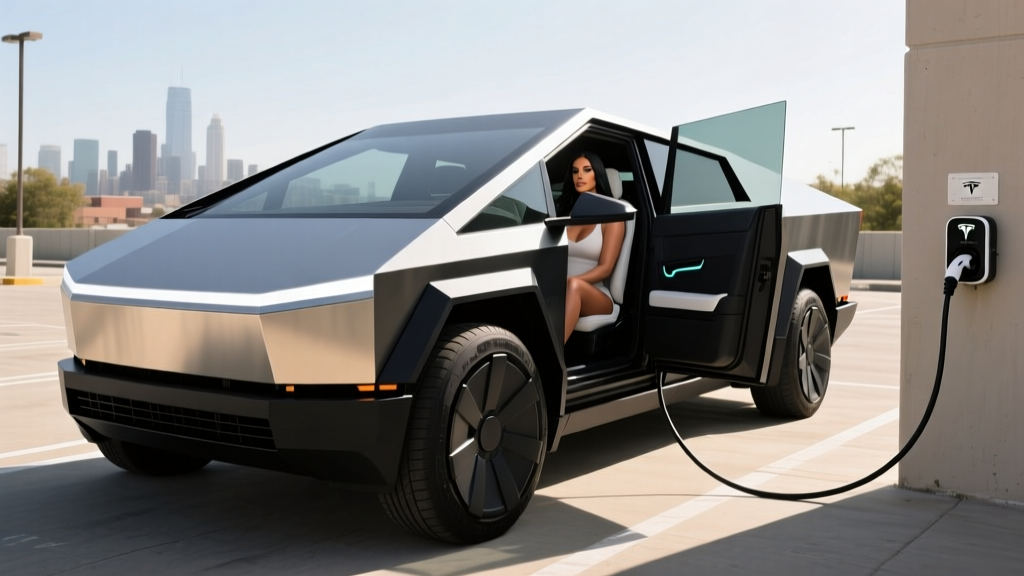
When celebrities like Kim Kardashian are spotted driving the Tesla Cybertruck, it's hard to ignore the buzz. But beyond the Instagram posts and viral moments, the Cybertruck remains one of the most divisive electric vehicles on the road. Love it or hate it, buyers need hard data—not hype—to decide if this angular stainless-steel pickup actually delivers as a daily driver, work truck, or family hauler.
After extensive testing across highway, city, and cold-weather conditions, here's what the Cybertruck actually offers in 2026: real range figures, charging realities, ownership costs, and whether it justifies its premium price tag versus established rivals like the Ford F-150 Lightning and Rivian R1T.
2026 Tesla Cybertruck: Core Specifications at a Glance
| Spec | AWD (Dual-Motor) | Cyberbeast (Tri-Motor) |
|---|---|---|
| EPA Range | 340 miles | 320 miles |
| Battery Capacity | ~123 kWh (NMC) | ~123 kWh (NMC) |
| 0-60 mph | 4.1 seconds | 2.6 seconds |
| Horsepower | 600 hp | 845 hp |
| Max DC Fast Charge | 250 kW | 250 kW |
| 10-80% DC Charge Time | ~30 minutes | ~30 minutes |
| Level 2 Home Charging | 11.5 kW (~44 mi/hr) | 11.5 kW (~44 mi/hr) |
| Towing Capacity | 11,000 lbs | 11,000 lbs |
| Cargo Bed Volume | 67 cu ft | 67 cu ft |
| Base MSRP | $79,990 | $99,990 |
| Battery/Powertrain Warranty | 8 years / 120,000 miles | 8 years / 120,000 miles |
Real-World Range: What the EPA Sticker Doesn't Tell You
The dual-motor AWD Cybertruck carries an EPA-estimated 340 miles of range, while the tri-motor Cyberbeast drops to 320 miles due to its higher power draw. But as any EV owner knows, EPA numbers represent idealized mixed driving—not what you'll see on a 75 mph highway run or a sub-freezing winter morning.
- EPA Combined: 340 miles
- Highway (70-75 mph, moderate temps): ~270-290 miles
- City (stop-and-go, regen-heavy): ~330-350 miles
- Cold Weather (below 32°F, highway): ~220-250 miles
The Cybertruck's boxy shape and 6,800+ lb curb weight create substantial aerodynamic drag at highway speeds. Expect 15-20% range loss on sustained interstate driving versus the EPA figure. Cold weather compounds this—battery preconditioning helps, but winter range loss of 25-35% is typical for large EVs without heat pump optimization.
For context, the Ford F-150 Lightning Extended Range (320-mile EPA) shows similar real-world highway degradation. The Rivian R1T with its 149 kWh Max Pack achieves 352 miles EPA but faces the same physics at speed. If your commute is mostly highway, plan for ~280 usable miles before needing a charge.
Charging Speed and Infrastructure: 250 kW Peak, But Watch the Curve
The Cybertruck supports up to 250 kW DC fast charging on Tesla's Supercharger network (V3 and V4 stalls). In controlled testing with a preconditioned battery starting at 10% state of charge, the truck sustains peak power briefly before tapering:
- 10-30% SoC: ~230-250 kW peak
- 30-60% SoC: ~170-200 kW sustained
- 60-80% SoC: ~100-130 kW taper
- 10-80% total time: ~30 minutes
This charge curve is typical for large NMC battery packs. The 250 kW headline number only applies in the lowest state-of-charge window. For road trips, plan 25-35 minute stops every 200-250 miles to stay in the efficient charging zone below 80%.
At home, the Cybertruck accepts 11.5 kW on a 48-amp Level 2 circuit (hardwired, 60-amp breaker). That translates to roughly 44 miles of range per hour of charging, or a full 10-100% charge in about 12-14 hours. Most owners charging overnight from 20-80% will need 6-8 hours—easily achievable with a Tesla Wall Connector or equivalent J1772/NACS unit.
Tesla's NACS (North American Charging Standard) connector is now the de facto industry standard, with Ford, GM, Rivian, and others adopting it for 2025+ models. Cybertruck owners have full access to Tesla's 5,500+ Supercharger stations nationwide, plus growing third-party networks like Electrify America and EVgo as they add NACS cables.
Performance: Absurd Acceleration, Questionable Utility
The Cyberbeast's 2.6-second 0-60 mph time is supercar territory in a vehicle weighing nearly three tons. The dual-motor AWD's 4.1-second sprint is still quicker than most sports sedans. But straight-line speed isn't why most pickup buyers choose a truck.
Where the Cybertruck delivers genuine utility:
- Towing: 11,000 lbs maximum (competitive with F-150 Lightning's 10,000 lbs, below Rivian R1T's 11,000 lbs)
- Payload: ~2,500 lbs in the 6-foot composite bed
- Ground clearance: Up to 17.4 inches (with adaptive air suspension in Extract Mode)
- Approach/departure angles: 35°/30° (off-road capable, though the low front end scrapes on steep driveways)
The steer-by-wire system (no mechanical connection between steering wheel and wheels) takes adjustment. At low speeds, it feels oddly detached; at highway speeds, it's precise but lacks road feedback. The rear-wheel steering helps the 20-foot-long truck maneuver in tight spaces, reducing its turning circle to 40.2 feet—surprisingly manageable for a full-size pickup.
Pricing, Trims, and Federal Tax Credit Eligibility
The 2026 Cybertruck lineup has simplified to two main trims after Tesla discontinued the base rear-wheel-drive model:
| Trim | Base MSRP | Federal Tax Credit (§30D) | Effective Price |
|---|---|---|---|
| AWD Dual-Motor | $79,990 | Up to $7,500 | ~$72,490 |
| Cyberbeast Tri-Motor | $99,990 | $0 (exceeds MSRP cap) | $99,990 |
- MSRP Cap: Vans, SUVs, and pickup trucks must be under $80,000 MSRP. The AWD Cybertruck at $79,990 squeaks under; the Cyberbeast at $99,990 does not qualify.
- Buyer Income Limits: Modified AGI must not exceed $300,000 (married filing jointly), $225,000 (head of household), or $150,000 (single).
- Battery Sourcing: Critical minerals and battery components must meet escalating domestic-content thresholds. Tesla's U.S.-built battery packs generally qualify, but verify at purchase using the IRS VIN-lookup tool at fueleconomy.gov.
- Point-of-Sale Transfer: Buyers can transfer the credit to the dealer at purchase, reducing the upfront price rather than waiting for a tax refund.
Note: Tax credit rules change annually. Confirm eligibility with a tax professional and check current IRS guidance at irs.gov before purchase.
Interior, Tech, and Daily Livability
The Cybertruck's minimalist interior centers on an 18.5-inch touchscreen handling nearly all vehicle functions—climate, media, navigation, and vehicle settings. There are no physical buttons for HVAC or volume, which frustrates some drivers but keeps the dashboard clean. The front trunk (frunk) adds 7.1 cu ft of lockable storage, and the rear seats fold flat for longer cargo.
Passenger space is adequate but not class-leading:
- Front legroom: 41.5 inches
- Rear legroom: 38.2 inches (tight for tall adults on long trips)
- Rear headroom: Limited by the sloping roofline—passengers over 6 feet will notice
Tesla's Autopilot (Level 2 driver assistance) comes standard, with Full Self-Driving (Supervised) available as a $8,000 option or $99/month subscription. FSD handles highway lane changes, city street navigation, and parking, but requires constant driver supervision. This is not autonomous driving—it's advanced cruise control with steering assist. For true Level 4 driverless operation, only Waymo's robotaxi service (available in select cities) qualifies.
Notable tech features:
- Bioweapon Defense Mode (HEPA air filtration)
- Powered tonneau cover with integrated bed lighting
- 120V/240V bed outlets (up to 9.6 kW output for tools or tailgating)
- Over-the-air software updates adding features post-purchase
Efficiency and Operating Costs
The dual-motor AWD Cybertruck achieves 79 MPGe combined (43 kWh per 100 miles) per EPA testing. That's less efficient than the Ford F-150 Lightning (77 MPGe, 44 kWh/100mi) but comparable given the Cyberbeast's performance orientation. In real-world highway driving, expect 45-50 kWh/100mi due to aerodynamic drag.
At the national average electricity rate of $0.16 per kWh, charging the Cybertruck costs roughly $6.90 per 100 miles. Compare that to a gas F-150 averaging 20 MPG at $3.50/gallon: $17.50 per 100 miles. The EV saves ~$10.60 per 100 miles, or about $1,590 annually at 15,000 miles/year. Over five years, fuel savings approach $8,000—substantial, but not enough to offset the Cybertruck's higher purchase price versus a base F-150.
Warranty and Long-Term Reliability
Tesla covers the Cybertruck's battery and drive units for 8 years or 120,000 miles (whichever comes first), with a minimum 70% capacity retention guarantee. The basic vehicle warranty is 4 years / 50,000 miles. This is competitive with Ford's 8-year/100,000-mile battery warranty on the Lightning and Rivian's 8-year/175,000-mile coverage.
Long-term reliability data for the Cybertruck is limited—the first deliveries occurred in late 2023, so most trucks are still under warranty. Early owner reports cite issues with the steer-by-wire system calibration, panel gaps, and the stainless-steel exoskeleton showing fingerprints and minor dents. The 48-volt electrical architecture (a first for Tesla) has been reliable so far, but it's unproven at high mileage.
Battery degradation data from Tesla's existing 100+ kWh packs (Model S/X) suggests 10-15% capacity loss over 150,000 miles. The Cybertruck's NMC chemistry should follow similar patterns, though the higher discharge rates from towing and performance driving may accelerate wear slightly.
Pros, Cons, and the Verdict
Pros
- Class-leading acceleration (Cyberbeast's 2.6s 0-60)
- Access to Tesla Supercharger network (most reliable DC fast-charging infrastructure)
- Stainless-steel exoskeleton resists dents and corrosion
- 9.6 kW onboard power output for job sites or camping
- Over-the-air updates add features post-purchase
Cons
- Highway range loss (15-20%) due to aerodynamics and weight
- Steer-by-wire lacks road feel and takes adjustment
- Rear seat headroom and legroom are tight for adults
- 250 kW peak charging is slower than 350 kW-capable rivals (Rivian R1T, Porsche Macan EV)
- Cyberbeast trim ineligible for federal tax credit
- Polarizing design limits resale appeal in conservative markets
Who Should Buy the Cybertruck (And Who Shouldn't)
Buy it if: You want a high-performance electric pickup with access to Tesla's Supercharger network, you value the 9.6 kW onboard power for work or recreation, and you're comfortable with the polarizing design and steer-by-wire quirks. The AWD trim with tax credit eligibility makes financial sense for buyers under the income cap.
Look elsewhere if: You need maximum rear-seat space for family (Rivian R1T offers more room), you prioritize proven reliability over cutting-edge tech (Ford F-150 Lightning has more real-world data), or you plan to tow frequently and need the longest possible range (Rivian R1T Max Pack at 352 miles EPA).
The Cybertruck is a compelling but flawed execution of the electric pickup concept. It's fast, capable, and undeniably attention-grabbing—but its real-world range, charging speed, and interior space fall short of the hype. For buyers who can accept those trade-offs, it's a unique ownership experience. For those who need a no-compromise work truck or family hauler, established rivals make a stronger case.
Frequently Asked Questions
What is the real-world range of the Tesla Cybertruck?
The dual-motor AWD Cybertruck has an EPA-estimated 340 miles, but expect 270-290 miles on sustained highway driving and 220-250 miles in cold weather below freezing. City driving with regenerative braking can exceed the EPA figure, reaching 330-350 miles.
How fast does the Cybertruck charge at home and on the road?
On a DC fast charger, it peaks at 250 kW and charges 10-80% in about 30 minutes. At home on a 48-amp Level 2 circuit (11.5 kW), it adds roughly 44 miles of range per hour, fully charging in 12-14 hours.
Does the Cybertruck qualify for the federal EV tax credit?
The AWD Dual-Motor at $79,990 MSRP qualifies for up to $7,500 under §30D, assuming the buyer meets income limits ($300,000 joint, $150,000 single) and the battery meets domestic-sourcing requirements. The Cyberbeast at $99,990 exceeds the $80,000 MSRP cap and does not qualify.
Is the Cybertruck worth buying versus the F-150 Lightning or Rivian R1T?
The Cybertruck offers superior acceleration and Tesla's Supercharger network, but the F-150 Lightning provides more rear-seat space and a lower starting price, while the Rivian R1T offers longer range (352 miles with Max Pack) and better off-road capability. Your choice depends on priorities: performance (Cybertruck), value (Lightning), or range/utility (R1T).
What are the biggest drawbacks of owning a Cybertruck?
Highway range loss due to poor aerodynamics, steer-by-wire that lacks road feel, tight rear-seat accommodations, and a polarizing design that may hurt resale value in some markets. The 250 kW peak charging speed also lags behind newer 350 kW-capable EVs.
Sources: EPA fuel economy data from fueleconomy.gov, Tesla Cybertruck specifications from tesla.com, IRS clean vehicle credit guidance from irs.gov.