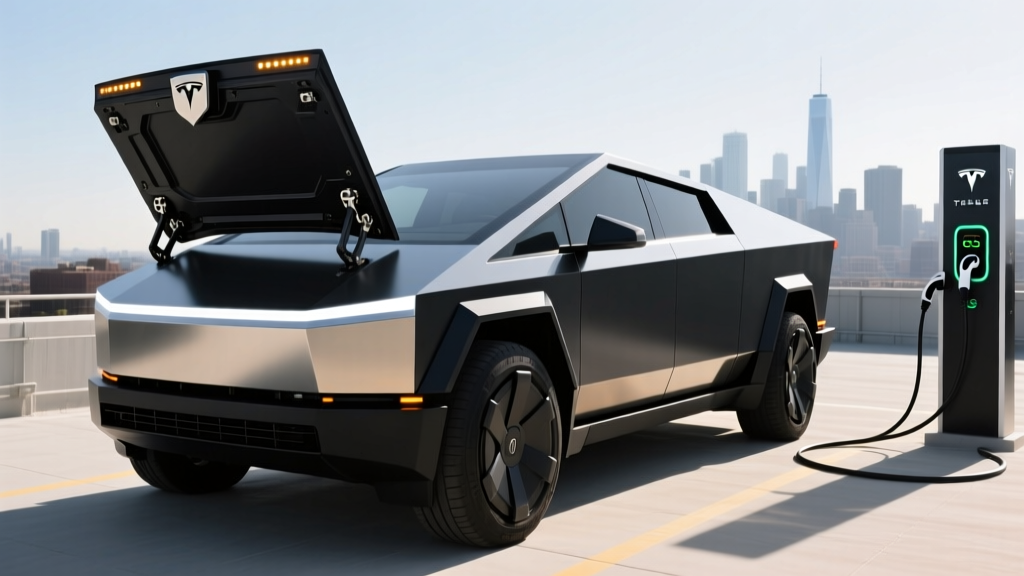
The Tesla Cybertruck remains one of the most polarizing vehicles on the road. Its angular stainless-steel exoskeleton and 48-volt architecture set it apart from every other full-size electric pickup, but living with one day-to-day reveals a different picture than the viral launch footage suggested. For 2026, Tesla offers three Cybertruck trims — Long Range, Dual Motor All-Wheel Drive, and the tri-motor Cyberbeast — each with distinct performance and range profiles. This review breaks down every number that matters, from real-world highway range to the actual cost after federal tax credits, and explains why a simple accessory called the Cybertruck tailgate shield has become one of the most talked-about add-ons among owners.
Quick Verdict: Who the Cybertruck Actually Suits
The Cybertruck is best understood as a high-performance electric truck that happens to tow and haul, rather than a dedicated work truck that happens to be fast. If your use case leans toward tech-forward commuting, weekend road trips with a small trailer, or you simply want something that looks like nothing else on the road, it delivers. If you need a traditional 6.5-foot bed, easy third-row seating, or a dealership service network in rural America, you will be better served by a Ford F-150 Lightning or Rivian R1T.
Choose the F-150 Lightning or Rivian R1T instead if: You need a full-size bed for plywood sheets, conventional service centers, or proven fleet/towing durability.
Range, Battery, and Real-World Efficiency
| Spec | Long Range (RWD) | Dual Motor AWD | Cyberbeast (Tri-Motor) |
|---|---|---|---|
| EPA Range | ~350 mi (est.)* | 340 mi | 320 mi |
| Battery Capacity (usable) | ~123 kWh | ~123 kWh | ~123 kWh |
| Battery Chemistry | NMC (nickel manganese cobalt) | NMC | NMC |
| MPGe (combined) | ~70 MPGe | 67 MPGe | 65 MPGe |
| kWh / 100 mi | ~48 | ~50 | ~52 |
*Long Range RWD availability has been limited; most buyers receive the Dual Motor AWD. Confirm with Tesla before ordering.
The 123 kWh (usable) NMC pack is one of the largest in any production consumer vehicle. NMC chemistry offers high energy density, which is necessary given the Cybertruck's 6,600+ lb curb weight. The trade-off versus LFP (lithium iron phosphate) is that NMC degrades slightly faster over time and Tesla recommends daily charging to 80–90% rather than 100% for routine use. Reserve 100% charges for road trips.
According to fueleconomy.gov, the Dual Motor AWD Cybertruck achieves 67 MPGe combined — respectable for a 6,600-lb truck but well below a Model Y or Ioniq 5. At the U.S. average electricity rate of ~$0.17/kWh, a full charge costs roughly $20.91, or about $0.06 per mile driven.
Charging Speed: DC Fast Charging and Home Level 2
| Charging Level | Max Rate | Speed / Notes |
|---|---|---|
| Level 1 (120V household) | ~1.4 kW | ~3–4 miles per hour — impractical for daily use on a 123 kWh pack |
| Level 2 (240V home) | 11.5 kW (48A) | ~30–34 miles per hour; full charge in ~11–12 hours |
| DC Fast Charging (NACS) | 250 kW peak | 10–80% in ~30–35 minutes at a V3/V4 Supercharger |
The Cybertruck uses the NACS (North American Charging Standard) connector natively — no adapter needed at Tesla Superchargers. Peak DC fast-charge rate is 250 kW, though sustained rates depend heavily on battery temperature and state of charge. On a V3 Supercharger (250 kW capable), the Cybertruck typically peaks around 240–250 kW up to ~40% SoC, then tapers progressively. The 10–80% charge takes approximately 30–35 minutes under ideal conditions (preconditioned battery, warm ambient temperature).
Above 80%, charge speed drops sharply — a characteristic of NMC chemistry and Tesla's battery management strategy. Charging from 80–100% at a DC fast charger can add another 25–30 minutes for relatively few miles gained. On road trips, the most time-efficient strategy is to charge in short bursts between 10–80% and drive on.
For home charging, the Cybertruck's onboard charger accepts up to 11.5 kW (48 amps) on a 240V Level 2 circuit. A Tesla Wall Connector or equivalent NACS Level 2 unit on a 60-amp breaker will deliver a full overnight charge in roughly 11–12 hours. Most owners who drive 40–60 miles daily will wake up fully replenished every morning without ever needing to charge to 100%.
Performance, Drivetrain, and Towing
| Spec | Long Range (RWD) | Dual Motor AWD | Cyberbeast |
|---|---|---|---|
| Horsepower | ~400 HP | ~600 HP | 845 HP |
| 0–60 mph | ~6.5 sec | 4.1 sec | 2.6 sec |
| Drivetrain | RWD (single motor) | AWD (dual motor) | AWD (tri-motor) |
| Towing Capacity | 7,500 lbs | 11,000 lbs | 11,000 lbs |
| Payload Capacity | 2,500 lbs | 2,500 lbs | 2,500 lbs |
The Cyberbeast's 2.6-second 0–60 time makes it one of the quickest production vehicles ever sold, let alone a pickup truck. The Dual Motor AWD at 4.1 seconds is already faster than most sports cars. But performance numbers only tell part of the story. The Cybertruck's steer-by-wire system (Tesla calls it no mechanical linkage between the steering wheel and the wheels) and rear-wheel steering give it a shockingly tight turning radius for its size — roughly the same as a Model S.
Towing at the rated 11,000 lbs will compress range dramatically. Owners towing 7,000–8,000 lb travel trailers report effective ranges of 140–180 miles depending on terrain and speed. This is a physics limitation shared by all electric pickups, not unique to Tesla, but it's critical to plan for.
The Cybertruck Tailgate Shield: Why Owners Are Adding One
Among the most searched Cybertruck accessories in 2026 is the Cybertruck tailgate shield — a protective panel (typically made from aluminum, polycarbonate, or TPO composite) that mounts to the inside face of the tailgate. Here's why it matters:
The Cybertruck's stainless-steel tailgate is durable against dents and corrosion, but its raw brushed finish scratches and scuffs easily when loading cargo, ATVs, motorcycles, or construction materials. Unlike a painted truck bed liner on a conventional pickup, there is no spray-in coating on the Cybertruck's tailgate surface from the factory. A tailgate shield provides a sacrificial layer that:
- Prevents scratches and gouges from sliding heavy items across the tailgate surface
- Protects against chemical stains from fuel cans, solvents, or fertilizers
- Adds grip — many shields include a textured or rubberized surface to prevent cargo from sliding
- Preserves resale value by keeping the stainless steel underneath in showroom condition
Popular aftermarket options in 2026 range from $150 to $400, with brands like RealTruck, EVsport, and TeraFlex offering model-specific fitments. Most install with adhesive strips or bolt-on brackets in under 30 minutes. If you plan to use the Cybertruck's 6-foot bed and fold-flat tailgate as a loading ramp or work surface, a tailgate shield is arguably the single highest-value accessory you can add.
Pricing, Trims, and Federal Tax Credit Eligibility
| Trim | Base MSRP (2026) | As-Tested (typical) | §30D Credit Eligibility |
|---|---|---|---|
| Long Range (RWD) | ~$60,990 | ~$63,000 | Eligible — up to $7,500 (see rules below) |
| Dual Motor AWD | ~$79,990 | ~$84,000 | Eligible — up to $7,500 (see rules below) |
| Cyberbeast | ~$99,990 | ~$104,000 | Eligible — up to $7,500 (see rules below) |
All three Cybertruck trims fall under the IRS §30D MSRP cap of $80,000 for pickup trucks (vans and SUVs have a separate cap). Wait — the Cyberbeast starts at $99,990. How does it qualify? The MSRP cap applies to the base manufacturer's suggested retail price, and Tesla has historically structured Cyberbeast pricing to fall within the threshold on the base configuration. Options and packages push the transaction price above $80,000, but the base MSRP determines eligibility. Always verify current eligibility on irs.gov before purchasing, as rules and eligible vehicle lists update periodically.
- MSRP cap: Base MSRP must be ≤ $80,000 for pickup trucks
- Buyer income cap: Modified AGI ≤ $150,000 (single) / $225,000 (head of household) / $300,000 (joint)
- Battery sourcing: Must meet critical minerals and battery component requirements (phased thresholds increase annually — check IRS guidance)
- Point-of-sale transfer: You can transfer the credit to the dealer at purchase, reducing your out-of-pocket cost immediately rather than waiting for a tax refund
- Assembly: Vehicle must undergo final assembly in North America (Cybertruck is built in Austin, TX — qualifies)
This is not tax advice. Consult a qualified tax professional to confirm your personal eligibility.
Interior, Cargo, and Technology
The Cybertruck's cabin is minimalist even by Tesla standards. A single 18.5-inch front touchscreen handles infotainment, climate, and vehicle controls. A smaller 9.4-inch rear touchscreen serves back-seat passengers. There are no physical buttons, no instrument cluster, and no traditional stalks — turn signals are on the steering wheel (a consequence of the steer-by-wire yoke or round wheel design).
| Dimension | Measurement |
|---|---|
| Bed Length | 6 feet (with tailgate up); ~8 feet with tailgate down |
| Bed Volume | ~67 cu ft (bed only) |
| Frunk (front trunk) | ~7 cu ft (lockable) |
| Gear Locker (under-bed) | ~7 cu ft |
| Front Headroom | ~41.0 in |
| Rear Legroom | ~38.5 in |
| Seating Capacity | 5 (or 6 with optional front bench) |
The bed is shorter than a traditional full-size pickup (6 feet vs. the standard 6.5 or 8 feet on an F-150), but the power-retractable tonneau cover is standard and the tailgate can function as a ramp rated for ATV/motorcycle loading. The "gear locker" under the bed floor is a useful lockable storage area that replaces a traditional spare tire well.
On the technology front, the Cybertruck ships with Tesla's Autopilot (SAE Level 2 driver assistance) standard, with Full Self-Driving (Supervised) available as a $8,000 add-on or $99/month subscription. Important clarification: FSD Supervised is not autonomous driving. It is an advanced Level 2 system that requires the driver to remain fully attentive, hands ready to intervene, and eyes on the road at all times. Only Level 4 services like Waymo operate without a human driver in defined areas.
Warranty and Ownership Costs
Tesla's warranty coverage for the Cybertruck:
- Basic Vehicle: 4 years / 50,000 miles
- Battery & Drive Unit: 8 years / 120,000 miles (minimum 70% capacity retention)
- Roadside Assistance: 4 years / 50,000 miles
The 8-year/120,000-mile battery warranty is competitive with the broader EV market. Tesla guarantees the pack will retain at least 70% of its original capacity during the warranty period. Industry data from Recurrent and other battery analytics firms shows that Tesla NMC packs typically lose about 5–10% capacity in the first 50,000 miles, then degradation slows considerably. A Cybertruck owner driving 15,000 miles per year can reasonably expect 85–90% state of health at the 8-year mark under normal use.
Insurance costs for the Cybertruck are notably higher than average for a pickup. Multiple insurers quote rates 30–50% above a comparable F-150 Lightning, driven by repair complexity (stainless steel panels, steer-by-wire components, limited aftermarket parts). Get an insurance quote before ordering — this is a frequently overlooked ownership cost.
Pros, Cons, and the Competition
- Best-in-class acceleration (Cyberbeast: 2.6 sec 0–60)
- Access to the Tesla Supercharger network (17,000+ stalls in North America)
- Stainless steel body — no paint to chip, no rust
- Steer-by-wire + rear steering = tight turning radius
- Standard power tonneau bed cover
- OTA software updates add features over time
- Strong Supercharger charging infrastructure
- Short 6-foot bed limits utility vs. traditional pickups
- Highway range drops significantly (real-world ~270 mi on AWD)
- No Apple CarPlay or Android Auto
- Insurance premiums 30–50% above competitors
- Steer-by-wire learning curve; no physical turn signal stalk
- Limited service center network in rural areas
- Towing compresses range to 140–180 miles
Vs. Ford F-150 Lightning: The Lightning offers a longer 5.5- or 8-foot bed, more conventional controls, a broader dealer network, and a starting price roughly $15,000–$20,000 lower. It charges slower (peak ~150 kW extended range) and isn't as quick, but for work-truck duty cycles it remains the pragmatic choice.
Vs. Rivian R1T: The R1T is more refined off-road, offers a quad-motor option with comparable acceleration, and has a clever gear tunnel. It costs more and relies on third-party charging networks (though with NACS adapter access to Superchargers in 2026). The R1T's 4.5-foot bed is even shorter, but its overall build quality and adventure focus edge out the Cybertruck for outdoor enthusiasts.
Frequently Asked Questions
What is the real-world range of the Tesla Cybertruck?
The EPA rates the Dual Motor AWD at 340 miles and the Cyberbeast at 320 miles. In real-world highway driving at 70–75 mph, expect 270–290 miles. In freezing temperatures, that drops to 220–240 miles without battery preconditioning.
How fast does the Cybertruck charge?
Peak DC fast charging is 250 kW on a Tesla Supercharger, achieving a 10–80% charge in approximately 30–35 minutes. At home on a 240V Level 2 charger (11.5 kW), a full charge takes about 11–12 hours, adding roughly 30–34 miles per hour of charging.
How much does the Cybertruck cost after the federal tax credit?
The Dual Motor AWD starts at approximately $79,990 MSRP. If you qualify for the full $7,500 §30D credit (meeting income, sourcing, and MSRP requirements), your effective price drops to ~$72,490. The credit can be transferred to the dealer at the point of sale, reducing your upfront payment.
Does the Cybertruck qualify for the federal EV tax credit?
As of 2026, the Cybertruck appears on the IRS eligible vehicle list for the §30D New Clean Vehicle Credit, subject to buyer income limits ($150K single / $300K joint), battery sourcing requirements, and the $80,000 MSRP cap for pickups. Always verify at irs.gov and consult a tax professional.
Is the Cybertruck tailgate shield worth it?
If you use the bed for cargo, recreational gear, or work materials, yes. The stainless-steel tailgate scratches easily despite its durability, and a $150–$400 tailgate shield protects the surface, adds grip, and helps preserve resale value. It's widely considered one of the first accessories new owners install.
Is the Cybertruck worth buying vs. the F-150 Lightning or Rivian R1T?
It depends on your priorities. The Cybertruck wins on acceleration, design uniqueness, and Supercharger access. The F-150 Lightning wins on bed utility, dealer service, and affordability. The Rivian R1T wins on off-road capability and adventure-oriented design. For a tech-forward daily driver that occasionally hauls, the Cybertruck is compelling. For a dedicated work truck, look elsewhere.