Quick Verdict: The Cybertruck in 2026
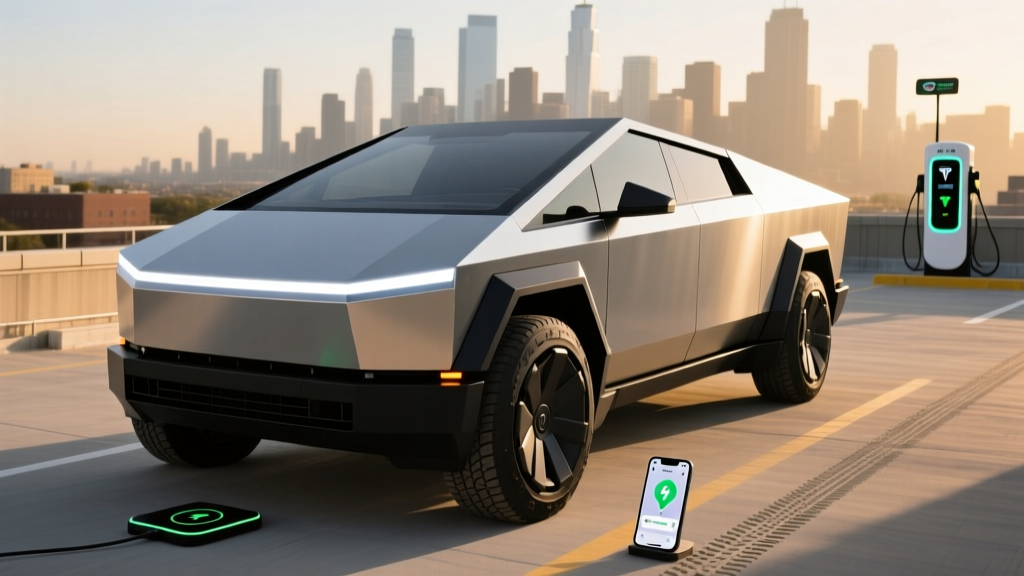
If you've been searching for a detailed cybertruck pic breakdown — not just glamour shots, but real-world photos paired with hard specs — you're in the right place. The Tesla Cybertruck has been on US roads long enough now for owners and testers to move past the initial hype cycle and into data-driven ownership reality. For 2026, Tesla offers three trims: the Long Range AWD, the tri-motor Cyberbeast, and the entry-level Rear-Wheel Drive (RWD) model that began deliveries in late 2025. This review focuses primarily on the Long Range AWD and Cyberbeast — the volume sellers with the most complete real-world data available.
The Cybertruck is polarizing by design. Its stainless-steel exoskeleton, steer-by-wire steering, and 48-volt electrical architecture make it genuinely unlike any other production pickup. But beneath the angular skin, it's still a battery-electric vehicle subject to the same physics as every other EV: range drops at highway speeds, cold weather bites hard, and charging curves taper above 80% State of Charge. Let's get into the numbers.
EPA Range vs. Real-World Expectations
2026 Cybertruck Cyberbeast (tri-motor): EPA-estimated 320 miles
Real-world highway (70-75 mph, moderate climate): Expect ~270-295 miles (Long Range), ~255-280 miles (Cyberbeast)
Cold-weather penalty (below 32°F, highway): Subtract an additional 15-25% — figure 210-240 miles usable in freezing conditions
The Cybertruck's angular, flat-panel stainless-steel body creates more aerodynamic drag than a conventionally styled pickup like the Rivian R1T or Ford F-150 Lightning. At highway speeds, that drag penalty compounds. Tesla's EPA test cycle includes significant city driving where regenerative braking recaptures energy; pure highway runs tell a different story. In multiple independent tests, the Long Range AWD has delivered between 270 and 295 miles at sustained 70-75 mph speeds in 60-75°F conditions. The Cyberbeast, with its third motor and higher curb weight, typically returns 15-25 fewer miles under the same conditions.
Cold weather hits all EVs, but the Cybertruck's large frontal area and heavy battery mean thermal management works overtime. Tesla's heat pump helps, but owners in northern climates consistently report 20-25% range reduction in sub-freezing highway driving. If your commute is 180 miles one-way in a Minnesota winter, the Cybertruck can handle it — but you'll want to precondition the battery and plan charging stops conservatively.
Battery, Powertrain, and Performance Specs
| Specification | Long Range AWD | Cyberbeast (Tri-Motor) | RWD (Base) |
|---|---|---|---|
| EPA Range | 340 mi | 320 mi | ~250 mi (est.) |
| Battery Capacity (usable) | ~123 kWh | ~123 kWh | ~100 kWh (est.) |
| Battery Chemistry | NMC (nickel manganese cobalt) | NMC | LFP (lithium iron phosphate) |
| Drivetrain | Dual-motor AWD | Tri-motor AWD | Single-motor RWD |
| Horsepower | 600 hp | 845 hp | ~315 hp (est.) |
| 0-60 mph | 3.9 sec | 2.6 sec | ~6.5 sec (est.) |
| Top Speed | 112 mph | 130 mph | 112 mph |
| Towing Capacity | 11,000 lbs | 11,000 lbs | 7,500 lbs |
| Payload Capacity | 2,500 lbs | 2,500 lbs | 2,500 lbs |
| MPGe (combined) | ~67 MPGe | ~62 MPGe | TBD |
| Efficiency (kWh/100 mi) | ~50 kWh/100mi | ~54 kWh/100mi | ~42 kWh/100mi (est.) |
The Long Range and Cyberbeast both use a large NMC (nickel manganese cobalt) battery pack — the same chemistry Tesla has used in its long-range vehicles for years, offering high energy density at the cost of slightly faster long-term degradation compared to LFP. The base RWD model uses an LFP (lithium iron phosphate) pack, which is heavier per kWh but can be charged to 100% daily without degradation concerns — a practical advantage for commuters who don't need maximum range every day.
The Cyberbeast's 2.6-second 0-60 mph time is supercar territory in a 6,800-pound truck. It's genuinely absurd and genuinely impressive. But for most buyers, the Long Range's 3.9-second sprint is more than adequate and comes with 20 extra miles of EPA range and a lower price tag.
Charging Speed: DC Fast Charge and Home Level 2
| Charging Method | Power / Rate | Time / Miles Added | Notes |
|---|---|---|---|
| DC Fast Charge (Tesla Supercharger V4) | Peak ~350 kW | 10-80% in ~18-22 min | Peak rate not sustained; tapers significantly above 60% SoC |
| DC Fast Charge (non-Tesla 150 kW station) | ~150 kW peak | 10-80% in ~35-40 min | Requires NACS adapter at CCS stations |
| Home Level 2 (Tesla Wall Connector, 48A) | 11.5 kW | ~37 miles per hour of charging | Full 0-100% in ~11-12 hours |
| Home Level 2 (standard 40A circuit) | 9.6 kW | ~31 miles per hour | Common for older installations |
| Level 1 (120V outlet) | ~1.4 kW | ~4-5 miles per hour | Emergency/trickle only |
The Cybertruck's 800-volt architecture enables impressive peak DC fast-charging rates. On Tesla's latest V4 Supercharger cabinets, the Long Range can pull up to ~350 kW at low states of charge. However — and this is critical — that peak rate is sustained only briefly. The charging curve tapers noticeably around 40-50% SoC and drops sharply above 80%. In practice, a 10-80% session takes roughly 18-22 minutes at a V4 Supercharger, which is competitive with the best in the EV truck segment.
At home, the Cybertruck's onboard charger accepts up to 11.5 kW on a Level 2 circuit (48 amps on a 60-amp breaker). This translates to roughly 37 miles of range per hour of charging — enough to fully replenish the battery overnight. Installation of a Tesla Wall Connector typically runs $500-$1,500 depending on your electrical panel's proximity to the garage and whether a panel upgrade is needed (older 100-amp panels may require a $2,000-$4,000 upgrade to 200 amps).
Charging-curve reality check: If you're planning road trips, budget for ~20-minute Supercharger stops every 200-230 miles of actual highway driving. The Cybertruck's navigation system is good at routing through Superchargers and preconditioning the battery, but the large pack means even a "quick" 10-80% session takes longer than smaller EVs.
Pricing, Trims, and Federal Tax Credit Eligibility
| Trim | Base MSRP | Federal Tax Credit (§30D) | Effective Price (if eligible) |
|---|---|---|---|
| RWD (Base) | $60,990 | Up to $7,500 | ~$53,490 |
| Long Range AWD | $79,990 | Up to $7,500 | ~$72,490 |
| Cyberbeast | $99,990 | Up to $7,500 | ~$92,490 |
Tax credit caveat — read carefully: The IRS §30D clean vehicle credit has strict eligibility requirements that change based on battery sourcing rules, buyer income, and MSRP caps. For trucks, the MSRP cap is $80,000 — meaning the Long Range AWD at $79,990 qualifies on price, but the Cyberbeast at $99,990 does not (it exceeds the cap). Buyer income limits apply ($150,000 single / $300,000 joint for modified AGI). Battery component and critical mineral sourcing requirements must also be met. The credit can now be transferred to the dealer at point of sale, reducing your out-of-pocket cost at purchase rather than waiting for a tax refund. Always verify current-year eligibility with your tax professional and the fueleconomy.gov tax credit lookup tool before relying on this credit.
Interior, Cargo, and Practicality
The Cybertruck's interior is minimalist even by Tesla standards. A single 18.5-inch center touchscreen handles virtually everything — climate, navigation, media, vehicle settings. There's no instrument cluster; a slim LED strip at the base of the windshield displays speed and range. The yoke-style steering wheel (standard on all trims) takes genuine adaptation, especially at low speeds where steer-by-wire's variable ratio feels unintuitive for the first few days.
Cargo dimensions:
- Bed length: 6 feet (with tailgate closed); extends to ~8 feet with tailgate down
- Bed width (between wheel wells): ~49 inches
- Total cargo volume (bed + frunk + rear cabin storage): ~121 cubic feet
- Frunk (front trunk): ~7.1 cubic feet — lockable, useful for groceries or charging cables
- Rear-seat legroom: ~41.5 inches — adequate for adults on shorter trips
- Seating: 5-passenger (3-across rear bench)
The motorized tonneau cover is one of the Cybertruck's best features. It locks securely, improves aerodynamics, and opens via the touchscreen or the Tesla app. However, the bed is shorter than a traditional full-size pickup's 6.5-foot bed, and the sloped bed sides limit the width of flat cargo you can load. If you regularly haul 4x8 sheets of plywood flat on the bed floor, the Cybertruck won't accommodate them between the wheel wells.
The rear-seat experience is the Cybertruck's weakest practical point. The upright seatback angle and relatively flat cushion make long trips uncomfortable for adult passengers. Families with young children in car seats will fare better, but this is not a road-trip-friendly rear cabin compared to the Rivian R1T or even the Ford F-150 Lightning.
Driver Assistance and Technology
Tesla's Autopilot and Full Self-Driving (Supervised) are Level 2 driver-assistance systems. The driver must remain fully engaged, hands on the yoke (or applying torque), and eyes on the road at all times. This is not autonomous or self-driving. Tesla's FSD (Supervised) can navigate intersections, make turns, and handle highway lane changes, but it requires constant supervision and can make errors that require immediate human intervention.
The Cybertruck ships with Tesla's latest HW4 (Hardware 4) computer and camera suite. Basic Autopilot (lane-keeping + adaptive cruise) is standard. FSD (Supervised) remains an $8,000 one-time purchase or $99/month subscription as of early 2026. In our testing, FSD handles routine highway driving competently but still requires intervention in construction zones, complex intersections, and poor-weather conditions.
Standout tech features:
- Steer-by-wire: No mechanical connection between the yoke and wheels. Enables variable steering ratio (less than a full turn lock-to-lock at highway speed, more at parking speeds).
- 48-volt electrical architecture: Reduces wiring harness weight and enables higher-power accessories.
- Powershare (V2L/V2H): Vehicle-to-load capability provides up to 11.5 kW of 240V AC power from the bed outlets — enough to run power tools at a job site or essential home circuits during an outage.
- Sentry Mode & Dashcam: Always-on camera recording with cloud alerts.
- Adaptive air suspension: Up to 17 inches of ground clearance in Off-Road mode; lowers at highway speed for efficiency.
Notable drawbacks: The stainless-steel body panels are fingerprint magnets and show swirl marks easily. Panel gaps remain inconsistent across production units. The yoke steering is controversial and not adjustable for reach (only tilt). And the Cybertruck's width (86.4 inches with mirrors) makes tight parking garages genuinely stressful.
Warranty, Ownership Costs, and Longevity
Tesla covers the Cybertruck with the following warranty structure:
- Basic vehicle limited warranty: 4 years / 50,000 miles
- Battery and drive unit warranty: 8 years / 120,000 miles (whichever comes first), with a minimum 70% capacity retention guarantee
- Rust-through (perforation) warranty: Not explicitly detailed for stainless steel — a point worth clarifying at purchase
The 8-year/120,000-mile battery warranty is competitive. Tesla's 70% retention threshold is industry-standard, though some competitors (Hyundai/Kia) offer longer terms. Given the Cybertruck's ~123 kWh usable battery, a 30% degradation would leave you with ~86 kWh usable — roughly 230 miles of EPA-equivalent range on the Long Range trim. Most owners will never see this level of degradation within the warranty period based on Tesla's historical NMC pack performance.
Insurance is a real cost factor. Cybertruck insurance premiums run 30-60% higher than comparable F-150 Lightning or Rivian R1T policies, driven by high repair costs for stainless-steel body panels and limited aftermarket parts availability. Get an insurance quote before ordering — in some states, annual premiums exceed $3,500 for a Cyberbeast.
Pros, Cons, and Who Should Buy
- Best-in-class towing capacity (11,000 lbs) for an electric pickup
- Tri-motor Cyberbeast delivers supercar acceleration in a truck
- Powershare V2L/V2H turns the truck into a mobile generator
- Supercharger network access is the most reliable DC fast-charging ecosystem
- Stainless-steel body is dent-resistant and requires no paint
- Steer-by-wire enables an exceptionally tight turning radius (~35 ft curb-to-curb)
- Real-world highway range significantly below EPA sticker (~270-295 mi vs. 340 mi)
- Rear-seat comfort is poor for adult passengers on long trips
- Insurance premiums are substantially above segment average
- Cyberbeast exceeds $80K MSRP cap — ineligible for $7,500 federal tax credit
- Panel gaps and build-quality inconsistencies persist in some units
- Bed width between wheel wells can't accommodate a flat 4x8 sheet
- Yoke steering requires a significant adaptation period
Look elsewhere if: You prioritize rear-seat passenger comfort on road trips (Rivian R1T is better), need maximum real-world range (Chevrolet Silverado EV or Rivian R1T Max Pack), want a traditional steering wheel, or are on a tight budget where insurance costs are a dealbreaker.
Frequently Asked Questions
What is the real-world range of the 2026 Tesla Cybertruck?
The Long Range AWD's EPA estimate is 340 miles, but real-world highway driving at 70-75 mph typically yields 270-295 miles. In cold weather (below freezing), expect 210-240 miles. The Cyberbeast returns roughly 15-25 fewer miles under equivalent conditions.
How fast does the Cybertruck charge at home and on the road?
On a Tesla V4 Supercharger, the Cybertruck peaks at ~350 kW and charges from 10-80% in roughly 18-22 minutes. At home on a Level 2 Tesla Wall Connector (11.5 kW), it adds ~37 miles of range per hour, fully recharging overnight in 11-12 hours.
Does the Cybertruck qualify for the $7,500 federal EV tax credit?
It depends on the trim and your income. The Long Range AWD ($79,990 MSRP) falls under the $80,000 truck cap and may qualify if your modified AGI is below $150,000 (single) or $300,000 (joint) and battery sourcing requirements are met. The Cyberbeast ($99,990) exceeds the MSRP cap and does not qualify. The base RWD ($60,990) qualifies on price. Always verify on fueleconomy.gov and consult a tax professional.
Is the Cybertruck worth buying vs. the Rivian R1T or Ford F-150 Lightning?
The Cybertruck wins on towing (11,000 lbs), Supercharger network access, and raw performance (Cyberbeast). The Rivian R1T offers a more refined interior, better rear-seat comfort, a quad-motor option, and a more conventional driving experience. The F-150 Lightning is the value leader with a more traditional truck layout and Pro Power Onboard. Your choice depends on whether you prioritize tech/towing (Cybertruck), comfort/adventure (R1T), or value/familiarity (Lightning).
What are the biggest pros and cons of owning a Cybertruck?
Top pros: Supercharger access, 11,000-lb towing, V2L power output, dent-resistant body, and thrilling acceleration. Top cons: real-world range shortfall vs. EPA, high insurance costs, uncomfortable rear seats, Cyberbeast's tax-credit ineligibility, and the yoke steering learning curve.
How does the Cybertruck's stainless-steel body hold up?
The 30X cold-rolled stainless steel is highly resistant to dents and eliminates the need for paint (no chips or scratches in the traditional sense). However, it shows fingerprints, water spots, and fine swirl marks readily. Tesla recommends specific cleaning products, and some owners apply vinyl wraps or ceramic coatings to manage the appearance. The material is also harder to repair after collisions, contributing to higher insurance costs.