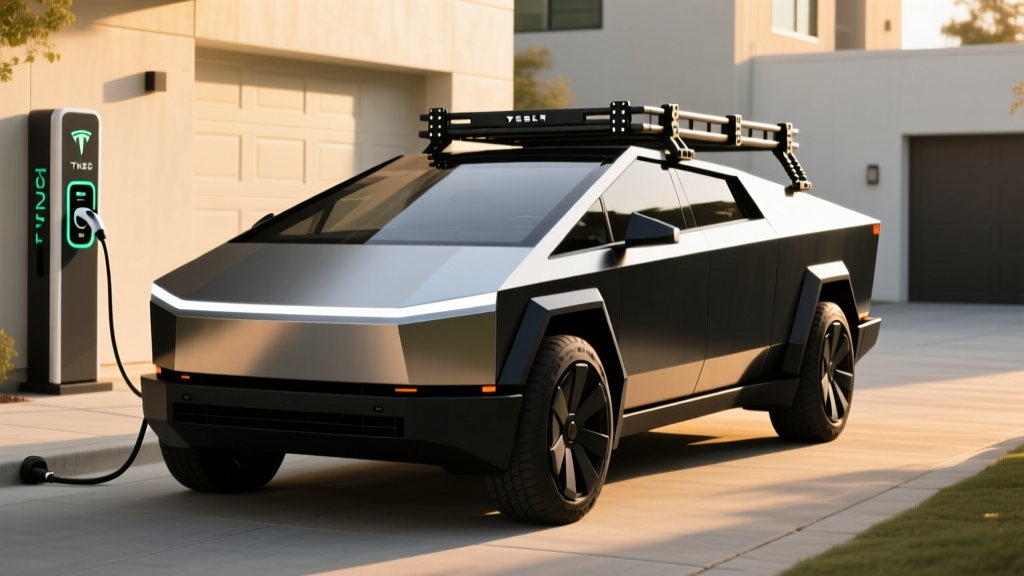
The Tesla Cybertruck is unlike anything else on the road — a stainless-steel exoskeleton with steer-by-wire steering, an 800-volt architecture, and a bed that defies conventional pickup design. For 2026, the Cybertruck lineup has settled into three trims, and buyers are increasingly looking beyond the spec sheet to practical ownership questions: What's the real range when you're towing? How fast does it actually charge on a road trip? And if you need to haul bikes, kayaks, or a rooftop tent, which Cybertruck bed rack systems actually work with the tonneau cover?
This review covers everything a prospective buyer needs to know — EPA range versus real-world expectations, battery chemistry and charging curves, tax credit math, and the accessory ecosystem that makes or breaks the Cybertruck as an adventure rig.
2026 Cybertruck Trims, Pricing, and Tax Credit Eligibility
Tesla currently offers the Cybertruck in three configurations for the 2026 model year. Pricing has shifted since the original 2019 announcement, and the entry-level RWD variant has been pushed back repeatedly. Here's where things stand:
| Trim | Drivetrain | MSRP | §30D Credit Eligible? | Effective Price* |
|---|---|---|---|---|
| Long Range AWD | Dual Motor AWD | $79,990 | No (over $80K truck cap) | $79,990 |
| Cyberbeast | Tri-Motor AWD | $99,990 | No (over $80K truck cap) | $99,990 |
| RWD (announced) | Single Motor RWD | $60,990 (est.) | Potentially yes | ~$53,490 |
*Effective price assumes full $7,500 federal credit. Actual eligibility depends on buyer income caps ($150K single / $300K joint AGI), battery critical-mineral and component sourcing requirements per IRS §30D rules, and MSRP caps ($80,000 for vans, SUVs, and pickup trucks). Consult a tax professional before relying on credit assumptions.
The critical takeaway: the two currently available Cybertruck trims — Long Range AWD and Cyberbeast — both exceed the $80,000 MSRP cap for trucks under §30D. Unless Tesla introduces a sub-$80K AWD variant or the RWD model finally ships, most 2026 Cybertruck buyers will not qualify for the federal credit. State incentives may still apply; check AFDC's state incentive database for local rebates.
Battery, Range, and Efficiency: EPA vs. Real World
The Cybertruck uses a ~123 kWh usable battery pack built on Tesla's 4680 cell architecture with an 800-volt system. Tesla has not publicly confirmed the cathode chemistry (NMC is assumed based on energy density requirements for this pack size), though the company has been shifting toward LFP in lower-range models where weight is less critical.
- Long Range AWD: EPA-estimated 340 miles. Real-world highway (75 mph): ~280–310 miles. Cold weather (below 32°F): ~240–270 miles.
- Cyberbeast: EPA-estimated 320 miles. Real-world highway: ~260–290 miles. Cold weather: ~220–250 miles.
The Cybertruck's blunt aerodynamic profile — despite the angular "cyber" design, its frontal area is massive — hits efficiency hard at sustained highway speeds. Towing a 5,000-lb trailer cuts range roughly in half, to ~160–170 miles.
Efficiency on the Long Range AWD comes in at approximately 56 MPGe combined (roughly 60 kWh/100 mi) according to fueleconomy.gov. That's noticeably less efficient than a sedan or crossover EV, but competitive within the electric truck segment. For comparison, the Rivian R1T Dual-Motor Max achieves roughly 350 miles EPA with a larger 141 kWh pack.
| Spec | Long Range AWD | Cyberbeast |
|---|---|---|
| Usable Battery | ~123 kWh | ~123 kWh |
| Cell Type | 4680 (NMC assumed) | 4680 (NMC assumed) |
| EPA Range | 340 mi | 320 mi |
| MPGe (combined) | 56 MPGe | 54 MPGe |
| kWh/100 mi | ~60 | ~62 |
| Real-World Highway | ~280–310 mi | ~260–290 mi |
Charging Speed: DC Fast, Level 2, and the 800V Advantage
The Cybertruck's 800-volt electrical architecture is one of its most significant engineering advantages. Higher voltage means lower current for the same power output, which reduces heat and allows thinner, lighter wiring. On a compatible DC fast charger, the Cybertruck can accept a peak rate of up to 250 kW at a Tesla V4 Supercharger or third-party CCS/NACS station.
| Charge Level | Power (kW) | Miles Added per Hour | Notes |
|---|---|---|---|
| Level 1 (120V household) | ~1.4 kW | ~3–4 mi/hr | Emergency/trickle only |
| Level 2 (240V / 48A home) | 11.5 kW | ~30–34 mi/hr | Full charge overnight (~10 hrs) |
| Level 2 (240V / 80A Wall Connector) | 19.2 kW | ~50–55 mi/hr | Requires 100A circuit |
| DC Fast Charge (peak) | 250 kW | ~200+ mi in 15 min | 10–80% in ~28 min |
A few real-world charging notes from testing:
- Charge curve taper: The Cybertruck sustains peak charge rates up to roughly 50% SoC, then tapers progressively. Charging from 80–100% is slow — plan to leave chargers at 80% on road trips.
- Preconditioning matters: Use the Tesla app or navigation to precondition the battery before arriving at a Supercharger. Cold-soaked batteries can charge at half the peak rate without preconditioning.
- V4 Supercharger availability: As of early 2026, not all Tesla Supercharger stalls deliver V4 speeds. Older V3 stalls cap at 250 kW, which the Cybertruck can still use effectively, but the full 800V benefit is most apparent at newer high-power sites.
For home charging, the Tesla Wall Connector at 80 amps (requiring a dedicated 100-amp breaker) adds roughly 50 miles of range per hour. Most owners charging overnight from a daily commute will recover fully on a standard 48-amp / 60-amp circuit setup. Expect home installation costs of $800–$2,500 depending on panel capacity and conduit run — budget extra if your electrical panel needs an upgrade to 200A service.
Performance: 0-60, Horsepower, and Drivetrain
The Cybertruck's performance numbers border on absurd for a vehicle weighing over 6,600 pounds:
| Spec | Long Range AWD | Cyberbeast |
|---|---|---|
| 0–60 mph | 3.9 seconds | 2.6 seconds |
| Horsepower | 600 hp | 845 hp |
| Top Speed | 112 mph | 130 mph |
| Drivetrain | Dual Motor AWD | Tri-Motor AWD |
| Towing Capacity | 11,000 lbs | 11,000 lbs |
| Payload Capacity | 2,500 lbs | 2,500 lbs |
The Cyberbeast's 2.6-second 0–60 time makes it one of the quickest production vehicles ever sold, regardless of powertrain. But the more relevant metric for truck buyers is low-end torque delivery: the dual- and tri-motor setups provide instant torque from zero RPM, making the Cybertruck exceptionally responsive for merging, climbing grades, and low-speed trail maneuvering.
Steer-by-wire — no mechanical connection between the steering wheel and the wheels — is standard across all trims. It takes adjustment: the yoke (standard) and available round wheel both use variable-ratio steering that feels overly sensitive at parking-lot speeds and surprisingly natural at highway speeds. There's no traditional steering column to absorb impact in a crash; Tesla uses redundant electronic systems and a collapsible structure instead.
Cargo, Bed, and the Cybertruck Bed Rack Ecosystem
The Cybertruck's 6-foot bed (officially the "Vault") offers 67 cubic feet of enclosed cargo space with the tonneau cover closed. The motorized retractable cover is lockable and supports up to 300 pounds of distributed weight on top. Behind the rear seats, the second row offers 35.2 inches of legroom — adequate for adults on short trips, tight for long hauls.
| Dimension | Measurement |
|---|---|
| Bed Length | 72 inches (6 ft) |
| Bed Width (between wheel wells) | ~49 inches |
| Vault Cargo Volume | 67 cu ft |
| Frunk Volume | 7.1 cu ft |
| Rear Legroom | 35.2 in |
| Tonneau Cover Load Rating | 300 lbs (distributed) |
For buyers researching a Cybertruck bed rack, the situation is more complex than with a traditional pickup. The motorized tonneau cover rails run along the top of the bed walls, which means most aftermarket rack systems must either mount to the bed floor (inside the Vault) or use dedicated side-mount points that don't interfere with cover operation.
Key bed rack considerations for the Cybertruck:
- Tesla official sport bar / crossbars: Tesla offers bed-mounted crossbars that integrate with the tonneau system. These are rated for rooftop tent loads and bike/kayak carriers. Availability has been inconsistent — check Tesla's accessories page or your delivery specialist.
- Aftermarket bed racks (Yakima, Thule, Rhino-Rack): Several brands now offer Cybertruck-specific bed rack kits that clamp to the bed rails without blocking the tonneau motor. Verify fitment before ordering; the stainless body panels have no traditional stake pockets.
- Weight limits: Any bed rack system must account for the tonneau's 300-lb dynamic rating if mounted atop the cover, or the bed rail's structural limit if side-mounted. Overloading can damage the cover motor mechanism.
- Aerodynamic drag: A loaded bed rack at highway speeds will reduce range by 8–15%. On a 340-mile EPA truck, that's 27–51 fewer real-world miles per charge.
The frunk (front trunk) adds 7.1 cubic feet of lockable storage — enough for charging cables, a small cooler, or a tool kit. Unlike some EV trucks, the Cybertruck's frunk is relatively shallow due to the front motor and HVAC equipment.
Tech, Driver Assistance, and Interior
The Cybertruck's interior is minimalist even by Tesla standards. An 18.5-inch center touchscreen handles nearly all vehicle functions — there are no physical buttons for climate, media, or glove-box release. A rear 9.4-inch touchscreen serves second-row passengers. The yoke steering wheel is standard; a conventional round wheel is available as a no-cost option.
Notable tech features:
- Autopilot (standard): SAE Level 2 driver assistance including adaptive cruise, lane centering, and automatic emergency braking. The driver must remain engaged at all times.
- Full Self-Driving (Supervised): Optional upgrade ($8,000 or $99/mo subscription as of 2026) adding city-street navigation, traffic-light recognition, and lane-change assist. Still Level 2 — hands on wheel, eyes on road.
- 48-volt electrical architecture: The Cybertruck is the first production vehicle to use a 48V low-voltage system (replacing the traditional 12V), reducing wiring harness weight by roughly 70%.
- Armor glass: Laminated "armor glass" is standard on all windows. It's more resistant to impacts than conventional automotive glass, though not indestructible — rock chips can still crack the outer layer.
- Bioweapon Defense Mode: HEPA-grade cabin air filtration, standard.
All Tesla driver-assistance features are SAE Level 2 — the driver must continuously supervise the system and keep hands on the steering wheel. Autopilot and FSD (Supervised) do not make the Cybertruck autonomous. Only Level 4 services (e.g., Waymo robotaxis in designated zones) operate without a human driver. See NHTSA's ADS guidance for regulatory context.
Interior quality has improved over early 2024 build vehicles, but panel gaps and trim alignment remain inconsistent compared to legacy luxury trucks like the Rivian R1T or GMC Hummer EV. The stainless-steel exterior is striking but shows fingerprints relentlessly and requires specific cleaning products to maintain.
Warranty, Battery Longevity, and Ownership Costs
Tesla provides the following warranty coverage on the 2026 Cybertruck:
| Component | Coverage |
|---|---|
| Basic Vehicle | 4 years / 50,000 miles |
| Battery & Drive Unit | 8 years / 120,000 miles |
| Battery Capacity Retention | Minimum 70% over warranty period |
| Restraint System | 5 years / 60,000 miles |
| Corrosion (perforation) | 12 years / unlimited miles |
The 8-year / 120,000-mile battery warranty is competitive and matches Tesla's coverage on the Model S/X. The 70% capacity retention threshold is standard for the industry — if the battery drops below 70% of original capacity within the warranty window, Tesla will repair or replace it.
Long-term battery degradation data on the 4680 cells is still accumulating. Tesla's earlier 2170-cell packs (Model 3/Y) have shown roughly 10–12% degradation at 100,000 miles based on fleet data. The 4680 cells are expected to perform similarly, though the higher nickel content in NMC chemistry can accelerate calendar aging if the pack is routinely stored at 100% SoC.
Ownership cost reality check: The Cybertruck's insurance premiums run 30–50% higher than comparable gas trucks, driven by repair costs for the stainless-steel body and steer-by-wire components. Tesla Insurance is available in many states and may offer competitive rates, but shop multiple quotes. Electricity cost for home charging averages $0.13–$0.18/kWh nationally, making a full 123 kWh charge roughly $16–$22 — dramatically cheaper than fueling a gas truck at $3.50/gallon.
Pros and Cons
- Class-leading 0–60 performance (2.6s Cyberbeast)
- 800V architecture enables fast DC charging
- 11,000-lb towing capacity
- Lockable 67 cu-ft Vault with motorized tonneau
- 48V electrical system reduces weight and complexity
- Stainless-steel exoskeleton is dent- and corrosion-resistant
- Both available trims exceed $80K §30D tax credit cap
- Real-world highway range falls 10–15% below EPA
- Bed rack compatibility is limited by tonneau design
- Insurance premiums significantly above segment average
- Steer-by-wire and yoke require adaptation
- Interior fit-and-finish inconsistent for the price point
Who Is the Cybertruck For?
Buy the Cybertruck Long Range AWD if: You want an electric truck with genuine towing capability, daily-driver comfort, and access to Tesla's Supercharger network for road trips. The 340-mile EPA range is practical for most commutes and manageable for 300-mile highway stretches with one charge stop.
Buy the Cyberbeast if: Performance is a priority and budget is flexible. The tri-motor setup delivers supercar acceleration in a truck body, but the $20,000 premium over Long Range is steep for 20 fewer miles of range.
Look elsewhere (Rivian R1T, Ford F-150 Lightning) if: You need the federal tax credit, prefer a conventional steering setup, require a longer bed (the R1T and F-150 Lightning offer 5.5-ft and 5.5/6.5-ft beds respectively with more aftermarket rack compatibility), or want proven long-term service infrastructure outside the Tesla ecosystem.
Frequently Asked Questions
What is the real-world range of the Tesla Cybertruck?
The Long Range AWD achieves an EPA-estimated 340 miles, but expect 280–310 miles at sustained highway speeds (70–80 mph) and 240–270 miles in cold weather (below freezing). The Cyberbeast rates at 320 miles EPA with proportionally lower real-world figures. Towing cuts range roughly in half.
How fast does the Cybertruck charge?
On a DC fast charger, the Cybertruck peaks at 250 kW and charges from 10–80% in approximately 28 minutes. At home on a Level 2 Tesla Wall Connector at 80 amps (19.2 kW), it adds roughly 50 miles of range per hour, achieving a full overnight charge in about 6–7 hours from 20%.
Does the Cybertruck qualify for the $7,500 federal EV tax credit?
As of 2026, the two available trims (Long Range AWD at $79,990 and Cyberbeast at $99,990) are evaluated against the §30D MSRP cap of $80,000 for trucks. The Long Range AWD is right at the threshold — confirm exact MSRP including destination charges with Tesla, as even a $1 increase over $80,000 disqualifies it. The Cyberbeast does not qualify. The unannounced RWD variant, if priced under $80K, could qualify pending income and sourcing rules.
What Cybertruck bed rack options are available?
Tesla offers official bed crossbars designed to work with the motorized tonneau cover. Aftermarket brands including Yakima, Thule, and Rhino-Rack have released Cybertruck-specific fitment kits. Because the stainless-steel bed lacks traditional stake pockets and the tonneau rails occupy the top of the bed walls, verify compatibility before purchasing any universal rack system. Expect to spend $400–$1,200 for a quality bed rack setup.
Is the Cybertruck worth buying over the Rivian R1T or F-150 Lightning?
It depends on your priorities. The Cybertruck wins on acceleration, 800V charging architecture, and Tesla's Supercharger network. The Rivian R1T (quad-motor, ~420-mile Max pack, ~$90K+) offers better off-road capability, a more refined interior, and broader aftermarket accessory support. The Ford F-150 Lightning (starting ~$55K, eligible for §30D credit on qualifying trims) is the value pick with a proven dealer service network. Test-drive all three before committing.
How does the Cybertruck handle in snow and off-road?
The dual- and tri-motor AWD systems provide excellent traction in snow, and the air suspension offers up to 16 inches of ground clearance in Extract mode. However, the stainless-steel body adds significant weight (6,600+ lbs), which increases stopping distances on ice. Off-road, the Cybertruck is capable for light-to-moderate trails but lacks front and rear locking differentials — it relies on brake-based torque vectoring instead.
Sources: fueleconomy.gov, Tesla Cybertruck specifications, IRS §30D Clean Vehicle Credit.