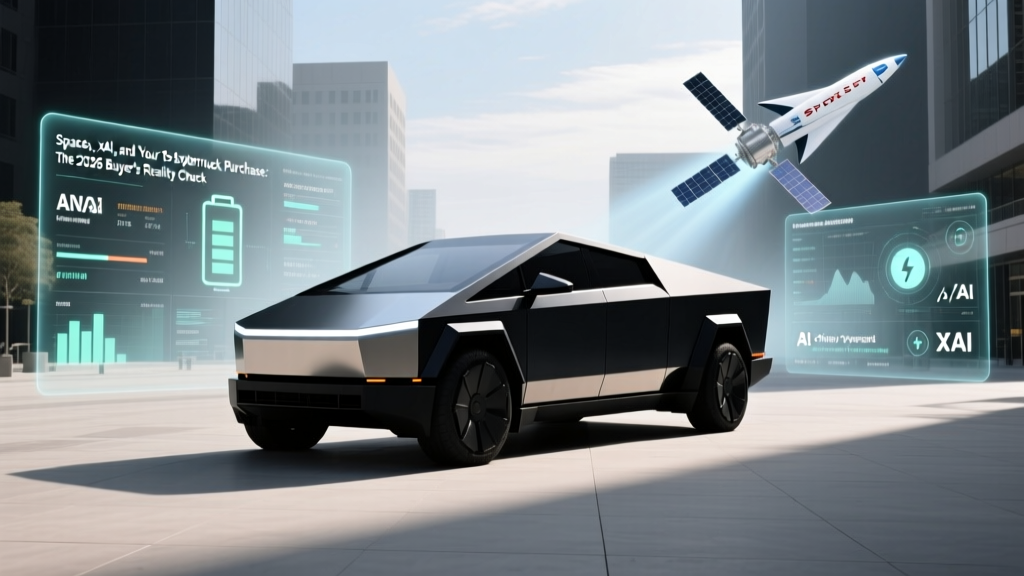
If you've been watching Tesla's Cybertruck dominate social media feeds, SpaceX launches, and xAI product announcements, you're not alone. The stainless-steel pickup has become a cultural lightning rod — and for many shoppers, a serious contender. But separating Elon Musk's cross-company hype from the actual ownership experience requires hard data, not headlines. This 2026 buyer's guide cuts through the noise with EPA numbers, real-world range testing, charging realities, and the tax-credit math that actually determines what you'll pay.
Range Reality Check: AWD & Cyberbeast
EPA Estimated: 318 miles (AWD) / 301 miles (Cyberbeast, 20" wheels)
Real-World Expectation: 260–285 miles highway at 70 mph; 230–250 miles in freezing temps. The RWD variant (est. 340+ mi EPA) remains limited in availability as of early 2026.
Specs at a Glance: 2026 Tesla Cybertruck
| Attribute | AWD | Cyberbeast |
|---|---|---|
| EPA Range | 318 mi | 301 mi |
| Battery (usable, est.) | ~123 kWh (NMC) | ~123 kWh (NMC) |
| 0–60 mph | 3.9 sec | 2.6 sec |
| Horsepower | 600 hp | 845 hp |
| Drivetrain | Dual-Motor AWD | Tri-Motor AWD |
| Max DC Fast Charge | 350 kW (peak) | 350 kW (peak) |
| 10–80% DC Time | ~22 min | ~22 min |
| Level 2 Home Charge | 11.5 kW (~34 mi/hr) | 11.5 kW (~34 mi/hr) |
| Towing Capacity | 11,000 lbs | 11,000 lbs |
| Payload | 2,500 lbs | 2,500 lbs |
| MPGe (combined) | 67 MPGe | 59 MPGe |
| Efficiency | 50 kWh/100 mi | 57 kWh/100 mi |
| Base MSRP | $79,990 | $99,990 |
| Battery/Drive Unit Warranty | 8 yr / 120,000 mi | 8 yr / 120,000 mi |
Real-World Range: What the EPA Sticker Doesn't Tell You
The Cybertruck AWD's 318-mile EPA rating sounds competitive against the Rivian R1T (352 mi on the Max pack) and Ford F-150 Lightning (320 mi on the Extended Range pack). But the Cybertruck's brutalist aerodynamics — a drag coefficient around 0.39 — punish highway efficiency far more than those rivals.
In independent highway loop testing at sustained 70–75 mph speeds in moderate temperatures, the AWD model consistently delivers 260–285 miles before hitting a 10% state of charge. The Cyberbeast, with its tri-motor power draw and stickier tires, drops to roughly 240–260 miles under the same conditions.
Cold weather compounds the loss. At 20°F, expect a 25–35% range reduction depending on cabin heating use and whether you precondition the battery. That puts a Cyberbeast winter highway range dangerously close to 170–190 miles — fine for commuting, stressful for road trips through the Mountain West where DC fast chargers remain sparse.
The ~123 kWh usable battery uses NMC (nickel-manganese-cobalt) chemistry, which offers high energy density but is more sensitive to sustained high state-of-charge storage than LFP packs. Tesla recommends daily charging to 80–90% and 100% only for trips.
Charging Speed: 350 kW Peak, but Read the Curve
The Cybertruck supports up to 350 kW peak DC fast charging on Tesla V4 Superchargers — but that number is a momentary spike, not a sustained rate. Here's what the charge curve actually looks like:
| Charge Method | Power | Speed | Time / Notes |
|---|---|---|---|
| DC Fast (V4 Supercharger) | 350 kW peak | ~15 mi/min at peak | 10–80% in ~22 min; tapers sharply above 60% |
| DC Fast (V3 Supercharger) | 250 kW peak | ~12 mi/min at peak | 10–80% in ~28 min |
| Level 2 (Wall Connector, 48A) | 11.5 kW | ~34 mi/hr | 0–100% in ~11 hours |
| Level 2 (Mobile Connector, 32A) | 7.7 kW | ~23 mi/hr | 0–100% in ~16 hours |
| Level 1 (120V outlet) | ~1.4 kW | ~3–4 mi/hr | Not viable for daily use on 123 kWh pack |
The critical insight: that 350 kW peak holds for roughly the first 15–20% of the charge session before tapering. By 60% SoC, you're likely at 120–150 kW, and above 80%, charging slows to under 50 kW. Plan your road-trip stops around the 10–80% window — sitting at a Supercharger to 100% adds 30+ minutes of diminishing returns.
At home, the Tesla Wall Connector on a 60A circuit delivers 11.5 kW, replenishing roughly 34 miles of range per hour. For a 123 kWh pack, that means an overnight session (10–12 hours) covers a full 0–100% charge. Most owners will rarely need a full charge, making a nightly 20–80% cycle a 7-hour top-off.
Performance: Supercar Numbers in a 6,800-lb Truck
The Cyberbeast's 2.6-second 0–60 mph time is genuinely absurd for a vehicle weighing nearly three and a half tons. The tri-motor setup (one front, two rear) produces 845 horsepower, and the torque-vectoring rear axle makes the truck feel unnervingly agile for its size. The AWD dual-motor variant is no slouch at 3.9 seconds and 600 hp.
But performance buyers should weigh the tradeoffs. The Cyberbeast's 57 kWh/100 mi efficiency means you're paying for speed at the charger — roughly $0.17–$0.22 per mile on utility-rate home charging, versus $0.14–$0.18 for the AWD. The adaptive air suspension (standard) adjusts ride height from 9" to 16" of ground clearance, but the stiff sidewalls of the 35" all-terrain tires transmit more road imperfections than the F-150 Lightning's independent rear suspension.
Towing capacity is rated at 11,000 lbs — competitive with the R1T and Lightning. However, towing a 7,000-lb trailer cuts range roughly in half, dropping real-world towing range to 130–160 miles. For frequent heavy towing, the Cybertruck works, but plan charging stops accordingly.
Cargo, Interior, and the Tech Stack
The 6-foot composite bed (lockable tonneau cover standard) offers 67 cubic feet of volume and integrated ramp-style tailgate. The front trunk (frunk) adds roughly 7 cu ft — useful for charging cables and groceries but smaller than the Lightning's massive 14 cu ft frunk. Interior rear-seat legroom measures 38.2 inches, adequate for adults but tighter than an F-150 SuperCrew.
The cabin centers on an 18.5-inch touchscreen running Tesla's latest infotainment OS. There are no physical buttons — climate, mirrors, and glovebox all operate through the screen, which requires a learning curve. The rear passengers get their own 9.4-inch touchscreen for climate and media controls.
On the driver-assistance front, Autopilot comes standard with adaptive cruise control and lane-centering. Full Self-Driving (Supervised) remains a $8,000 add-on or $99/month subscription. Critically, FSD is an SAE Level 2 system — you must keep your hands on the yoke and eyes on the road at all times. This is not autonomous driving, despite the branding. Tesla's vision-only approach (no lidar, no radar on current builds) occasionally struggles with construction-zone cones, faded lane markings, and heavy rain.
⚠ Driver-Assist Limitation Notice
Tesla Autopilot and FSD (Supervised) are SAE Level 2 driver-assistance systems. The driver must remain fully engaged, monitor the road, and be prepared to take over instantly. These systems do NOT make the Cybertruck self-driving. Hands-on-wheel monitoring is enforced via camera.
The stainless-steel exoskeleton is dent-resistant and eliminates paint (reducing repair complexity for minor scrapes but making major body-panel replacement more specialized). However, the angular design creates significant blind spots at the rear corners — the digital rearview camera mirror is helpful but not a full substitute for visibility.
Pricing, Trims, and the §30D Tax Credit Question
| Trim | Base MSRP | Est. As-Tested | §30D Credit Eligible? |
|---|---|---|---|
| AWD | $79,990 | $83,000–$88,000 | No — exceeds $80,000 truck MSRP cap |
| Cyberbeast | $99,990 | $104,000–$112,000 | No — exceeds $80,000 truck MSRP cap |
| RWD (limited availability) | $60,990 (est.) | $64,000–$68,000 | Potentially — under cap, but subject to sourcing/income rules |
Here's the tax-credit reality most Cybertruck coverage glosses over: the AWD and Cyberbeast do not qualify for the $7,500 federal §30D tax credit. IRS rules cap eligible pickups at an $80,000 MSRP. Both the $79,990 AWD (which with destination and mandatory options typically invoices above $80K) and the $99,990 Cyberbeast blow past that threshold. The base RWD, once broadly available, could qualify — but only if the buyer also meets income caps ($150K single / $300K joint AGI) and the battery meets critical-mineral and component sourcing requirements that shift annually.
Point-of-sale transfer of the credit (allowing dealers to apply the $7,500 as a down-payment reduction) is available for qualifying trims, but again, the high-volume AWD and Cyberbeast are excluded. Check the latest fueleconomy.gov listings for current eligible vehicles before assuming credit availability.
Who Should Actually Buy the Cybertruck?
Buy the Cybertruck If:
- You want a 300+ mile EV pickup with supercar acceleration and don't need the $7,500 tax credit to make the math work.
- You have reliable home Level 2 charging and primarily drive in moderate climates.
- The stainless-steel, maintenance-free exterior appeals to you (no paint to chip, no clear coat to fade).
- You value Tesla's Supercharger network for road-trip convenience — it remains the most reliable DC fast-charging ecosystem in North America.
Look Elsewhere If:
- Tax credit eligibility is essential to your purchase math — the Rivian R1T (Dual-Motor Standard) and Ford F-150 Lightning (XLT/Lariat trims) may qualify.
- You frequently tow heavy loads long distances — all EV pickups lose ~50% range while towing, but the Cybertruck's aero makes it worse than the Lightning.
- Rear-seat passenger comfort and visibility are priorities — the F-150 Lightning offers a more conventional, spacious cabin.
- You live in a region with extreme winters and limited DC fast-charging infrastructure — the cold-weather range loss is significant.
Pros and Cons: The Honest Scorecard
✅ Pros
- Class-leading acceleration (2.6s Cyberbeast, 3.9s AWD)
- 350 kW peak DC charging on V4 Superchargers
- Stainless-steel body is dent- and corrosion-resistant
- Access to Tesla's Supercharger network (17,000+ stalls in North America)
- 11,000-lb towing + 2,500-lb payload
- Adaptive air suspension with up to 16" ground clearance
- OTA software updates continuously add features
❌ Cons
- AWD and Cyberbeast exceed $80K MSRP cap — no §30D federal tax credit
- Real-world highway range falls 10–18% below EPA sticker
- Poor rear visibility; heavy reliance on camera mirrors
- Touchscreen-only controls require significant adaptation
- FSD (Supervised) is Level 2 only, not autonomous — $8K add-on
- High efficiency consumption (50–57 kWh/100 mi) raises home charging cost
- Specialized stainless-steel body repair limits collision-center options
Warranty and Long-Term Ownership
Tesla covers the Cybertruck's battery and drive units for 8 years or 120,000 miles (whichever comes first), with a minimum 70% capacity retention threshold. The limited vehicle warranty is 4 years / 50,000 miles. These terms are competitive with Rivian (8/120,000 battery) and slightly better than Ford's Lightning battery coverage (8/100,000).
NMC battery degradation for Tesla's large-pack vehicles historically averages 8–12% over the first 100,000 miles based on fleet data, though the Cybertruck's heavy weight and high discharge rates could push degradation slightly higher for aggressive drivers. Avoid routinely charging to 100% and storing at high SoC in hot climates to maximize longevity.
Insurance costs run 20–35% higher than comparable gas pickups, reflecting the Cybertruck's repair complexity, high MSRP, and performance classification. Get quotes before committing — annual premiums of $3,200–$4,800 are common depending on state and driving record.
Frequently Asked Questions
What is the real-world range of the Tesla Cybertruck?
The AWD model delivers roughly 260–285 miles on highway drives at 70 mph in moderate temperatures, versus the EPA's 318-mile sticker. The Cyberbeast nets about 240–260 miles. Cold weather (below 32°F) can cut these figures by an additional 25–35%.
How fast does the Cybertruck charge at home and on the road?
On a V4 Supercharger, it peaks at 350 kW and charges 10–80% in roughly 22 minutes, though the rate tapers significantly above 60% SoC. At home on a Level 2 Wall Connector (11.5 kW), expect about 34 miles of range per hour, or a full charge in approximately 11 hours.
Does the Cybertruck qualify for the federal EV tax credit?
The AWD ($79,990) and Cyberbeast ($99,990) exceed the IRS §30D $80,000 MSRP cap for trucks and do not qualify. The base RWD (once widely available) may qualify if the buyer meets income caps ($150K single / $300K joint) and battery-sourcing requirements. Always verify current eligibility on fueleconomy.gov before purchasing.
How does the Cybertruck compare to the Rivian R1T and F-150 Lightning?
The Cybertruck wins on acceleration and Supercharger access. The R1T (Max pack, 352 mi EPA) offers better real-world range and a more refined interior at similar pricing. The F-150 Lightning provides a more conventional truck experience, better rear-seat space, a larger frunk, and — in mid-tier trims — potential §30D credit eligibility. Choose based on your priorities: performance (Cybertruck), range and build quality (R1T), or practicality and tax credits (Lightning).
Is Full Self-Driving worth the $8,000 upgrade?
FSD (Supervised) is an SAE Level 2 driver-assist system — not autonomous driving. It handles highway lane changes, on-ramps, and some city streets impressively but requires constant driver supervision and struggles with construction zones and poor weather. For most buyers, the standard Autopilot (included) handles highway commuting well. The $99/month subscription is a lower-risk way to try FSD before committing $8,000 upfront.
What does it cost to charge a Cybertruck at home?
At the US average residential electricity rate of ~$0.16/kWh, fully charging the ~123 kWh pack costs roughly $19.68, yielding about $0.07–$0.08 per mile. That compares to $0.18–$0.22 per mile for a gas F-150 at $3.50/gallon and 18 MPG. Annual fuel savings (15,000 miles) run approximately $1,500–$2,100 depending on local electricity rates.
Sources: fueleconomy.gov (EPA range and MPGe data), IRS §30D Clean Vehicle Credit rules, Tesla official specifications. Pricing and credit eligibility reflect 2026 model-year data and are subject to change. Always verify with your tax professional and the manufacturer before purchasing.