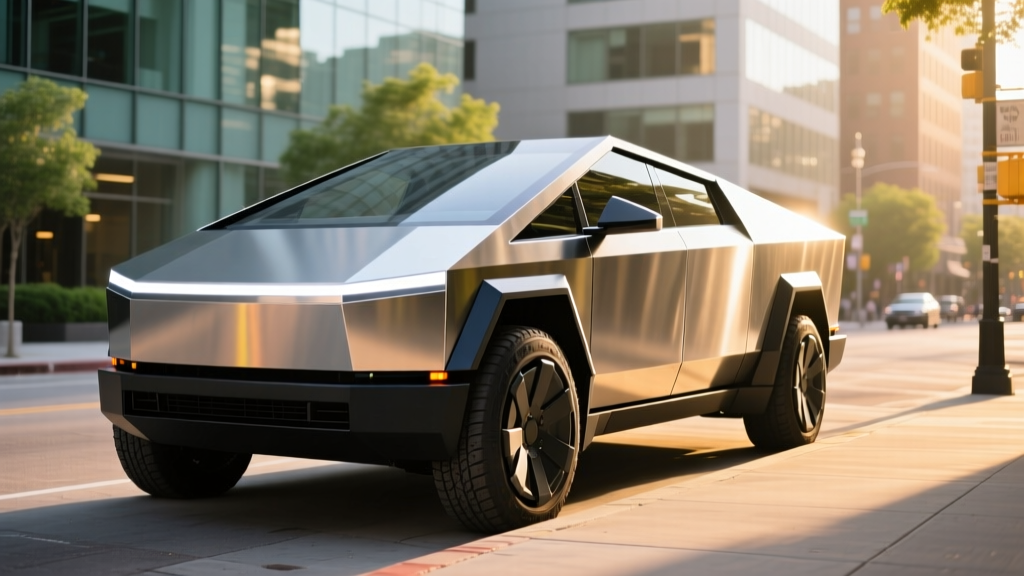
When Tesla rolled out a rainbow-wrapped Cybertruck to its Pride celebrations in June 2024, the images went viral almost instantly. The so-called Pride Cybertruck became one of the most searched, screenshotted, and debated EVs on the internet — a stainless-steel polygon draped in the progress flag, polarizing buyers and onlookers alike. But strip away the wrap (which is a vinyl dealer- or owner-applied accessory, not a factory paint option), and you're left with the 2025/2026 Tesla Cybertruck underneath: a 48-volt-architecture, steer-by-wire, stainless-steel pickup that is genuinely unlike anything else on the road.
This review covers the Cybertruck as it stands for the 2026 model year — trims, battery, charging, real-world range, tax credit eligibility, and whether the truck's polarizing design and tech justify its price. The Pride wrap is an aesthetic add-on; the engineering story is what actually matters for your wallet and your driveway.
2026 Cybertruck Trims, Pricing, and the Pride Wrap Reality
First, a clarification that matters for shoppers searching for a "Pride Cybertruck" to buy: Tesla does not sell a factory Pride Edition. The rainbow truck was a one-off promotional vehicle. Any Cybertruck you see in a Pride wrap has had it applied aftermarket — typically a $2,500–$4,500 full-body PPF/vinyl job from shops like Cyberwrap or local installers. That's actually good news for buyers who want the look: you can wrap any trim.
| Trim | Drivetrain | Base MSRP | As-Tested (typical) |
|---|---|---|---|
| Long Range AWD | Dual Motor AWD | $79,990 | $83,000–$86,000 |
| Cyberbeast | Tri-Motor AWD | $99,990 | $104,000–$110,000 |
The rear-wheel-drive $60,990 variant originally announced has been repeatedly delayed and, as of early 2026, is not generally available to retail buyers. Foundation Series packages (which bundled FSD Supervised, Powershare, and premium accessories) added roughly $20,000 to early deliveries but have been replaced with a la carte options for 2026.
Federal tax credit eligibility (§30D): The Cybertruck is assembled in Austin, Texas, and its battery sourcing has shifted across model years. As of 2026, the Long Range AWD qualifies for up to $3,750 of the federal credit (critical-minerals portion), while the Cyberbeast's eligibility can vary by build month due to battery-component sourcing rules. Both trims fall under the IRS §30D truck MSRP cap of $80,000 — which means the Cyberbeast at $99,990 MSRP is not eligible for the credit regardless of sourcing. Buyer income caps still apply ($300k joint / $225k head of household / $150k single). Always verify current eligibility on the fueleconomy.gov credit lookup before signing, and consult a tax professional for point-of-sale transfer rules.
| Trim | MSRP | Max §30D Credit | Effective Price* |
|---|---|---|---|
| Long Range AWD | $79,990 | $3,750 | ~$76,240 |
| Cyberbeast | $99,990 | $0 (over MSRP cap) | $99,990 |
*Before state incentives, destination, or dealer fees. Verify yearly IRS rules.
Battery, Chemistry, and Real-World Range
The 2026 Cybertruck uses a structural battery pack with an estimated ~123 kWh usable capacity. Tesla has not published cell chemistry officially for the Cybertruck line, but teardowns and supplier reporting indicate a mix of NMC (nickel manganese cobalt) 4680 cells in the performance-oriented Cyberbeast and a blend in the Long Range. LFP is not used in the Cybertruck as of 2026 — the pack needs the energy density that NMC provides to hit its range targets in a 6,800+ lb vehicle.
- Long Range AWD: EPA-est. 340 miles (with tonneau cover deployed). Real-world highway at 70 mph: expect ~270–290 miles. Cold-weather (below 32°F) mixed driving: ~220–250 miles.
- Cyberbeast: EPA-est. 320 miles. Real-world highway: ~250–270 miles. Cold-weather: ~200–230 miles.
The Cybertruck's slab-sided stainless body has a drag coefficient around Cd 0.38–0.42 depending on ride height and mirror configuration — meaningfully higher than a Model Y (~0.23). That's why highway range drops more sharply than the EPA sticker suggests. Speed matters enormously: 80 mph shaves another 10–15% versus 70 mph.
For context, a Rivian R1T Dual-Motor Max Pack rates at 420 miles EPA but costs substantially more; a Ford F-150 Lightning Extended Range rates at 320 miles EPA and is closer in price. The Cybertruck sits in the middle on range and near the top on efficiency-per-pound given its weight.
Charging: 800V Architecture Done Right
This is where the Cybertruck quietly excels. Its 800-volt electrical architecture allows DC fast charging at up to 350 kW peak at V4 Superchargers and compatible CCS/NACS stations — one of the fastest light-duty truck charge rates on sale in 2026.
| Level | Power | Speed | Typical Use |
|---|---|---|---|
| Level 1 (120V) | ~1.4 kW | ~3–4 mi/hr | Emergency / trickle |
| Level 2 (240V, 48A) | 11.5 kW | ~30–34 mi/hr | Home overnight |
| DC Fast (V4 Supercharger) | Up to 350 kW peak | 10–80% in ~22 min | Road trips |
| DC Fast (150 kW station) | ~150 kW sustained | 10–80% in ~38 min | Older networks |
Real-world charging caveat: the 350 kW peak is only sustained roughly between 10–30% State of Charge. Above 50%, the curve tapers to ~150 kW, and above 80% it drops to under 50 kW. A typical 10–80% session averages closer to 200–220 kW. Always precondition the battery via the Tesla nav route to a Supercharger — skipping preconditioning can add 5–8 minutes to your stop, especially in cold weather.
At home, the Cybertruck's 11.5 kW onboard charger is robust. A full 0–100% on a Wall Connector takes roughly 11–12 hours. Most owners charging from 20–80% overnight add back their daily 40–60 miles of driving in under two hours. Installation of a NACS Wall Connector on a 60A circuit typically runs $800–$2,000 depending on panel proximity; a 200A service panel upgrade can add $1,500–$3,500 if your home needs it.
Performance, Drivetrain, and Towing
| Metric | Long Range AWD | Cyberbeast |
|---|---|---|
| 0–60 mph | 3.9 sec | 2.6 sec |
| Horsepower | ~600 hp | ~845 hp |
| Drivetrain | Dual Motor AWD | Tri-Motor AWD (torque vectoring) |
| Top Speed | 112 mph | 130 mph |
| Max Towing | 11,000 lbs | 11,000 lbs |
| Payload | ~2,500 lbs | ~2,500 lbs |
The Cyberbeast's 2.6-second 0–60 time is supercar territory in a vehicle with a 6.5-foot bed. It is also, frankly, irrelevant to 95% of buyers — what matters more is the instant torque for merging and the tri-motor torque vectoring that makes the truck feel far smaller than its 223-inch length suggests.
Towing is a mixed story. The 11,000-lb rating is competitive with the F-150 Lightning and exceeds the Rivian R1T. But towing a 7,000-lb trailer cuts real-world range roughly in half — expect 140–170 miles between stops at highway speed. For frequent heavy towing, a diesel remains the pragmatic choice; for occasional boat or camper pulls, the Cybertruck handles it well, and the integrated bed power (Powershare, up to 11.5 kW output) is genuinely useful at campsites and job sites.
Interior, Cargo, and Daily Livability
The Cybertruck's cabin is minimalism taken to an extreme: a single 18.5-inch front touchscreen, a 9.4-inch rear screen, no traditional instrument cluster, no physical stalks (turn signals are steering-wheel buttons), and a yoke-style or round wheel depending on order date. Build quality on 2025/2026 trucks is markedly better than the first 2024 Foundation Series units, though panel-gap variance on the stainless exoskeleton remains a talking point.
- Front legroom: 41.0 in
- Rear legroom: 34.8 in (tight for tall adults on long trips)
- Bed length: 6.5 ft (74.3 in) with motorized tonneau
- Bed width (between wheel wells): ~49 in — will not fit a standard 4x8 sheet of plywood flat
- Cargo volume behind rear seats: ~34 cu ft (with seats up)
- Front trunk (frunk): ~7 cu ft lockable
The 48-volt electrical architecture and steer-by-wire are the engineering headline. Steer-by-wire means the steering ratio changes with speed — tight at parking lots, stable on the highway — and it takes about 30 minutes of driving to build muscle memory. Some owners love it; a meaningful minority report fatigue on long trips from the lack of physical feedback. Test-drive before committing.
Driver Assistance: Autopilot and FSD Supervised
Tesla Autopilot and Full Self-Driving (Supervised) are SAE Level 2 driver-assistance systems. The driver must remain attentive, hands engaged (or eyes monitored via cabin camera), and ready to take over at any moment. These are not Level 4 robotaxi systems like Waymo. Treat them as advanced cruise + lane-keeping, not autonomy.
FSD Supervised is bundled or available as a $99/month subscription in 2026. On the Cybertruck, it performs comparably to the Model 3/Y — strong on divided highways, improving but still imperfect in urban environments. The cabin camera-based attention monitoring is stricter than the older steering-torque detection and catches phone use aggressively.
Warranty, Ownership Costs, and Who Should Buy
| Category | Coverage |
|---|---|
| Basic Vehicle | 4 years / 50,000 miles |
| Battery & Drive Units | 8 years / 120,000 miles (min 70% retention) |
| Roadside Assistance | 4 years / 50,000 miles |
The 8-year/120,000-mile battery warranty with a 70% capacity retention threshold is in line with the industry and better than some. Replacement cost for a Cybertruck structural pack, should it be needed out of warranty, is estimated at $15,000–$22,000 based on current Tesla service pricing — higher than a Model Y due to the pack's size and structural role.
Who the Cybertruck suits best:
- Tech-forward buyers who want a statement vehicle and daily-drive something genuinely novel.
- Light-duty truck users who value bed security (the lockable tonneau is excellent) and Powershare for tools/camping.
- Supercharger-network loyalists who road-trip frequently and value 350 kW charging.
Who should look elsewhere:
- Traditional truck buyers who need a 4x8-flat bed, easy third-row access, or a conventional control layout.
- Fleet and commercial buyers (Cybertruck is not currently offered in a commercial fleet program).
- Buyers whose primary concern is maximizing range per dollar — a Model Y Long Range delivers far more miles per dollar.
- Class-leading 350 kW DC fast-charge peak
- Supercar-level Cyberbeast acceleration (2.6s 0–60)
- Lockable motorized tonneau + Powershare bed outlet
- Access to Tesla Supercharger network (NACS native)
- Distinctive design — nothing else looks like it
- Highway range falls well short of EPA (Cd penalty)
- Rear seat legroom tight for adults on long trips
- Bed cannot fit a 4x8 plywood sheet flat
- Cyberbeast ineligible for §30D credit (over MSRP cap)
- Steer-by-wire polarizing; requires adaptation
Frequently Asked Questions
Can I actually buy a Tesla Cybertruck Pride Edition from the factory?
No. The Pride Cybertruck was a one-off promotional wrap, not a production trim. Any Pride-wrapped Cybertruck you see has an aftermarket vinyl wrap ($2,500–$4,500 installed). You can replicate the look on any Long Range or Cyberbeast.
What is the real-world highway range of the Cybertruck?
Expect 270–290 miles on the Long Range AWD and 250–270 miles on the Cyberbeast at 70 mph in moderate weather. Cold weather (under 32°F) typically drops those figures by another 15–20%. The EPA sticker of 340/320 miles reflects a mixed cycle with the tonneau cover deployed.
Does the Cybertruck qualify for the $7,500 federal EV tax credit?
Only partially and only on the Long Range AWD trim. The Long Range AWD qualifies for up to $3,750 (critical-minerals portion) under 2026 IRS §30D rules, subject to buyer income caps. The Cyberbeast, at $99,990 MSRP, exceeds the $80,000 truck MSRP cap and is ineligible regardless of battery sourcing. Always verify at irs.gov.
How fast does the Cybertruck charge at home?
On a 240V/48A Level 2 Wall Connector, the Cybertruck charges at 11.5 kW, adding roughly 30–34 miles of range per hour. A full overnight session easily replenishes 80–100% of daily driving needs.
Is the Cybertruck worth it versus the Rivian R1T or F-150 Lightning?
It depends on priority. The F-150 Lightning wins on price, conventional truck utility, and back-seat space. The Rivian R1T (2025+ dual-motor Max) wins on range (up to 420 mi EPA) and adventure features. The Cybertruck wins on charging speed, performance per dollar (Cyberbeast), and distinctiveness. For a pure daily-driver commuter who rarely tows, the Lightning is the pragmatic pick; for someone who wants a statement truck with cutting-edge tech, the Cybertruck earns its premium.
What's the biggest drawback of owning a Cybertruck?
Highway efficiency and the resulting range drop. The stainless-steel exoskeleton looks iconic but creates more aerodynamic drag than a traditional truck, which makes long road trips at 75–80 mph noticeably more stop-heavy than the EPA sticker implies. Pair that with cold weather and you need to plan charging carefully on trips over 250 miles.
Sources: fueleconomy.gov, Tesla Cybertruck specifications, IRS Clean Vehicle Tax Credits.