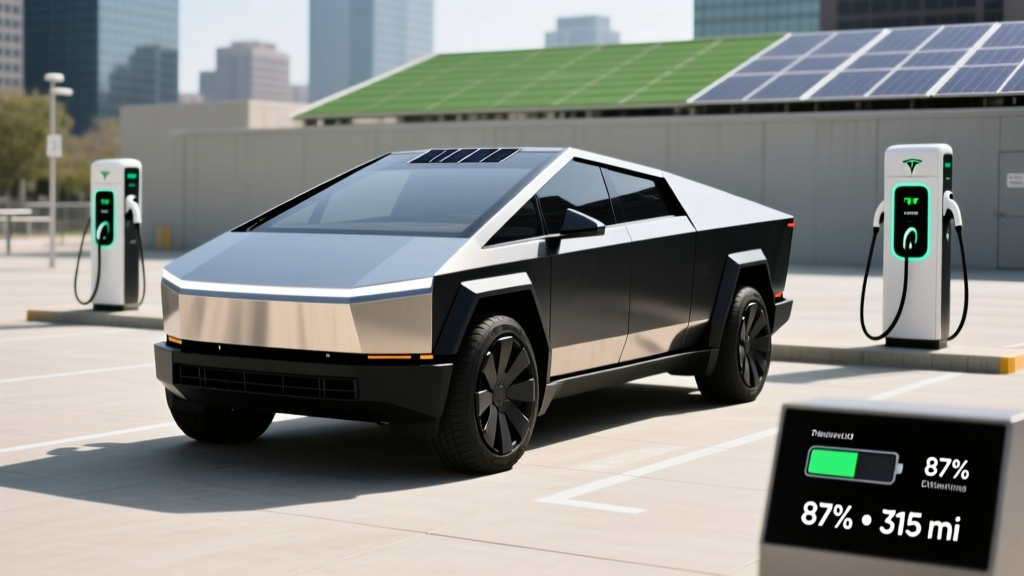
If you have been searching for an honest answer to how much money is a Cybertruck, the short version is that the 2026 Tesla Cybertruck starts at $79,990 for the dual-motor AWD trim and climbs to $99,990 for the Cyberbeast — before destination fees, options, or tax considerations. Those numbers place it squarely in the premium electric-truck segment, competing against the Rivian R1T, Ford F-150 Lightning, and Chevrolet Silverado EV. But sticker price is only part of the equation. Federal tax credit eligibility, charging infrastructure costs, insurance premiums, and real-world efficiency all reshape what you will actually spend over five years of ownership.
This guide walks through every 2026 Cybertruck trim, the real-world range you can expect beyond the EPA sticker, DC fast-charging realities, and the nuanced rules around the IRS §30D federal tax credit — so you can determine whether the Cybertruck fits your budget and your use case.
2026 Cybertruck Pricing by Trim: What You Will Actually Pay
Tesla currently offers the Cybertruck in three configurations for the 2026 model year. The long-promised rear-wheel-drive base model has been repeatedly delayed and, as of early 2026, remains listed as "coming later" on Tesla's website without a firm delivery date. Here is what is available now:
| Trim | Drivetrain | Base MSRP | EPA Range | 0-60 mph | Horsepower |
|---|---|---|---|---|---|
| AWD (Dual-Motor) | AWD | $79,990 | 340 mi | 4.1 sec | 600 hp |
| Cyberbeast (Tri-Motor) | AWD | $99,990 | 320 mi | 2.6 sec | 845 hp |
| RWD (Base) | RWD | TBD (~$60,990 est.) | TBD | TBD | TBD |
Destination and order fees: Tesla adds a $1,390 destination charge plus a $250 order fee, bringing the effective starting price of the AWD trim to approximately $81,630 before taxes or registration.
As-tested pricing: A Cyberbeast with the optional Foundation Series package (which was bundled on early-production units at a $20,000 premium) can push well past $120,000. Tesla has since unbundled some Foundation Series features, but buyers should still budget $2,000–$5,000 above MSRP for wraps, accessories, or the Powershare mobile generator accessory.
Federal Tax Credit: Does the Cybertruck Qualify for §30D?
This is where the "how much money is a Cybertruck" question gets complicated. Under the IRS §30D clean vehicle credit, the Cybertruck faces several hurdles:
- Vehicle MSRP cap: Trucks must be ≤$80,000. The AWD trim at $79,990 clears this bar; the Cyberbeast at $99,990 does NOT.
- Buyer income cap: AGI ≤$150,000 (single), ≤$225,000 (head of household), ≤$300,000 (joint).
- Battery sourcing: Critical minerals and battery components must meet escalating annual thresholds for US/free-trade-agreement sourcing and cannot contain any foreign-entity-of-concern (FEOC) materials.
- Final assembly: Must be assembled in North America (the Cybertruck is built in Austin, TX — this requirement is met).
- Point-of-sale transfer: Eligible buyers can apply the credit at purchase, reducing the out-of-pocket price immediately.
Bottom line: Only the AWD trim is eligible, and only if you fall under the income cap and the vehicle's battery sourcing satisfies current-year critical-mineral and component requirements. Tesla's battery supply chain has shifted repeatedly, and the specific credit amount ($3,750 or $7,500) can change quarterly based on updated sourcing certifications. Always verify current eligibility on fueleconomy.gov before purchasing. The Cyberbeast is categorically ineligible due to the $80,000 MSRP cap for trucks.
| Scenario | MSRP + Destination | Federal Credit | Effective Price |
|---|---|---|---|
| No credit (income too high or sourcing fails) | $81,380 | $0 | $81,380 |
| Partial credit ($3,750 — minerals only) | $81,380 | −$3,750 | $77,630 |
| Full credit ($7,500 — minerals + components) | $81,380 | −$7,500 | $73,880 |
Note: State and local incentives vary by jurisdiction. Consult a tax professional for your specific situation.
Real-World Range vs. EPA Estimates
AWD: EPA 340 miles — expect ~270–290 miles on highway trips at 70+ mph; ~240–260 miles in freezing temperatures.
Cyberbeast: EPA 320 miles — expect ~250–275 miles highway; ~220–245 miles in cold weather.
The Cybertruck's angular stainless-steel exoskeleton looks striking, but it creates a drag coefficient that hurts highway efficiency. In real-world testing by multiple outlets, the AWD trim averages roughly 2.0–2.2 kWh/mile at highway speeds, compared to its EPA-rated efficiency of approximately 48 MPGe (combined). That translates to roughly 50 kWh per 100 miles in mixed driving, which is thirsty by EV standards.
The Cybertruck uses a structural battery pack with 4680-format cells in an NMC (nickel manganese cobalt) chemistry, with a total usable capacity of approximately 123 kWh. That massive pack is what enables the 340-mile EPA figure despite the truck's aerodynamic penalty and 6,600+ lb curb weight.
Cold-weather caveat: Like all NMC packs, expect 20–30% range reduction in sustained sub-freezing temperatures. Tesla's heat pump and battery preconditioning help mitigate this, but the Cybertruck's sheer mass and drag mean cold-weather range loss is more noticeable than in lighter, sleeker EVs.
Charging Speed: DC Fast Charging and Home Level 2
Charging a 123 kWh battery is a significant undertaking. Here is what to expect at each charging level:
| Charging Level | Power / Rate | Time / Speed | Notes |
|---|---|---|---|
| Level 1 (120V household) | ~1.4 kW | ~3–4 mi/hr | Not practical for daily use; 300+ mi takes days |
| Level 2 (240V, 48A Wall Connector) | 11.5 kW | ~37 mi/hr; full charge ~10–12 hrs | Standard home solution; requires NEMA 14-50 or hardwired 60A circuit |
| DC Fast Charge (V4 Supercharger) | Peak 250 kW | 10–80% in ~30 min | Charge curve tapers significantly above 80%; peak rate sustained only briefly |
Charging-curve reality check: The Cybertruck's 250 kW peak rate sounds impressive, but the massive 123 kWh pack means even at peak power, you are adding roughly 3–3.5% of battery per minute. The 10–80% time of approximately 30 minutes is competitive but not class-leading. Above 80% SoC, the charge rate drops sharply to protect the NMC cells — a full 80–100% top-off can add another 30–40 minutes. Plan road-trip stops around 10–80% cycles for efficiency.
NACS connector: The Cybertruck uses Tesla's NACS (North American Charging Standard) connector natively, giving it seamless access to the Tesla Supercharger network — over 6,000 stations and 60,000+ connectors in North America. This is a meaningful ownership advantage over CCS-equipped trucks that must rely on third-party networks with variable reliability.
Performance, Efficiency, and Capability
The Cybertruck delivers sports-car acceleration in a truck body. The Cyberbeast's 2.6-second 0-60 mph time makes it one of the quickest production trucks ever built. Even the dual-motor AWD's 4.1-second run handily outruns most V8 pickups off the line.
| Spec | AWD (Dual-Motor) | Cyberbeast (Tri-Motor) |
|---|---|---|
| Horsepower | 600 hp | 845 hp |
| 0-60 mph | 4.1 sec | 2.6 sec |
| Top Speed | 112 mph | 130 mph |
| Towing Capacity | 11,000 lbs | 11,000 lbs |
| Payload | 2,500 lbs | 2,500 lbs |
| MPGe (combined) | ~48 MPGe | ~45 MPGe |
| kWh/100 mi | ~50 | ~53 |
Towing range impact: If you plan to tow near the 11,000-lb maximum, expect range to drop by 40–50%. Real-world towing range with a heavy trailer may be as low as 150–180 miles. This is a physics reality shared by all EV trucks, not unique to the Cybertruck.
Cargo, Interior Space, and Daily Livability
The Cybertruck seats five across two rows. Interior space is adequate but not class-leading for a full-size truck:
- Front headroom: ~40.2 inches
- Front legroom: ~41.3 inches
- Rear legroom: ~38.1 inches
- Bed length: 6 feet (72 inches)
- Bed volume: ~67 cu ft (with tonneau cover closed)
- Front trunk (frunk): ~7.1 cu ft — lockable, useful for groceries or charging cables
- Total cargo volume (bed + frunk + under-bed): ~120 cu ft
Standout tech features:
- 18.5-inch center touchscreen with Tesla's latest UI and over-the-air updates
- 9.4-inch rear-seat touchscreen for climate and media control
- Steer-by-wire system (no mechanical connection between yoke and wheels) — a first for a production consumer vehicle in the US
- Adaptive air suspension with up to 16 inches of ground clearance in Extract mode
- Powershare: 120V and 240V bed outlets (up to 11.5 kW continuous output) for job-site tools or home backup power
- Tesla Autopilot (Level 2 driver-assist) with optional FSD (Supervised) capability
Notable drawbacks:
- Steer-by-wire and the yoke steering take significant adjustment; some drivers find low-speed maneuvering unintuitive
- The stainless-steel body panels show fingerprints constantly and are difficult to repair — collision repair costs and insurance premiums are notably high
- Rear visibility is limited despite the camera-based digital rearview mirror
- The angular bed design with the motorized tonneau cover limits aftermarket truck accessories (bed racks, camper shells) compared to conventional trucks
- No Apple CarPlay or Android Auto — Tesla's native infotainment only
Warranty and Long-Term Battery Outlook
| Component | Coverage |
|---|---|
| Basic Vehicle | 4 years / 50,000 miles |
| Battery & Drive Unit | 8 years / 120,000 miles (min 70% capacity retention) |
| Restraint System | 5 years / 60,000 miles |
| Corrosion | 12 years / unlimited miles (stainless steel body) |
The 8-year/120,000-mile battery warranty with a 70% capacity-retention threshold is in line with industry standards for premium EVs. NMC 4680 cells have shown promising cycle-life data in early fleet monitoring, but long-term degradation curves for the structural pack are still maturing. For context, a full battery replacement on a Cybertruck would likely cost $15,000–$25,000+ out of warranty based on current Tesla service estimates — though this is a worst-case scenario and most packs retain well above 80% capacity at 100,000 miles based on historical Tesla data.
Is the Cybertruck Worth It vs. the Competition?
- You want the Tesla Supercharger network advantage for road trips
- Acceleration and tech-forward features (steer-by-wire, Powershare) matter to you
- You value over-the-air updates and Tesla's software ecosystem
- You need 11,000-lb towing capacity with zero tailpipe emissions
- Rivian R1T ($69,900+): Better off-road capability, more conventional truck ergonomics, quad-motor option, eligible for full §30D credit on lower trims
- Ford F-150 Lightning ($54,995+): Lower entry price, more traditional truck feel, Ford Pro fleet support, broader dealer service network
- Chevrolet Silverado EV ($57,000+): 400-mile range on 4WT trim, Multi-Flex midgate for extended bed length, GM Ultium platform
✓ Pros
- Class-leading acceleration (Cyberbeast: 2.6s 0-60)
- Tesla Supercharger network access (NACS native)
- 11,000-lb towing capacity
- Powershare 240V outlet for tools/backup power
- Stainless-steel body: corrosion-proof, dent-resistant
- Steer-by-wire enables tighter turning radius than expected
✗ Cons
- High MSRP; Cyberbeast ineligible for §30D tax credit
- Efficiency is poor (~50 kWh/100 mi); range drops sharply when towing
- Steer-by-wire and yoke are polarizing and take acclimation
- Limited aftermarket truck accessories due to bed/tonneau design
- High insurance premiums due to stainless-steel repair costs
- RWD base trim still not available — no sub-$65K option
Who Is the Cybertruck Best Suited For?
Tech-forward truck buyers: If you want an electric truck that doubles as a rolling tech platform — with steer-by-wire, Powershare, and OTA updates — nothing else matches the Cybertruck's feature set.
Heavy-towing suburban users: The 11,000-lb tow rating and 123 kWh battery make it viable for boat or trailer towing on shorter routes, though range will be halved under load.
Road-trippers who value Superchargers: The NACS-native Supercharger advantage is real. Cross-country trips are more predictable and faster than in CCS-equipped competitors still reliant on Electrify America or third-party networks.
Not ideal for: Budget-conscious buyers (the F-150 Lightning or Silverado EV offer lower entry points), traditionalists who prefer a conventional steering wheel and truck ergonomics, or fleet operators who need widespread dealer-level service support.
Frequently Asked Questions
How much money is a Cybertruck after tax credits?
If you qualify for the full $7,500 §30D federal credit and purchase the AWD trim ($79,990 MSRP), your effective price drops to approximately $73,880 including destination. However, eligibility depends on your income (≤$300K joint), the vehicle's battery sourcing compliance, and the $80,000 MSRP cap for trucks. The Cyberbeast at $99,990 is categorically ineligible due to the MSRP cap.
What is the real-world range of the Cybertruck?
The AWD trim is EPA-rated at 340 miles, but expect 270–290 miles in real-world highway driving at 70+ mph, and 240–260 miles in freezing temperatures. The Cyberbeast's 320-mile EPA rating drops to roughly 250–275 miles highway. Towing cuts range roughly in half.
How fast does the Cybertruck charge?
On a V4 Tesla Supercharger, the Cybertruck peaks at 250 kW and charges from 10–80% in approximately 30 minutes. At home on a Level 2 Tesla Wall Connector (48A/11.5 kW), a full charge takes 10–12 hours, adding roughly 37 miles of range per hour. Level 1 (standard 120V outlet) adds only 3–4 miles per hour and is impractical for regular use.
Is the Cybertruck worth buying over the Rivian R1T or F-150 Lightning?
It depends on priorities. The Cybertruck wins on acceleration, Supercharger access, and tech features. The R1T offers better off-road capability and more conventional truck ergonomics at a lower starting price. The F-150 Lightning is the most affordable entry point with the broadest dealer network. If you tow heavy and road-trip often, the Cybertruck's Supercharger advantage is significant. If you want a work truck with conventional controls, look at Ford or Rivian.
Does the Cybertruck qualify for the federal EV tax credit?
The AWD trim at $79,990 is eligible for the §30D credit if the buyer meets income requirements and the vehicle's battery sourcing passes current-year critical-mineral and component rules. The Cyberbeast at $99,990 exceeds the $80,000 MSRP cap for trucks and is not eligible. Always verify current eligibility at fueleconomy.gov before purchasing, as sourcing rules and credit amounts change periodically.
What does it cost to insure a Cybertruck?
Insurance premiums for the Cybertruck are notably higher than average, typically $3,000–$5,000+ annually depending on your state, driving record, and coverage level. The stainless-steel body panels are expensive to repair or replace after collisions, and the vehicle's high MSRP contributes to elevated comprehensive and collision premiums. Get quotes from multiple insurers before committing.
Sources: IRS §30D Clean Vehicle Credit, fueleconomy.gov (EPA), Tesla official specifications.