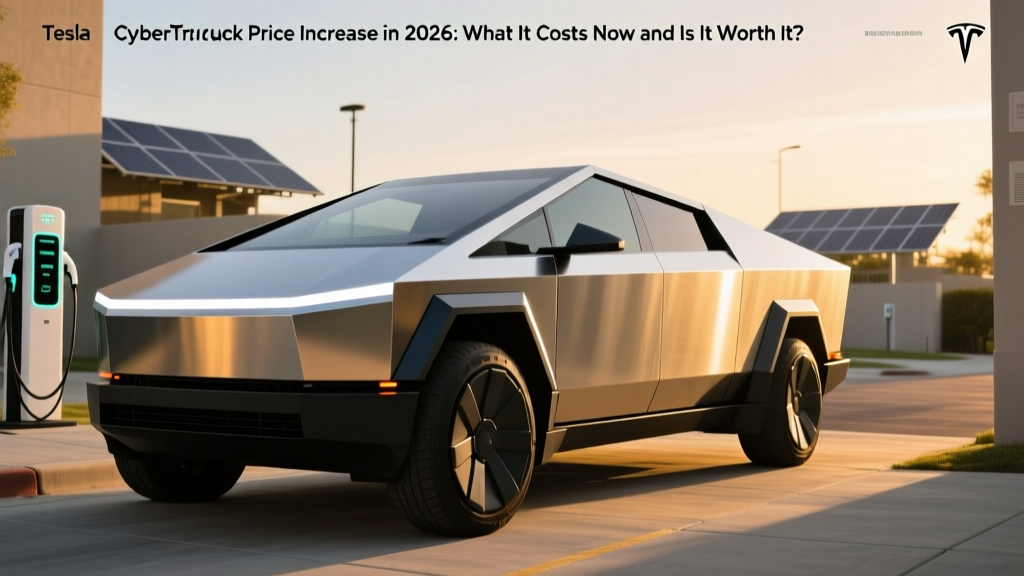
The Tesla Cybertruck has never been a conventional pickup, and its pricing trajectory has been equally unconventional. Since its late-2023 delivery launch, the Cybertruck has seen multiple price revisions — most recently a 2026 adjustment that pushed the dual-motor AWD trim above $80,000 and the Cyberbeast well into six-figure territory. For buyers tracking the Tesla Cybertruck price increase, the question now is whether the truck's capabilities, range, and tech justify the premium, or if rivals like the Ford F-150 Lightning and Rivian R1T offer better value.
This review covers the 2026 Cybertruck lineup with exact specs, real-world range data, charging performance, tax credit eligibility under current IRS §30D rules, and a clear verdict on who should — and shouldn't — buy one.
2026 Tesla Cybertruck Pricing and Trim Breakdown
Tesla restructured the Cybertruck lineup for 2026, discontinuing the originally promised sub-$60,000 rear-wheel-drive model and positioning the truck firmly as a premium electric pickup. Here's where the trims land after the latest price adjustments:
| Trim | Drivetrain | Base MSRP | As-Tested (w/ common options) |
|---|---|---|---|
| Long Range AWD | Dual-Motor AWD | $81,630 | ~$86,000 |
| Cyberbeast | Tri-Motor AWD | $101,630 | ~$108,000 |
The Long Range AWD saw roughly a $2,000 increase over its 2025 pricing, while the Cyberbeast held relatively steady after its initial Foundation Series premium was removed. Tesla also offers a rear-wheel-drive variant at $61,630, but availability remains limited and delivery timelines stretch well into 2027.
For context, the Ford F-150 Lightning Lariat starts around $62,000, and the Rivian R1T Dual-Motor begins near $75,000 — making the Cybertruck's post-increase pricing a meaningful conversation for cross-shoppers.
Federal Tax Credit Eligibility: Does the Cybertruck Qualify?
IRS §30D Federal EV Tax Credit — 2026 Rules
- MSRP Cap for Trucks: $80,000 (the Cybertruck Long Range AWD at $81,630 exceeds this cap)
- Buyer Income Limits: $150,000 single / $225,000 head of household / $300,000 joint (modified AGI)
- Battery Sourcing: Critical minerals and battery components must meet phased-in domestic/free-trade sourcing thresholds
- Point-of-Sale Transfer: Eligible buyers can transfer the credit to the dealer at purchase for an immediate price reduction
- Cyberbeast ($101,630): Exceeds the $80,000 MSRP cap — not eligible
The pricing situation creates a frustrating gap: the Long Range AWD narrowly misses the §30D MSRP cap for trucks, meaning most buyers will not receive the $7,500 federal credit. Tesla has structured pricing to sometimes offer destination or option adjustments that may bring certain configurations under the cap, but as of the current 2026 sticker, the base Long Range AWD does not qualify. The Cyberbeast is well above the threshold. Always verify current eligibility on IRS.gov before purchasing, as sourcing requirements and model eligibility lists update periodically.
Range, Efficiency, and Real-World Expectations
The 2026 Cybertruck Long Range AWD carries an EPA-estimated range of 340 miles on its approximately 123 kWh (usable) battery pack. The Cyberbeast, with its tri-motor powertrain and higher power draw, is rated at 320 miles EPA. Tesla uses NMC (nickel manganese cobalt) chemistry in the Cybertruck's structural battery pack — chosen for energy density to support the truck's substantial 6,800+ lb curb weight.
Real-World Range Reality Check
EPA Estimate: 340 mi (Long Range AWD) / 320 mi (Cyberbeast)
Highway (70-80 mph): Expect ~260-290 miles. The Cybertruck's angular stainless-steel exoskeleton creates significant aerodynamic drag (Cd ~0.38 estimated), which hits efficiency hard at sustained highway speeds.
Cold Weather (below 32°F): Range drops 20-30%, bringing usable range to ~220-260 miles depending on cabin heating demands. The heat pump helps, but the large battery mass takes longer to precondition.
City/Commuting: Closest to EPA estimates — regenerative braking recovers energy effectively in stop-and-go traffic.
| Spec | Long Range AWD | Cyberbeast |
|---|---|---|
| EPA Range | 340 mi | 320 mi |
| Battery (Usable) | ~123 kWh, NMC | ~123 kWh, NMC |
| MPGe (Combined) | 70 MPGe | 66 MPGe |
| Efficiency | 48 kWh/100 mi | 51 kWh/100 mi |
Efficiency is the Cybertruck's weak point compared to sleeker EVs. At 48-51 kWh per 100 miles, you're consuming significantly more energy per mile than a Model Y (~27 kWh/100 mi). This matters for charging cost and road-trip planning — you'll stop more often and pay more per fill on DC fast chargers.
Charging Speed: DC Fast, Level 2, and the 800V Advantage
The Cybertruck uses an 800-volt electrical architecture, enabling strong DC fast-charging performance on compatible stations. Here's the full charging picture:
| Charging Level | Power / Rate | Time / Miles Added |
|---|---|---|
| DC Fast Charge (Peak) | 350 kW (max) | 10-80% in ~20 minutes (on 350 kW+ station) |
| DC Fast Charge (Sustained) | ~200-250 kW average | 10-80% in ~28 minutes (typical 250 kW V3 Supercharger) |
| Level 2 (Home, 48A) | 11.5 kW | ~34 mi/hr; 0-100% in ~11 hours |
| Level 2 (Mobile Connector, 32A) | 7.7 kW | ~23 mi/hr; 0-100% in ~16 hours |
| Level 1 (120V, 12A) | 1.4 kW | ~4 mi/hr (emergency/trickle only) |
Charging curve reality: The Cybertruck peaks near 350 kW only at low state of charge (10-25% SoC) on a 350 kW+ charger. Above 50% SoC, the rate tapers to ~150 kW, and above 80% it drops sharply to protect the NMC cells. Plan road-trip stops to 80% and go — charging from 80-100% can add 25+ minutes for only ~70 miles of range.
The Cybertruck ships with a NACS (North American Charging Standard) port, giving native access to the full Tesla Supercharger network — currently the most reliable DC fast-charging infrastructure in the U.S. with over 6,000 stations. You can also use adapters for CCS1-equipped networks like Electrify America and EVgo, though NACS is rapidly becoming the dominant standard.
For home charging, a 48-amp Level 2 wall connector on a 60-amp circuit adds roughly 34 miles of range per hour. With the Cybertruck's 123 kWh pack, a full charge from near-empty takes about 11 hours — feasible for overnight charging. Installation of a home Level 2 setup typically runs $800-$2,500 depending on panel capacity and conduit distance (consult a licensed electrician for your specific setup).
Performance, Powertrain, and Towing
| Spec | Long Range AWD | Cyberbeast |
|---|---|---|
| Powertrain | Dual-Motor AWD | Tri-Motor AWD |
| Horsepower | 600 hp | 845 hp |
| 0-60 mph | 4.1 seconds | 2.6 seconds |
| Top Speed | 130 mph | 130 mph |
| Towing Capacity | 11,000 lbs | 11,000 lbs |
| Payload | 2,500 lbs | 2,500 lbs |
The Cyberbeast's 2.6-second 0-60 time makes it one of the quickest production pickups ever built — a remarkable figure for a vehicle weighing over 6,800 pounds. The dual-motor Long Range still manages 4.1 seconds, which is sports-car territory from a decade ago.
Towing at 11,000 lbs is competitive with the F-150 Lightning (10,000 lbs max) and exceeds the Rivian R1T (11,000 lbs with max tow package). However, towing at capacity will slash range by roughly 40-50% — expect 160-190 miles of real-world range when pulling a heavy trailer. This is physics, not a Cybertruck flaw, but it demands route planning around charging infrastructure on any long tow haul.
Cargo, Interior, and Daily Usability
The Cybertruck's 6-foot bed (with the tailgate closed; extendable to ~7 feet with the tailgate down and bed extender) offers 67 cubic feet of cargo volume. The motorized retractable tonneau cover is standard and supports up to 300 lbs of distributed load — useful for gear or even standing on at a campsite.
Interior space accommodates five passengers:
- Front legroom: 41.3 inches
- Rear legroom: 38.2 inches (adequate for adults, tighter than an F-150 SuperCrew)
- Front headroom: 40.8 inches
- Rear headroom: 38.4 inches (the sloped roofline cuts into rear headroom for taller passengers)
The 18.5-inch front touchscreen dominates the minimalist dash, running Tesla's latest infotainment software with navigation, streaming, gaming, and vehicle controls. A 9.4-inch rear touchscreen gives back-seat passengers climate and media control. The yoke-style steering wheel (now optional with a round wheel after significant owner feedback) remains a polarizing choice — fine for highway cruising, awkward for low-speed maneuvering and three-point turns.
Notable drawbacks: The stainless-steel body panels show fingerprints aggressively and are difficult to repair if dented — panel replacement is often the only option. The frunk (front trunk) is small at ~7 cu ft, useful for charging cables but not much else. Visibility rearward is limited by the bed walls and angular design, making the backup camera essential. Build quality has improved since early 2024 deliveries, but panel-gap inconsistencies still appear on some units.
Driver Assistance and Technology
The Cybertruck ships with Tesla's Basic Autopilot (traffic-aware cruise control and lane centering). Enhanced Autopilot ($6,000) adds auto lane change, autopark, and Smart Summon. Full Self-Driving (Supervised) at $8,000 adds traffic light and stop sign recognition and city-street navigation on autopilot.
SAE Automation Level: Level 2
All Tesla driver-assistance features — including FSD (Supervised) — are SAE Level 2 systems. This means the driver must remain fully engaged, hands on the wheel (or providing torque input), and eyes on the road at all times. The Cybertruck is not a self-driving vehicle. Level 4 driverless operation (no human needed) is currently limited to geofenced robotaxi services like Waymo in select cities.
The Cybertruck's steer-by-wire system (no mechanical connection between the steering wheel and the wheels) is a first for a mass-production vehicle in the U.S. It enables the variable-ratio steering that makes the yoke viable at highway speeds, and it reduces the number of turns lock-to-lock. Some drivers adapt quickly; others find the lack of mechanical feedback disconcerting. Test-drive before committing.
Battery Warranty and Long-Term Ownership
Tesla covers the Cybertruck's battery and drive units with an 8-year / 150,000-mile warranty (whichever comes first), with a guaranteed minimum 70% capacity retention over that period. The limited vehicle warranty is 4 years / 50,000 miles.
NMC chemistry typically degrades faster than LFP (lithium iron phosphate) in the first 2-3 years, then stabilizes. Based on Tesla's historical Model S/X data and industry averages, expect roughly 8-12% total capacity loss over 8 years of typical use. The Cybertruck's large 123 kWh pack provides a buffer — even at 70% retained capacity, you'd still have ~86 kWh usable, translating to roughly 240 miles of range.
Battery replacement out of warranty for a pack this size would likely cost $18,000-$25,000+ based on current pricing — a significant ownership risk beyond the warranty window. However, most modern EV batteries outlast their warranty periods without catastrophic failure.
Cybertruck vs. Key Competitors: Is It Worth Buying?
| Spec | Tesla Cybertruck LR AWD | Ford F-150 Lightning Lariat | Rivian R1T Dual-Motor |
|---|---|---|---|
| Base MSRP | $81,630 | ~$62,000 | ~$75,000 |
| EPA Range | 340 mi | 320 mi (Ext. Range) | 352 mi (Max Pack) |
| Max DC Charge | 350 kW | 150 kW | 220 kW |
| 0-60 mph | 4.1 sec | ~4.5 sec | ~4.5 sec |
| Towing | 11,000 lbs | 10,000 lbs | 11,000 lbs |
| §30D Tax Credit | Not eligible (MSRP cap) | Eligible (qualifying trims) | Eligible (qualifying trims) |
Choose the Cybertruck if: You prioritize acceleration and performance, want native Supercharger network access, value the stainless-steel aesthetic and bed utility, and are comfortable paying a premium above $80,000 without a federal tax credit.
Choose the F-150 Lightning if: You want a proven truck platform at a lower entry price, qualify for the $7,500 federal credit, prefer a conventional pickup cab and bed layout, and value Ford dealer service accessibility.
Choose the Rivian R1T if: You want the longest available range (352 mi with Max Pack), prefer a more refined interior, value Rivian's adventure-focused features (gear tunnel, camp kitchen), and can accept a smaller but growing charging network.
Pros and Cons at a Glance
Pros
- Class-leading acceleration (2.6s Cyberbeast, 4.1s LR AWD)
- 350 kW peak DC charging on 800V architecture
- Native NACS / Supercharger network access
- 11,000-lb towing capacity
- Unique stainless-steel exoskeleton and motorized bed cover
- Steer-by-wire with responsive handling
- Strong over-the-air update cadence
Cons
- $81,630+ MSRP misses the §30D tax credit cap
- Poor efficiency (48-51 kWh/100 mi) increases charging costs
- Real-world highway range significantly below EPA estimate
- Stainless panels show fingerprints; difficult to repair
- Yoke steering polarizing; rear visibility limited
- Rear legroom and headroom tighter than full-size competitors
- Build quality still inconsistent on some units
Frequently Asked Questions
What is the real-world range of the 2026 Cybertruck?
The EPA rates the Long Range AWD at 340 miles and the Cyberbeast at 320 miles. In real-world highway driving at 70-80 mph, expect 260-290 miles. In cold weather below freezing, range drops to roughly 220-260 miles. City driving with regenerative braking comes closest to the EPA sticker.
How fast does the Cybertruck charge?
On a 350 kW+ DC fast charger, the Cybertruck charges from 10-80% in approximately 20 minutes at peak rate, though sustained average is closer to 28 minutes on a typical 250 kW V3 Supercharger. At home on a 48-amp Level 2 charger, it adds about 34 miles per hour, with a full charge taking ~11 hours.
How much does the Cybertruck cost after tax credits?
As of 2026, neither the Long Range AWD ($81,630) nor the Cyberbeast ($101,630) qualifies for the $7,500 federal §30D tax credit because both exceed the $80,000 MSRP cap for trucks. The effective purchase price is the sticker price plus destination and options, with no federal offset. Some state incentives may still apply — check your state's EV rebate program.
Does the Cybertruck qualify for the federal EV tax credit?
No, as currently priced. The IRS §30D credit caps eligible trucks at $80,000 MSRP. The Cybertruck Long Range AWD starts at $81,630 and the Cyberbeast at $101,630. Always verify on IRS.gov as eligibility lists update based on battery sourcing compliance.
Is the Cybertruck worth buying vs. the F-150 Lightning or Rivian R1T?
If performance, Supercharger access, and the Cybertruck's unique utility (motorized bed cover, stainless body, steer-by-wire) matter to you and budget is flexible above $80,000, it's a compelling truck. If value, tax credit eligibility, and conventional truck practicality are priorities, the F-150 Lightning offers similar capability for $20,000 less with a $7,500 credit. The Rivian R1T delivers the longest range and a more polished interior at a mid-range price.
What is the Cybertruck's battery warranty?
Tesla provides an 8-year / 150,000-mile battery and drive unit warranty with a minimum 70% capacity retention guarantee. The vehicle limited warranty covers 4 years / 50,000 miles.