PowerShare Turns the Cybertruck Into a 11.5 kW Rolling Generator
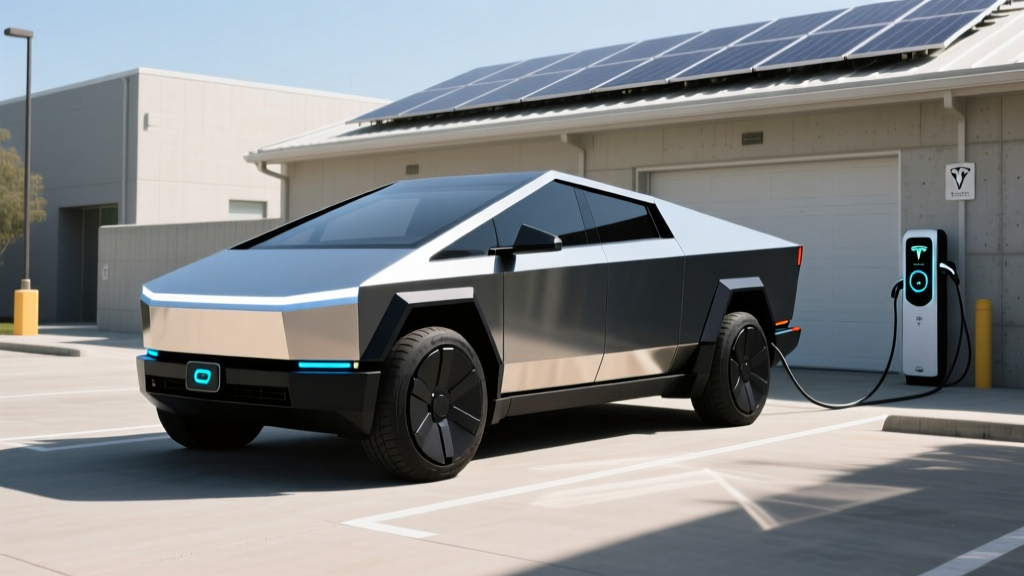
Tesla Cybertruck PowerShare is the truck's bidirectional energy system, enabling vehicle-to-home (V2H) and vehicle-to-load (V2L) power delivery at up to 11.5 kW. For EV owners evaluating the Cybertruck as more than a daily driver — specifically as a home backup power source or off-grid energy supply — PowerShare is arguably the feature that justifies the truck's premium price. This review covers every PowerShare spec, real-world runtime scenario, installation requirement, and ownership cost so you can decide whether it replaces a standby generator for your household.
| Specification | Dual Motor AWD | Cyberbeast (Tri-Motor) |
|---|---|---|
| EPA Range | 340 miles | 320 miles |
| Battery (usable) | ~123 kWh, NMC | ~123 kWh, NMC |
| Max DC Fast Charge | 350 kW (peak) | 350 kW (peak) |
| 10–80% DCFC Time | ~28 minutes | ~28 minutes |
| Level 2 Charge Rate | 11.5 kW / ~44 mi/hr | 11.5 kW / ~44 mi/hr |
| PowerShare Output (max) | 11.5 kW | 11.5 kW |
| PowerShare Bed Outlets | 2× 120V/20A, 1× 240V/48A | 2× 120V/20A, 1× 240V/48A |
| 0–60 mph | 3.9 seconds | 2.6 seconds |
| Horsepower | 600 hp | 845 hp |
| Towing Capacity | 11,000 lbs | 11,000 lbs |
| EPA Efficiency | ~2.0 kWh/mi (50 MPGe) | ~2.2 kWh/mi (46 MPGe) |
What Is Tesla Cybertruck PowerShare and How Does It Work?
PowerShare is Tesla's branding for the Cybertruck's bidirectional charging capability. Unlike standard EVs that only accept energy, the Cybertruck can push energy back out through two pathways:
- Vehicle-to-Load (V2L): Powering tools, appliances, or devices directly through the bed-mounted outlets — up to 9.6 kW from the 240V NEMA 14-50 outlet and up to 1.9 kW each from the two 120V/20A outlets.
- Vehicle-to-Home (V2H): Feeding power into your home's electrical panel through the Tesla PowerShare Wall Connector, sustaining up to 11.5 kW continuous output — enough to run most or all of an average home's circuits during an outage.
The system manages output automatically. If your home's instantaneous draw exceeds 11.5 kW (for example, if central A/C, electric oven, and a clothes dryer all cycle on simultaneously), PowerShare will prioritize circuits based on your configuration in the Tesla app and shed non-essential loads. The Cybertruck's ~123 kWh battery is the energy reservoir; the 11.5 kW inverter hardware built into the truck is what converts DC battery energy to usable AC power.
Real-World Range and PowerShare Runtime: What to Expect
EPA Range: 340 miles (Dual Motor AWD) / 320 miles (Cyberbeast)
Real-World Expectation: Highway driving at 70–75 mph yields approximately 260–290 miles in moderate temperatures. Cold-weather highway range (below 32°F) can drop to 220–250 miles due to increased cabin heating demand and reduced battery efficiency. The stainless-steel exoskeleton creates more aerodynamic drag than a conventional truck, amplifying highway energy consumption.
For PowerShare specifically, what matters is energy capacity, not miles. With ~123 kWh of usable battery, here's how long the Cybertruck can sustain various home loads:
| Scenario | Avg. Draw | Estimated Runtime |
|---|---|---|
| Essential circuits only (fridge, lights, Wi-Fi, a few outlets) | ~1.5 kW | ~80+ hours (3+ days) |
| Moderate whole-home (above + gas furnace fan, TV, microwave intermittently) | ~3.5 kW | ~34 hours |
| Heavy whole-home (above + electric heat or A/C cycling) | ~7.0 kW | ~17 hours |
| Max continuous output | 11.5 kW | ~10.5 hours |
These figures assume you begin with a full charge and reserve approximately 10% battery buffer to protect long-term cell health. Tesla allows you to set a minimum State of Charge (SoC) reserve in the app so you never fully deplete the pack — a smart default for battery longevity.
Charging Speeds: DC Fast Charging and Home Level 2
Charging the Cybertruck is a tale of two realities. At a V4 Tesla Supercharger or compatible 350 kW DC fast charger, the truck peaks near 350 kW but — as with all large-battery EVs — the charge curve tapers significantly above 50–60% SoC. Tesla estimates a 10–80% session in approximately 28 minutes under optimal thermal preconditioning. Expect real-world sessions at older 150 kW Superchargers to take 45–55 minutes for the same 10–80% window.
| Level | Power | Approx. Miles Added per Hour | Notes |
|---|---|---|---|
| Level 1 (120V household) | ~1.4 kW | ~3–4 mi/hr | Emergency only; ~35+ hours for full charge |
| Level 2 (240V/48A) | 11.5 kW | ~44 mi/hr | Full charge in ~11 hours; standard home setup |
| DC Fast (350 kW peak) | Up to 350 kW | N/A (time-based) | 10–80% in ~28 min; tapers above 60% SoC |
| DC Fast (150 kW) | Up to 150 kW | N/A (time-based) | 10–80% in ~45–55 min; common Supercharger tier |
Preconditioning matters: Navigate to a Supercharger using the Cybertruck's built-in navigation and the battery thermal management system will warm the pack to optimal temperature before arrival. Skipping this step — for example, arriving at a charger without navigation routing — can reduce peak charge rates by 30–50% in cold weather.
PowerShare Installation: V2H Setup and Costs
To use PowerShare for whole-home backup, you need the Tesla PowerShare Wall Connector (a bidirectional-capable wall unit) plus a backup gateway/transfer switch installed by a licensed electrician between your main electrical panel and the utility feed. Here's a realistic cost breakdown based on typical 2025–2026 installations:
| Component | Estimated Cost Range |
|---|---|
| Tesla PowerShare Wall Connector (hardware) | $1,200–$1,600 |
| Backup gateway / automatic transfer switch | $800–$1,500 |
| Electrical panel upgrade (if needed, 200A service) | $1,500–$3,500 |
| Electrician labor (8–16 hours typical) | $1,200–$3,000 |
| Permits and inspections | $200–$600 |
| Total (typical install) | $4,900–$10,200 |
Homes with older 100A electrical panels will likely need a service upgrade to 200A, adding $1,500–$3,500. If your panel is already 200A and located near where the Wall Connector will mount, expect costs at the lower end. Always get a site assessment from a licensed electrician before committing — conduit runs, panel location, and local code requirements vary significantly.
For V2L-only use (powering tools or devices directly from the bed outlets), no installation is required. The Cybertruck's bed outlets are ready to use immediately — plug in and go.
Pricing, Trims, and Federal Tax Credit Eligibility
| Trim | Base MSRP | As-Tested (typical options) |
|---|---|---|
| Dual Motor AWD | $79,990 | $83,000–$88,000 |
| Cyberbeast (Tri-Motor AWD) | $99,990 | $103,000–$110,000 |
Federal tax credit (§30D) eligibility is a critical limitation: The Cybertruck's MSRP exceeds the IRS cap for pickup trucks ($80,000 for trucks, vans, and SUVs under current IRS §30D rules). The Dual Motor AWD at $79,990 base MSRP technically sits at the threshold — but adding any factory options (FSD, armor, accessories) pushes the MSRP above $80,000, eliminating eligibility. The Cyberbeast at $99,990 does not qualify regardless of options.
Additional §30D requirements that apply if you do manage to configure a Dual Motor under the cap:
- Buyer income caps: Modified AGI must not exceed $300,000 (joint filers), $225,000 (head of household), or $150,000 (single).
- Battery sourcing: Critical minerals and battery component requirements phase in annually — check IRS guidance for current-year compliance, as Tesla's supply chain sourcing determines eligibility on a per-batch basis.
- Point-of-sale transfer: If eligible, the credit can be transferred to Tesla at purchase, reducing your out-of-pocket cost immediately rather than waiting for tax filing.
Bottom line: most Cybertruck buyers should budget the full MSRP without expecting the federal credit. Consult a tax professional to confirm eligibility for your specific configuration and tax year.
Standout Tech, Drawbacks, and Ownership Considerations
Standout technology:
- 18.5-inch center touchscreen running Tesla's latest vehicle software with native PowerShare monitoring, energy flow visualization, and remote outage-mode activation via the Tesla app.
- Steer-by-wire system with four-wheel steering — gives the 20-foot truck a surprisingly tight turning radius and eliminates the mechanical steering column.
- Tesla Autopilot (SAE Level 2) comes standard; Full Self-Driving (Supervised) is available as an add-on. Both require active driver engagement at all times — this is not autonomous driving.
- Stainless-steel exoskeleton with armored glass; no paint required (though Tesla now offers optional factory color wraps).
- Adaptive air suspension with up to 16 inches of ground clearance in Off-Road mode.
Notable drawbacks:
- Visibility is compromised by the angular design — the rear camera and digital mirror are essential, not optional luxuries.
- The bed is shorter than a full-size truck (approximately 6 feet vs. the 6.5–8 feet typical of F-150/Silverado), limiting utility for large cargo.
- No Apple CarPlay or Android Auto — Tesla's native infotainment is the only option.
- Insurance premiums run 20–40% higher than comparable gas trucks due to repair costs for the stainless-steel body and proprietary parts.
- Public charging outside the Tesla Supercharger network requires a NACS-to-CCS adapter (included), and non-Tesla chargers with tight cable reach can be awkward given the truck's charge port location.
Pros
- 11.5 kW V2H/V2L eliminates need for a standby generator for most homes
- ~123 kWh battery provides 1–3 days of backup power for essential circuits
- Tri-motor Cyberbeast delivers 2.6-second 0–60 — supercar acceleration in a truck
- Steer-by-wire and four-wheel steering make it surprisingly maneuverable
- Access to Tesla Supercharger network (17,000+ stalls in North America)
- OTA software updates continuously add features and refinements
Cons
- $80,000–$110,000 price; most configurations ineligible for federal tax credit
- Real-world highway range 20–25% below EPA due to aero and weight
- V2H installation adds $5,000–$10,000+ on top of vehicle cost
- Short bed limits truck utility for construction or large-item hauling
- High insurance premiums and proprietary repair costs
- Stainless-steel body shows fingerprints, scratches differently than paint
Cargo, Passenger Space, and Warranty
The Cybertruck seats five across two rows. Rear legroom measures approximately 38 inches — adequate for adults but not class-leading versus a crew-cab F-150 or Silverado. The bed offers roughly 34 cubic feet of volume (6-foot length, ~4-foot width between wheel wells), plus a front trunk (frunk) providing approximately 7 cubic feet of lockable, weatherproof storage — useful for charging cables and tools.
Warranty coverage:
| Coverage | Term |
|---|---|
| Basic Vehicle | 4 years / 50,000 miles |
| Battery & Drive Unit | 8 years / 120,000 miles (minimum 70% capacity retention) |
The 8-year/120,000-mile battery warranty with a 70% retention threshold is competitive. Tesla's NMC chemistry in the Cybertruck is proven across the Model S/X/3/Y fleet. Expect approximately 8–12% degradation over the first 100,000 miles based on fleet data from similar Tesla packs, with the rate of loss slowing significantly after the initial break-in period. Frequent PowerShare use at moderate discharge rates (under 5 kW) has minimal additional impact on cycle life — but regularly draining below 20% SoC will accelerate degradation.
Who Should Buy the Cybertruck for PowerShare?
Ideal buyer: Homeowners in areas with frequent multi-hour or multi-day outages (Texas grid events, California PSPS shutoffs, Gulf Coast hurricane seasons) who want a dual-purpose vehicle — daily driver and backup generator — without maintaining a separate gas-powered standby unit. The Cybertruck's 123 kWh battery stores roughly 5–10× the energy of a typical home battery system (Tesla Powerwall stores 13.5 kWh), making it a genuinely compelling backup solution if you also need a truck.
Not ideal for: Budget-conscious buyers (total cost with V2H install approaches $90,000–$120,000), apartment dwellers without home charging access, or those who primarily need a work truck with a long bed for construction or commercial use. For pure backup power without the vehicle cost, a Tesla Powerwall or competitor home battery paired with solar remains more cost-effective.
Frequently Asked Questions
What is the real-world range of the Tesla Cybertruck?
The EPA rates the Dual Motor AWD at 340 miles and the Cyberbeast at 320 miles. In real-world highway driving at 70–75 mph, expect 260–290 miles in moderate weather and 220–250 miles in freezing temperatures. The truck's weight (~6,700 lbs) and angular stainless-steel body create significant aerodynamic drag at highway speeds, which is the primary range killer.
How fast does the Cybertruck charge at home and on the road?
On a Level 2 home charger at 240V/48A, the Cybertruck charges at 11.5 kW, adding approximately 44 miles of range per hour — a full charge takes about 11 hours. On a 350 kW DC fast charger, the 10–80% session takes roughly 28 minutes, though the charge curve tapers significantly above 60% SoC. At older 150 kW Superchargers, plan for 45–55 minutes.
How much does the Cybertruck cost after tax credits?
For most buyers, the full MSRP applies: $79,990 for the Dual Motor AWD and $99,990 for the Cyberbeast. The Dual Motor base MSRP is at the $80,000 truck cap for the §30D federal credit, but adding options pushes it over — and the Cyberbeast is well above the cap. Even at base MSRP, buyer income limits and battery-sourcing rules may disqualify you. Budget the full price.
Is the Cybertruck PowerShare worth it vs. a home generator or Powerwall?
If you already want a Cybertruck as a vehicle, PowerShare is an outstanding no-maintenance backup power solution that outperforms a gas generator (no fuel storage, no engine maintenance, silent operation) and stores far more energy than a single Powerwall (~123 kWh vs. 13.5 kWh). However, if you only need backup power, a Powerwall at ~$12,000–$15,000 installed is far cheaper than buying an $80,000+ truck. PowerShare makes financial sense as a vehicle feature, not as a standalone power investment.
Does the Cybertruck qualify for the federal EV tax credit?
It depends on configuration and buyer income, but most Cybertrucks do not qualify. The IRS §30D credit caps truck MSRP at $80,000. The Dual Motor base price is $79,990, but any factory options push it over. The Cyberbeast at $99,990 is ineligible. Additionally, buyer income must be under $300,000 (joint) / $150,000 (single), and battery-sourcing requirements must be met. Verify current rules at IRS.gov before purchasing.
Can PowerShare power my entire home during an outage?
Yes, for most homes — up to 11.5 kW continuous output covers typical whole-home loads. However, if multiple high-draw appliances (central electric heat, electric oven, dryer) cycle simultaneously, you may exceed 11.5 kW. The PowerShare gateway manages load shedding automatically based on your priority settings. For homes with very high peak demand, a dual PowerShare setup or supplemental Powerwall may be needed.
Does using PowerShare degrade the battery faster?
Moderate V2H/V2L use (discharging at 3–5 kW) has minimal impact on long-term battery health. The primary degradation factor is depth of discharge — regularly draining below 20% SoC accelerates wear. Tesla's app lets you set a minimum SoC reserve (e.g., 20%) so PowerShare stops discharging before reaching damaging levels. Occasional outage use a few times per year will have negligible effect on the 8-year/120,000-mile warranty coverage.
Sources: fueleconomy.gov (EPA range and efficiency data), IRS §30D Clean Vehicle Credit (tax credit rules and MSRP caps), Tesla Cybertruck owner specifications.