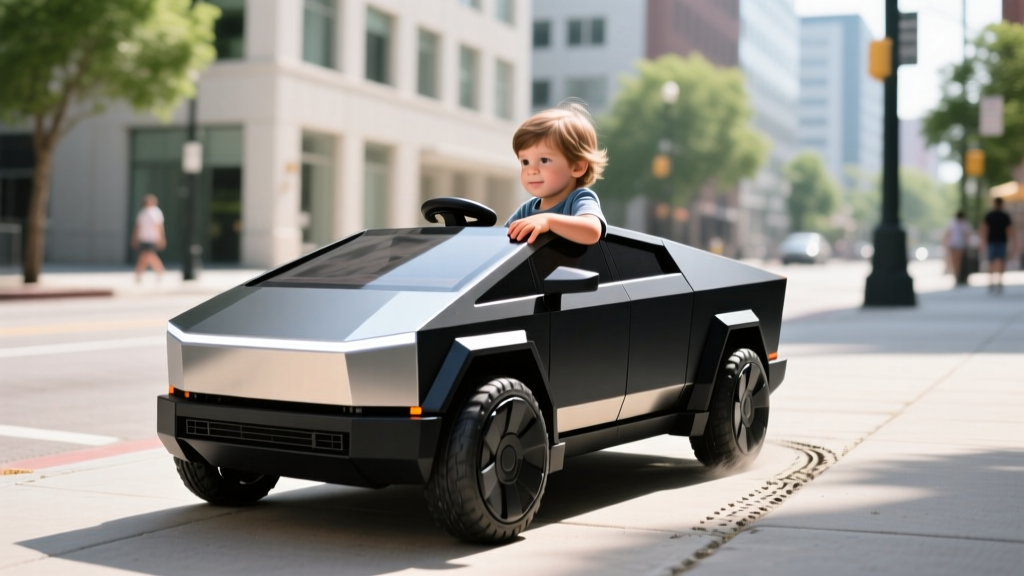
If you've spent any time on EV forums or parent Facebook groups lately, you've probably seen the Tesla Cybertruck Power Wheels ride-on toy making the rounds. Modeled after Tesla's polarizing stainless-steel pickup, this battery-powered kids' vehicle has become one of the most talked-about entries in the ride-on toy market. But strip away the Tesla branding and the angular aesthetic, and what do you actually get for your money?
As someone who has tested everything from full-size electric trucks to the latest ride-on toys for the kids in my life, I'm breaking down the Tesla Cybertruck Power Wheels with the same spec-driven, no-fluff approach I bring to any EV review. Below you'll find battery life data, speed specs, build quality notes, pricing, and a clear-eyed look at whether this toy earns a spot in your garage — or whether a competitor does the job better.
Quick Verdict: What the Tesla Cybertruck Power Wheels Gets Right (and Wrong)
The Tesla Cybertruck Power Wheels ride-on is a licensed, officially branded miniature replica aimed at children roughly ages 3 to 8. It's manufactured under license (typically through Radio Flyer or a similar partner) and carries the Cybertruck's distinctive angular design language in a kid-friendly, low-speed package.
The strengths are obvious: it's a head-turner, the build quality is a step above generic ride-ons, and the Tesla brand cachet makes it a hit at birthday parties and car shows alike. The weaknesses are equally real — the battery capacity limits continuous runtime, the top speed won't thrill older kids, and the price premium over non-branded competitors is substantial.
| Specification | Detail |
|---|---|
| Recommended Age | 3–8 years |
| Weight Capacity | ~65–130 lbs (varies by model year) |
| Battery Type | Sealed lead-acid (SLA) 12V |
| Battery Capacity | ~12 Ah (estimated, not lithium) |
| Top Speed | ~2.5 mph (low) / ~5 mph (high) |
| Runtime Per Charge | ~40–90 minutes (usage-dependent) |
| Charge Time | ~8–14 hours (overnight) |
| Drivetrain | Dual rear-wheel drive (2 motors) |
| Motor Power | ~30W per motor (estimated) |
| Dimensions (L×W×H) | ~44" × 24" × 22" (approx.) |
| Vehicle Weight | ~35–50 lbs |
| MSRP (Base) | $300–$450 (retail) |
| Federal EV Tax Credit | Not eligible (toy, not motor vehicle) |
| Warranty | 1-year limited manufacturer |
Design and Build Quality: Miniature Cybertruck, Real Attention to Detail
The first thing you notice is the design fidelity. Tesla and its licensing partner went to considerable effort to replicate the Cybertruck's angular, origami-fold aesthetic at roughly 1:3 scale. The body panels use textured plastic that mimics the full-size truck's cold-rolled stainless steel look, and the signature light bar across the front actually illuminates.
Build quality sits in the upper tier of the Power Wheels category. The chassis uses a steel-reinforced frame beneath the plastic body shell — a meaningful upgrade over the all-plastic tubs found in budget ride-ons. Wheel construction uses hard plastic with a molded tread pattern, which works well on pavement and packed dirt but struggles on grass or loose gravel.
The interior includes a single bench seat with a molded steering wheel, a working horn button, and a simple forward/reverse selector. There's no seatbelt in most versions (a low-speed toy typically doesn't require one), and the foot-pedal accelerator is positioned for small feet. Parents should note: there's no parent remote override on most Cybertruck Power Wheels models, unlike some competitors that include a Bluetooth remote for steering control.
Battery, Speed, and Runtime: The Numbers That Matter
Let's talk about the battery and drivetrain in detail, because this is where ride-on toys live or die for practical use.
The Tesla Cybertruck Power Wheels uses a 12-volt sealed lead-acid (SLA) battery, typically rated around 12 amp-hours. This is important context: unlike the full-size Cybertruck's lithium-ion (NMC chemistry) traction battery, the toy uses decades-old SLA technology — the same kind found in UPS backups and mobility scooters. It's cheap, safe, and heavy, but it has significant limitations compared to lithium cells.
Runtime Reality Check
Claimed runtime: Up to 90 minutes on a full charge (manufacturer estimate, light use on flat pavement).
Real-world expectation: Plan for 40–60 minutes of continuous use with a child near the weight limit, especially on grass or inclines. SLA batteries suffer significant voltage sag under load — you'll notice the truck slowing noticeably in the last 15–20 minutes of a charge cycle. Cold weather (below 50°F) cuts runtime further, by roughly 20–30%.
The dual rear motors deliver a top speed of approximately 5 mph on the high setting and 2.5 mph on the low setting. The low-speed mode is ideal for toddlers still developing coordination; the high setting is fast enough to be fun for a 6-year-old without being genuinely dangerous. A parent-controlled speed lockout switch is typically included to prevent younger riders from accidentally selecting the high gear.
Charging takes 8 to 14 hours from a depleted state using the included wall adapter (a simple 120V trickle charger). There's no fast-charging option, and you cannot swap in a second battery without modification. Practical advice: charge it overnight after every use, and buy a second battery ($25–$40 for a compatible 12V 12Ah SLA) if your child is a heavy user. Swapping batteries extends play sessions without the overnight wait.
How It Charges: No DC Fast Charging Here
Unlike a full-size EV where we obsess over DC fast-charge curves and peak kW rates, the Cybertruck Power Wheels charging story is simple:
| Charge Level | Power | Time (0–100%) | Notes |
|---|---|---|---|
| Included Wall Charger (120V AC adapter) | ~15–20W | 8–14 hours | Trickle charge; overnight recommended |
| Aftermarket Smart Charger (12V SLA) | ~25–40W | 6–8 hours | Can extend battery life with proper desulfation cycle |
| DC Fast Charge / Level 2 | N/A | N/A | Not supported — SLA battery chemistry |
The included charger is adequate but basic. If you plan to use the toy frequently, a smart SLA charger with an automatic float mode (around $20–$35) will significantly extend battery lifespan. Standard SLA batteries degrade rapidly if stored in a partially discharged state — leaving the Cybertruck Power Wheels uncharged for weeks during winter is the fastest way to kill the battery.
Pricing, Availability, and the Tax Credit Question
The Tesla Cybertruck Power Wheels typically retails between $300 and $450, depending on the specific model variant, retailer, and whether you're buying during a promotional period. Tesla's own shop has carried versions directly, and authorized retailers like Radio Flyer, Amazon, and select toy stores stock it as well.
| Item | Cost |
|---|---|
| Tesla Cybertruck Power Wheels (base model) | $300–$450 |
| Replacement 12V 12Ah SLA battery | $25–$40 |
| Smart SLA charger (recommended upgrade) | $20–$35 |
| Federal EV Tax Credit (§30D) | $0 — Not eligible |
| State/local EV incentives | $0 — Toys are excluded |
| Total realistic first-year cost | $345–$525 |
A frequent question: Does the Tesla Cybertruck Power Wheels qualify for the federal EV tax credit under IRS §30D? The answer is no. The §30D credit applies to new clean motor vehicles — defined as four-wheeled vehicles with a gross vehicle weight rating under 14,000 lbs that are made by a qualified manufacturer and meet battery sourcing, MSRP cap, and buyer income requirements. A children's ride-on toy does not meet the definition of a motor vehicle under NHTSA regulations, regardless of the Tesla branding. No federal, state, or local EV incentive applies to this product.
That said, at $300–$450, the Cybertruck Power Wheels is priced in the premium tier of ride-on toys but not absurdly so. Comparable 12V dual-motor ride-ons from Power Wheels (Fisher-Price), Costzon, and Best Choice Products typically run $180–$350. You're paying a $50–$150 premium for the Tesla licensing and Cybertruck-specific design.
Tech Features: What's Included (and What's Missing)
For a children's toy, the feature list is modest but appropriate:
- Working LED light bar — front and rear, mimicking the Cybertruck's signature lighting
- Dual-speed selector — parent-lockable low/high (2.5 mph / 5 mph)
- Functional horn — button on steering wheel
- Forward/reverse gear selector — simple toggle
- Foot-pedal accelerator — with automatic brake-on-release (lift foot, truck stops)
- Storage bed — small rear cargo area that can hold a water bottle or small toy
What's not included, which some competing ride-ons offer:
- No Bluetooth parent remote control — you cannot steer or stop the truck remotely
- No app connectivity — despite the Tesla brand, there's no phone integration
- No MP3/Bluetooth audio — some competitors include a speaker for music
- No suspension — hard plastic wheels on a rigid frame; bumps are felt
- No seatbelt or harness — acceptable at 5 mph, but worth noting for cautious parents
The lack of a parent remote is the most significant omission. Competitors like the Costzon 12V ride-on trucks and the Best Choice Products licensed Ford F-150 ride-ons include a 2.4GHz Bluetooth remote that lets a parent steer, accelerate, and emergency-stop the vehicle from up to 50 feet away. For children under 4, this feature is a genuine safety advantage.
Pros and Cons: The Honest Scorecard
Pros
- Excellent design fidelity to the real Cybertruck — a genuine conversation-starter
- Steel-reinforced chassis outperforms all-plastic competitors
- Dual 12V motors handle mild inclines and grass better than single-motor toys
- Automatic brake-on-release is intuitive and safe for young children
- Tesla brand licensing ensures a level of quality control above generic ride-ons
- Replacement SLA batteries are cheap and widely available
Cons
- SLA battery limits runtime to ~40–60 min real-world; voltage sag is noticeable
- 12+ hour charge time means one play session per day without a spare battery
- No parent remote override — a real gap vs. competitors for toddlers
- Hard plastic wheels struggle on grass, gravel, and uneven surfaces
- $50–$150 price premium over comparable non-branded 12V ride-ons
- No suspension — ride is harsh on anything but smooth pavement
- Single-seat design limits use to one child at a time
Tesla Cybertruck Power Wheels vs. Key Competitors
How does it stack up against other premium 12V ride-on trucks? Here's a side-by-side comparison against three popular alternatives:
| Feature | Tesla Cybertruck Power Wheels | Power Wheels Ford F-150 (Fisher-Price) | Costzon 12V Ride-On Truck | Best Choice Products 12V Kids' Truck |
|---|---|---|---|---|
| Price | $300–$450 | $280–$380 | $180–$250 | $200–$300 |
| Battery | 12V SLA ~12Ah | 12V SLA ~12Ah | 12V SLA ~7–12Ah | 12V SLA ~10Ah |
| Top Speed | 5 mph | 5 mph | 3–5 mph | 3.7 mph |
| Runtime (real) | 40–60 min | 45–75 min | 30–50 min | 40–60 min |
| Parent Remote | No | No | Yes (2.4GHz) | Yes (2.4GHz) |
| Bluetooth Audio | No | No | Yes | Yes |
| Seats | 1 | 2 | 1–2 | 1–2 |
| Suspension | None | Spring (rear) | Spring (4-wheel) | Spring (rear) |
| Design Appeal | Very high (Tesla brand) | High (Ford license) | Moderate (generic truck) | High (licensed models) |
The Cybertruck Power Wheels wins on design and brand cachet but loses to the Costzon and Best Choice Products options on practical features — specifically the parent remote, Bluetooth audio, and (in some models) two-seat capacity. The Fisher-Price Power Wheels F-150 is the closest direct competitor: similar pricing, similar battery specs, but with a two-seat layout and rear spring suspension.
Who Should Buy the Tesla Cybertruck Power Wheels?
Buy the Cybertruck Power Wheels if:
- Your child (or you, the buyer) is a Tesla fan and the Cybertruck design is the primary draw
- The child is 4–7 years old, under the weight limit, and primarily rides on paved or hard-packed surfaces
- You value build quality and design fidelity over feature count
- You don't mind the runtime limitations and are willing to buy a spare battery
Choose a competitor if:
- Your child is under 3 and you need a parent remote for safety steering
- You want two children to ride simultaneously (look at the Power Wheels F-150 or Costzon two-seater)
- Most riding will happen on grass or rough terrain — the hard plastic wheels are a real limitation
- Budget is tight — the Costzon options deliver 80% of the experience at 50–60% of the price
For families who already own a full-size Tesla (or are on the waitlist for a real Cybertruck), the Power Wheels version is a delightful companion piece. Kids love the visual connection to "mom and dad's truck," and it photographs brilliantly at family events. But if you're evaluating it purely as a ride-on toy with no brand attachment, the feature-per-dollar math favors competitors with parent remotes and better suspension.
Frequently Asked Questions
What is the real-world range and runtime of the Tesla Cybertruck Power Wheels?
Expect approximately 40 to 60 minutes of continuous use on a full charge with a child near the weight limit on flat pavement. Lighter children on smooth surfaces may push closer to 75–90 minutes. Grass, inclines, and cold weather all reduce runtime significantly — plan for 30–40 minutes in those conditions. The SLA battery exhibits noticeable voltage sag in the final 20% of charge, so the truck will slow down before it stops entirely.
How fast does the Tesla Cybertruck Power Wheels charge?
The included 120V wall adapter delivers roughly 15–20 watts to the 12V SLA battery, requiring 8 to 14 hours for a full charge from empty. There is no fast-charging option. A smart SLA charger ($20–$35) can shave 2–4 hours off and will extend overall battery lifespan by preventing overcharge and sulfation. Buy a spare battery and rotate them for all-day play.
How much does the Tesla Cybertruck Power Wheels cost?
Retail pricing ranges from $300 to $450 depending on the model variant and retailer. With a recommended spare battery ($25–$40) and smart charger ($20–$35), total first-year cost lands around $345–$525. No federal or state EV tax credits apply — this is classified as a toy, not a motor vehicle.
Does the Tesla Cybertruck Power Wheels qualify for the federal EV tax credit?
No. Under IRS §30D, the federal clean vehicle credit applies only to qualified motor vehicles meeting specific MSRP caps (under $80,000 for trucks/SUVs), buyer income limits, battery critical-mineral sourcing requirements, and NHTSA motor vehicle classification. A children's ride-on toy does not meet any of these criteria. State and local EV incentives similarly exclude toys.
Is the Tesla Cybertruck Power Wheels worth buying vs. competitors?
If design and brand appeal are your top priorities — yes, it's worth the premium. The Cybertruck aesthetic is unmatched, build quality is above average, and Tesla fans (kids and adults) get genuine joy from the visual connection to the real vehicle. If practical features matter more — parent remote control, Bluetooth audio, two-seat capacity, suspension — competitors like the Costzon 12V truck or the Power Wheels Ford F-150 offer more capability for similar or lower prices.
What are the biggest pros and cons?
Pros: Outstanding Cybertruck design fidelity, steel-reinforced frame, dual-motor capability, automatic brake-on-release safety, strong brand appeal. Cons: Limited 40–60 min real-world runtime, 8–14 hour charge time, no parent remote, hard plastic wheels perform poorly off-pavement, no suspension, premium pricing vs. feature-rich competitors.
What age is the Tesla Cybertruck Power Wheels best for?
The manufacturer recommends ages 3–8, but the sweet spot is 4 to 7 years old. Three-year-olds may find the controls slightly complex and the lack of a parent remote is a concern at that age. Children over 8 will likely find the 5 mph top speed underwhelming and may approach the weight limit, which further reduces performance.
Sources: Product specifications from Tesla Shop and authorized retailer listings; IRS §30D Clean Vehicle Credit guidelines; NHTSA motor vehicle classification standards.