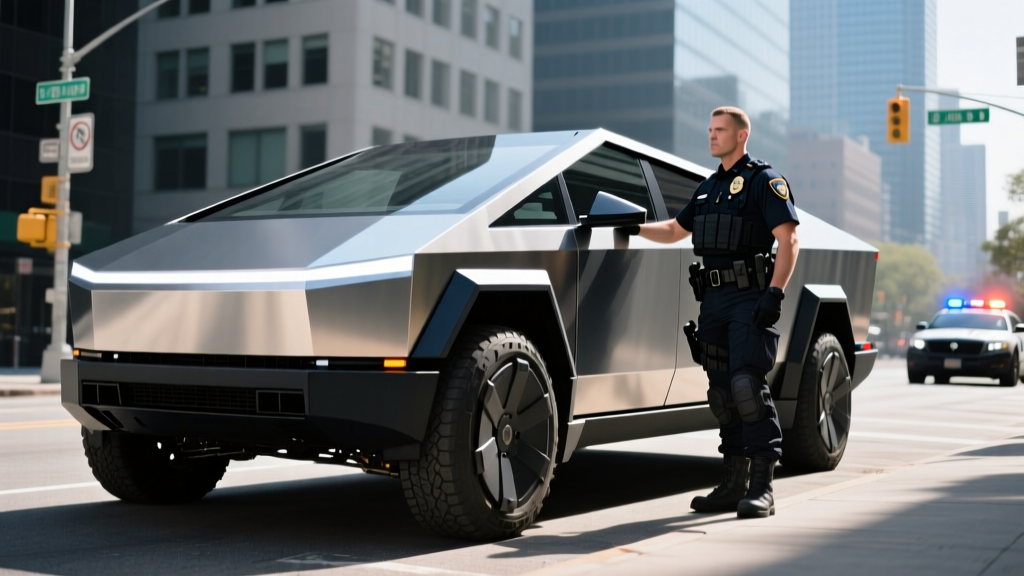
The search for a Tesla police truck leads to one candidate: the Cybertruck. Since its late-2023 launch, several law enforcement agencies have explored or adopted the Cybertruck as a patrol and specialty vehicle. But does an electric stainless-steel wedge actually make sense for police work? This review examines the 2025/2026 Cybertruck through a fleet-buyer and taxpayer lens — range under pursuit conditions, charging logistics, upfit feasibility, total cost of ownership, and how it stacks up against the Ford F-150 Lightning and Chevrolet Silverado EV that departments are also evaluating.
Quick Verdict: The Cybertruck as a Police Platform
The Cybertruck offers compelling advantages for specific law enforcement roles — particularly community liaison, traffic enforcement, and urban patrol where its 0-60 time, low running costs, and attention-grabbing design serve recruitment and visibility goals. However, its angular bed geometry, limited aftermarket upfit ecosystem, and range degradation under high-speed pursuit conditions make it a specialty tool rather than a wholesale replacement for traditional police interceptors. Departments considering it should treat it as a supplement to, not a substitute for, purpose-built pursuit vehicles like the Ford Explorer Police Interceptor or Dodge Charger Pursuit.
| Specification | AWD (Dual-Motor) | Cyberbeast (Tri-Motor) |
|---|---|---|
| EPA Range | 340 miles | 320 miles |
| Battery Capacity (usable) | ~123 kWh (NMC) | ~123 kWh (NMC) |
| Peak DC Fast Charge | 250 kW | 250 kW |
| 10–80% DC Charge Time | ~28 minutes | ~28 minutes |
| Level 2 Home/Depot Rate | 11.5 kW (~37 mi/hr) | 11.5 kW (~37 mi/hr) |
| 0–60 mph | 4.1 seconds | 2.6 seconds |
| Horsepower | 600 hp | 845 hp |
| Drivetrain | Dual-Motor AWD | Tri-Motor AWD |
| Towing Capacity | 11,000 lbs | 11,000 lbs |
| MPGe (combined) | 79 MPGe | 76 MPGe |
| Efficiency | 43 kWh/100mi | 45 kWh/100mi |
| Base MSRP | $79,990 | $99,990 |
| Battery Warranty | 8 yr / 150,000 mi | 8 yr / 150,000 mi |
Real-World Range: What Patrol Use Actually Looks Like
EPA Sticker: 340 miles (AWD) / 320 miles (Cyberbeast)
Real-World Highway (70 mph): Expect 250–280 miles
Real-World Patrol (mixed city/idle/siren load): ~200–240 miles effective
Cold-Weather Penalty (below 30°F): 20–30% range reduction — plan for 160–200 miles in northern winters
Police work is not a highway commute. Patrol vehicles spend hours idling with electronics running — radios, MDTs (mobile data terminals), light bars, and HVAC — all drawing from the traction battery. Tesla's architecture handles accessory loads better than an idling gas engine (no fuel waste, instant torque when needed), but the cumulative drain matters. A typical 10-hour shift with 80 miles of driving and 4+ hours of stationary electronics use might consume the equivalent of 150–180 miles of range, depending on climate control demands.
High-speed pursuit is the worst-case scenario for any EV. Sustained speeds above 100 mph cause energy consumption to spike exponentially due to aerodynamic drag. The Cybertruck's 0.384 Cd (drag coefficient) is poor by EV standards — its angular design prioritizes aesthetics and stainless-steel stamping over aerodynamics. In real-world testing by independent reviewers, highway efficiency at 75 mph drops to roughly 50–55 kWh/100mi, cutting effective range to around 220–240 miles from a full charge.
For departments in temperate climates with predictable shift patterns and depot charging, the Cybertruck's range is workable. For rural agencies covering 200+ mile beats or northern departments facing sub-zero winters, range planning becomes a daily operational constraint.
Charging Infrastructure: The Fleet Depot Question
| Charging Level | Power (kW) | Miles Added per Hour | Full Charge Time |
|---|---|---|---|
| Level 1 (120V, 15A) | 1.4 kW | ~3–4 mi/hr | ~80+ hours |
| Level 2 (240V, 48A) | 11.5 kW | ~37 mi/hr | ~12–14 hours |
| DC Fast (peak) | 250 kW | ~13 mi/min (peak) | 10–80% in ~28 min |
| Tesla Supercharger V4 | Up to 250 kW | ~13 mi/min (peak) | 10–80% in ~28 min |
Fleet charging is the make-or-break factor for any electric police vehicle. Most police vehicles return to a depot or station between shifts, making overnight Level 2 charging the primary strategy. At 11.5 kW, a Cybertruck recovering 200 miles of range needs roughly 5.5 hours on a Level 2 station — easily achievable during an 8–12 hour off-shift window.
However, departments must budget for charging infrastructure. A single commercial Level 2 station (ChargePoint, EVgo, or Tesla Wall Connector) installed at a depot costs $2,000–$6,000 per stall including electrical work, with a 240V/60A circuit requiring a dedicated breaker. A fleet of 10 Cybertrucks needs at minimum 5–10 Level 2 ports (assuming staggered shifts), representing a $20,000–$60,000 upfront infrastructure investment. Some agencies have secured federal or state grants to offset these costs.
DC fast charging at 250 kW means a mid-shift top-up from 20% to 80% takes about 28 minutes at a Tesla Supercharger. The charge curve tapers significantly above 80% — going from 80% to 100% can take nearly as long as 10–80%, so fleet managers should target the 20–80% window for operational efficiency. The Cybertruck's NMC battery chemistry supports repeated fast charging, but Tesla recommends limiting daily charges to 80–90% for longevity, reserving 100% for when maximum range is genuinely needed.
One advantage: Tesla's Supercharger network is the most reliable public DC network in the US, with uptime consistently above 95%. For agencies without depot charging, proximity to Superchargers becomes a route-planning factor.
Performance: Pursuit Capability and Powertrain
The Cybertruck AWD hits 60 mph in 4.1 seconds; the Cyberbeast does it in 2.6 seconds. For context, a Ford Explorer Police Interceptor Hybrid does 0–60 in roughly 7.5 seconds, and a Dodge Charger Pursuit V8 manages about 5.5 seconds. The Cybertruck's instant electric torque delivers off-the-line acceleration that no conventional pursuit vehicle can match, which matters for traffic enforcement and merging into emergency response scenarios.
The dual-motor AWD system provides excellent traction in rain and light snow without the mechanical complexity of a traditional transfer case. Regenerative braking recovers energy during deceleration, reducing brake wear — a meaningful maintenance savings for stop-and-go patrol driving. Tesla's brake pads routinely last 100,000+ miles in normal use due to regen handling most deceleration.
However, sustained high-speed pursuit generates significant heat in the battery pack and motors. Tesla's thermal management system is robust, but any EV will eventually thermally limit power output under continuous extreme load. For prolonged high-speed scenarios (think highway pursuits lasting 15+ minutes), agencies should have backup interceptor vehicles available. The Cybertruck is best suited as a first-response and traffic enforcement platform rather than a dedicated pursuit unit.
The stainless-steel exoskeleton offers inherent crash protection — its body panels are far more impact-resistant than conventional aluminum or steel body-on-frame trucks. NHTSA has not published a full crash rating for the Cybertruck as of early 2026, which is a consideration for fleet risk managers who rely on standardized safety data.
Upfit and Equipment: The Aftermarket Gap
This is where the Tesla police truck concept meets reality. Traditional police upfitters (Setina, Whelen, Code 3) have decades of templates for Crown Vics, Explorers, Tahoes, and Chargers. The Cybertruck's angular stainless-steel body, unconventional bed shape, and integrated electronics architecture present unique challenges:
- Light bars: The roofline is angular and relatively low-profile. Standard crossbar light bars require custom mounting brackets. Several upfitters (including Whelen) have begun offering Cybertruck-specific solutions, but options remain limited compared to conventional platforms.
- Partitions and cages: The interior cabin geometry differs from traditional body-on-frame trucks. Custom prisoner transport partitions are available from niche upfitters but are not yet widely standardized.
- Bed storage: The Cybertruck's 6-foot bed with powered tonneau cover is shorter and more angular than a standard F-150 or Silverado bed. Standard slide-out equipment trays and lockboxes require modification.
- Electrical integration: Siren controllers, radios, and MDTs need 12V auxiliary power. The Cybertruck has a 12V system but integrating high-draw police electronics without voiding warranty provisions requires Tesla-authorized or experienced upfitters.
- Push bumpers: Front-end push bars for PIT maneuvers or obstacle clearance are available from a handful of manufacturers, but the Cybertruck's front-end geometry (crumple zones, sensor placement) complicates design.
Several agencies — including the police departments in Irving, Texas, and South Pasadena, California — have deployed Cybertrucks in community-facing or specialty roles rather than as primary patrol units. These deployments typically involve lighter upfit packages (decal wraps, basic light bars, radio integration) rather than full interceptor builds.
Pricing, Tax Credits, and Fleet Economics
| Trim | Base MSRP | Federal §30D Credit | Effective Price |
|---|---|---|---|
| AWD (Dual-Motor) | $79,990 | $0 (exceeds MSRP cap) | $79,990 |
| Cyberbeast (Tri-Motor) | $99,990 | $0 (exceeds MSRP cap) | $99,990 |
The IRS §30D clean vehicle credit caps eligible trucks at an $80,000 MSRP. The Cybertruck AWD at $79,990 technically falls under this cap, but any added options (FSD, accessories, destination charges) push it above the threshold. Additionally, the buyer must meet income caps ($150,000 single / $300,000 joint) and the vehicle must satisfy critical-mineral and battery-component sourcing requirements that have tightened significantly under 2024–2026 rules.
For fleet purchases by government entities, the §30D credit is largely irrelevant — municipalities don't pay federal income tax and cannot claim it directly. However, the elective pay provision (IRC §6417) allows tax-exempt organizations, including state and local governments, to receive a direct payment equivalent to the credit amount. This makes the credit potentially accessible for municipal fleet purchases, subject to the same MSRP and sourcing rules.
The real economic case for a Tesla police truck rests on total cost of ownership (TCO):
- Fuel savings: At $3.50/gallon and 15 MPG for a gas interceptor, fueling costs ~$0.23/mile. The Cybertruck at $0.13/kWh (national fleet electricity average) and 43 kWh/100mi costs ~$0.056/mile — a savings of ~$0.17/mile. Over 100,000 miles, that's $17,000 in fuel savings.
- Maintenance savings: No oil changes, no transmission fluid, minimal brake wear (regen braking), no spark plugs, no emissions testing. Fleet maintenance savings typically run $3,000–$5,000 over 100,000 miles vs. a gas interceptor.
- Higher upfront cost: A Ford F-150 Police Responder starts around $55,000–$60,000. The Cybertruck AWD at $79,990 represents a $20,000+ premium before upfit.
- Insurance: Cybertruck insurance premiums are 30–50% higher than comparable trucks due to stainless-steel body repair costs and limited collision-repair network. Fleet insurance negotiations should factor this in.
For a department running a vehicle 25,000 miles/year over 5 years (125,000 miles total), the fuel and maintenance savings roughly offset the higher purchase price — but only if the vehicle remains in service for its full lifecycle and charging infrastructure costs are amortized across multiple vehicles.
Interior, Tech, and Daily Usability
The Cybertruck's cabin seats five with 36.1 inches of rear legroom — adequate for a front-seat officer and rear-seat transport, though the angular roofline limits headroom for taller officers. The 18.5-inch center touchscreen handles navigation, climate, and vehicle settings. Tesla's interface is responsive but lacks the physical buttons that officers prefer when operating controls while driving — adjusting climate or accessing camera views requires screen taps rather than tactile controls.
The integrated Tesla app provides fleet managers with real-time vehicle location, charge status, and remote preconditioning — useful for warming or cooling the cabin before a shift without idling. Over-the-air updates continuously add features and refine performance, though they also mean the vehicle's behavior can change without fleet mechanic intervention.
Autopilot and FSD (Supervised) are available but must be understood correctly:
SAE Level 2 — Driver Assistance, NOT Self-Driving.
Tesla Autopilot and FSD (Supervised) require the driver to remain fully engaged, hands on the wheel, eyes on the road at all times. These systems assist with lane centering, adaptive cruise, and navigation-guided lane changes, but the officer is responsible for all driving decisions. No Tesla vehicle is autonomous. Level 4 driverless capability exists only in geofenced robotaxi services like Waymo.
For police use, Autopilot can reduce fatigue on highway patrols and long transport drives, but agencies must establish clear policies about its use during emergency response (it should be disengaged during lights-and-sirens operation).
Notable drawbacks for police use:
- No Apple CarPlay or Android Auto — Tesla's proprietary system only
- Stainless-steel body panels are dent-resistant but expensive to replace if severely damaged; few body shops are equipped for repairs
- Ride quality is firm, particularly with the 20-inch wheels; officers on 10-hour shifts may find it less comfortable than a body-on-frame SUV
- Tonneau cover motor and bed design limit traditional cap/canopy upfits for equipment storage
- Public attention — the Cybertruck draws crowds and cell-phone cameras, which can complicate traffic stops and community interactions
Cybertruck vs. Ford F-150 Lightning vs. Chevrolet Silverado EV for Fleet Duty
| Attribute | Tesla Cybertruck AWD | Ford F-150 Lightning (Ext. Range) | Chevy Silverado EV 4WT |
|---|---|---|---|
| EPA Range | 340 mi | 320 mi | 492 mi (3WT/4WT) |
| Battery | ~123 kWh (NMC) | 131 kWh (NMC) | ~200 kWh (NMC) |
| Peak DC Charge | 250 kW | 150 kW | 350 kW |
| 10–80% Time | ~28 min | ~41 min | ~20 min |
| 0–60 mph | 4.1 sec | 4.0 sec | ~4.5 sec |
| Base MSRP (Fleet-Relevant) | $79,990 | ~$69,995 | ~$72,900 (3WT) |
| Upfit Ecosystem | Limited / Emerging | Strong (established upfitters) | Moderate (growing) |
| Bed Length | 6 ft | 5.5 ft (5.5-ft box) | 5 ft 11 in |
| Towing | 11,000 lbs | 10,000 lbs | 10,000 lbs |
| ProPower / V2L | Powershare (120V/240V) | ProPower Onboard (9.6 kW) | V2L capable |
The Ford F-150 Lightning remains the most practical electric police truck for most agencies. Ford's established police upfitter network, ProPower Onboard (which can power scene lighting, command posts, or even a station during outages), and lower base price make it the fleet manager's pragmatic choice. The Cybertruck wins on acceleration, Supercharger network access, and sheer visibility. The Silverado EV offers the longest range by a wide margin (492 miles EPA on the 3WT/4WT work truck trims), making it the strongest candidate for rural agencies, but its 200 kWh battery means longer charge times at lower-power stations and a higher purchase price.
Who Should Consider a Tesla Police Truck?
Choose the Cybertruck if:
- Your department prioritizes community engagement and recruitment visibility — the Cybertruck generates enormous public interest and social media attention
- You have depot charging infrastructure or proximity to Tesla Superchargers
- The vehicle will serve in traffic enforcement, community liaison, or specialty roles rather than as a primary pursuit interceptor
- You operate in a temperate climate where cold-weather range loss is manageable
- Your fleet plan includes a 5+ year ownership cycle to recoup fuel and maintenance savings
Choose the F-150 Lightning or Silverado EV if:
- You need a proven upfit ecosystem with standardized police equipment integration
- Your officers require a conventional truck bed for equipment trays, lockboxes, or canopy upfits
- Your agency is risk-averse regarding repair networks and insurance costs
- You need maximum range (Silverado EV) or established fleet management tools (Ford Pro)
Pros and Cons
Pros
- Class-leading acceleration (4.1s / 2.6s 0–60) for traffic enforcement and rapid response
- Low per-mile energy cost (~$0.056/mi vs $0.23/mi for gas interceptors)
- Minimal scheduled maintenance — no oil, transmission, or spark plug service
- Stainless-steel body is highly dent- and corrosion-resistant
- Tesla Supercharger network provides reliable long-distance capability for transport/training trips
- Over-the-air updates and remote fleet management via Tesla app
- Strong public visibility — effective for recruitment and community engagement
Cons
- $79,990+ base price — significantly higher than gas interceptors or F-150 Lightning
- Limited police-specific upfit ecosystem; custom solutions required for most equipment
- Short 6-foot bed limits equipment storage vs. standard full-size trucks
- High insurance premiums due to repair costs and limited body-shop network
- Firm ride quality may cause fatigue on long shifts
- No Apple CarPlay/Android Auto — proprietary Tesla interface only
- Cold-weather range loss (20–30%) requires careful shift planning in northern climates
- No NHTSA crash rating published as of early 2026
Frequently Asked Questions
What is the real-world range of the Cybertruck during a police shift?
The EPA rates the AWD at 340 miles, but real-world patrol use — with idling electronics, HVAC, and mixed-speed driving — typically yields 200–240 effective miles per charge. Highway driving at 75+ mph reduces range to roughly 250–280 miles. In cold weather (below 30°F), expect a further 20–30% reduction.
How fast does the Cybertruck charge at a depot or Supercharger?
On a Level 2 depot charger (11.5 kW), the Cybertruck adds about 37 miles per hour — a full overnight shift (10–12 hours) recovers most of a day's patrol use. At a Tesla Supercharger, it peaks at 250 kW and charges from 10–80% in approximately 28 minutes, though the charge rate tapers significantly above 80%.
Does the Cybertruck qualify for the $7,500 federal EV tax credit?
The AWD trim at $79,990 base MSRP technically falls under the §30D truck MSRP cap of $80,000, but adding any options pushes it above. Additionally, buyer income caps and battery-sourcing requirements apply. For government fleet purchases, the elective pay provision (IRC §6417) may allow tax-exempt entities to receive a direct payment — consult the IRS guidelines and a tax professional for your specific situation.
Is the Cybertruck worth buying vs. the F-150 Lightning for police use?
For most departments, the F-150 Lightning is the more practical choice — lower price, established upfit ecosystem, ProPower Onboard for scene power, and Ford Pro fleet management tools. The Cybertruck makes sense as a specialty or community-engagement vehicle where its visibility, acceleration, and Supercharger access justify the higher cost and upfit limitations.
Can the Cybertruck be used for high-speed pursuits?
It can, but it shouldn't be a department's primary pursuit vehicle. Sustained high-speed driving rapidly depletes the battery and generates significant thermal load. The Cybertruck is best suited as a first-response, traffic enforcement, and patrol platform, with dedicated pursuit interceptors (gas or electric) available as backup.
What is the Cybertruck's battery warranty?
Tesla covers the battery and drive unit for 8 years or 150,000 miles, whichever comes first, with a minimum 70% capacity retention guarantee. For fleet vehicles accumulating high mileage quickly, this warranty provides meaningful protection through the typical first-owner lifecycle.
How much does it cost to charge a Cybertruck vs. fueling a gas interceptor?
At a national fleet electricity average of ~$0.13/kWh, fully charging the Cybertruck's ~123 kWh battery costs roughly $16 — yielding 300+ real-world miles. Fueling a gas interceptor getting 15 MPG for the same 300 miles at $3.50/gallon costs about $70. Over 100,000 miles, the energy cost savings exceed $17,000.