Quick Verdict: Is the Cybertruck Ready for Police Duty?
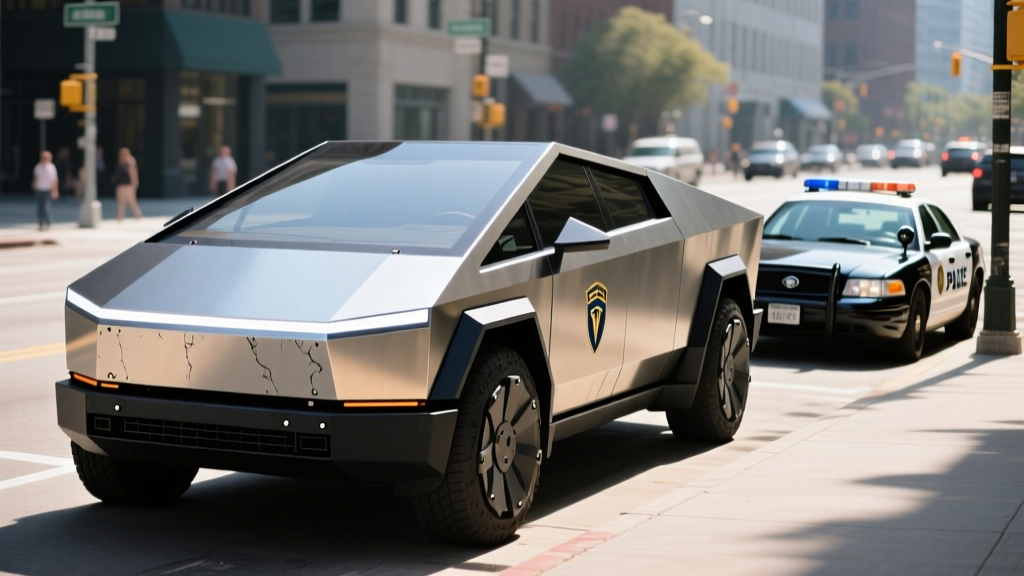
The Tesla Cybertruck has generated significant interest from law enforcement agencies exploring electric vehicle adoption. While its stainless steel exoskeleton and impressive performance metrics make headlines, the practical realities of police fleet deployment reveal a more nuanced picture. This review examines whether the Cybertruck's specifications align with the demanding requirements of patrol work, pursuit scenarios, and 24/7 fleet operations.
| Specification | Cybertruck AWD | Cybertruck Beast |
|---|---|---|
| EPA Range | 340 miles | 320 miles |
| Battery Capacity | ~123 kWh (NMC) | ~123 kWh (NMC) |
| 0-60 mph | 4.1 seconds | 2.6 seconds |
| Horsepower | 600 hp | 845 hp |
| Top Speed | 112 mph | 130 mph |
| Max DC Fast Charge | 250 kW | 250 kW |
| 10-80% DC Charge | ~18 minutes | ~18 minutes |
| Level 2 Home Charging | 11.5 kW (44 mi/hr) | 11.5 kW (44 mi/hr) |
| Towing Capacity | 7,500 lbs | 7,500 lbs |
| Cargo Volume (Bed) | 74 cu ft | 74 cu ft |
| Base MSRP | $79,990 | $99,990 |
Range and Efficiency: Real-World Patrol Considerations
The EPA rates the dual-motor AWD Cybertruck at 340 miles and the tri-motor Beast at 320 miles. However, police operations demand a more realistic assessment of range under operational conditions.
Real-World Range Reality: In mixed patrol use combining city stop-and-go, highway response, and idle time with emergency equipment running, expect 220-260 miles of practical range. Cold-weather testing shows 25-30% range reduction in sub-40°F conditions, dropping effective range to 170-200 miles. Highway-speed pursuits at 80+ mph further reduce efficiency due to the Cybertruck's brick-like aerodynamics (drag coefficient ~0.38).
Efficiency metrics from fueleconomy.gov show the AWD model achieves 70 MPGe combined (48 kWh/100mi), while the Beast drops to 65 MPGe (52 kWh/100mi). For fleet managers calculating operational costs, this translates to roughly $0.12-0.15 per mile at average commercial electricity rates, compared to $0.18-0.22 per mile for gasoline in comparable full-size trucks.
Charging Infrastructure: Fleet Depot Challenges
Police fleet charging presents unique logistical challenges that differ significantly from consumer home charging scenarios. The Cybertruck's charging capabilities must align with shift patterns and rapid-response requirements.
| Charging Method | Power | Miles Added per Hour | Time for 200 Miles |
|---|---|---|---|
| Level 1 (120V) | 1.4 kW | 5 mi/hr | 40 hours |
| Level 2 (240V/48A) | 11.5 kW | 44 mi/hr | 4.5 hours |
| DC Fast Charge | 250 kW peak | N/A | ~18 min (10-80%) |
For 24/7 patrol operations, Level 2 depot charging requires strategic scheduling. A typical 8-hour shift covering 150-200 miles needs a full recharge between shifts, demanding either multiple vehicles per charger or extended downtime. DC fast charging at Tesla Superchargers or compatible CCS stations (with adapter) can restore 80% in under 20 minutes, but peak rates only sustain until ~50% state of charge before tapering. Fleet managers must account for this charge curve when planning rapid turnaround scenarios.
Home charging for take-home patrol units works well with Level 2 installation, but requires electrical panel capacity assessment. Most residential installations cost $1,200-2,500 for the charger and electrician work, assuming a 200-amp panel with available capacity.
Performance and Capability: Pursuit and Utility
The Cybertruck's performance specifications exceed traditional police interceptors in straight-line acceleration. The Beast model's 2.6-second 0-60 mph time outpaces the Ford Police Interceptor Utility (5.5 seconds) and Dodge Charger Pursuit (5.8 seconds). However, pursuit driving involves more than acceleration—handling, braking, and visibility matter critically.
The Cybertruck's 6,800-pound curb weight (AWD) creates significant momentum that impacts braking distances and tire wear during aggressive maneuvers. The steer-by-wire system provides quick response but lacks traditional steering feel feedback that officers rely on during high-speed operations. Ground clearance of 16.1 inches and approach/departure angles support off-road capability for rural or disaster-response scenarios.
Towing capacity of 7,500 pounds enables trailer deployment for mobile command posts or equipment transport, though towing reduces range by 40-50% based on Tesla's own guidance.
Pricing and Tax Credit Eligibility
The Cybertruck's pricing places it in premium fleet territory, requiring careful cost-benefit analysis against conventional alternatives.
| Model | Base MSRP | Federal Tax Credit | Effective Price |
|---|---|---|---|
| Cybertruck AWD | $79,990 | $0 (exceeds MSRP cap) | $79,990 |
| Cybertruck Beast | $99,990 | $0 (exceeds MSRP cap) | $99,990 |
Critical Tax Credit Note: The Cybertruck does NOT qualify for the federal §30D tax credit. IRS rules cap eligible trucks at $80,000 MSRP, and both Cybertruck variants exceed this threshold (source: IRS.gov). Even the base AWD model at $79,990 sits at the absolute limit, and any options or destination charges push it over. Additionally, buyer income caps ($300k joint/$150k single) and battery sourcing requirements further restrict eligibility. Government fleet purchases may qualify under separate commercial clean vehicle credit (§45W), but this requires consultation with municipal finance departments.
For police departments, total cost of ownership calculations must factor in higher upfront cost against lower fuel and maintenance expenses. Tesla's 8-year/100,000-mile battery warranty (minimum 70% capacity retention) provides some long-term assurance, though police use patterns with frequent fast charging may accelerate degradation compared to consumer driving.
Cargo, Equipment, and Upfitting
The Cybertruck's 6.5-foot bed offers 74 cubic feet of cargo space, but the sloped bed design and tonneau cover limit vertical clearance for traditional police equipment racks. Departments must evaluate whether standard light bars, prisoner transport cages, and weapon lockers can be adapted to the Cybertruck's unconventional geometry.
Interior space accommodates five passengers with 41.5 inches of front legroom and 38.2 inches in rear—adequate for most officers but tighter than full-size SUV interceptors. The 18.5-inch touchscreen controls most vehicle functions, which could present distraction concerns during high-stress driving scenarios.
Tesla's Autopilot and Full Self-Driving (Supervised) features are SAE Level 2 driver assistance systems requiring constant driver engagement—these are NOT autonomous driving capabilities. While adaptive cruise and lane-keeping can reduce fatigue during highway patrols, officers must maintain hands-on-wheel awareness and cannot rely on these systems during emergency responses.
Pros and Cons for Police Fleet Deployment
Pros
- Exceptional acceleration for pursuit scenarios (Beast model)
- Lower per-mile fuel cost vs gasoline interceptors
- Stainless steel body resists minor impacts and vandalism
- Strong towing capacity for equipment trailers
- Over-the-air updates can add features post-purchase
- Reduced maintenance (no oil changes, fewer brake replacements with regen)
Cons
- No federal tax credit due to MSRP cap
- Limited upfitting options and aftermarket police equipment
- High initial purchase price vs traditional interceptors
- Charging infrastructure demands for 24/7 operations
- Weight impacts tire wear and braking performance
- Unproven long-term durability in police fleet conditions
- Steer-by-wire lacks traditional feedback for pursuit driving
Who Should Consider the Cybertruck for Police Use?
The Cybertruck makes most sense for departments with specific operational profiles: agencies with depot charging infrastructure already in place, jurisdictions prioritizing visible EV adoption for community relations, and units requiring occasional heavy towing capability. It's less suited for departments needing proven upfitting ecosystems, operating in extreme cold climates, or running high-mileage 24/7 patrol rotations where charging downtime creates coverage gaps.
For most law enforcement agencies, conventional hybrid interceptors or purpose-built electric police vehicles (when available) offer more practical near-term solutions. The Cybertruck remains a viable option for specialized units, take-home programs in EV-friendly regions, or departments willing to invest in charging infrastructure as part of broader electrification initiatives.
What is the real-world range for police patrol use?
Expect 220-260 miles in mixed patrol conditions, dropping to 170-200 miles in cold weather or during high-speed operations.
How fast does it charge at a depot?
Level 2 charging adds 44 miles per hour, requiring 4-5 hours for a full charge. DC fast charging reaches 80% in 18 minutes but requires Supercharger access.
Does the Cybertruck qualify for federal tax credits?
No. Both variants exceed the $80,000 MSRP cap for the §30D credit. Government fleets may qualify under §45W commercial credits with proper documentation.
Is it worth buying vs Ford Police Interceptor?
For most departments, no—the Ford offers proven upfitting, lower cost, and established fleet support. The Cybertruck suits specialized use cases with charging infrastructure already in place.
What are the biggest maintenance concerns?
Tire wear due to vehicle weight and instant torque, potential steer-by-wire service complexity, and battery degradation from frequent fast charging in patrol cycles.
Can it handle police equipment and upfitting?
Currently limited. The unconventional bed design and lack of established police upfitter partnerships make standard equipment installation challenging compared to traditional interceptors.