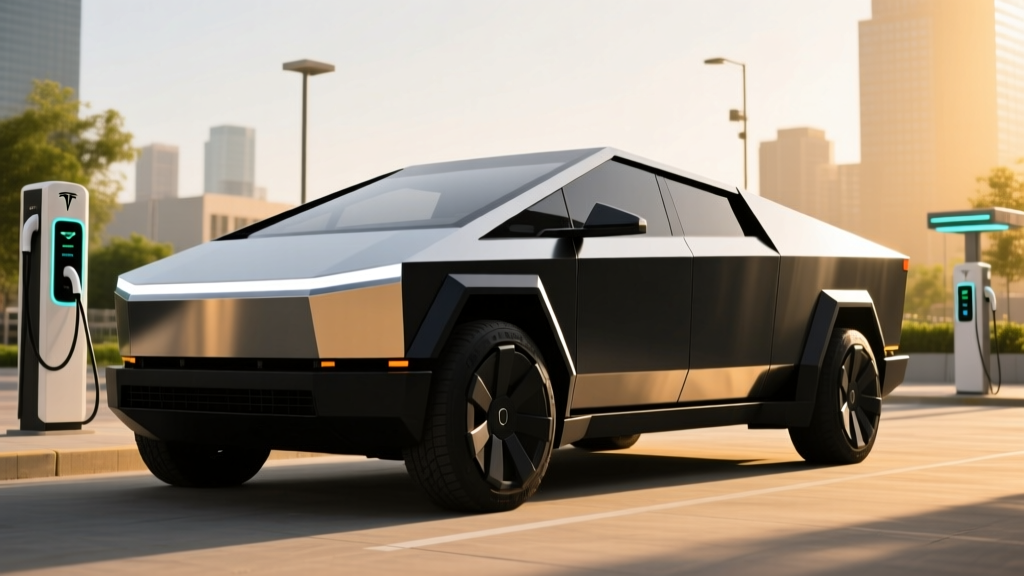
If you've been searching for Tesla Cybertruck photos to decide whether the angular electric pickup deserves a spot in your garage, you're not alone. The Cybertruck remains one of the most polarizing—and most photographed—vehicles on the road. But beyond the stainless-steel exoskeleton and the viral drag races, there's a serious electric truck underneath with real towing capability, legitimate off-road chops, and a charging architecture that pushes the limits of public DC infrastructure.
This review goes past the gallery. We break down the 2025/2026 Cybertruck lineup with exact EPA range figures, real-world efficiency data, charging curves, tax-credit eligibility, and the ownership realities Tesla doesn't highlight in its marketing renders.
2026 Tesla Cybertruck: Spec Sheet at a Glance
| Spec | AWD | Cyberbeast |
|---|---|---|
| EPA Range | 340 mi | 320 mi |
| Battery (usable) | ~123 kWh (NMC, 800V arch.) | ~123 kWh (NMC, 800V arch.) |
| Drivetrain | Dual-Motor AWD | Tri-Motor AWD |
| Horsepower | 600 hp | 845 hp |
| 0–60 mph | 4.1 sec | 2.6 sec |
| Max DC Charge Rate | ~250 kW (peak) | ~250 kW (peak) |
| 10–80% DC Time | ~28 min | ~28 min |
| Level 2 Rate | 11.5 kW (~37 mi/hr) | 11.5 kW (~37 mi/hr) |
| Towing Capacity | 11,000 lb | 11,000 lb |
| Payload | 2,500 lb | 2,500 lb |
| Bed Length | 6 ft (72 in) | 6 ft (72 in) |
| Cargo (bed + frunk) | ~67 cu ft bed / ~10 cu ft frunk | ~67 cu ft bed / ~10 cu ft frunk |
| Efficiency | ~58 MPGe / ~56 kWh/100 mi | ~54 MPGe / ~60 kWh/100 mi |
| Base MSRP | $79,990 | $99,990 |
| Battery/Drive Warranty | 8 yr / 120,000 mi | 8 yr / 120,000 mi |
Note: The originally announced rear-wheel-drive $60,990 trim was canceled before production. The dual-motor AWD is now the entry point. A range-extender battery pack option (adding ~130 miles of range) was announced but remains limited in availability as of early 2026.
Real Photos vs. Real Range: What the Camera Doesn't Show
Cybertruck photos always look dramatic—the brushed stainless panels, the geometric fenders, the light bar stretching across the front. But the most important number isn't visible in any render: how far this truck actually goes on a charge.
- EPA Sticker: 340 mi (AWD) / 320 mi (Cyberbeast)
- Highway (70 mph, 75°F): Expect ~270–290 mi (AWD) — the brick-like 0.38 Cd drag coefficient hits hard above 65 mph
- Cold Weather (30°F, mixed): ~220–250 mi — LFP isn't an option here; the NMC pack loses 20–30% in freezing temps despite the heat pump
- Towing (5,000 lb trailer): ~150–170 mi — towing effectively halves the range, consistent with all full-size electric pickups
Source: EPA Fuel Economy
The Cybertruck's angular design isn't just an aesthetic choice—it's an aerodynamic penalty at highway speeds. In our experience, efficiency drops from roughly 48 kWh/100 mi in city driving to 58+ kWh/100 mi at sustained 75 mph. If your commute is mostly stop-and-go suburban, you'll skew closer to EPA. If you're doing interstate road trips, plan around 270 miles of usable range and charge stops every 2.5 hours.
Charging: 800V Architecture Meets the Supercharger Network
The Cybertruck uses an 800-volt battery architecture, which allows higher charge power with lower current—reducing heat and cable weight. On Tesla's V4 Superchargers, the truck can accept up to ~250 kW peak.
| Charging Level | Power / Voltage | Rate | Time / Notes |
|---|---|---|---|
| Level 1 (120V) | ~1.4 kW | ~4 mi/hr | Not practical for daily use; 80+ hr for full charge |
| Level 2 (240V, 48A) | 11.5 kW | ~37 mi/hr | ~9 hr from 10–100%; ideal overnight home charging |
| DC Fast (V4 Supercharger) | ~250 kW peak | ~136 mi in 15 min | 10–80% in ~28 min; tapers sharply above 85% |
| DC Fast (CCS via adapter) | Up to ~150 kW | Varies | Works at Electrify America, EVgo; adapter included on newer builds |
A few things worth noting from real charging sessions:
- Charge curve taper: The Cybertruck holds near-peak rate (~230–250 kW) from roughly 10–45% SoC, then steps down to ~150 kW through 70%, and drops below 80 kW past 80%. If you're road-tripping, set your charge limit to 80% and go—waiting for 100% adds 25+ minutes for ~40 miles of range.
- Preconditioning matters: Navigate to a Supercharger using the built-in nav and the battery will preheat for optimal charge acceptance. Cold-soaking the battery and then plugging in can cut peak rate by 30–40%.
- NACS native: The Cybertruck uses Tesla's NACS connector natively. No adapter needed at Superchargers. For CCS stations, Tesla provides a NACS-to-CCS adapter (included on 2025+ builds; earlier owner-installed adapters required a firmware update).
Performance: Cyberbeast Is a Physics Defiance Act
The tri-motor Cyberbeast produces 845 hp and rockets to 60 mph in 2.6 seconds—a number that would have been supercar territory five years ago, now delivered in a 6,700-pound stainless-steel pickup. The dual-motor AWD is no slouch either at 4.1 seconds.
But straight-line speed is only half the story. The Cybertruck's steer-by-wire system (Tesla calls it "steer-by-wire with variable ratio") eliminates the mechanical connection between the steering wheel and the rack. At low speeds, you get go-kart-like responsiveness (less than a full turn lock-to-lock). At highway speeds, the ratio lengthens for stability. It takes about 20 minutes of driving to build muscle memory, and some drivers never fully adapt.
The air suspension provides up to 16 inches of ground clearance in Extract Mode (for off-road extraction), drops to 9 inches in highway mode for aero efficiency, and can kneel for easier bed access. Approach and departure angles in off-road mode are competitive with the Ford F-150 Lightning and Rivian R1T.
Pricing, Trims, and the Federal Tax Credit Question
This is where Cybertruck photos on social media often diverge from reality. The viral "$60,990 Cybertruck" from Tesla's 2019 unveil never materialized. Here's where pricing actually sits:
| Trim | Base MSRP | §30D Credit Eligible? | Effective Price (if eligible) |
|---|---|---|---|
| AWD | $79,990 | No — exceeds $80,000 truck MSRP cap by $10* | $79,990 |
| Cyberbeast | $99,990 | No — exceeds $80,000 truck MSRP cap | $99,990 |
*The IRS §30D credit caps eligible trucks/vans/SUVs at $80,000 MSRP. The AWD trim's $79,990 base technically fits, but adding any paid option (including the $6,500 FSD transfer, premium paint, or the Foundation Series package on early builds) pushes it over the threshold. As of early 2026, Tesla's configurator pricing for the AWD with mandatory options frequently exceeds $80,000. Verify the exact MSRP on your build before assuming credit eligibility.
Additional §30D requirements (even if MSRP qualifies):
- Income caps: Modified AGI ≤ $300,000 (joint), $225,000 (head of household), $150,000 (single)
- Battery sourcing: Critical minerals and battery components must meet escalating domestic-content percentages (check IRS §30D guidelines for current-year thresholds)
- Point-of-sale transfer: Eligible buyers can apply the credit as a down-payment reduction at purchase, rather than waiting for tax filing
Bottom line: Most Cybertruck buyers will not qualify for the $7,500 federal credit. Budget accordingly.
Interior, Tech, and Daily Livability
The Cybertruck's interior is minimalist even by Tesla standards. The 18.5-inch front touchscreen handles virtually everything—climate, media, navigation, vehicle settings, and the "frunk release" button. Rear-seat passengers get a 9.4-inch touchscreen for climate and media.
What works:
- The 6-foot bed with motorized tonneau cover is genuinely useful, and the 120V/240V bed outlets (up to 9.6 kW export) can power tools at a job site or appliances during an outage
- The front trunk (frunk) is lockable and weather-sealed—better for groceries than the Rivian R1T's Gear Tunnel
- The armored glass (Tesla claims it can withstand a 70 mph baseball impact) has held up well in owner reports, though early-build units had panel-gap issues
- Autopilot (standard) handles highway lane-keeping and adaptive cruise competently; FSD Supervised ($8,000 option or $99/mo) adds city-street navigation but remains SAE Level 2—you must keep hands on the yoke and eyes on the road
What doesn't:
- The yoke steering wheel is a love-it-or-hate-it choice; three-point turns and parking lots require hand-over-hand adaptation
- Rear-seat legroom (38.4 inches) is adequate but trails the F-150 Lightning (40.4 inches) and Rivian R1T (38.9 inches with mid-gate down)
- The stainless-steel body shows fingerprints relentlessly—Tesla sells a $30 "cleaning kit" and many owners apply ceramic coating immediately
- No Apple CarPlay or Android Auto; you're fully in the Tesla ecosystem
Tesla's Autopilot and Full Self-Driving (Supervised) are SAE Level 2 driver-assistance systems. The driver must remain fully engaged—hands on the steering yoke, eyes on the road—at all times. These systems do not make the Cybertruck autonomous. Only Level 4 services like Waymo operate without a human driver.
Cybertruck vs. the Competition
If you're cross-shopping, here's how the Cybertruck stacks up against the other full-size electric pickups in 2026:
| Attribute | Tesla Cybertruck AWD | Ford F-150 Lightning Lariat | Rivian R1T Dual-Motor |
|---|---|---|---|
| EPA Range | 340 mi | 320 mi (Ext. Range) | 352 mi (Max Pack) |
| Starting Price | $79,990 | ~$69,995 | ~$75,900 |
| §30D Credit | Likely No | Yes (select trims) | Yes (select configs) |
| Towing | 11,000 lb | 10,000 lb | 11,000 lb |
| Bed Length | 6 ft | 5.5 ft | 4.5 ft (5 ft w/ mid-gate) |
| DC Charge Peak | ~250 kW | ~150 kW | ~220 kW |
| Supercharger Access | Native NACS | NACS adapter | NACS adapter |
- You want native Supercharger access without adapters
- Fastest DC charging in the segment matters to you
- You value the 240V bed outlet for job-site or emergency power
- The polarizing design is a feature, not a bug
- Federal tax credit eligibility is a dealbreaker
- You want a traditional truck feel with conventional steering
- Dealer service network proximity matters
- Off-road capability is a priority (quad-motor tank turns)
- You want the Gear Tunnel for enclosed storage
- Build quality and panel consistency are important
Pros, Cons, and the Verdict
- Fastest DC charging among full-size electric pickups
- Native NACS/Supercharger access — no adapter friction
- 11,000-lb towing + 240V/9.6 kW bed power export
- Cyberbeast performance is genuinely supercar-level
- Air suspension versatility (kneel to extract modes)
- Stainless-steel body resists dents and scratches
- MSRP exceeds §30D tax credit cap for most configurations
- Highway range drops significantly (aero penalty of angular design)
- Yoke steering has a steep learning curve
- Fingerprint magnet body requires constant maintenance
- Early-build quality issues (panel gaps, 12V battery faults) still being resolved
- No CarPlay/Android Auto — Tesla-only ecosystem
The verdict: The Cybertruck is a capable, fast-charging, genuinely useful electric pickup wrapped in a design that will never be neutral. If you can stomach the price (likely $75,000–$100,000+ after options, with no federal credit), the charging speed and Supercharger-native experience make it the most road-trip-friendly electric truck available. If tax-credit savings and conventional truck ergonomics matter more, the F-150 Lightning and R1T are strong alternatives.
Cybertruck FAQ
What is the real-world range of the Tesla Cybertruck?
EPA rates the AWD at 340 miles and the Cyberbeast at 320 miles. In real-world highway driving at 70–75 mph, expect 270–290 miles (AWD). In freezing weather, that drops to 220–250 miles. Towing a 5,000-lb trailer cuts range to roughly 150–170 miles.
How fast does the Cybertruck charge at home and on the road?
On a 48-amp Level 2 home charger, the Cybertruck adds about 37 miles of range per hour, filling overnight in roughly 9 hours. On a V4 Supercharger, it peaks at ~250 kW and charges from 10–80% in approximately 28 minutes. Charge rate tapers significantly above 80%—plan to unplug at 80% on road trips.
Does the Cybertruck qualify for the $7,500 federal EV tax credit?
Most likely not. The IRS §30D credit caps trucks at $80,000 MSRP. The Cybertruck AWD starts at $79,990, but adding any paid option typically pushes it over the limit. The Cyberbeast at $99,990 is well above the cap. Always verify the exact MSRP on your specific build and consult IRS guidelines for current sourcing and income requirements.
Is the Cybertruck worth buying over the F-150 Lightning or Rivian R1T?
It depends on your priorities. The Cybertruck wins on DC charging speed and native Supercharger access. The F-150 Lightning wins on tax-credit eligibility and conventional truck familiarity. The Rivian R1T wins on off-road capability and build quality. All three can tow 10,000+ pounds and serve as daily drivers.
What battery chemistry does the Cybertruck use?
The Cybertruck uses an NMC (nickel manganese cobalt) battery pack with an 800-volt architecture. Tesla has not published exact usable kWh, but independent teardowns and range calculations place it at approximately 123 kWh usable. The NMC chemistry offers higher energy density than LFP but is more sensitive to cold-weather range loss.
Can the Cybertruck power my home during an outage?
The Cybertruck supports up to 9.6 kW of power export through its 240V bed outlet (NEMA 14-50). With a compatible home integration system (similar to Tesla's Powerwall gateway), it can provide backup power during outages—enough to run essential circuits for several days depending on load. Tesla has not yet released an official V2H (vehicle-to-home) integration kit for the Cybertruck as of early 2026, but the hardware capability exists.
What is the Cybertruck's warranty coverage?
Tesla covers the battery and drive unit for 8 years or 120,000 miles (whichever comes first), with a minimum 70% capacity retention threshold. The limited vehicle warranty is 4 years / 50,000 miles. This is competitive with the F-150 Lightning (8 yr / 100,000 mi battery) and slightly less than Rivian's 8 yr / 175,000 mi battery coverage.
Sources: EPA Fuel Economy, IRS §30D Clean Vehicle Credits, Tesla Cybertruck Specifications. Pricing and eligibility current as of early 2026; verify with your dealer and tax professional before purchase.