The Cybertruck's Pricing Reality Check
When Tesla unveiled the Cybertruck in 2019, the promised starting prices — $39,900 for a single-motor RWD, $49,900 for dual-motor AWD, and $69,900 for the tri-motor Cyberbeast — generated headlines and reservation queues. By the time deliveries began in late 2023, those figures had evaporated. Now in the 2026 model year, the Cybertruck lineup has stabilized, and understanding the gap between Cybertruck original pricing and what you actually pay today is essential before signing a purchase agreement.
This review breaks down the current MSRP structure, real-world range and efficiency data, DC fast-charging performance, federal tax credit eligibility under IRS §30D, and whether the Cybertruck holds up against competitors like the Rivian R1T and Ford F-150 Lightning in 2026.
2026 Cybertruck Trims and Pricing Breakdown
Tesla simplified the Cybertruck lineup after discontinuing the limited Foundation Series packages. For the 2026 model year, three trims remain available:
| Trim | Original Pricing (2019 Announcement) | 2026 Current MSRP | Drivetrain | Est. Delivery |
|---|---|---|---|---|
| Long Range AWD | $49,900 | $79,990 | Dual-Motor AWD | 2-4 weeks |
| All-Wheel Drive | $49,900 (base dual-motor) | $99,990 | Dual-Motor AWD | Available |
| Cyberbeast | $69,900 | $114,990 | Tri-Motor AWD | Available |
The single-motor RWD variant, originally promised at $39,900, was canceled before production began. Tesla has not announced plans to reintroduce it. Every Cybertruck sold today is AWD, which partly explains the price escalation, but even accounting for drivetrain upgrades, current MSRPs represent a 60–70% increase over the original pricing Tesla communicated to reservation holders.
The $99,990 All-Wheel Drive trim effectively replaced the earlier "AWD" badge at a higher price point, bundling features that were previously optional. The Cyberbeast remains the performance flagship with its tri-motor setup and 845 horsepower output.
Range, Efficiency, and Real-World Expectations
The Cybertruck's angular stainless-steel exoskeleton creates substantial aerodynamic drag, which directly impacts highway efficiency. Here is what the EPA rates and what you should actually expect:
EPA Range vs Real-World Range
| Trim | EPA Est. Range | Battery (Usable) | Real-World Highway (70 mph) | Cold Weather Est. (20°F) | Efficiency (MPGe) |
|---|---|---|---|---|---|
| Long Range AWD | 340 miles | ~123 kWh (NMC) | ~270–290 miles | ~220–250 miles | 67 MPGe combined |
| All-Wheel Drive | 318 miles | ~123 kWh (NMC) | ~255–275 miles | ~210–235 miles | 64 MPGe combined |
| Cyberbeast | 301 miles | ~123 kWh (NMC) | ~240–260 miles | ~195–220 miles | 59 MPGe combined |
Key takeaway: Expect to lose 15–20% of EPA range at sustained highway speeds and up to 30–35% in sub-freezing temperatures. The Cybertruck's efficiency (measured in kWh/100mi) trails the Rivian R1T and F-150 Lightning due to its weight (~6,800 lbs curb) and poor drag coefficient.
Tesla uses NMC (nickel manganese cobalt) lithium-ion cells in the Cybertruck's structural battery pack. NMC offers higher energy density than LFP chemistry, which is necessary given the truck's mass, but it requires more careful state-of-charge management — Tesla recommends daily charging to 80–90% rather than 100% for longevity. According to fueleconomy.gov, the Cybertruck's combined efficiency ranges from 59–67 MPGe depending on trim, placing it below most electric sedans and crossovers but competitive within the electric truck segment.
Charging Speed: DC Fast and Home Level 2
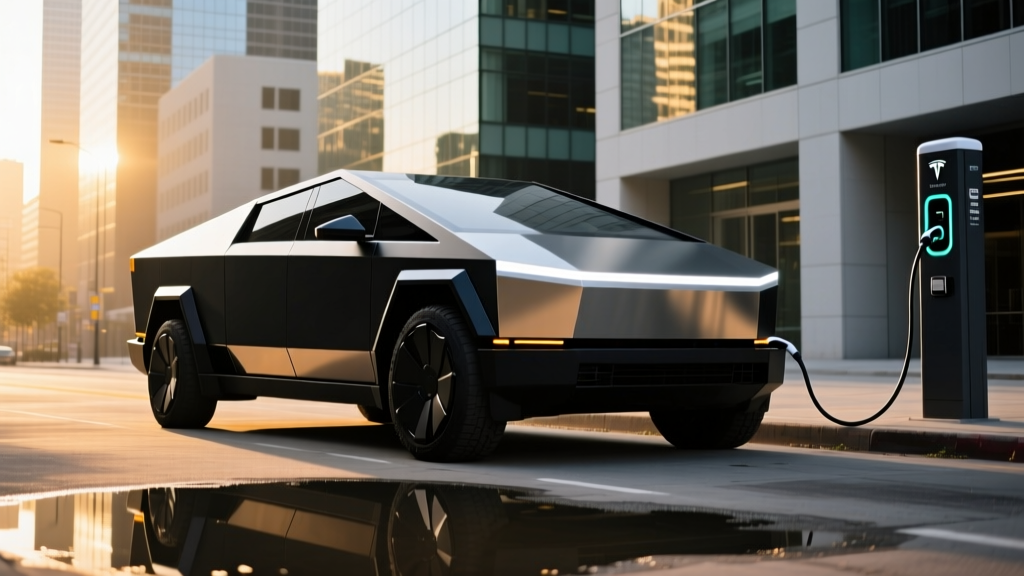
The Cybertruck supports Tesla's 48-volt electrical architecture and charges via the NACS (North American Charging Standard) connector natively. Here is what charging looks like across different scenarios:
| Charging Level | Power / Voltage | Speed (Miles Added/Hour) | Time / Notes |
|---|---|---|---|
| Level 1 (120V household) | ~1.4 kW | ~3–4 mi/hr | Not practical for daily use; 300+ mi would take 75+ hours |
| Level 2 (240V home, 48A) | ~11.5 kW | ~30–34 mi/hr | Full charge in ~10–12 hours; ideal overnight |
| Level 2 (Tesla Wall Connector, 80A) | ~19.2 kW | ~44–52 mi/hr | Requires 100A circuit; full charge ~6–8 hours |
| DC Fast (V4 Supercharger) | Peak ~250 kW | ~128 mi in 15 min | 10–80% in ~28–32 minutes |
| DC Fast (V3 Supercharger) | Peak ~250 kW | ~128 mi in 15 min | 10–80% in ~30–35 minutes |
Charging curve reality: The Cybertruck peaks near 250 kW only at low state-of-charge (10–25% SoC). By 50% SoC, charge rate drops to roughly 150–170 kW, and above 80% it tapers sharply to under 50 kW. This is normal lithium-ion behavior driven by cell-protection protocols, but it means the advertised "15-minute charge" only applies to a narrow SoC window. On a road trip, plan for 30–35 minute stops for a 10–80% fill, not the 15-minute marketing claim.
Home charging on a Tesla Wall Connector at 80 amps is the sweet spot for Cybertruck owners. With a ~123 kWh usable battery, you will recover roughly 200–250 miles of range overnight (8–10 hours), which covers most daily driving plus a buffer. Installation of an 80A circuit typically requires a 100A breaker and 2-gauge copper wire — budget $800–$2,000 for a licensed electrician depending on panel proximity, per industry estimates. Always confirm your home electrical panel can handle the additional load before purchasing equipment.
Performance, Cargo, and Capability
The Cybertruck's performance figures vary dramatically by trim:
| Spec | Long Range AWD | All-Wheel Drive | Cyberbeast |
|---|---|---|---|
| 0–60 mph | ~4.1 sec | ~3.9 sec | 2.6 sec |
| Horsepower | ~600 hp | ~600 hp | 845 hp |
| Top Speed | 112 mph | 130 mph | 130 mph |
| Max Towing | 11,000 lbs | 11,000 lbs | 11,000 lbs |
| Payload Capacity | ~2,500 lbs | ~2,500 lbs | ~2,500 lbs |
| Bed Length | 6 ft (72 in) | ||
| Cargo Volume (bed) | ~67 cu ft (with tonneau closed) | ||
| Frunk Volume | ~7 cu ft | ||
| Front Legroom | 41.5 in | ||
| Rear Legroom | 38.2 in | ||
The Cyberbeast's 2.6-second 0–60 time makes it one of the quickest production trucks ever sold, rivaling supercars. But the practical story is the Long Range and AWD trims, which still deliver sub-4.5-second acceleration while offering more range. Towing capacity of 11,000 lbs matches heavy-duty gas trucks, though real-world towing range drops significantly — expect roughly 50–60% of unloaded range when pulling a 7,000+ lb trailer, consistent with all electric trucks.
The 6-foot bed with powered tonneau cover (called the "sail pillar" design) is lockable and weather-sealed, which is a genuine advantage over open-bed competitors. However, the angular bed walls and limited width between wheel wells constrain what you can load flat. The frunk adds 7 cu ft of lockable front storage, useful for charging cables and groceries.
Federal Tax Credit and Incentives
The Cybertruck's eligibility for the IRS §30D federal tax credit depends on several factors that change frequently. As of the 2026 tax year:
- MSRP Cap: Trucks/vans/SUVs must have an MSRP at or below $80,000 to qualify. Only the Long Range AWD trim at $79,990 clears this threshold. The AWD ($99,990) and Cyberbeast ($114,990) are ineligible.
- Buyer Income Cap: Modified adjusted gross income must not exceed $300,000 (joint filers), $225,000 (head of household), or $150,000 (single filers).
- Battery Sourcing: A percentage of critical minerals and battery components must be sourced from the US or free-trade-agreement countries. Tesla's supply chain has progressively met these thresholds, but eligibility can shift by production batch. Always verify the specific VIN's eligibility at fueleconomy.gov before purchasing.
- Point-of-Sale Transfer: Qualified buyers can transfer the up-to-$7,500 credit to the dealer at purchase, reducing the purchase price directly rather than waiting for a tax refund.
| Trim | MSRP | Max §30D Credit | Effective Price (if eligible) |
|---|---|---|---|
| Long Range AWD | $79,990 | $7,500 | ~$72,490 |
| All-Wheel Drive | $99,990 | $0 (over MSRP cap) | $99,990 |
| Cyberbeast | $114,990 | $0 (over MSRP cap) | $114,990 |
Critical caveat: Tax credit rules, including critical-mineral sourcing percentages and FTA country lists, are subject to annual adjustment by the IRS and Treasury Department. Consult a tax professional and verify your specific vehicle's VIN eligibility before relying on the credit for purchase budgeting. State and local incentives (such as California's CVRP or Colorado's state credit) may provide additional savings — check your state energy office for current programs.
Tech, Driver Assists, and Ownership Experience
The Cybertruck runs Tesla's latest infotainment platform with an 18.5-inch center touchscreen and a rear 9.4-inch display for passengers. Standard features include:
- Tesla Autopilot (SAE Level 2 driver assist) with Traffic-Aware Cruise Control and Autosteer
- Full Self-Driving (Supervised) available as a $8,000 add-on or $99/month subscription — still requires active driver supervision at all times
- Adaptive air suspension with up to 16 inches of ground clearance in Extract Mode
- Powered frunk and bed tonneau with smartphone integration
- Bioweapon Defense Mode (HEPA cabin filtration)
- Over-the-air software updates adding features post-purchase
Driver Assist Clarification
Tesla's Autopilot and Full Self-Driving (Supervised) are SAE Level 2 systems. The driver must remain fully engaged, hands on the wheel, and eyes on the road at all times. These are not autonomous or self-driving systems. Only Level 4 services like Waymo operate without a human driver, and those are limited to specific geofleets in select cities. Treat the Cybertruck's driver assists as advanced cruise control and lane-keeping — nothing more.
Notable drawbacks: The steer-by-wire system (no mechanical connection between steering wheel and wheels) takes significant adaptation and has drawn mixed owner feedback. Visibility is compromised by the thick A-pillars and angular rear sail pillars, making the backup camera essential. Panel gap consistency has improved since early production units, but stainless-steel body panels are difficult and expensive to repair after collision damage. Insurance premiums for the Cybertruck run 25–40% higher than comparable trucks, according to industry data, partly due to repair costs and parts availability.
Warranty and Long-Term Battery Outlook
Tesla covers the Cybertruck with the following warranty structure:
- Basic Vehicle Limited Warranty: 4 years or 50,000 miles, whichever comes first
- Battery and Drive Unit Warranty: 8 years or 150,000 miles (whichever comes first), with a minimum 70% battery capacity retention guaranteed over that period
- Restraint System: 5 years or 60,000 miles
The 8-year/150,000-mile battery warranty is competitive with the Rivian R1T (8yr/175,000mi) and Ford F-150 Lightning (8yr/100,000mi). Tesla's NMC cells have demonstrated strong longevity data across the Model 3/Y fleet, with median degradation of approximately 12–15% over 150,000 miles based on owner-reported data. The Cybertruck's larger pack and thermal management system should deliver similar or better retention, but long-term data specific to this platform won't exist until 2028–2029.
Cybertruck vs. the Competition: Is It Worth Buying?
Pros
- Class-leading acceleration (Cyberbeast: 2.6s 0–60)
- Stainless-steel body resists dents and corrosion
- Sealed, lockable bed with powered tonneau is highly practical
- Access to Tesla Supercharger network (20,000+ stalls in North America)
- Steer-by-wire provides extremely quick steering ratio
- 11,000-lb towing capacity rivals heavy-duty gas trucks
Cons
- Current pricing far exceeds Cybertruck original pricing promises
- Efficiency (59–67 MPGe) trails Rivian R1T and F-150 Lightning
- Real-world highway range significantly below EPA sticker
- Steer-by-wire adaptation curve is steep and polarizing
- Poor rear visibility; heavy reliance on cameras
- Insurance premiums 25–40% above segment average
- Only the base trim qualifies for the federal tax credit
Who should buy the Cybertruck? The Long Range AWD at ~$72,490 (after tax credit, if eligible) is the value play for buyers who want an electric truck with strong range, Supercharger access, and genuine towing capability. The Cyberbeast appeals to performance enthusiasts who prioritize acceleration over efficiency. The mid-tier AWD trim at $99,990 is the hardest to justify — it offers minimal range or performance gains over the Long Range while costing $20,000 more and losing tax credit eligibility.
Who should look elsewhere? If efficiency and real-world range are your top priorities, the Rivian R1T (Dual-Motor, ~352 mi EPA, ~76 MPGe) delivers better miles per kWh. If you need a more conventional driving experience with proven dealer service infrastructure, the Ford F-150 Lightning (Extended Range, ~320 mi EPA) is a more conservative choice. If you need a work truck with a traditional 8-foot bed and don't care about acceleration, neither the Cybertruck nor its electric rivals match the utility of a gas F-250.
Frequently Asked Questions
What happened to the Cybertruck's original pricing?
Tesla announced the Cybertruck in 2019 with starting prices of $39,900–$69,900. By the 2024 production launch, prices had risen to $79,990–$99,990 due to material costs, added features, the cancellation of the RWD trim, and market positioning. The 2026 lineup starts at $79,990 for the Long Range AWD and tops out at $114,990 for the Cyberbeast — a 60–70% increase over the original pricing Tesla communicated to reservation holders.
What is the real-world range of the Cybertruck?
The EPA rates the Long Range AWD at 340 miles, the AWD at 318 miles, and the Cyberbeast at 301 miles. In real-world highway driving at 70 mph, expect roughly 270–290 miles from the Long Range, 255–275 from the AWD, and 240–260 from the Cyberbeast. In cold weather (below freezing), reduce those figures by an additional 15–20%. The truck's weight and poor aerodynamics are the primary range killers.
Does the Cybertruck qualify for the federal EV tax credit?
Only the Long Range AWD trim ($79,990 MSRP) qualifies for the up-to-$7,500 §30D credit, because it falls under the $80,000 MSRP cap for trucks. The AWD ($99,990) and Cyberbeast ($114,990) exceed the cap and are ineligible regardless of buyer income. Even for the Long Range, eligibility depends on buyer income limits ($150K single / $300K joint) and battery-sourcing compliance, which varies by production batch. Always verify VIN-specific eligibility at fueleconomy.gov.
How fast does the Cybertruck charge at home and on the road?
At home on a 240V/48A Level 2 charger, the Cybertruck adds roughly 30–34 miles of range per hour, requiring 10–12 hours for a full charge. On a Tesla Wall Connector at 80A, that improves to 44–52 miles per hour. On a V3 or V4 Supercharger, it peaks at ~250 kW and charges from 10–80% in approximately 28–35 minutes, with significant taper above 50% state of charge.
Is the Cybertruck worth buying vs the Rivian R1T or F-150 Lightning?
The Cybertruck wins on acceleration, Supercharger network access, and the sealed lockable bed. The Rivian R1T offers better efficiency (~76 MPGe), a quad-motor option, and a more conventional driving feel. The F-150 Lightning provides Ford dealer service infrastructure, a larger bed, and more conservative styling. If Supercharger access and performance matter most, the Cybertruck Long Range is compelling at ~$72,490 after credit. If efficiency and traditional truck utility are priorities, the R1T or Lightning may serve you better.
What are the biggest ownership costs beyond the purchase price?
Insurance is the largest surprise cost — Cybertruck premiums run 25–40% above comparable trucks due to stainless-steel body repair complexity and parts costs. Electricity costs are moderate: at the US average of ~$0.16/kWh, a full charge costs roughly $19–20, or about $0.06–0.07 per mile. Home charger installation adds $800–$2,000 if you need an 80A circuit. Tesla's 8-year/150,000-mile battery warranty reduces long-term risk, but out-of-warranty battery replacement (if needed post-2034) would likely cost $15,000–$25,000 based on current large-pack pricing.