Tesla Cybertruck Military Target Analysis: Is the Stainless Steel EV Built for Combat?
The Tesla Cybertruck has always courted controversy with its angular stainless-steel exoskeleton, shatter-resistant glass, and marketing that leans heavily into apocalyptic, military-adjacent imagery. But when enthusiasts and defense analysts search for a "Tesla Cybertruck military target analysis," what they're really asking is: How tough is this electric pickup under extreme conditions, and does its survivability translate into practical, everyday ownership value? This review dissects the 2026 Tesla Cybertruck's real-world range, charging capability, pricing after federal tax credits, and whether its militaristic posture holds up beyond the marketing.
2026 Tesla Cybertruck Spec Overview
| Specification | Cybertruck AWD | Cyberbeast |
|---|---|---|
| EPA Range | 340 miles | 320 miles |
| Battery Capacity | ~123 kWh (NMC) | ~123 kWh (NMC) |
| Drivetrain | Dual-Motor AWD | Tri-Motor AWD |
| Horsepower | 600 hp | 845 hp |
| 0-60 mph | 4.1 seconds | 2.6 seconds |
| Max DC Fast Charge | 250 kW | 250 kW |
| 10-80% DC Charge Time | ~20 minutes | ~20 minutes |
| Level 2 Charge Rate | 11.5 kW (~37 mi/hr) | 11.5 kW (~37 mi/hr) |
| MPGe (Combined) | 67 MPGe | 63 MPGe |
| Towing Capacity | 11,000 lbs | 11,000 lbs |
| Cargo Volume (Bed + Frunk) | 67 cu ft bed + 7 cu ft frunk | 67 cu ft bed + 7 cu ft frunk |
| Base MSRP (2026) | $79,990 | $99,990 |
Real-World Range vs. EPA Estimates
EPA Estimated Range: 340 miles (AWD) / 320 miles (Cyberbeast)
Real-World Expectation: Expect 270-300 miles on highway road trips at 70-80 mph. In cold weather (below 32°F), range can drop 20-30%, landing closer to 220-250 miles depending on cabin heating demands and driving speed.
The Cybertruck's massive frontal area and 6,800+ lb curb weight work against it aerodynamically. While Tesla's NMC battery pack stores roughly 123 kWh of usable energy, the truck's efficiency hovers around 2.0-2.2 kWh/mile in mixed driving — meaning you'll burn through electrons faster than in a Model Y or even the Rivian R1T. For buyers searching for a Tesla Cybertruck military target analysis, the takeaway is clear: this vehicle prioritizes brute-force capability over efficiency.
Charging Speed: DC Fast Charging and Home Level 2
| Charging Level | Power | Speed | Use Case |
|---|---|---|---|
| Level 1 (120V) | ~1.4 kW | ~4-5 miles/hr | Emergency/trickle |
| Level 2 (240V, 48A) | 11.5 kW | ~37 miles/hr | Home daily charging |
| DC Fast Charge | Peak 250 kW | 10-80% in ~20 min | Road trips |
The Cybertruck charges at a peak of 250 kW on Tesla Superchargers (V3 and V4 stalls). However, as with all EVs, peak rate is not sustained rate. The charge curve tapers significantly above 60% state of charge, and the massive 123 kWh battery means even at peak rate, you're adding roughly 4-5 miles of range per minute. A 10-80% session takes approximately 20 minutes under ideal conditions (preconditioned battery, optimal ambient temperature).
For home charging, a 48-amp Level 2 setup on a 60-amp circuit delivers 11.5 kW, replenishing roughly 37 miles of range per hour. A full overnight charge (8-10 hours) easily tops off the battery for daily use. Installation costs for a Level 2 home charger typically range from $500 (simple outlet near panel) to $2,500+ if a panel upgrade or long conduit run is required.
Pricing, Trim Levels, and Federal Tax Credit Eligibility
| Trim | 2026 MSRP | Federal Tax Credit (§30D) | Effective Price (if eligible) |
|---|---|---|---|
| AWD | $79,990 | Up to $7,500 (point-of-sale) | $72,490 |
| Cyberbeast | $99,990 | $0 (exceeds MSRP cap) | $99,990 |
Federal tax credit eligibility for the Cybertruck is nuanced and governed by IRS §30D rules. The AWD trim, priced at $79,990, falls under the $80,000 MSRP cap for trucks and may qualify for up to $7,500 in federal tax credits — provided the buyer meets income limits ($150,000 single / $300,000 joint AGI) and the vehicle satisfies battery critical-mineral and component sourcing requirements. As of 2026, the credit can be transferred to the dealer at point of sale, reducing the purchase price directly.
The Cyberbeast trim at $99,990 exceeds the MSRP cap and does not qualify for the federal credit, regardless of buyer income or battery sourcing. Buyers should consult a tax professional and verify current-year eligibility on IRS.gov before assuming credit availability.
Performance, Cargo, and Survivability Claims
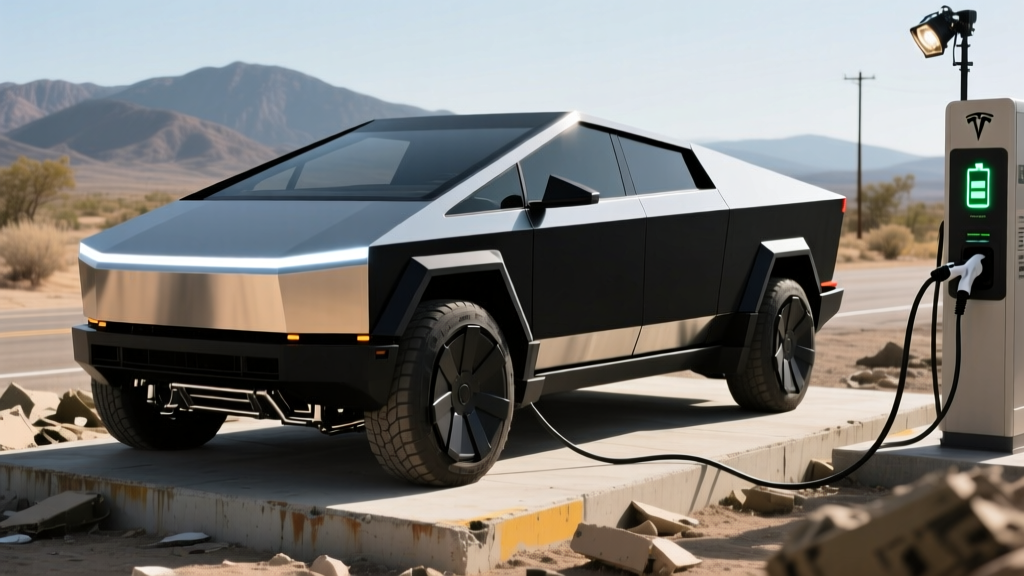
The Cybertruck's 30X cold-rolled stainless-steel exoskeleton is the centerpiece of its "military target" marketing narrative. Tesla claims the body panels resist dents, scratches, and even small-arms fire (though Tesla has never submitted the Cybertruck for formal ballistic certification). The armor glass, while improved since the infamous 2019 demo window-shattering incident, remains a polymer-layered composite — not bulletproof in any MIL-STD sense.
Performance figures are staggering: the Cyberbeast's 845 horsepower and 2.6-second 0-60 time make it one of the quickest production vehicles on Earth, regardless of powertrain. The dual-motor AWD variant still hits 60 mph in 4.1 seconds with 600 hp — more than adequate for merging, towing, and off-road crawling.
Cargo capacity includes a 67 cu ft bed (6-foot length with tailgate closed) and a 7 cu ft front trunk (frunk). Rear-seat legroom measures 41.3 inches, sufficient for adults on longer trips. The bed features a motorized tonneau cover and built-in ramp, but the sloped bed floor and limited tie-down points draw criticism from traditional truck buyers.
Driver Assistance and Technology
SAE Automation Level: Level 2 (Partial Automation)
Tesla Autopilot and Full Self-Driving (Supervised) require continuous driver engagement. The driver must keep hands on the wheel (or demonstrate attention via cabin camera) and remain prepared to take over at any moment. This is not autonomous driving.
The Cybertruck ships with Tesla's latest HW4 Autopilot hardware, featuring improved cameras and processing for Autosteer, Traffic-Aware Cruise Control, and the optional Full Self-Driving (Supervised) package ($8,000 one-time or $99/month). FSD Supervised handles highway interchanges, traffic lights, and stop signs, but real-world performance varies significantly by geography and road complexity. As of 2026, FSD remains a Level 2 driver-assist system — not a self-driving solution.
The 18.5-inch center touchscreen runs Tesla's latest infotainment software, including navigation, streaming, gaming, and vehicle controls. A rear-seat 9.4-inch touchscreen handles climate and entertainment for passengers. Notably absent: Apple CarPlay and Android Auto, which Tesla continues to eschew in favor of its proprietary ecosystem.
Warranty and Ownership Costs
Tesla covers the Cybertruck with a 4-year/50,000-mile basic warranty and an 8-year/120,000-mile battery and drive unit warranty. Tesla guarantees the battery will retain at least 70% of its original capacity during the warranty period. Real-world degradation data for the Cybertruck is still emerging (given its 2023 launch), but Tesla's NMC packs in Model S/X have historically shown 10-15% degradation over 150,000 miles.
Insurance costs for the Cybertruck run 30-50% higher than comparable gas pickups, reflecting repair complexity, stainless-steel panel replacement costs, and the vehicle's high MSRP. Buyers should obtain insurance quotes before purchasing.
Pros and Cons
Pros
- Stunning acceleration (2.6s 0-60 Cyberbeast)
- 11,000-lb towing capacity
- Stainless-steel body resists dents and corrosion
- Access to Tesla Supercharger network (17,000+ stalls)
- Over-the-air software updates add features post-purchase
Cons
- Poor efficiency (2.0+ kWh/mile) reduces real-world range
- Cyberbeast exceeds MSRP cap, ineligible for federal tax credit
- Controversial styling limits resale appeal in some markets
- No Apple CarPlay/Android Auto
- High insurance premiums
Who Should Buy the Tesla Cybertruck?
The Cybertruck suits buyers who prioritize performance, technology, and statement-making design over traditional truck utility. It excels as a high-speed tow vehicle, a tech-forward daily driver, and an off-road capable adventure rig. However, fleet buyers, commercial contractors, and those needing maximum cargo flexibility may find the Rivian R1T or Ford F-150 Lightning better suited to work duties. The Cybertruck's "military target" toughness is more marketing aesthetic than certified ballistic protection — but for buyers who want an EV that looks like it could survive the apocalypse, nothing else compares.
Frequently Asked Questions
What is the real-world range of the Tesla Cybertruck?
Expect 270-300 miles on highway trips and 220-250 miles in cold weather, below the EPA's 340-mile estimate for the AWD trim.
How fast does the Cybertruck charge?
At a 250 kW DC fast charger, the Cybertruck charges from 10-80% in approximately 20 minutes. Home Level 2 charging adds ~37 miles of range per hour.
Does the Tesla Cybertruck qualify for the federal EV tax credit?
The AWD trim ($79,990) may qualify for up to $7,500 if the buyer meets income limits and the vehicle satisfies battery sourcing requirements. The Cyberbeast ($99,990) exceeds the MSRP cap and does not qualify.
Is the Cybertruck bulletproof?
No. Tesla's stainless-steel body and armor glass are highly resistant to dents and impacts, but the Cybertruck has not received formal ballistic certification and is not rated for small-arms fire.
How does the Cybertruck compare to the Rivian R1T and Ford F-150 Lightning?
The Cybertruck offers superior acceleration and access to Tesla's Supercharger network. The R1T excels in off-road capability and cargo versatility. The F-150 Lightning provides more traditional truck utility and lower starting prices.