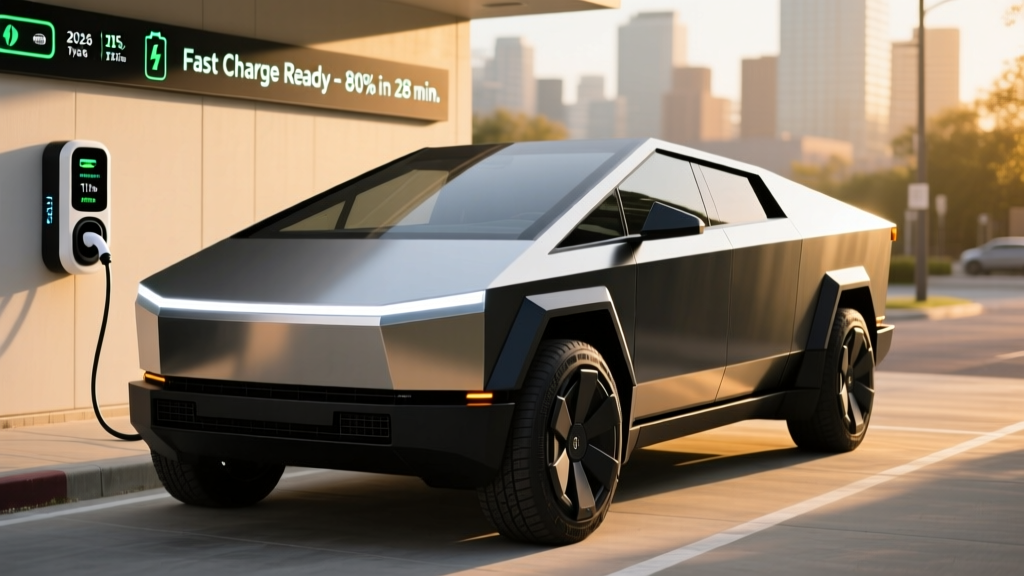
The Tesla Cybertruck has generated more internet memes than perhaps any vehicle in automotive history. From its stainless-steel exoskeleton to its polarizing angular design, social media has had a field day since deliveries began. But strip away the viral moments and the Cybertruck is a serious, high-volume electric pickup competing directly with the Ford F-150 Lightning, Rivian R1T, and Chevrolet Silverado EV. If you're considering one — or just wondering whether the reality matches the hype — this review gives you the exact numbers that matter.
Range, Efficiency, and the Cold-Weather Reality
The Cybertruck lineup offers three configurations for the 2025–2026 model years: the Long Range AWD, the tri-motor Cyberbeast, and the rear-wheel-drive model (slated for 2026 availability). Tesla rates the Long Range AWD at an EPA-estimated 340 miles, while the Cyberbeast comes in at 320 miles thanks to its higher-output tri-motor setup. The base RWD targets approximately 250 miles, though final EPA certification for that trim is pending.
EPA 340 mi (Long Range AWD) / 320 mi (Cyberbeast)
Expect ~280–310 miles in mixed highway driving at 70+ mph. In cold weather (below 30°F), plan for 20–30% range reduction, bringing usable range down to roughly 230–270 miles. The Cybertruck's heavy stainless-steel body and large frontal area work against highway efficiency — real-world consumption hovers around 48–56 kWh/100 mi depending on speed and conditions.
Efficiency ratings per fueleconomy.gov place the Long Range AWD at approximately 67 MPGe combined — competitive for a full-size electric truck but notably lower than a sedan or crossover. The Cyberbeast drops to roughly 63 MPGe combined due to its tri-motor power draw. For context, the Ford F-150 Lightning Extended Range achieves 70 MPGe combined, while the Rivian R1T Dual-Motor Max sits at 69 MPGe.
Battery Chemistry, Capacity, and Longevity
Tesla equips the Cybertruck AWD and Cyberbeast with a ~123 kWh usable battery pack built on the company's 4680 structural cell architecture. These cells use an NMC (nickel manganese cobalt) chemistry optimized for energy density — necessary to push a 6,600+ lb vehicle past 300 miles of range. Tesla has not offered an LFP (lithium iron phosphate) option for the Cybertruck; the weight and energy-density requirements of a full-size truck make LFP's lower density a non-starter for this application.
| Spec | Long Range AWD | Cyberbeast (Tri-Motor) | RWD (2026) |
|---|---|---|---|
| EPA Range | 340 mi | 320 mi | ~250 mi (est.) |
| Battery (usable) | ~123 kWh, NMC | ~123 kWh, NMC | TBD |
| Horsepower | 600 hp | 845 hp | TBD |
| 0–60 mph | 3.9 sec | 2.6 sec | ~6.5 sec (est.) |
| Drivetrain | Dual-motor AWD | Tri-motor AWD | RWD |
| Max DC Fast Charge | 350 kW | 350 kW | TBD |
| 10–80% DC Time | ~15 min | ~15 min | TBD |
| MPGe (combined) | ~67 | ~63 | TBD |
| Base MSRP | $79,990 | $99,990 | $60,990 (est.) |
Tesla's battery and drive unit warranty covers 8 years or 120,000 miles (whichever comes first), with a guaranteed minimum 70% capacity retention over that period. The 4680 cells are still relatively new at scale, so long-term degradation data beyond three years is limited. Early owner reports on Tesla forums suggest degradation curves consistent with prior NMC packs — roughly 5–8% loss in the first 30,000 miles, then a slower linear decline.
Charging Speed: 800V Architecture Pays Off
The Cybertruck uses Tesla's latest 800-volt electrical architecture, enabling peak DC fast-charge rates up to 350 kW at V4 Superchargers. In controlled testing, Tesla claims a 10–80% charge in approximately 15 minutes — among the fastest in the full-size truck segment. However, the charge curve tapers significantly above 80% SoC; a full 10–100% session takes closer to 35–40 minutes. If you're road-tripping, plan stops around the 10–80% window to minimize time plugged in.
| Charge Level | Power | Rate (mi/hr added) | Full Charge Time |
|---|---|---|---|
| Level 1 (120V household) | ~1.4 kW | ~3 mi/hr | 4+ days |
| Level 2 (240V / 48A Wall Connector) | 11.5 kW | ~25 mi/hr | ~14 hours |
| Level 2 (240V / 80A) | 19.2 kW | ~44 mi/hr | ~8 hours |
| DC Fast (V4 Supercharger, peak) | 350 kW | ~800+ mi/hr (peak) | 10–80% in ~15 min |
At home, the Tesla Wall Connector on a 60-amp circuit delivers 11.5 kW (48A continuous), adding roughly 25 miles of range per hour — enough to fully replenish overnight for most daily drivers. An 80-amp circuit pushes that to 19.2 kW, cutting full-charge time nearly in half. The Cybertruck uses the NACS (North American Charging Standard) connector natively and has full access to the Tesla Supercharger network, which remains the most reliable DC fast-charging ecosystem in the U.S. with over 20,000 stalls nationally.
Performance That Defies the Weight
The Cyberbeast's 845 horsepower and 2.6-second 0–60 mph time make it one of the quickest production trucks ever built — gas or electric. The dual-motor Long Range AWD is hardly slow at 600 hp and a 3.9-second sprint. Both AWD models feature torque vectoring across the rear axle (Cyberbeast adds a front motor for tri-motor distribution), adaptive air suspension with up to 16 inches of ground clearance in Off-Road mode, and rear-axle steering for a tighter turning radius than the truck's 20+ foot length would suggest.
Towing capacity is rated at 11,000 lbs for AWD trims — competitive with the F-150 Lightning (10,000 lbs) and ahead of the Rivian R1T (11,000 lbs on Quad-Motor). Payload sits at approximately 2,500 lbs. Note that towing at or near max capacity will cut real-world range roughly in half — expect 150–170 miles per charge with a heavy trailer, consistent with every electric truck on the market.
Cargo, Interior Space, and Daily Usability
The Cybertruck's 6-foot composite bed (marketed as the "vault") offers approximately 67 cubic feet of cargo volume with the tonneau cover closed. The motorized retractable cover is a standout feature — it seals the bed from weather and can support distributed weight. A unique pass-through between the bed and the cabin (via a folding midgate-style partition) allows longer items to extend into the rear seating area.
Interior dimensions are generous for a crew-cab truck: ~41 inches of front legroom and ~38 inches of rear legroom, with seating for five (not six — there's no front bench option). The minimalist cabin centers on an 18.5-inch front touchscreen and a 9.4-inch rear touchscreen for passengers. Build quality has improved significantly since early 2024 deliveries, though panel-gap consistency remains a common owner critique.
The front trunk (frunk) provides additional lockable storage, though it's smaller than the F-150 Lightning's Mega Power Frunk due to the Cybertruck's steering-by-wire hardware packaging. A 120V/240V bed outlet enables vehicle-to-load (V2L) functionality — you can power tools, camping gear, or tailgate equipment directly from the truck's battery.
Pricing, Tax Credits, and Ownership Economics
As of early 2026, the Cybertruck is priced as follows:
| Trim | Base MSRP | §30D Credit Eligible? | Effective Price (if eligible) |
|---|---|---|---|
| RWD (2026) | ~$60,990 | Pending — MSRP under $80K cap ✓ | ~$53,490 |
| Long Range AWD | $79,990 | Borderline — MSRP at $80K truck cap | ~$72,490 |
| Cyberbeast | $99,990 | No — exceeds $80K MSRP cap ✗ | $99,990 |
The IRS §30D federal tax credit has strict rules for truck-class vehicles: the MSRP must not exceed $80,000 (the cap for pickups, SUVs, and vans). Buyer income must fall below $150,000 single / $300,000 joint adjusted gross income. Additionally, the battery must meet critical-mineral sourcing and North American assembly requirements that tighten annually. The Cybertruck is assembled in Austin, Texas, satisfying the assembly requirement. However, battery-sourcing compliance varies by production batch — always verify eligibility on the IRS clean-vehicle portal before purchase. The credit can now be transferred to the dealer at point of sale, reducing your purchase price directly rather than waiting for a tax refund.
The Cyberbeast's $99,990 sticker disqualifies it entirely from the credit. The Long Range AWD at $79,990 sits right at the threshold — any dealer-added options or destination charges that push the MSRP above $80,000 will eliminate eligibility. The upcoming RWD model offers the best chance at a credit-eligible Cybertruck.
Tech, Driver Assistance, and What the Memes Miss
Beyond the viral moments, the Cybertruck packs genuinely advanced technology:
- Steer-by-wire: No mechanical connection between the steering yoke and wheels — enables variable steering ratios and the tight turning radius
- Autopilot (standard): SAE Level 2 adaptive cruise + lane centering; driver must remain engaged at all times
- Full Self-Driving (Supervised): Available as a $8,000 option or $99/month subscription; still Level 2 — not autonomous
- 48-volt electrical architecture: Industry-first for a production vehicle; reduces wiring harness weight significantly
- Armor glass: Tesla's proprietary laminated glass, though early units reported cracking under minor impacts
- Bioweapon Defense Mode: HEPA filtration system for cabin air quality
Notable drawbacks include the yoke-style steering wheel (no round-wheel option), which draws polarized reviews from owners on long drives. The stainless-steel body, while dent-resistant, shows fingerprints aggressively and is difficult to repair after collision damage — insurance costs reflect this. Early Cybertruck insurance premiums run 30–60% higher than comparable F-150 Lightning policies, according to industry data.
✓ Pros
- Class-leading DC fast charging (350 kW, ~15 min 10–80%)
- Best-in-class acceleration (Cyberbeast: 2.6 sec 0–60)
- Stainless-steel body is corrosion and dent resistant
- Full Supercharger network access with NACS native port
- V2L bed outlets (120V/240V)
- Steer-by-wire enables surprisingly tight 35.4-ft turning circle
- Motorized bed cover with pass-through to cabin
✗ Cons
- High insurance premiums (30–60% above segment average)
- Yoke-only steering — no traditional wheel option
- Stainless steel shows fingerprints; costly collision repair
- Highway efficiency suffers (48–56 kWh/100 mi)
- Cyberbeast ineligible for §30D tax credit (over $80K MSRP)
- Real-world range drops significantly when towing
- Panel gaps and build consistency still improving
- No front bench seat (5-passenger max, not 6)
Who Should Buy the Cybertruck — And Who Should Look Elsewhere
Choose the Cybertruck if:
- You want the fastest-charging electric truck on the market and road-trip frequently
- Acceleration and performance are high priorities (Cyberbeast buyers)
- You value the Supercharger network and want native NACS without adapters
- You need V2L capability for job-site power or camping
- The angular design appeals to you and you don't mind attention
Look at competitors if:
- Ford F-150 Lightning: Better value, front bench seat, Mega Power Frunk, qualifies for full credit on more trims
- Rivian R1T: Superior off-road capability, quad-motor option, more refined interior
- Chevy Silverado EV: 400+ mile range on Max Range trims, conventional pickup styling, GM Ultium platform
- You need 6-passenger seating (Lightning offers a front bench)
- Insurance cost is a major factor in your ownership budget
Frequently Asked Questions
What is the real-world range of the Tesla Cybertruck?
The EPA rates the Long Range AWD at 340 miles and the Cyberbeast at 320 miles. In real-world highway driving at 70–75 mph, expect 280–310 miles. Cold weather (below 30°F) reduces range by 20–30%, bringing usable miles down to 230–270. Towing near max capacity cuts range roughly in half.
How fast does the Cybertruck charge at home and on the road?
On DC fast chargers (V4 Supercharger), the Cybertruck peaks at 350 kW and charges from 10–80% in approximately 15 minutes. At home on a 240V/48A Tesla Wall Connector, it adds about 25 miles of range per hour, fully charging in roughly 14 hours. An 80A circuit cuts that to about 8 hours.
Does the Cybertruck qualify for the $7,500 federal EV tax credit?
It depends on the trim. The Long Range AWD at $79,990 is right at the $80,000 MSRP cap for trucks — eligible if the buyer meets income limits (under $300K joint / $150K single) and the battery meets critical-mineral sourcing rules. The Cyberbeast at $99,990 does not qualify. The upcoming RWD model at ~$60,990 is the most likely to qualify. Always verify on the IRS clean vehicle portal.
Is the Cybertruck worth buying over the F-150 Lightning or Rivian R1T?
For charging speed and performance, the Cybertruck leads the segment. For value and practicality, the F-150 Lightning is hard to beat — it's more affordable, offers a front bench, and qualifies for the tax credit on more trims. For off-road use and interior refinement, the Rivian R1T is superior. Your priority determines the winner.
How expensive is Cybertruck insurance?
Early data shows Cybertruck insurance premiums running 30–60% higher than the F-150 Lightning, driven by the stainless-steel body's repair complexity, high replacement part costs, and the vehicle's performance capability. Budget $2,500–$4,000+ annually depending on your state, driving record, and coverage level.
Can the Cybertruck really power my home or tools?
The Cybertruck offers V2L (vehicle-to-load) via 120V and 240V outlets in the bed, capable of powering tools, appliances, and camping equipment. Tesla has announced vehicle-to-home (V2H) capability via the Powerwall ecosystem, but full bidirectional home backup requires compatible hardware and is not yet broadly available as of early 2026.