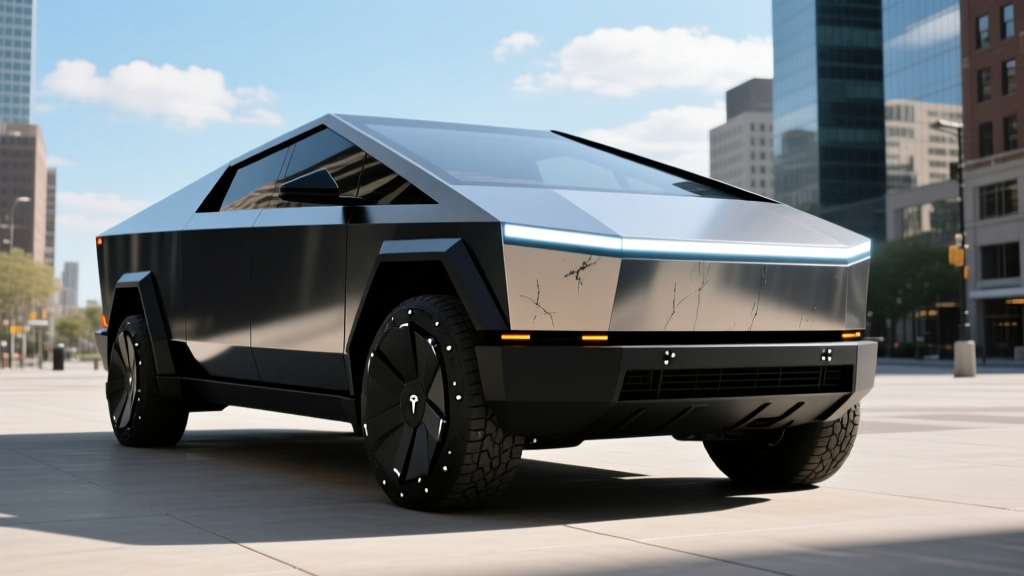
If you have spent any time on social media in the last two years, the Tesla Cybertruck meme is inescapable. From window-smash replays to stainless-steel fingerprint complaints, the internet has turned Tesla's angular pickup into a cultural punching bag. But strip away the viral clips and subreddit threads, and you are left with a 7,000-pound electric truck that actually has to perform in driveways, job sites, and highway rest stops across America.
This review ignores the hype cycle and focuses on what matters to buyers and owners: EPA range versus real-world range, charging curves at DC fast chargers, battery chemistry, tax credit eligibility under current IRS §30D rules, and whether any trim justifies its MSRP against the Ford F-150 Lightning, Rivian R1T, and Chevrolet Silverado EV.
2026 Tesla Cybertruck: Full Spec Sheet at a Glance
| Spec | RWD (Standard Range) | AWD (Long Range) | Cyberbeast |
|---|---|---|---|
| Base MSRP | $60,990 | $79,990 | $99,990 |
| EPA Range | 250 mi | 340 mi | 320 mi |
| Battery (usable) | ~100 kWh (est.) | ~123 kWh | ~123 kWh |
| Chemistry | NMC | NMC | NMC |
| 0-60 mph | 6.5 sec | 4.1 sec | 2.6 sec |
| Horsepower | 315 hp | 600 hp | 845 hp |
| Drivetrain | RWD (single motor) | AWD (dual motor) | AWD (tri-motor) |
| Max DC Fast Charge | 250 kW | 350 kW | 350 kW |
| 10-80% DC Time | ~28 min | ~18 min | ~18 min |
| Level 2 Home Rate | 11.5 kW (~34 mi/hr) | 11.5 kW (~34 mi/hr) | 11.5 kW (~34 mi/hr) |
| MPGe (combined) | 67 MPGe | 64 MPGe | 61 MPGe |
| kWh/100 mi | 50 | 52 | 55 |
| Tow Rating | 7,500 lb | 11,000 lb | 11,000 lb |
| Bed Length | 6 ft (vault) | ||
| Cargo Volume (bed + frunk) | ~67 cu ft (vault) + ~7 cu ft (frunk) | ||
| Rear Legroom | 38.4 in | ||
| Battery/Drive Unit Warranty | 8 yr / 120,000 mi | ||
Real-World Range: What the EPA Sticker Does Not Tell You
The Cybertruck's stainless-steel exoskeleton is thick, heavy, and offers no structural benefit to energy efficiency. At roughly 50-55 kWh per 100 miles, it is one of the least efficient EVs on the market. For context, a Rivian R1T Dual-Motor achieves around 48 kWh/100 mi, and the Ford F-150 Lightning Extended Range sits near 49 kWh/100 mi, according to fueleconomy.gov.
Efficiency matters because it directly dictates how often you stop on road trips and how much you pay per mile when DC fast charging at $0.35-$0.50/kWh on networks like Electrify America or Tesla Superchargers. At 55 kWh/100 mi and $0.40/kWh, the Cyberbeast costs roughly $0.22 per mile on public fast chargers — approaching the per-mile fuel cost of a gas-powered F-150 at 20 MPG and $3.50/gallon.
If your commute is mostly city driving with regenerative braking opportunities, the gap between EPA and real-world narrows considerably. But for road-trippers and towers, the Cybertruck's efficiency penalty is a genuine ownership friction, not a meme exaggeration.
Charging Speeds: Peak kW, Sustained Curves, and Home Setup
Tesla equips the AWD and Cyberbeast trims with an 800-volt architecture capable of peaking at 350 kW at a V4 Supercharger. However, as with every EV, peak rate is not sustained rate. The charge curve tapers meaningfully after 50% State of Charge (SoC), and by 80% you are typically pulling under 100 kW.
| Charging Level | Power | Rate / Time | Best Use Case |
|---|---|---|---|
| Level 1 (120V outlet) | ~1.4 kW | ~4 mi/hr | Emergency trickle only |
| Level 2 (240V, 48A) | 11.5 kW | ~34 mi/hr; full charge in ~11 hrs | Overnight home charging |
| DC Fast (V4 Supercharger) | Up to 350 kW (AWD/Beast) | 10-80% in ~18 min | Road trips, quick top-ups |
| DC Fast (RWD trim) | Up to 250 kW | 10-80% in ~28 min | Road trips (slower curve) |
Preconditioning matters. Navigate to a Supercharger using the Cybertruck's built-in navigation, and the battery thermal management system will warm or cool the pack to optimize charge acceptance. Arriving at a charger without preconditioning — especially in cold weather — can add 5-10 minutes to your 10-80% session as the pack reaches optimal temperature.
For home Level 2 charging, you will need a 60-amp circuit to deliver the full 48 amps (11.5 kW) the Cybertruck can accept. Most homes with a 200-amp electrical panel can accommodate this, but older panels or homes with heavy existing loads (electric heat, hot tubs, EV + dryer simultaneously) may require a panel upgrade — typically $1,500-$3,000 on top of the $500-$1,200 charger-and-install cost. Always have a licensed electrician evaluate your panel before committing.
One advantage: the Cybertruck ships with the NACS connector natively, giving it full access to Tesla's Supercharger network — still the most reliable and widespread DC fast-charging network in the US, with over 25,000 stalls nationally.
Performance and Drivetrain: Where the Memes Meet Physics
The Cyberbeast's 2.6-second 0-60 mph time is genuinely supercar territory in a vehicle with a 6.5-foot bed and 11,000-pound tow rating. The tri-motor setup (one front, two rear) delivers 845 hp and torque-vectoring that makes the truck feel improbably agile at low speeds. The AWD dual-motor at 600 hp and 4.1 seconds is the performance sweet spot for most buyers — more than adequate for highway merging and trailering without the Cyberbeast price premium.
The RWD Standard Range model, added to broaden accessibility, drops to a single rear motor and 315 hp. Its 6.5-second 0-60 time is unremarkable for a $61,000 vehicle, and the 250-mile EPA range is tight for a full-size truck. This trim exists primarily as a fleet and price-leader play.
Steer-by-wire is standard across all trims — there is no mechanical connection between the yoke (or optional round wheel) and the rack. At highway speeds, the system feels precise and well-tuned. At very low speeds (parking, tight trailering), the variable ratio takes adjustment. If you are towing frequently, give yourself a week to build muscle memory.
Ride quality benefits from the adaptive air suspension, which offers up to 12 inches of ground clearance in Extract Mode for off-road use and drops for highway efficiency. Body panel gaps and the stainless-steel finish remain points of contention — owner forums document inconsistent gap tolerances and the steel's tendency to show every fingerprint and water spot. These are cosmetic, not functional, but they matter at this price point.
Pricing, Trims, and Federal Tax Credit Eligibility
The Cybertruck launched at much lower prices before Tesla restructured its trim lineup. As of the 2026 model year, here is where pricing stands before incentives:
| Trim | Base MSRP | Federal §30D Credit | Effective Price (if eligible) |
|---|---|---|---|
| RWD (Standard Range) | $60,990 | Up to $7,500 | ~$53,490 |
| AWD (Long Range) | $79,990 | Up to $7,500 | ~$72,490 |
| Cyberbeast | $99,990 | Up to $7,500 | ~$92,490 |
- MSRP Cap: Pickup trucks must have an MSRP at or below $80,000. The AWD ($79,990) barely qualifies. The Cyberbeast ($99,990) does NOT qualify.
- Buyer Income Cap: Modified AGI must not exceed $150,000 (single), $225,000 (head of household), or $300,000 (joint).
- Battery Sourcing: Critical minerals and battery components must meet escalating domestic/free-trade sourcing thresholds per IRS guidance. Tesla has shifted significant supply chain to comply, but verify current-year eligibility at irs.gov or with a tax professional before purchase.
- Point-of-Sale Transfer: Eligible buyers can transfer the credit to the dealer at purchase, reducing the out-of-pocket price directly rather than waiting for a tax refund.
- VIN Registration: The vehicle must be registered in your name and not purchased for resale.
The MSRP cap is the Cybertruck's biggest tax-credit story. Only the RWD and AWD trims are potentially eligible, and the AWD sits right at the $80,000 line. Any dealer-installed accessories or destination charges that push the final MSRP above $80,000 will disqualify the AWD. Confirm the exact window sticker before signing.
Interior, Tech, and Daily Livability
The Cybertruck's cabin is minimalist in the extreme: a single 18.5-inch front touchscreen handles virtually all vehicle controls, navigation, media, and climate. A smaller rear touchscreen serves back-seat passengers. There are no physical buttons for HVAC, glovebox release, or mirror adjustment — everything is on-screen.
What works: The front trunk (frunk) offers ~7 cu ft of lockable storage. The 6-foot bed vault with a powered tonneau cover is weatherproof and includes built-in ramps. Rear legroom at 38.4 inches is competitive with full-size crew cabs. The HEPA air filtration system and bioweapon-defense mode are genuine differentiators for air-quality-conscious buyers.
What does not: The yoke steering wheel is polarizing and impractical for low-speed maneuvers like three-point turns or tight trailering — the optional round wheel is strongly recommended unless you are committed to the aesthetic. The stainless-steel bed surface scratches easily under cargo. Visibility is hampered by thick A-pillars and the angular roofline, making the camera system essential for parking.
Autopilot is standard; Full Self-Driving (Supervised) is a $8,000 add-on or $99/month subscription. Both are SAE Level 2 driver-assistance systems — you must remain engaged, hands on the yoke/wheel, and eyes on the road at all times. FSD is not autonomous driving, despite the branding. Only Level 4 services like Waymo operate without a human driver.
How It Stacks Up: Cybertruck vs. F-150 Lightning vs. Rivian R1T
The Cybertruck does not exist in a vacuum. Here is how it compares to its two most relevant competitors on the metrics buyers actually care about:
| Metric | Cybertruck AWD | F-150 Lightning (Ext. Range) | Rivian R1T (Dual-Motor Max) |
|---|---|---|---|
| EPA Range | 340 mi | 320 mi | 352 mi |
| Starting MSRP | $79,990 | ~$76,995 | ~$83,000 |
| §30D Eligible | Yes (under cap) | Yes (under cap) | Varies by trim |
| Max Tow Rating | 11,000 lb | 10,000 lb | 11,000 lb |
| 10-80% DC Charge | ~18 min | ~41 min | ~21 min |
| Bed Length | 6 ft | 5.5 ft | 4.5 ft |
| Charging Network | NACS (Supercharger) | NACS adapter / CCS | NACS adapter / CCS |
The F-150 Lightning wins on familiarity, dealer network, and conventional truck ergonomics. The Rivian R1T Max Pack wins on range and off-road capability with a quad-motor option. The Cybertruck wins on DC fast-charging speed and the integrated Supercharger ecosystem, but loses on efficiency (kWh/100 mi) and real-world interior refinement.
Who Should Buy the Cybertruck (and Who Should Not)
- You rely on Tesla's Supercharger network for frequent road trips and value the fastest 10-80% charging in the pickup segment.
- You want tri-motor performance (Cyberbeast) or dual-motor acceleration that embarrasses sports cars.
- You value the sealed bed vault and powered tonneau for secure, weatherproof cargo.
- Steer-by-wire and a yoke/round-wheel minimalist cockpit appeal to you.
- Efficiency (kWh/100 mi) and per-mile charging cost are top priorities — the Lightning and R1T are thriftier.
- You need a full 8-foot bed for job-site materials (none of these trucks offer that, but the Cybertruck's 6-foot vault is shorter than some competitors with bed extenders).
- Physical buttons, conventional ergonomics, and a proven dealer service network matter — the F-150 Lightning is the pragmatic choice.
- You plan to tow near max capacity regularly — real-world range while towing drops 40-50% across all EV trucks, and the Cybertruck's poor baseline efficiency makes it hit harder.
Pros and Cons
- Class-leading DC fast-charge speed (10-80% in ~18 min on V4 Superchargers)
- Native NACS — full Supercharger access without adapters
- Cyberbeast performance: 2.6-sec 0-60 in a full-size truck
- Sealed bed vault with integrated ramps and 11,000-lb tow rating
- Adaptive air suspension with Extract Mode for off-road clearance
- 8 yr / 120,000 mi battery and drive unit warranty
- Poor efficiency (50-55 kWh/100 mi) raises per-mile charging cost
- Real-world highway range falls well short of EPA, especially in cold weather
- Yoke steering and screen-only controls demand adjustment and are controversial for towing
- Stainless-steel panels scratch, fingerprint, and show inconsistent gaps
- Cyberbeast ($99,990) does NOT qualify for the §30D federal tax credit
- Limited service center network compared to legacy automakers
Frequently Asked Questions
What is the real-world range of the Tesla Cybertruck?
The AWD Long Range is EPA-rated at 340 miles, but expect roughly 270-290 miles on the highway in mild weather and 220-250 miles in freezing conditions. The Cyberbeast delivers about 250-270 miles real-world highway. Towing near max capacity cuts range by 40-50%.
How fast does the Cybertruck charge at home and on the road?
At home on a 240V Level 2 charger (48A), the Cybertruck adds approximately 34 miles of range per hour, filling the battery overnight in about 11 hours. On a V4 Supercharger, the AWD and Cyberbeast peak at 350 kW and reach 10-80% in roughly 18 minutes with battery preconditioning. The RWD peaks at 250 kW and takes about 28 minutes for 10-80%.
Does the Tesla Cybertruck qualify for the federal EV tax credit?
The RWD ($60,990) and AWD ($79,990) trims fall under the $80,000 MSRP cap for pickup trucks and are potentially eligible for up to $7,500 under IRS §30D, subject to buyer income limits ($150K single / $300K joint) and battery-sourcing requirements. The Cyberbeast at $99,990 exceeds the cap and does not qualify. Always verify current-year rules at irs.gov and consult a tax professional.
Is the Cybertruck worth buying over the F-150 Lightning or Rivian R1T?
It depends on your priorities. The Cybertruck charges faster than both on DC and has native Supercharger access. The F-150 Lightning offers a more conventional truck experience, a broader dealer service network, and slightly lower pricing. The Rivian R1T Max Pack leads on EPA range (352 mi) and off-road capability. If charging speed and Tesla ecosystem integration matter most, the Cybertruck has an edge. If efficiency, ergonomics, or service accessibility lead your list, look at the Lightning or R1T.
What battery chemistry does the Cybertruck use?
The Cybertruck uses NMC (nickel-manganese-cobalt) lithium-ion cells. NMC offers higher energy density than LFP (lithium iron phosphate), which is necessary given the truck's weight and range targets. The battery and drive unit are warrantied for 8 years or 120,000 miles, whichever comes first, with Tesla guaranteeing a minimum of 70% capacity retention over that period.
Can I daily-drive the Cybertruck as a commuter?
Yes, but understand the footprint: it is 231 inches long and over 80 inches wide (excluding mirrors). Garage fitment, tight urban parking, and drive-through lanes require attention. Home Level 2 charging makes daily commuting practical — most owners charge overnight and rarely visit public chargers unless road-tripping. At ~34 miles of range added per hour on Level 2, a typical 40-mile round-trip commute is easily replenished in just over an hour of charging.