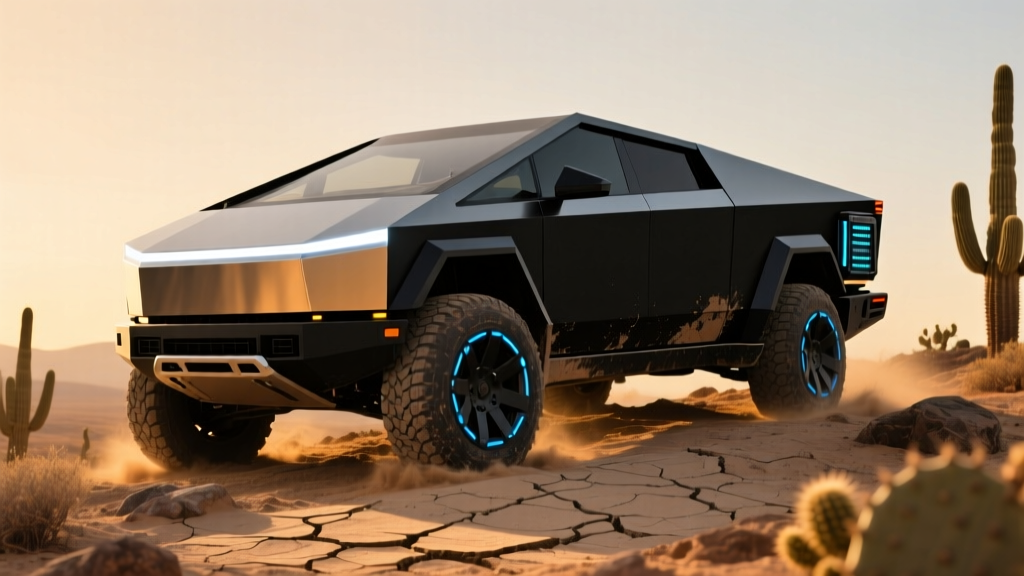
The phrase "Tesla Mad Max" has become shorthand across forums and social media for the most rugged, dystopian-looking configuration of the Tesla Cybertruck — typically the Cyberbeast trim wrapped in matte armor film, fitted with all-terrain tires, light bars, and aftermarket overlanding gear. But beyond the Instagram aesthetic, what does a fully kitted "Mad Max" Cybertruck actually deliver as a daily-driver electric pickup? In this review, we break down the 2026 Tesla Cyberbeast platform that serves as the foundation for these builds, evaluate its real-world range, charging speed, off-road capability, and ownership economics, and answer whether this apocalyptic EV truck earns its hype.
2026 Cyberbeast: The Foundation Behind Every 'Mad Max' Build
When enthusiasts reference a "Tesla Mad Max" truck, they are almost always starting with the Cyberbeast trim — Tesla's tri-motor, all-wheel-drive flagship. For 2026, the Cyberbeast carries over with a 123 kWh usable battery pack (NMC chemistry), an EPA-estimated 320 miles of range, and a staggering 845 horsepower. Tesla does not sell an official "Mad Max" package; the moniker is community-driven, typically involving aftermarket modifications like Stealth matte PPF wraps, 35-inch all-terrain tires on Method wheels, rooftop tent platforms, auxiliary LED lighting, and armored rock sliders.
The stock Cyberbeast already looks like it rolled out of a George Miller film. Its stainless-steel exoskeleton body, angular geometry, and absence of traditional paint give it a brutalist, post-apocalyptic presence that no other production EV matches. The modifications simply amplify what's already there.
| Spec | Value |
|---|---|
| EPA Range | 320 miles |
| Battery (usable) | 123 kWh, NMC |
| Drivetrain | Tri-motor AWD |
| Horsepower | 845 hp |
| 0–60 mph | 2.6 seconds |
| Max DC Fast Charge | 250 kW (peak) |
| 10–80% DC Charge | ~28 minutes |
| Level 2 Home Charge | 11.5 kW (~37 mi/hr) |
| MPGe (combined) | 68 MPGe |
| Efficiency | 48 kWh/100 mi |
| Towing Capacity | 11,000 lbs |
| Payload | 2,500 lbs |
| Bed Length | 6 ft (72 in) |
| Cargo Volume (bed + frunk) | ~67 cu ft combined |
| Base MSRP | $99,990 |
| Battery Warranty | 8 years / 150,000 miles |
Real-World Range: What 320 EPA Miles Actually Means
The Cyberbeast's EPA sticker reads 320 miles. In practice, expect 265–290 miles during mixed highway driving at 70–75 mph. In cold weather (below 32°F), range drops to approximately 220–250 miles due to battery heating demands and increased air density. Adding aftermarket all-terrain tires and a roof tent can knock off another 10–15% — bringing a "Mad Max" build down to 230–260 real-world miles in moderate conditions.
The Cybertruck's 48 kWh/100 mi efficiency figure is among the highest of any EV on the market, a direct consequence of its 6,800-pound curb weight and slab-sided aerodynamics. The stainless-steel body panels, while visually striking, create more drag than the curved aluminum or stamped steel used on the Ford F-150 Lightning or Rivian R1T. At highway speeds, that aero penalty compounds.
If you plan to build out a Mad Max-style Cyberbeast with larger, knobbier tires, understand that rolling resistance increases significantly. Switching from the stock 35-inch Goodyear Territory R/T tires to aggressive mud-terrains will cost you roughly 15–25 miles of range per charge. It's a meaningful trade-off for the off-road traction gain.
Charging Speed: DC Fast, Home, and the Supercharger Advantage
The Cyberbeast supports a peak DC fast-charge rate of 250 kW on Tesla V3 and V4 Superchargers using its native NACS connector. In real-world testing, the charge curve peaks near 250 kW between 10–30% State of Charge (SoC), then tapers progressively. The 10–80% charge takes approximately 28 minutes, with the final 80–100% adding another 25+ minutes due to cell-balancing at high SoC.
| Charge Level | Power | Miles Added per Hour | Notes |
|---|---|---|---|
| Level 1 (120V) | 1.4 kW | ~3 mi/hr | Emergency/top-up only |
| Level 2 (240V, 48A) | 11.5 kW | ~37 mi/hr | Full charge in ~10.5 hours |
| DC Fast (V3 Supercharger) | 250 kW peak | ~145 mi in 15 min | 10–80% in ~28 min |
| DC Fast (CCS adapter) | ~150 kW peak | ~90 mi in 15 min | Non-Tesla networks, adapter required |
At home on a Tesla Wall Connector (11.5 kW / 48 amps), a full overnight charge replenishes the 123 kWh pack in roughly 10.5 hours — adequate for any daily commute. The critical advantage of the Cyberbeast is seamless access to the Tesla Supercharger network, which in 2026 includes over 25,000 V3/V4 stalls across North America with unmatched uptime reliability compared to third-party networks.
For non-Tesla DC networks (Electrify America, EVgo), Tesla provides a CCS adapter, but charge rates are typically limited to 150 kW due to handshake and protocol differences. If you plan frequent road trips outside the Supercharger footprint, factor in slower charging and sparser coverage.
Off-Road Capability and the 'Mad Max' Modification Path
Stock, the Cyberbeast offers genuine off-road credentials: 16 inches of ground clearance in Extract mode (adaptive air suspension), 35-degree approach and departure angles, and a torque-vectoring tri-motor system that can send power to individual wheels in milliseconds. The steer-by-wire system provides a variable ratio that tightens at low speeds — useful on technical trails.
The "Mad Max" build path typically adds:
- 35x12.50R20 all-terrain or mud-terrain tires on beadlock-capable wheels (Method, Fuel)
- Aftermarket suspension lift (1–2 inches over stock Extract mode)
- Steel rock sliders and skid plates for underbody protection
- Roof rack with auxiliary LED light bar (50-inch curved bars are popular)
- Matte stealth PPF or vinyl wrap over the stainless body
- Bed-mounted overlanding setup: rooftop tent, slide-out kitchen, auxiliary battery
Important caveat: the Cybertruck's steer-by-wire system and 48-volt electrical architecture are proprietary and tightly integrated. Aftermarket suspension modifications can interfere with the air suspension calibration and may void portions of the powertrain warranty if Tesla service identifies non-OEM components during a claim. Always document modifications and consult with Tesla service before major chassis work.
Pricing, Tax Credit Eligibility, and Total Build Cost
The 2026 Cyberbeast starts at $99,990 before destination. With typical options (FSD Supervised at $8,000 or $99/month, premium interior packages), as-tested pricing reaches $108,000–$112,000. A full "Mad Max" aftermarket build adds another $15,000–$30,000 in tires, wheels, armor, lighting, and overlanding gear — pushing total investment to $125,000–$140,000.
| Item | Cost |
|---|---|
| Cyberbeast Base MSRP | $99,990 |
| FSD Supervised (purchase) | $8,000 |
| Destination Fee | $1,990 |
| As-Tested (stock) | ~$109,980 |
| Aftermarket Mad Max Build | $15,000–$30,000 |
| Total Investment | $125,000–$140,000 |
The Cyberbeast does NOT qualify for the $7,500 federal EV tax credit under current IRS §30D rules. The MSRP cap for trucks is $80,000, and the Cyberbeast's $99,990 base price exceeds it. Additionally, buyer income caps apply ($300K joint / $225K head of household / $150K individual). Even the lower-priced Cybertruck Long Range AWD at ~$79,990 faces battery-sourcing and critical-mineral requirements that may limit eligibility. Always verify current-year eligibility on IRS.gov before relying on the credit in your purchase decision.
Interior, Tech, and Daily Livability
The Cybertruck's cabin is minimalism taken to an extreme. A single 18.5-inch touchscreen dominates the dash, handling all vehicle controls, navigation, media, and climate functions. There are no physical buttons, no traditional instrument cluster, and no Apple CarPlay or Android Auto — everything runs through Tesla's proprietary software.
Passenger space is adequate but not generous for a full-size truck. Front legroom measures 41.5 inches; rear legroom is 38.2 inches — tighter than the F-150 Lightning's 43.6-inch rear. The rear bench seats three but is best suited for two adults on longer drives. Cargo space includes a 6-foot bed with a motorized tonneau cover (rated to 300 lbs of distributed load on top) and a front trunk (frunk) with approximately 7 cu ft of lockable storage.
Standout tech:
- Steer-by-wire with variable ratio (no mechanical connection between wheel and rack)
- Adaptive air suspension with Extract mode (+2.5 inches)
- Powered bed vault with integrated 120V and 240V outlets (up to 11.5 kW bidirectional power — V2H capable)
- Sentry Mode with stainless body acting as a natural deterrent
- FSD Supervised (SAE Level 2 — requires active driver attention at all times)
Notable drawbacks:
- Rear visibility is severely limited; relies entirely on the backup camera
- No physical buttons makes simple adjustments (wipers, mirrors) require screen taps while driving
- Stainless body panels show fingerprints and can be difficult to repair after dents
- Ride quality on stock 20-inch wheels is firm; potholes transmit sharply into the cabin
Pros and Cons at a Glance
- Tri-motor AWD with 845 hp and 2.6s 0–60 — supercar acceleration in a truck
- Stainless exoskeleton is dent- and corrosion-resistant
- 11.5 kW V2H bidirectional power can run home essentials during outages
- Best-in-class Supercharger network access
- 11,000-lb towing capacity
- Unmistakable design that turns every parking lot into a car show
- Does not qualify for $7,500 federal tax credit (MSRP exceeds $80K cap)
- Real-world range with AT tires drops to ~230–260 miles
- Rear visibility nearly nonexistent without camera
- No CarPlay, no physical buttons, steep learning curve
- Aftermarket mods may void portions of warranty
- $125K+ all-in for a Mad Max build is serious money
Cyberbeast vs. Rivian R1T Tri-Motor: Which Adventure EV Truck Wins?
The closest competitor to a Mad Max Cyberbeast build is the Rivian R1T Tri-Motor Max, which offers comparable power (850 hp), similar range (~350 miles EPA with the Max pack), and a more conventional truck layout with a gear tunnel for extra storage. The R1T starts around $99,000 for the Tri-Motor and also exceeds the tax credit MSRP cap.
Where the Cyberbeast wins: raw acceleration (2.6s vs. ~3.0s), V2H capability, and Supercharger network access. Where the R1T wins: conventional steering feel, better rear visibility, the gear tunnel (11 cu ft of side-access storage), and a more established aftermarket ecosystem for overlanding. For a pure Mad Max aesthetic and Tesla ecosystem lock-in, the Cyberbeast is the canvas. For practical overlanding with a more traditional truck experience, the R1T edges ahead.
Who Should Build a 'Mad Max' Cyberbeast?
This build suits a specific buyer: someone who wants a head-turning, high-performance electric truck that doubles as a weekend overlander and daily driver, has home Level 2 charging, doesn't need the federal tax credit to make the math work, and accepts the range compromises that come with aggressive tires and added weight.
If your primary use case is towing heavy loads long-distance (300+ miles without stopping), the Cyberbeast's real-world range while towing drops to roughly 120–150 miles — a significant limitation. For commuters with a sub-80-mile round trip and access to home charging, the daily experience is excellent: instant torque, quiet operation, and the ability to precondition the cabin from your phone every morning.
Frequently Asked Questions
What is the real-world range of a Mad Max Cyberbeast build?
With aftermarket all-terrain tires and accessories, expect 230–260 miles in moderate conditions. Stock, the Cyberbeast delivers 265–290 miles on the highway. Cold weather reduces both figures by roughly 15–20%.
How fast does the Cyberbeast charge at home and on the road?
At home on a Level 2 Tesla Wall Connector (11.5 kW), you gain roughly 37 miles per hour, fully charging overnight in about 10.5 hours. On a V3 Supercharger (250 kW peak), 10–80% takes approximately 28 minutes.
Does the Cyberbeast qualify for the $7,500 federal EV tax credit?
No. The Cyberbeast's $99,990 MSRP exceeds the $80,000 truck cap set by IRS §30D. Buyer income limits and battery-sourcing requirements further restrict eligibility even on lower-priced trims. Always check IRS.gov for current rules.
Will aftermarket modifications void my Cybertruck warranty?
Potentially. Tesla's warranty covers defects in materials and workmanship, but modifications to the suspension, steering, or electrical system can be flagged during warranty claims. Cosmetic wraps and bolt-on accessories (light bars, bed racks) are generally safe. Consult Tesla service before making structural changes.
Is the Cyberbeast good for towing?
It's rated for 11,000 lbs — competitive with full-size gas trucks. However, towing at or near max capacity cuts real-world range roughly in half, to 120–150 miles. For frequent heavy towing, plan charging stops carefully and understand that DC fast charging while hitched requires pull-through stations, which remain rare.
Is FSD Supervised actually self-driving?
No. Tesla's Full Self-Driving (Supervised) is an SAE Level 2 driver-assistance system. It can handle highway lane-keeping, automatic lane changes, and some city-street navigation, but the driver must remain fully engaged, hands on the wheel, and eyes on the road at all times. It is not autonomous driving.
Sources: EPA Fuel Economy, Tesla Cybertruck Specifications, IRS §30D Clean Vehicle Credits.