The Cybertruck Logo and Tesla's Boldest Design Statement
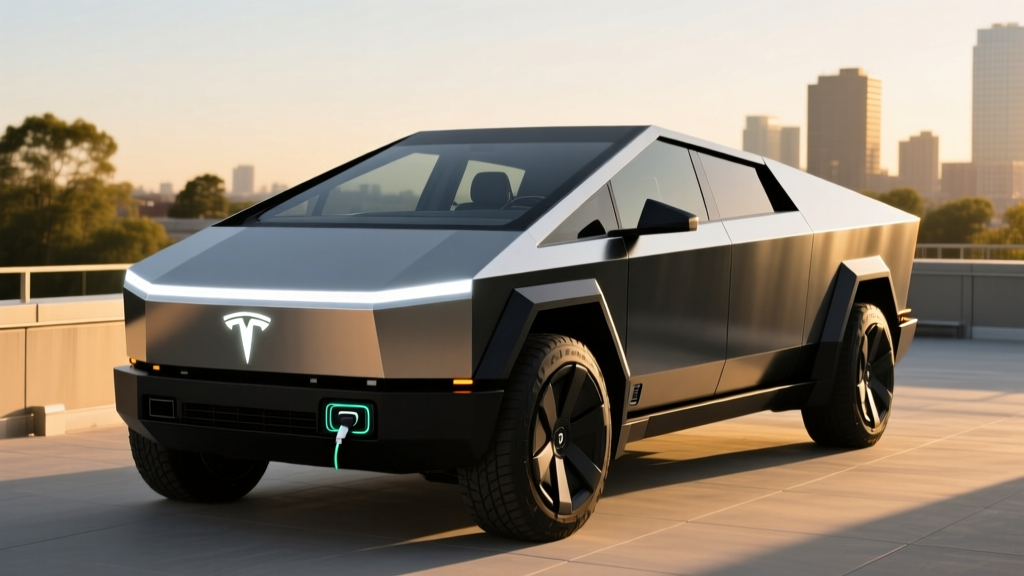
If you've seen the Tesla Cybertruck on the road, the first thing you notice isn't the badge — it's the silhouette. The Cybertruck logo, a minimalist angular wordmark etched into the stainless-steel tailgate, mirrors the truck's origami-fold exoskeleton. Unlike the stylized "T" shield found on the Model Y or Model S, the Cybertruck branding strips away ornamentation entirely: a sans-serif, geometric typeface that reads more like an architectural blueprint than an automotive emblem. It's a deliberate choice. Tesla positioned the Cybertruck as a departure from legacy truck design, and the logo reinforces that ethos — no chrome, no heritage crest, just cold-rolled steel and sharp angles.
But the Cybertruck is far more than its logo suggests. For the 2026 model year, Tesla continues to offer the truck in three primary configurations: the Long Range AWD, the Dual Motor AWD, and the performance-oriented Cyberbeast. Each variant carries a distinct price point, range profile, and capability set. Below, we break down everything a prospective buyer needs to know — from real-world range to tax-credit eligibility — so you can decide whether the Cybertruck earns a spot in your garage.
2026 Cybertruck Specs at a Glance
| Spec | Long Range AWD | Dual Motor AWD | Cyberbeast (Tri-Motor) |
|---|---|---|---|
| EPA Range | ~340 mi | ~320 mi | ~320 mi |
| Battery (usable, est.) | ~123 kWh (NMC) | ~123 kWh (NMC) | ~123 kWh (NMC) |
| Drivetrain | Dual Motor AWD | Dual Motor AWD | Tri-Motor AWD |
| Horsepower | ~600 hp | ~600 hp | ~845 hp |
| 0–60 mph | ~4.8 sec | ~3.9 sec | ~2.6 sec |
| Max DC Fast Charge | ~250 kW (Supercharger) | ~250 kW (Supercharger) | ~250 kW (Supercharger) |
| 10–80% DCFC Time | ~28 min | ~28 min | ~28 min |
| Level 2 Home Charge | ~11.5 kW / ~37 mi/hr | ~11.5 kW / ~37 mi/hr | ~11.5 kW / ~37 mi/hr |
| MPGe (combined, est.) | ~70 MPGe | ~68 MPGe | ~65 MPGe |
| Towing Capacity | 11,000 lb | 11,000 lb | 11,000 lb |
| Payload | ~2,500 lb | ~2,500 lb | ~2,500 lb |
| Base MSRP | ~$79,990 | ~$84,990 | ~$99,990 |
Note: Specs reflect Tesla's published and estimated figures for the 2026 model year. Tesla adjusts pricing and trim availability periodically; verify on Tesla's Cybertruck page before ordering.
Real-World Range: What the EPA Number Doesn't Tell You
Long Range AWD: EPA 340 mi → Expect ~280–310 mi mixed highway/city; ~240–260 mi in sustained cold (below 32°F) or at 80+ mph.
Dual Motor / Cyberbeast: EPA 320 mi → Expect ~260–290 mi mixed; ~220–250 mi in cold or high-speed driving.
The Cybertruck's angular stainless-steel body is striking, but it carries an aerodynamic penalty at highway speeds compared to more rounded EVs. The truck's frontal area and sharp creases create turbulence that increases energy consumption above 65 mph. In real-world highway testing at 75 mph in moderate temperatures, owners report efficiency in the range of 48–52 kWh/100mi, which translates to roughly 260–290 miles on a full charge for the Dual Motor variant.
Cold weather compounds the effect. The Cybertruck uses a heat pump for cabin and battery thermal management, which mitigates some loss, but expect a 15–25% range reduction in sub-freezing conditions. If you're planning a winter road trip through the Rockies or upper Midwest, budget for charging stops every 220–240 miles to maintain a comfort buffer. City driving with frequent regenerative braking recovers more energy, pushing real-world range closer to the EPA sticker.
For context on how the EPA calculates these figures, see the methodology at fueleconomy.gov.
Charging Speed: DC Fast Charging and Home Level 2
| Charging Level | Power (kW) | Miles Added per Hour | Notes |
|---|---|---|---|
| Level 1 (120V household) | ~1.4 kW | ~3–4 mi/hr | Emergency/top-off only; ~80+ hours for full charge |
| Level 2 (240V, 48A) | ~11.5 kW | ~37 mi/hr | Full charge overnight in ~10–12 hours |
| DC Fast (Tesla Supercharger V3/V4) | Up to ~250 kW peak | ~200+ mi in 15 min | 10–80% in ~28 min; tapers sharply above 80% |
The Cybertruck charges on Tesla's North American Charging Standard (NACS) connector natively — no adapter required at Superchargers. At a V3 or V4 Supercharger stall, the truck peaks near 250 kW, but like all large-battery EVs, the charge curve tapers significantly as the battery fills. You'll see peak speeds between 10–40% State of Charge, after which the rate drops to protect cell longevity. A 10–80% session takes approximately 28 minutes under ideal thermal conditions.
Preconditioning is critical here. If you navigate to a Supercharger using the truck's built-in navigation, the battery management system will warm the pack en route, enabling faster charge acceptance on arrival. Skipping preconditioning — especially in cold weather — can add 10–15 minutes to your session as the battery limits charge rate to protect itself.
For home charging, a Wall Connector on a 60A circuit delivers up to 11.5 kW, adding roughly 37 miles of range per hour. A full overnight charge from 10% to 100% takes about 10–12 hours. Most owners who charge nightly from a 50–80% daily window will top off in 3–4 hours — well within a standard evening at home. If your electrical panel is older or maxed out, consult a licensed electrician; a panel upgrade to 200A service can add $1,500–$3,000 to your installation cost.
Performance and Drivetrain: From Practical to Ludicrous
The Cybertruck lineup covers a wide performance spectrum. The Long Range AWD uses a dual-motor setup producing approximately 600 horsepower, with a 0–60 mph time around 4.8 seconds — brisk for a truck weighing nearly 7,000 pounds. The Dual Motor AWD trims that to roughly 3.9 seconds with a more aggressive torque delivery map.
The Cyberbeast is the headline act. Its tri-motor configuration — one front, two rear — produces an estimated 845 horsepower and rockets to 60 mph in approximately 2.6 seconds. That puts it in supercar territory, which is absurd for a vehicle with a 6-foot bed and 11,000-pound tow rating. But the Cyberbeast exists as much for brand statement as for practical use.
All trims feature adaptive air suspension with up to 16 inches of ground clearance in Extract Mode, making the Cybertruck genuinely capable off-road. The steer-by-wire system (Tesla calls it no physical steering column linkage) provides variable ratio steering — quick at low speeds for parking, slower and more stable at highway speed. Adaptation takes a few drives, but most owners report it becomes intuitive quickly.
For safety ratings and crash-test data, check NHTSA.gov and IIHS.org, though the Cybertruck's unique stainless-steel exoskeleton and geometry have made standardized testing more complex than typical unibody vehicles.
Pricing, Trims, and Federal Tax Credit Eligibility
| Trim | Base MSRP | As-Tested (est. w/ options) | §30D Federal Credit Eligibility |
|---|---|---|---|
| Long Range AWD | ~$79,990 | ~$84,000–$88,000 | Not eligible — exceeds MSRP cap |
| Dual Motor AWD | ~$84,990 | ~$89,000–$95,000 | Not eligible — exceeds MSRP cap |
| Cyberbeast | ~$99,990 | ~$105,000–$115,000 | Not eligible — exceeds MSRP cap |
Here's the hard truth for bargain-hunters: no Cybertruck trim qualifies for the $7,500 federal EV tax credit under IRS §30D. The reason is straightforward — the §30D credit caps eligible pickups and SUVs at an MSRP of $80,000. Even the base Long Range AWD, priced around $79,990, often crosses that threshold once destination fees or mandatory options are included. The Dual Motor and Cyberbeast are well above the line.
Additionally, §30D imposes buyer income limits (modified adjusted gross income of $150,000 single / $300,000 joint filers) and battery critical-mineral and component sourcing requirements that shift annually. Even if a future base trim dipped below the MSRP cap, sourcing rules could still disqualify it. Always verify current eligibility on IRS.gov before assuming credit availability.
Some states offer their own EV rebates or tax incentives that aren't subject to the federal MSRP cap — check your state's energy or DMV website for specifics, as these vary widely by jurisdiction.
Cargo, Interior Space, and Daily Livability
The Cybertruck's 6-foot bed offers approximately 74 cubic feet of cargo volume with the tonneau cover closed. The bed is wide enough for 4×8 sheets of plywood (with the tailgate down and some angling), and the powered tonneau is lockable and robust. The vault-style bed with integrated LED lighting and 120V/240V outlets is a standout feature for job-site or camping use.
Inside, the cabin seats five (a six-seat front bench option has been announced but availability varies). Rear legroom measures approximately 38–40 inches — adequate for adults on longer trips but tighter than a full-size F-150 Lightning crew cab. The 18.5-inch center touchscreen dominates the dash, running Tesla's latest infotainment software with navigation, streaming, and vehicle controls. There's no traditional instrument cluster; all driving information is projected on the main screen or visible through the yoke-style steering wheel.
Front trunk (frunk) space is modest — roughly 7 cubic feet — useful for charging cables, a small bag, or groceries, but not a major cargo area. Interior materials are vegan leather and hard plastics, consistent with Tesla's minimalist approach. Build quality on 2026 models has improved significantly over early-production 2024 units, with tighter panel gaps and fewer reported fitment issues.
Driver Assistance: Autopilot and FSD Supervised
Tesla Autopilot and Full Self-Driving (Supervised) are Level 2 driver-assistance systems, not self-driving. The driver must remain fully engaged, hands on the yoke, and eyes on the road at all times. The Cybertruck does not operate autonomously.
Every Cybertruck ships with Tesla's basic Autopilot (traffic-aware cruise control and lane-keeping). Full Self-Driving (Supervised) is available as an add-on purchase or subscription, adding features like automatic lane changes, traffic-light and stop-sign recognition, and Navigate on Autopilot for highway on/off-ramp guidance.
FSD Supervised has improved substantially through 2025–2026 software updates, but it remains a driver-assist system that can make errors — particularly in construction zones, unmapped areas, and adverse weather. Treat it as a fatigue-reduction tool on long highway stretches, not a replacement for attentive driving.
Battery, Warranty, and Long-Term Ownership
The Cybertruck uses a large NMC (nickel manganese cobalt) battery pack with an estimated usable capacity of approximately 123 kWh. Tesla does not publish exact cell chemistry details publicly, but teardown analysis and supply-chain reporting indicate a 4680-format NMC cell manufactured at Tesla's Texas Gigafactory.
Tesla's battery and drive unit warranty covers 8 years or 120,000 miles (whichever comes first), with a minimum 70% capacity retention threshold over that period. This is competitive with the broader EV truck segment. Based on Tesla's fleet degradation data across the Model S/X/3/Y lineup, most packs lose roughly 10–12% capacity over the first 100,000 miles, with the degradation curve flattening significantly afterward.
Replacement cost out of warranty for a pack this size is substantial — estimated between $15,000 and $25,000 depending on labor and cell pricing at the time. However, the vast majority of Tesla battery packs outlast the vehicle's useful economic life without requiring full replacement.
Who Should Buy the Cybertruck — and Who Shouldn't
- You want a full-size electric pickup with genuine towing (11,000 lb) and off-road capability
- You value the Supercharger network for long-distance road trips
- You want standout design and don't mind attention (positive and negative)
- You need 240V bed outlets for job-site tools or camping
- Budget allows $80,000+ without relying on the federal tax credit
- You need maximum rear-seat space for tall adults or car seats (F-150 Lightning is roomier)
- Federal tax credit eligibility is a dealbreaker for your budget
- You prefer a conventional truck interior with physical buttons and familiar ergonomics
- Your daily commute is short and you don't need 300+ miles of range
- You want a proven, multi-year track record — the Cybertruck is still a relatively new platform
Pros and Cons
Pros
- Unmatched Supercharger network access for road trips
- 240V bed outlets and robust towing capacity
- Stainless-steel exoskeleton is dent- and corrosion-resistant
- Tri-motor Cyberbeast offers supercar acceleration in a truck
- OTA software updates continuously add features
- Air suspension with Extract Mode for serious off-road clearance
Cons
- No federal tax credit eligibility due to MSRP cap
- Rear seat space is tighter than F-150 Lightning or Rivian R1T
- Steep learning curve with steer-by-wire and yoke steering
- Highway efficiency drops noticeably at 75+ mph
- Stainless-steel body shows fingerprints and is difficult to repair
- Visibility challenges — large blind spots require camera reliance
Frequently Asked Questions
What is the real-world range of the Cybertruck?
The EPA rates the Long Range AWD at approximately 340 miles and the Dual Motor/Cyberbeast at around 320 miles. In real-world mixed driving, expect 280–310 miles for the Long Range and 260–290 miles for the Dual Motor. Sustained highway speeds above 70 mph and cold weather (below 32°F) will reduce these figures by 15–25%.
How fast does the Cybertruck charge at home and on the road?
At home on a Level 2 Wall Connector (11.5 kW), the Cybertruck adds about 37 miles of range per hour, reaching a full charge in roughly 10–12 hours. On a Tesla Supercharger (up to 250 kW DC), a 10–80% session takes approximately 28 minutes, though the charge rate tapers significantly above 80% State of Charge.
Does the Cybertruck qualify for the $7,500 federal EV tax credit?
No. Under current IRS §30D rules, the Cybertruck exceeds the $80,000 MSRP cap for pickup trucks in all trims, making it ineligible for the federal clean vehicle credit. Some state-level incentives may still apply — check your state's energy office for details. Always verify current rules on IRS.gov.
Is the Cybertruck worth buying over the Ford F-150 Lightning or Rivian R1T?
It depends on your priorities. The Cybertruck wins on Supercharger network access, off-road clearance via air suspension, and raw Cyberbeast performance. The F-150 Lightning offers more rear-seat room, a more conventional driving experience, and some trims may qualify for the federal tax credit. The Rivian R1T excels in adventure-focused features and interior quality but at a similar or higher price point. Test-drive all three before committing.
What does the Cybertruck logo look like, and where is it placed?
The Cybertruck logo is a minimalist, angular wordmark — "CYBERTRUCK" in a geometric sans-serif typeface — that mirrors the truck's folded-steel design language. It appears on the tailgate in place of a traditional badge. The Tesla "T" logo is not prominently featured on the exterior, a departure from other Tesla vehicles. The angular branding is also used in the Cybertruck's UI menus and marketing materials.
Can I tow with the Cybertruck, and how does it affect range?
Yes — all Cybertruck trims are rated for 11,000 pounds of towing. However, towing a heavy trailer (5,000+ lb) can reduce range by 40–50% due to the combined weight and aerodynamic drag of the trailer. Plan for charging stops every 130–160 miles when towing at maximum capacity, and use Tesla's built-in trip planner to identify Supercharger locations along your route.