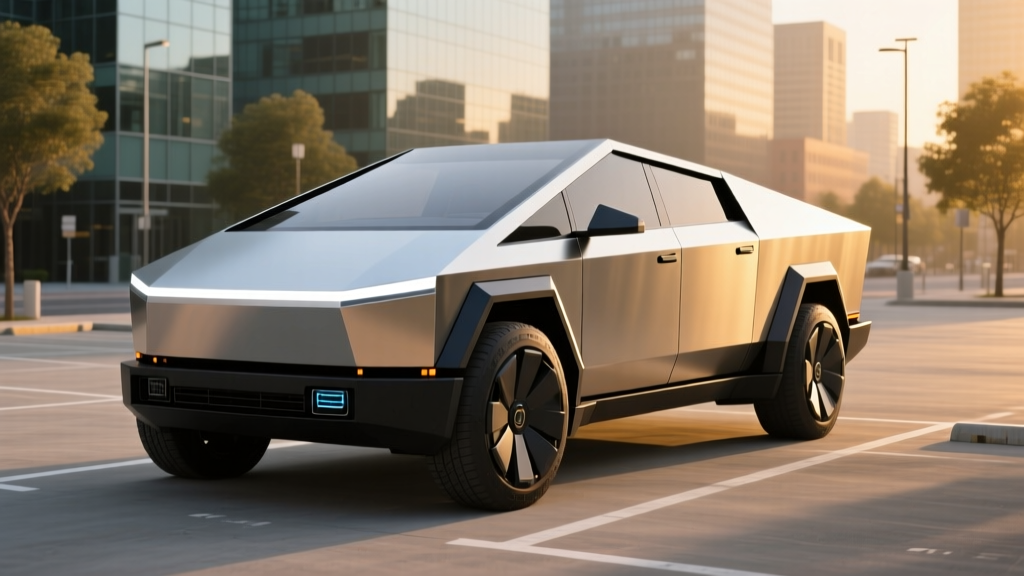
If you're researching the Tesla Cybertruck, one of the first things that jumps out is its sheer physical presence. The Cybertruck length, angular footprint, and stainless-steel exoskeleton make it unlike any other pickup on the road — and understanding its exact dimensions is critical before you measure your garage, plan a bed build-out, or compare it against the Ford F-150 Lightning or Rivian R1T.
This guide breaks down every exterior and interior dimension you need, then pairs that with the numbers that actually determine daily livability: real-world range, 800-volt charging behavior, trim-level pricing under 2026 IRS §30D tax credit rules, and the ownership trade-offs that spec sheets rarely surface.
Cybertruck Length and Exterior Dimensions: The Numbers
At 226.2 inches long, the Cybertruck sits between the Ford F-150 Lightning (231.7 in. for the SuperCrew) and the Rivian R1T (217.1 in.). It's not the longest full-size truck, but its monowedge silhouette and 80.0-inch width (mirrors excluded) create real-world parking and garage challenges that raw length alone doesn't capture.
| Dimension | Cybertruck | F-150 Lightning | Rivian R1T |
|---|---|---|---|
| Overall Length | 226.2 in. | 231.7 in. | 217.1 in. |
| Width (no mirrors) | 80.0 in. | 79.9 in. | 81.8 in. |
| Height | 70.5 in. | 78.9 in. | 73.0 in. |
| Wheelbase | 141.7 in. | 145.5 in. | 135.9 in. |
| Bed Length | 72.0 in. (6 ft) | 67.0 in. (5.5 ft) | 54.0 in. (4.5 ft) |
| Bed Width (between wells) | ~50.0 in. | 50.6 in. | 50.0 in. |
| Curb Weight (AWD) | ~6,650 lb | ~6,015 lb | ~7,148 lb |
| Ground Clearance (max) | 16.0 in. | 8.9 in. | 14.9 in. |
A few things worth calling out:
- Garage fit: A standard two-car garage door is 80–96 inches wide. The Cybertruck fits, but its sharp corners and flat roofline make the approach angle unforgiving — leave extra margin.
- Bed advantage: The 72-inch (6-foot) bed beats both Lightning and R1T, and the motorized tonneau cover plus front trunk (frunk) add sealed cargo volume that traditional trucks can't match.
- Air suspension travel: The adaptive air suspension drops ~2 inches for highway efficiency and raises to 16 inches of ground clearance off-road — a dimension that changes based on drive mode.
Real-World Range vs. EPA Estimates
EPA Range (2026 trims):
- AWD: 340 miles (est.)
- Cyberbeast: 320 miles (est.)
- RWD (2026): ~250 miles (announced)
Real-world expectation: Plan on 260–290 highway miles at 70–75 mph in moderate temps; cold-weather highway range can drop 20–30% (to ~200–230 mi in sub-freezing conditions). The Range Extender battery pack, when available, is projected to push AWD toward 470 miles but remains unreleased as of early 2026.
Tesla's EPA figures for the dual- and tri-motor Cybertruck are competitive for a 6,600+ lb stainless-steel pickup, but the truck's aerodynamics — despite the wedge shape — and weight work against it at sustained highway speeds. In independent testing, 75-mph highway loops have yielded closer to 2.0–2.2 kWh/mile, translating to roughly 270 miles on a full charge for the AWD. City and suburban driving with regenerative braking recovers more energy, and owners report 300+ miles easily in mixed 45-mph use.
Cold weather is the bigger variable. The heat pump helps, but a 6,650-lb truck with a large battery mass takes longer to thermally condition. Expect 20–30% range reduction in sustained sub-32°F highway driving — a figure consistent with most large BEVs but worth budgeting for if you commute in northern climates.
Battery, Chemistry, and Efficiency
Tesla has not published official usable battery capacity for the Cybertruck, but teardowns and charge-log analysis from owners point to a ~123 kWh usable NMC (nickel-manganese-cobalt) pack for the AWD and Cyberbeast trims. This is a large, high-energy-density pack — LFP chemistry is not used here, which matters for two reasons:
- NMC trade-off: Higher energy density (more range per pound) but slightly faster long-term degradation than LFP. Tesla's thermal management and charge-limit software mitigate this.
- Charge target: NMC packs benefit from daily charge limits around 80%, reserving 100% for road trips. The vehicle's UI makes this straightforward.
Efficiency on the EPA cycle is rated around 54 MPGe combined for the AWD (~63 kWh/100 mi), which is unimpressive against lighter EVs but respectable for a truck this size. For comparison, the F-150 Lightning Extended Range lands at ~66 MPGe combined, while the Rivian R1T Dual-Motor is around 70 MPGe with a smaller pack.
Charging Speed: 800V Architecture in Practice
The Cybertruck uses an 800-volt electrical architecture, which is the headline feature for charging. On Tesla's V4 Superchargers and other compatible 800V+ DC fast chargers, the truck can accept high peak power — but the charge curve tells the real story.
| Charging Level | Power | Speed | Notes |
|---|---|---|---|
| DC Fast (V4 Supercharger) | Peak ~250–350 kW | 10–80% in ~20–25 min | Preconditioning required; tapers sharply above 80% |
| DC Fast (V3 Supercharger) | Peak ~250 kW | 10–80% in ~30 min | Most common Tesla network hardware |
| Level 2 (Tesla Wall Connector) | 11.5 kW (48A) | ~34 miles/hr | Full overnight charge in ~10–12 hours |
| Level 2 (generic J1772/NACS) | 7.7–11.5 kW | ~23–34 miles/hr | Depends on circuit amperage |
| Level 1 (120V outlet) | ~1.4 kW | ~3–4 miles/hr | Emergency/trickle only |
A few owner-relevant realities:
- Preconditioning is non-negotiable. Without 20–30 minutes of battery preheat (automatic when you navigate to a Supercharger), peak kW drops dramatically, especially below 50°F.
- Peak ≠ sustained. The truck hits peak kW briefly in the 10–30% SoC window, then tapers. A 10–80% session is the practical metric, not the peak number.
- CCS adapters: The Cybertruck ships with a NACS port. Tesla's CCS1 adapter works at Electrify America and other networks, but 800V handshakes on non-Tesla hardware aren't always seamless — verify station compatibility on long trips.
Performance, Drivetrain, and Towing
| Spec | AWD | Cyberbeast |
|---|---|---|
| Drivetrain | Dual-Motor AWD | Tri-Motor AWD |
| Horsepower | ~600 hp | ~845 hp |
| 0–60 mph | 3.9 sec | 2.6 sec |
| Top Speed | 130 mph | 130 mph |
| Max Towing | 11,000 lb | 11,000 lb |
| Payload | ~2,500 lb | ~2,500 lb |
The Cyberbeast's 2.6-second 0–60 time is legitimately supercar territory in a vehicle that weighs over three tons — a function of tri-motor torque vectoring and instant electric torque. The AWD dual-motor at 3.9 seconds is still faster than nearly every gas pickup ever sold.
Towing is where reality checks in. The 11,000-lb rating is competitive with half-tons, but towing at max capacity cuts range roughly in half. On a 7,000-lb trailer, expect 150–170 miles of real-world range at highway speeds. Tesla's integrated trailer brake controller and tow-assist camera views are well-executed, but long-distance towing still requires careful Supercharger route planning.
Pricing, Trims, and 2026 Federal Tax Credit Eligibility
| Trim | Base MSRP | Federal Credit (max) | Effective Price |
|---|---|---|---|
| RWD (announced) | ~$60,990 | Up to $7,500* | ~$53,490* |
| AWD | ~$79,990 | Up to $7,500* | ~$72,490* |
| Cyberbeast | ~$99,990 | Up to $7,500* | ~$92,490* |
*Under IRS §30D rules, the full $7,500 credit requires meeting critical-mineral and battery-component sourcing thresholds that shift annually. Buyer income caps apply ($150K single / $300K joint MAGI), and the truck qualifies under the $80,000 MSRP cap for pickups/SUVs/vans. The Cyberbeast exceeds the MSRP cap and does NOT qualify. Point-of-sale transfer is available at participating dealers. Confirm current-year rules with a tax professional before purchase.
This is where the Cyberbeast's price crosses a hard line: at ~$99,990 MSRP, it exceeds the §30D cap for trucks ($80,000), making it ineligible for the federal credit. The AWD, at ~$79,990, sits right at the threshold — any dealer-installed options that push MSRP over $80K could disqualify it. The RWD, once it ships, will be the credit-friendly variant.
Interior, Cargo, and Technology
The Cybertruck interior is minimalist in a way that divides opinion. An 18.5-inch front touchscreen handles nearly every function (no physical gauges, no traditional stalks — turn signals are on the yoke-style steering wheel). A rear 9.4-inch screen serves passengers. Materials are vegan leather and hard plastics that prioritize wipe-down durability over luxury.
Passenger space is adequate but not class-leading:
- Front legroom: ~41.5 in.
- Rear legroom: ~38.0 in. (tighter than F-150 Lightning's ~43 in.)
- Seating: 6-passenger (bench front seat)
- Frunk: ~7.1 cu ft (sealed, lockable, drainable)
- Bed volume: ~67 cu ft with tonneau closed
The steer-by-wire system and 48-volt electrical architecture are genuinely novel — no other production vehicle uses either at this scale. Steer-by-wire enables variable steering ratios (tight in parking, stable on highway) but has a learning curve. The 48V architecture reduces wiring-harness weight and allows higher-power accessories.
Driver assistance comes via Tesla's Autopilot (Level 2 SAE) with optional FSD (Supervised) — which remains a driver-monitoring-required system, not autonomous. It's capable on highways but requires hands-on-wheel attention.
Warranty and Long-Term Ownership
Tesla's warranty structure is competitive for the EV segment:
- Basic vehicle: 4 years / 50,000 miles
- Battery & drive units: 8 years / 120,000 miles (with minimum 70% capacity retention)
The 70% retention threshold at 8 years is standard for the industry, per fueleconomy.gov comparisons. Battery replacement costs out of warranty are significant — large-pack replacements currently run $15,000–$22,000 depending on labor, though real-world degradation on Tesla's thermal-managed NMC packs typically stays under 10% in the first 100,000 miles based on fleet data.
Insurance premiums are a real ownership cost to model. The Cybertruck's stainless-steel panels, steer-by-wire components, and limited aftermarket repair network push premiums higher than comparable gas trucks — often 30–50% above F-150 Lightning quotes. Get a quote before ordering.
Pros, Cons, and Who This Truck Is For
Pros
- Class-leading 6-foot bed with sealed tonneau and large frunk
- 800V architecture with strong DC fast-charge performance
- Sub-4-second 0–60 (AWD) with 11,000-lb towing
- Adaptive air suspension with 16 inches of ground clearance
- Over-the-air updates continue adding features post-purchase
- AWD trim qualifies for §30D credit under current MSRP rules
Cons
- Cyberbeast exceeds §30D MSRP cap — no federal credit
- Range drops sharply when towing (plan 150–170 mi at max load)
- Steep learning curve: steer-by-wire, yoke, screen-only controls
- Insurance premiums significantly higher than rival trucks
- Rear legroom trails F-150 Lightning
- RWD trim still announced, not yet shipping
- Cold-weather highway range drops 20–30%
Who should buy the Cybertruck?
- Choose the AWD if: You want a daily-drivable electric truck with a full-size bed, qualify for §30D, and value Supercharger network access for road trips.
- Choose the Cyberbeast if: Performance is the priority, budget is flexible, and you don't need the tax credit.
- Wait for the RWD if: Price sensitivity is high and you don't need AWD — it will be the most affordable and credit-friendly variant.
- Look at the F-150 Lightning or R1T if: Rear-seat space, conventional controls, or proven long-term reliability data are higher priorities than design novelty.
Frequently Asked Questions
What is the exact length of the Tesla Cybertruck?
The 2026 Tesla Cybertruck measures 226.2 inches long overall, with a 72.0-inch (6-foot) bed and a 141.7-inch wheelbase. It's shorter than an F-150 Lightning SuperCrew but longer than the Rivian R1T.
What is the real-world range of the Cybertruck?
EPA estimates are 340 miles (AWD) and 320 miles (Cyberbeast). Real-world highway driving at 70–75 mph typically yields 260–290 miles in moderate temperatures, with 20–30% reduction in sustained sub-freezing conditions.
How fast does the Cybertruck charge?
On Tesla V4 Superchargers, the 800V Cybertruck can peak around 250–350 kW and reach 10–80% in roughly 20–25 minutes with preconditioning. On V3 Superchargers, expect ~30 minutes. Home Level 2 at 11.5 kW adds about 34 miles per hour of charging.
Does the Cybertruck qualify for the $7,500 federal tax credit?
The AWD trim at ~$79,990 MSRP qualifies under the §30D $80,000 truck cap, subject to buyer income limits ($150K single / $300K joint), critical-mineral and battery-component sourcing rules, and point-of-sale transfer availability. The Cyberbeast (~$99,990) exceeds the cap and does not qualify. Verify current-year rules on irs.gov.
Is the Cybertruck worth it versus the F-150 Lightning or Rivian R1T?
The Cybertruck wins on bed length, 800V charging, and performance-per-dollar in the AWD trim. The F-150 Lightning wins on rear-seat space, conventional controls, and fleet/dealer support. The R1T wins on off-road refinement and interior quality. Your answer depends on which of those trade-offs matters most.
How much does it cost to insure a Cybertruck?
Insurance premiums typically run 30–50% higher than comparable gas half-ton trucks due to stainless-steel body repair costs, steer-by-wire components, and limited third-party repair networks. Get quotes from multiple carriers before ordering.
Will the Cybertruck fit in a standard garage?
Yes, but with minimal margin. At 226.2 inches long and 80.0 inches wide (excluding mirrors), it fits most standard two-car garage openings, but the sharp body corners and flat roofline require careful approach. Measure your garage depth and door width before committing.