Tesla Cybertruck Dimensions: Length, Width, and Bed Specs
The question "what is the Tesla Cybertruck length?" comes up constantly — and for good reason. At 231.7 inches (19.3 feet) long, the Cybertruck sits between full-size pickups like the Ford F-150 Lightning (232.7 in.) and midsize trucks like the Rivian R1T (217.1 in.). That length directly shapes its garage fit, turning radius, and bed capacity.
| Dimension | Cybertruck | F-150 Lightning | Rivian R1T |
|---|---|---|---|
| Overall Length | 231.7 in. | 232.7 in. | 217.1 in. |
| Overall Width (w/ mirrors) | 95.0 in. | 96.0 in. | 81.8 in. |
| Overall Height | 70.5 in. | 78.3 in. | 73.0 in. |
| Wheelbase | 143.5 in. | 145.5 in. | 135.9 in. |
| Bed Length | 72.0 in. (6 ft) | 66.0 in. (5.5 ft) | 54.0 in. (4.5 ft) |
| Bed Volume | 67 cu ft | 52.8 cu ft | 27.0 cu ft (bed) + 11 cu ft (frunk) |
| Front Legroom | 41.5 in. | 43.9 in. | 41.3 in. |
| Rear Legroom | 34.2 in. | 43.6 in. | 36.6 in. |
| Curb Weight | ~6,800 lbs (AWD) | ~6,171 lbs | ~7,148 lbs |
| Towing Capacity | 11,000 lbs | 10,000 lbs | 11,000 lbs |
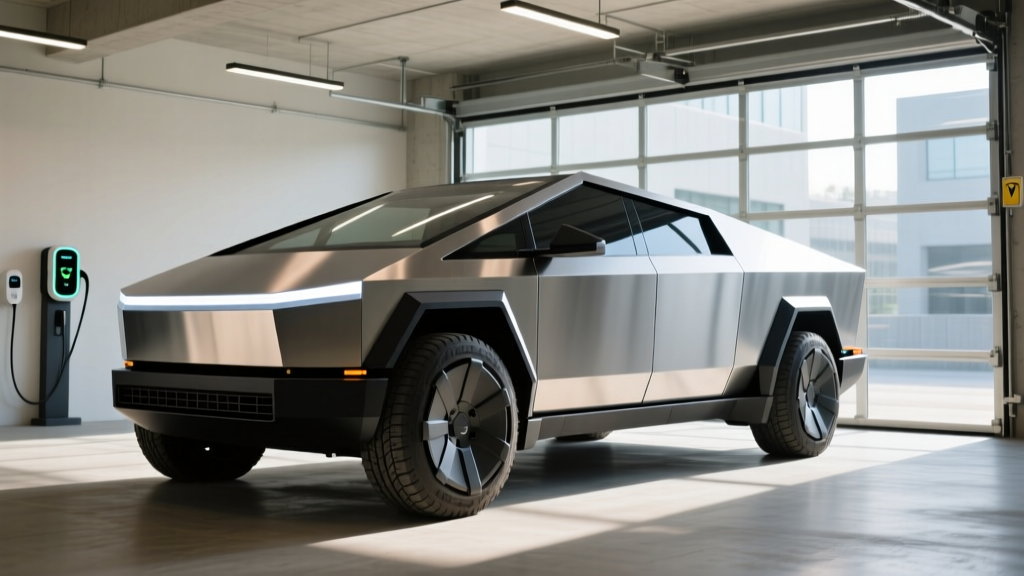
The Cybertruck's 95-inch width with mirrors folded is a real-world issue: many older residential garage doors are 8 or 9 feet wide, and the stainless-steel exoskeleton won't forgive tight squeezes. Measure your garage before committing. On the plus side, the 6-foot composite bed with a motorized tonneau cover gives it more enclosed cargo space than the R1T and matches many short-bed gas trucks.
Range, Battery, and Real-World Efficiency
Tesla offers the 2026 Cybertruck in two battery configurations: a Dual Motor AWD with an EPA-estimated 318 miles and the Cyberbeast (Tri Motor AWD) with 320 miles. The previously announced Range Extender option — a bolt-on battery pack in the bed — was projected to push AWD models to ~470 miles, but Tesla has not made it available for retail order as of early 2026.
EPA: 318 mi (AWD) / 320 mi (Cyberbeast). Real-world expectation: plan for 240–270 miles at sustained 70–80 mph highway speeds, and 190–220 miles in sub-30°F winter conditions. The Cybertruck's slab-sided stainless body yields a high drag coefficient (~0.34 Cd), and towing a 7,000-lb trailer cuts range roughly in half to ~150–170 miles. Independent testers at Edmunds have recorded highway-range figures in the 250-mile zone under mixed conditions.
The energy storage is a ~123 kWh usable lithium-ion pack. Tesla does not publish cell chemistry publicly, but teardown data and supply-chain reporting indicate an NMC (nickel manganese cobalt) cathode, consistent with Tesla's performance and long-range models. LFP chemistry is reserved for the lower-cost Model 3/Y RWD trims. The NMC pack supports the Cybertruck's high charge rates and towing demands but carries the usual 80% daily-charge recommendation for longevity.
Efficiency on the EPA cycle is rated at 70 MPGe combined (AWD) and 69 MPGe (Cyberbeast), translating to roughly 48–50 kWh per 100 miles. That's thirstier than the F-150 Lightning (66 MPGe / 49 kWh/100 mi) and far less efficient than a passenger EV like the Model Y (122 MPGe). Heavy weight, high drag, and all-terrain tires explain the penalty.
Charging Speed: DC Fast, Level 2, and Home Setup
The Cybertruck uses an 800-volt architecture — a first for Tesla's consumer lineup — enabling peak DC fast-charge rates up to 350 kW on V4 Superchargers. At that rate, Tesla claims a 10–80% session in approximately 17 minutes. In practice, the charge curve tapers sharply above 60% SoC, so expect the final 20% to add another 15–20 minutes. Sustained average from 10–80% is closer to 200–220 kW on a V4 post.
| Charge Level | Power | Speed / Time | Notes |
|---|---|---|---|
| Level 1 (120V) | ~1.4 kW | ~3 mi/hr | Emergency trickle only |
| Level 2 (240V, 48A) | 11.5 kW | ~23 mi/hr | Home Wall Connector; ~14 hrs for full charge |
| DC Fast (V4 Supercharger) | Up to 350 kW | 10–80% in ~17 min | 800V architecture; taper above 60% |
| DC Fast (CCS adapter, 150 kW) | 150 kW | 10–80% in ~40 min | Via Tesla CCS adapter on third-party networks |
At home, the Tesla Wall Connector delivers up to 11.5 kW (48 amps on a 60-amp circuit). With the Cybertruck's ~123-kWh pack, a full 0–100% home charge takes roughly 13–14 hours. Most owners who plug in nightly between 20–80% SoC will top up in 6–8 hours. A 200-amp electrical panel is usually sufficient, but if your panel is maxed out or you need a 100-foot conduit run, budget $1,500–$3,500 for a licensed electrician — and confirm with a professional whether a panel upgrade to 200A or 400A is needed.
Tesla's NACS connector is native. For Electrify America, EVgo, or other CCS networks, Tesla sells a CCS adapter (~$250). The Cybertruck can also precondition its battery via navigation to a Supercharger, warming the pack to optimize the charge curve — essential in cold weather to avoid the painful "cold-gate" taper that can stretch a 17-minute session to 40+ minutes.
Performance, Drivetrain, and Towing
The Dual Motor AWD pairs two permanent-magnet synchronous motors for a combined 600 horsepower and a 0–60 mph time of 4.1 seconds. The Cyberbeast adds a third rear motor for 845 horsepower and a blistering 2.6-second 0–60 — faster than a Porsche 911 Turbo, in a 6,800-pound stainless wedge.
| Spec | Dual Motor AWD | Cyberbeast (Tri Motor) |
|---|---|---|
| Horsepower | 600 hp | 845 hp |
| 0–60 mph | 4.1 sec | 2.6 sec |
| Top Speed | 112 mph | 130 mph |
| Drivetrain | Dual Motor AWD | Tri Motor AWD |
| Towing Capacity | 11,000 lbs | 11,000 lbs |
| Payload | 2,500 lbs | 2,500 lbs |
Towing the full 11,000 lbs is technically possible, but real-world range drops to ~150 miles, and regenerative braking alone cannot safely manage that mass on steep grades — you'll want a trailer with its own brakes. The adaptive air suspension provides up to 16 inches of ground clearance and can self-level under load, a practical advantage over leaf-spring competitors that sag when loaded.
Steer-by-wire replaces the mechanical steering column with electronic actuators. It enables the Cybertruck's remarkably tight 35-foot turning circle despite its 143.5-inch wheelbase, but drivers accustomed to traditional steering feedback report a learning curve, especially at highway speeds. The yoke steering wheel is standard; a round wheel is available as a no-cost option.
Pricing, Trims, and Federal Tax Credit Eligibility
Tesla has reshuffled Cybertruck pricing several times since its late-2023 launch. As of early 2026, the lineup stands at two trims:
| Trim | Base MSRP | Est. Federal Credit (§30D) | Effective Price |
|---|---|---|---|
| Dual Motor AWD | $79,990 | $0 (MSRP exceeds cap) | $79,990 |
| Cyberbeast (Tri Motor) | $99,990 | $0 (MSRP exceeds cap) | $99,990 |
Critical tax-credit detail: The IRS §30D clean vehicle credit caps pickup truck eligibility at an $80,000 MSRP. The Dual Motor AWD at $79,990 technically squeaks under, but adding any paid option (FSD, paint, wheels) pushes it over. The Cyberbeast at $99,990 is firmly ineligible. Additionally, the credit phases out for single filers above $150,000 MAGI and joint filers above $300,000. Battery-component and critical-mineral sourcing rules under the Inflation Reduction Act further restrict eligibility — always verify current-year rules at IRS.gov §30D and consult a tax professional before counting on the credit.
Destination fees, state registration, and potential dealer-installed accessories add $1,500–$3,000 to the out-the-door price. Insurance premiums run 25–40% higher than a comparable F-150 Lightning, per industry data, driven by the stainless-steel body's repair complexity and the Cybertruck's high replacement-part costs.
Technology, Driver Assistance, and Interior
The cabin centers on an 18.5-inch touchscreen running Tesla's latest infotainment OS, with a secondary 9.4-inch rear-seat display. There are no physical buttons — climate, mirrors, glovebox, and wiper speed are all screen-controlled. The front trunk (frunk) is notably absent; the Cybertruck's frunk space was repurposed during development, leaving only the 67-cu-ft bed and under-bed "gear locker" (7.1 cu ft) for cargo.
Autopilot is standard and includes adaptive cruise control, lane centering, and automatic emergency braking. Full Self-Driving (Supervised) — a $8,000 option or $99/month subscription — adds automated lane changes, traffic-light recognition, and city-street navigation. Important: FSD is an SAE Level 2 driver-assistance system. The driver must remain fully engaged, hands on the yoke/wheel, eyes on the road. It is not autonomous driving. Only Level 4 robotaxi services like Waymo operate without a human driver.
FSD does not make the Cybertruck self-driving. It requires continuous driver supervision, can misread construction zones, struggles in heavy rain or snow, and may make unexpected lane-change decisions. NHTSA continues to investigate Autopilot/FSD incidents. Treat it as an advanced cruise-control aid, not a chauffeur.
Notable tech includes a 48-volt electrical architecture (reducing wiring harness weight), ethernet-based vehicle networking, a built-in air compressor in the bed, 120V/240V power outlets (Powershare vehicle-to-load), and over-the-air software updates that have added features like range improvements and new driving modes post-delivery.
Warranty and Long-Term Ownership
Tesla covers the Cybertruck with a 4-year / 50,000-mile basic vehicle warranty and an 8-year / 100,000-mile battery and drive unit warranty. The battery warranty guarantees retention of at least 70% capacity over the coverage period. Given the ~123-kWh pack, 70% retention means roughly 86 kWh usable — still enough for ~220 miles of real-world range.
Replacement cost for the battery pack is not officially published, but industry estimates for a pack of this size place it between $20,000 and $30,000 out of warranty. The stainless-steel body panels are dent-resistant but expensive to replace if damaged; collision repair requires Tesla-certified body shops, and wait times for parts have been lengthy based on owner reports.
- Class-leading 350-kW DC fast charging on V4 Superchargers
- 11,000-lb towing with adaptive air suspension self-leveling
- Unique stainless exoskeleton resists dents and corrosion
- Tri Motor Cyberbeast offers supercar acceleration (2.6s 0–60)
- Tight 35-ft turning circle via steer-by-wire
- 240V Powershare for job-site tools or emergency backup
- Real-world highway range ~250 mi; ~150 mi when towing
- No federal tax credit at most trim/option configurations
- Rear legroom (34.2 in.) is tight for a truck this size
- No frunk — all cargo goes in the bed or gear locker
- Steer-by-wire and yoke require significant adaptation
- Insurance premiums 25–40% above comparable pickups
- Fingerprint-prone stainless panels require frequent cleaning
Who Should Buy the Cybertruck — And Who Shouldn't
- You need a 6-foot enclosed bed with 11,000-lb towing and 350-kW fast charging for work-site or road-trip use.
- You want tri-motor AWD performance that no other electric pickup matches.
- You value Tesla's Supercharger network access and over-the-air feature updates.
- Real-world range is your top priority — the F-150 Lightning Extended Range (EPA 320 mi, more efficient at highway speeds) may serve better.
- You need a usable back seat for adults — the Rivian R1T and F-150 Lightning both offer significantly more rear legroom.
- You depend on the $7,500 federal tax credit to make the math work — the Cybertruck's MSRP mostly disqualifies it.
Frequently Asked Questions
What is the exact Tesla Cybertruck length?
The 2026 Tesla Cybertruck measures 231.7 inches (19.3 feet) from bumper to bumper. That's 1 inch shorter than the Ford F-150 Lightning SuperCrew but 14.6 inches longer than the Rivian R1T. Width with mirrors is 95.0 inches, which may not fit in older single-car garages.
What is the real-world range of the Cybertruck?
EPA estimates are 318 miles (AWD) and 320 miles (Cyberbeast). In real-world highway driving at 70–80 mph, expect 240–270 miles. In cold weather (below 30°F), that drops to 190–220 miles. Towing a 7,000-lb trailer reduces range to approximately 150–170 miles.
How fast does the Cybertruck charge?
On a Tesla V4 Supercharger, it peaks at 350 kW and charges 10–80% in roughly 17 minutes, though the curve tapers above 60% SoC. At home on a Level 2 Wall Connector (11.5 kW), a full charge takes about 13–14 hours, with a typical 20–80% overnight session lasting 6–8 hours.
Does the Cybertruck qualify for the federal EV tax credit?
Under current IRS §30D rules, the pickup MSRP cap is $80,000. The Dual Motor AWD at $79,990 base is technically eligible, but adding any paid option exceeds the cap. The Cyberbeast at $99,990 does not qualify. Income limits ($150K single / $300K joint) and battery-sourcing requirements further restrict eligibility. Verify at IRS.gov.
Is the Cybertruck worth buying vs. the F-150 Lightning or Rivian R1T?
The Cybertruck wins on DC charging speed (350 kW vs. Lightning's ~150 kW and R1T's ~220 kW), towing capacity (11,000 lbs), and straight-line performance. The F-150 Lightning offers more rear-seat space, a frunk, and broader tax-credit eligibility. The R1T excels in off-road capability and build quality but has a shorter bed and higher price. Your priorities — range, space, charging, or performance — determine the best fit.
What battery chemistry does the Cybertruck use?
Tesla has not officially published the chemistry, but industry teardowns indicate an NMC (nickel manganese cobalt) cathode in a ~123-kWh usable pack. NMC offers higher energy density than LFP, supporting the Cybertruck's range and charge-rate targets, but Tesla recommends daily charging to 80% for longevity.