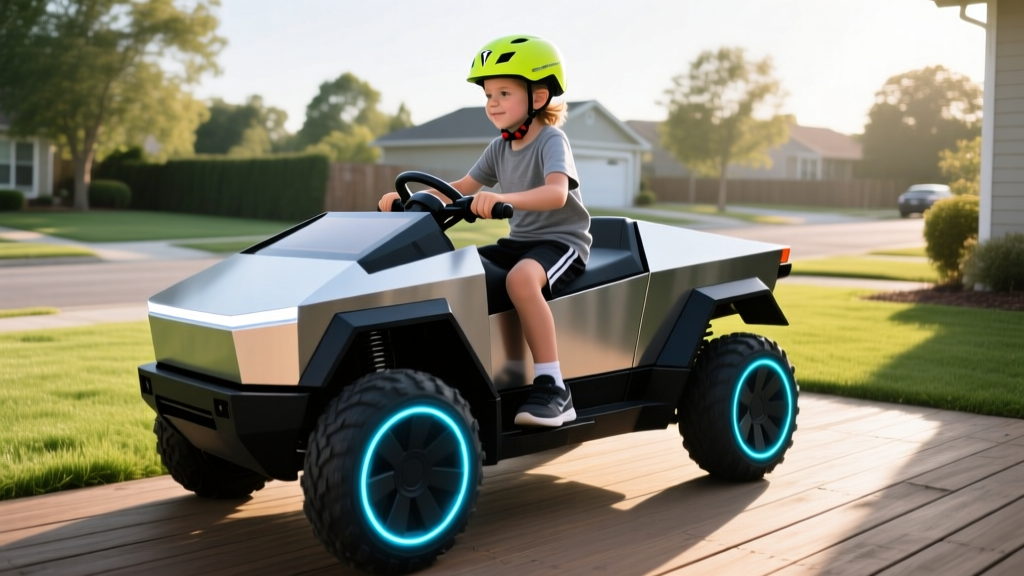
The Tesla Cybertruck has spawned countless imitators, but the official Cyberquad for Kids remains the most recognizable electric ATV for young riders. Originally bundled with Cybertruck deliveries and now sold separately, this miniature off-roader targets children ages 8-14 with genuine electric propulsion—not a toy-grade motor struggling up a driveway incline.
But at $1,900, does the Cyberquad for Kids deliver enough range, charging convenience, and build quality to justify the Tesla tax? We break down the real-world specs, battery chemistry, and ownership practicalities that matter to parents evaluating this purchase.
Cyberquad for Kids: Core Specifications
| Specification | Cyberquad for Kids |
|---|---|
| Base MSRP | $1,900 |
| EPA Range | Not EPA-rated (off-road vehicle) |
| Manufacturer Claimed Range | 15 miles (varies by terrain/rider weight) |
| Battery Capacity | Not officially disclosed (estimated 0.5-0.8 kWh) |
| Battery Chemistry | Lithium-ion (specific chemistry undisclosed) |
| Top Speed | 10 mph (adjustable via parental controls) |
| Motor Power | Not officially disclosed |
| Max Rider Weight | 150 lbs |
| Charge Time (0-100%) | Approximately 5 hours (120V household outlet) |
| Warranty | 1-year limited |
Real-World Range Expectations
Manufacturer claim: 15 miles
Real-world reality: Expect 10-12 miles on mixed terrain with a 100-lb rider. Flat pavement maximizes range; hills, sand, or a heavier rider (approaching the 150-lb limit) reduce it to 8-10 miles. Cold weather (below 50°F) can cut range by 15-20%.
Battery and Charging: What Parents Need to Know
The Cyberquad for Kids uses a small lithium-ion battery pack—likely in the 0.5-0.8 kWh range based on its power output and runtime. Tesla hasn't disclosed the exact chemistry (LFP vs NMC), but given the modest capacity and cost constraints, it's almost certainly a standard NMC or NCA cell configuration similar to what powers Powerwall units, not the LFP chemistry found in some Tesla vehicles.
Charging reality: The Cyberquad charges via a standard 120V household outlet using an included charger. There's no DC fast-charging capability (this isn't a highway vehicle), and Level 2 charging isn't applicable at this scale. The 5-hour charge time means overnight charging is the practical approach—a full day of riding requires planning ahead.
| Charging Method | Power | Time (0-100%) | Range Added |
|---|---|---|---|
| 120V Household Outlet | ~100-150W (estimated) | ~5 hours | 15 miles (full charge) |
| DC Fast Charging | Not available | N/A | N/A |
Practical insight: Unlike full-size EVs where charging speed is a purchase-critical factor, the Cyberquad's slow charge rate is acceptable given its use case. Kids typically ride for 1-2 hours, then the ATV sits unused for days. The real limitation is spontaneous weekend adventures—if you forget to charge it Friday night, Saturday morning riding is off the table.
Performance and Handling
The Cyberquad's 10 mph top speed sounds modest until you watch an 11-year-old hit it on a gravel path. That's faster than most kids can safely handle without supervision, which is why Tesla includes adjustable speed limiters via a parental control app.
Acceleration: The electric motor delivers instant torque, meaning the Cyberquad accelerates briskly off the line—faster than gas-powered ATVs in the same size class. There's no published 0-60 time (the vehicle doesn't reach 60 mph), but 0-10 mph happens in roughly 3-4 seconds based on owner reports.
Handling: The low center of gravity (battery mounted under the seat) makes the Cyberquad stable on flat terrain, but the short wheelbase and light weight (approximately 120 lbs) mean it can feel tippy on steep inclines or uneven ground. This is an ATV for groomed trails and large backyards, not technical single-track or dune riding.
Suspension: Basic front and rear suspension with limited travel. Expect a firm ride over rocks and roots—this isn't a Polaris RZR mini-me. Tire pressure and terrain choice matter more than suspension tuning at this scale.
Tech Features and Parental Controls
The Cyberquad for Kids includes a companion app (iOS/Android) that enables:
- Speed limiting: Parents can cap top speed at 5, 7, or 10 mph
- Geofencing: Set virtual boundaries; the ATV won't operate outside the defined area
- Remote lock: Disable the vehicle via app when riding time is over
- Usage tracking: Monitor ride duration and distance
These features are genuinely useful for parents managing screen-time-averse kids who suddenly have motorized freedom. The geofencing is particularly valuable for families with nearby roads, ponds, or property boundaries a child might not respect.
Notable drawbacks:
- No built-in GPS tracker (geofencing relies on the ATV's internal sensors, not real-time location tracking)
- App requires Bluetooth connection within ~30 feet to adjust settings mid-ride
- No headlight or taillight (daytime use only, unless you add aftermarket lighting)
- Build quality is good but not premium—plastic body panels, basic seat upholstery
Safety Considerations
The Cyberquad for Kids is classified as an off-road vehicle, not a toy. It carries real injury risk if used improperly. Tesla's manual specifies:
- Ages 8+ only
- Helmet and closed-toe shoes required
- Adult supervision recommended for riders under 12
- Not street-legal (no DOT certification for road use)
The 150-lb weight limit means many teens and adults can technically ride it, but the frame and suspension aren't designed for that load long-term. Exceeding the limit accelerates wear and increases rollover risk on uneven terrain.
Parental judgment call: A mature 10-year-old who respects speed limits and understands terrain hazards can handle the Cyberquad safely. An impulsive 12-year-old who treats it like a dirt bike will find its limits quickly—and those limits include tipping on side slopes or losing traction on wet grass.
Pricing, Tax Credits, and Value
At $1,900, the Cyberquad for Kids sits in a strange market position. It's significantly more expensive than generic kids' electric ATVs ($600-$1,200 on Amazon), but cheaper than premium youth ATVs from Polaris or Razor's higher-end models ($2,000-$3,000).
| Model | Price | Range | Top Speed | Age Range |
|---|---|---|---|---|
| Tesla Cyberquad for Kids | $1,900 | 15 miles | 10 mph | 8-14 |
| Razor Dirt Quad 500 | $800 | 10 miles | 9 mph | 8+ |
| Polaris RZR 170 (gas) | $5,500 | N/A (gas tank) | 25 mph | 10+ |
| Generic Amazon Kids ATV | $700 | 8 miles | 8 mph | 6-12 |
Federal Tax Credit Eligibility
The Cyberquad for Kids does NOT qualify for the federal EV tax credit (§30D).
Reason: The IRS §30D credit applies to highway-capable vehicles with at least four wheels, a gross vehicle weight rating under 14,000 lbs, and specific battery sourcing requirements. The Cyberquad is classified as an off-road recreational vehicle, not a motor vehicle for road use. It also lacks the battery capacity and MSRP characteristics that trigger credit eligibility.
For context on what does qualify, see the IRS clean vehicle credit guidelines.
Value assessment: You're paying a $700-$1,100 premium over comparable generic ATVs for the Tesla brand, the app-based parental controls, and (theoretically) better build quality. Whether that's worth it depends on your household's Tesla affinity and how much you value the geofencing/speed-limiting features.
Who Should Buy the Cyberquad for Kids?
Buy it if:
- You have a large, safe property (5+ acres, no nearby roads) where a kid can ride freely
- Your child is 10-13, mature enough to respect speed limits, and interested in off-road riding
- You value app-based parental controls over mechanical speed governors
- You already own a Cybertruck and want the aesthetic match
- Budget isn't the primary constraint ($1,900 is discretionary spending for your family)
Skip it if:
- You need a street-legal vehicle (the Cyberquad isn't DOT-certified for road use)
- Your child is under 8 or lacks the judgment to handle motorized vehicles safely
- You want longer range or faster charging (consider a gas-powered youth ATV instead)
- Price sensitivity matters—generic ATVs deliver 80% of the functionality at 40% of the cost
- You expect premium build quality commensurate with Tesla's automotive standards
Warranty and Long-Term Ownership
The Cyberquad for Kids carries a 1-year limited warranty covering manufacturing defects. This is standard for recreational vehicles in this price range but shorter than the 8-year/100,000-mile battery warranties Tesla provides on its cars.
Battery longevity: Tesla doesn't publish cycle-life data for the Cyberquad, but lithium-ion packs in this application typically last 500-800 full charge cycles before significant degradation. With moderate use (2-3 rides per week, partial discharges), expect 4-6 years of functional life before range drops noticeably.
Replacement cost: If the battery fails outside warranty, replacement is approximately $400-$600 based on third-party repair estimates. That's 20-30% of the original purchase price—steep enough that many owners will retire the ATV rather than repair it.
Parts availability: Tesla sells replacement tires, chargers, and cosmetic parts directly. Mechanical components (suspension, motor) have limited aftermarket support compared to gas-powered ATVs, where any small-engine shop can perform repairs.
Frequently Asked Questions
What is the real-world range of the Cyberquad for Kids?
Tesla claims 15 miles, but expect 10-12 miles with a 100-lb rider on mixed terrain. Hills, sand, cold weather, and heavier riders reduce range to 8-10 miles. Plan for 1-1.5 hours of continuous riding before needing a recharge.
How fast does the Cyberquad charge?
Approximately 5 hours from empty to full using a standard 120V household outlet. There's no fast-charging option. Overnight charging is the practical approach for regular use.
Does the Cyberquad for Kids qualify for the federal EV tax credit?
No. The IRS §30D credit applies to highway-capable four-wheel vehicles meeting specific battery and MSRP requirements. The Cyberquad is classified as an off-road recreational vehicle and doesn't qualify.
Is the Cyberquad safe for a 10-year-old?
With parental supervision, speed limiting (set to 5-7 mph), and proper safety gear (helmet, closed-toe shoes), yes. However, maturity matters more than age—a reckless 12-year-old is at higher risk than a cautious 10-year-old. The geofencing feature helps enforce property boundaries.
Can adults ride the Cyberquad for Kids?
Technically, yes—the weight limit is 150 lbs, and many adults fall under that. However, the frame, suspension, and motor aren't designed for sustained adult use. You'll accelerate wear and increase rollover risk on uneven terrain. It's a kids' vehicle, not a multi-generational ATV.
How does it compare to gas-powered youth ATVs?
Electric advantages: instant torque, quiet operation, no fuel/oil maintenance, app-based parental controls. Gas advantages: longer range (unlimited with refueling), faster refueling, more repair options, higher top speeds for experienced riders. If range and charging time are deal-breakers, consider a Polaris or Honda gas ATV.
Where can I buy the Cyberquad for Kids?
Directly from Tesla's online shop. It's not available at third-party retailers. Shipping typically takes 2-4 weeks depending on inventory.
Is it worth the $1,900 price tag?
That depends on your priorities. If you value Tesla's brand, app-based controls, and the aesthetic (especially paired with a Cybertruck), yes. If you're budget-conscious and just want a functional kids' ATV, the Razor Dirt Quad 500 at $800 delivers comparable performance with fewer frills.
Final Verdict
The Tesla Cyberquad for Kids is a competent electric ATV with genuine utility for families with safe, spacious properties and mature young riders. The app-based parental controls are its standout feature—genuinely useful for managing a child's motorized freedom without constant physical supervision.
But at $1,900, you're paying a significant brand premium. Generic competitors deliver similar range and speed at half the price, albeit without Tesla's ecosystem integration or geofencing. If budget is flexible and you value the Tesla experience (or already own a Cybertruck), the Cyberquad is a justifiable purchase. If you're optimizing for value-per-dollar, explore Razor or Polaris alternatives first.
The Cyberquad won't qualify for EV tax credits, won't handle technical trails, and won't satisfy teens seeking high-speed thrills. But for its intended use case—a 10-13 year old riding safely on family property with parental oversight—it delivers exactly what Tesla promises.