What Is "Tesla Cyber Juice" — And Is It Alcohol?
If you have spent any time in EV forums or social media comment threads, you have probably encountered the question: is Tesla Cyber juice alcohol? The short answer is no. "Cyber Juice" is not an alcoholic beverage, nor is it a secret Tesla-branded spirit. The phrase is a persistent internet mashup born from two unrelated Tesla products colliding in meme culture.
On one side, Tesla sells a children's drink called Cyber Juice — a shelf-stable, fruit-flavored beverage marketed alongside the Cyberquad for Kids. It contains apple and strawberry juice concentrate, water, and natural flavors. It has zero alcohol content. On the other side, Tesla briefly sold a novelty Tequila in 2020 (a limited-run, $250 bottle of añejo in a lightning-bolt-shaped decanter), which has long since sold out and is now a collector's item.
The confusion arises because people conflate "Cyber Juice" (the kids' drink) with Tesla's novelty tequila, or they assume "juice" is slang for the Cybertruck's battery energy. In EV parlance, "juice" does colloquially refer to electrical charge — as in "the truck has enough juice to make it to the next Supercharger." But no Tesla product called "Cyber Juice" contains alcohol.
Bottom line: Tesla Cyber Juice is a non-alcoholic children's fruit drink. Tesla Tequila was a separate, limited-edition spirit sold in 2020. They are unrelated products, and neither is available as a standard retail item in 2026.
Now that we have cleared up the myth, let us turn to what actually matters for prospective buyers: the 2026 Tesla Cybertruck itself. Below is a comprehensive, data-driven review covering range, charging, pricing, tax credits, and real-world ownership.
2026 Tesla Cybertruck: Core Specifications at a Glance
| Spec | Long Range AWD | Cyberbeast (Tri-Motor) |
|---|---|---|
| Base MSRP | $79,990 | $99,990 |
| EPA Range | 340 miles | 320 miles |
| Battery (usable) | ~123 kWh (estimated, NMC) | ~123 kWh (estimated, NMC) |
| Drivetrain | Dual-Motor AWD | Tri-Motor AWD |
| Horsepower | 600 hp | 845 hp |
| 0–60 mph | 3.9 sec | 2.6 sec |
| Peak DC Fast Charge | 250 kW | 250 kW |
| 10–80% DC Charge | ~28 min | ~28 min |
| Level 2 Charge Rate | 11.5 kW (~37 mi/hr) | 11.5 kW (~37 mi/hr) |
| MPGe (combined) | 67 MPGe | 64 MPGe |
| kWh/100 mi | 50 kWh | 53 kWh |
| Towing Capacity | 11,000 lbs | 11,000 lbs |
| Cargo (bed + frunk) | ~67 cu ft bed + ~7 cu ft frunk | ~67 cu ft bed + ~7 cu ft frunk |
| Battery Warranty | 8 yr / 120,000 mi | 8 yr / 120,000 mi |
Sources: fueleconomy.gov, Tesla official specifications. Battery capacity is estimated based on teardown analysis; Tesla does not publish official usable kWh figures.
Real-World Range: What the EPA Number Does Not Tell You
EPA Estimated Range: 340 miles (Long Range AWD) / 320 miles (Cyberbeast)
Real-World Expectation: Expect approximately 270–300 miles on highway road trips at 70–75 mph in moderate temperatures. In cold weather (below 30°F), range can drop to 220–260 miles depending on cabin heating demand and whether you precondition the battery.
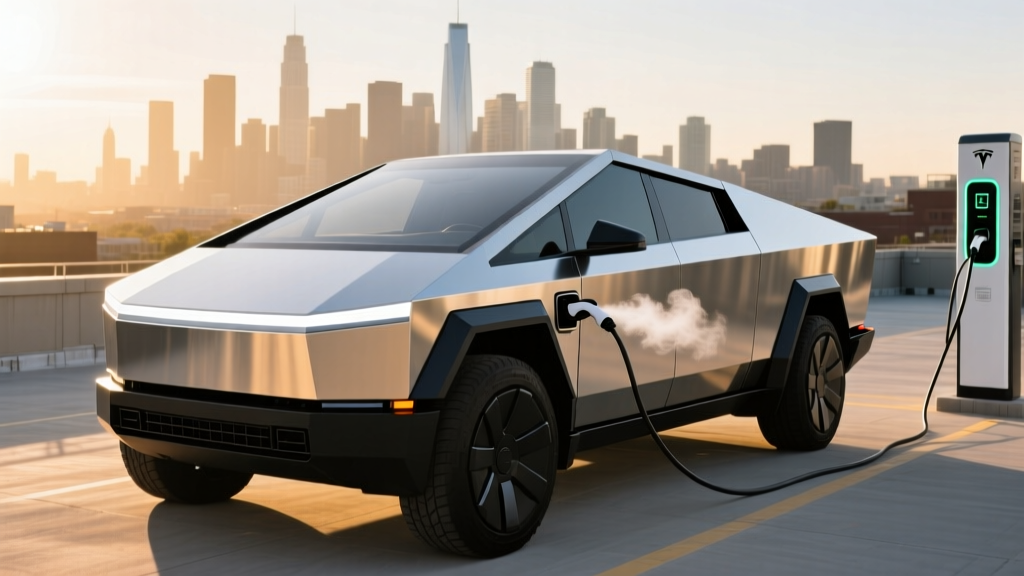
The Cybertruck's angular stainless-steel exoskeleton is visually striking but aerodynamically costly. Its drag coefficient is higher than a sleek sedan like the Model S, which means highway efficiency suffers disproportionately at speed. In city driving with frequent regenerative braking opportunities, you will see results closer to the EPA sticker. But on a 75-mph interstate run in January, plan your charging stops around 220–240 miles of usable range to keep a safety buffer.
Efficiency figures from fueleconomy.gov confirm the Cybertruck Long Range at 50 kWh per 100 miles — meaning it takes 50 kWh of energy to travel 100 miles. That is roughly double the consumption of a Tesla Model 3 Long Range (25 kWh/100 mi), so your electricity cost per mile is correspondingly higher.
Charging Speed: DC Fast, Level 2, and the Charge Curve Reality
| Level | Power | Speed (approx.) | Use Case |
|---|---|---|---|
| Level 1 (120V) | ~1.4 kW | ~4 mi/hr | Emergency / trickle |
| Level 2 (240V, 48A) | 11.5 kW | ~37 mi/hr | Overnight home charging |
| DC Fast (Supercharger) | Peak 250 kW | 10–80% in ~28 min | Road trips |
The Cybertruck uses the NACS (North American Charging Standard) connector natively — no adapter needed at Tesla Superchargers. At a V3 or V4 Supercharger stall, the truck peaks at 250 kW, but as with all EVs, that peak is not sustained. The charge curve tapers significantly above 50% state of charge (SoC), and above 80% it slows to a trickle to protect the battery. This is why the industry-standard metric is 10–80% time: approximately 28 minutes under ideal thermal conditions.
Cold-weather charging caveat: If you arrive at a Supercharger with a cold battery (below ~60°F) and have not preconditioned, the peak charge rate may be limited to 50–100 kW until the thermal management system warms the pack. Always navigate to a Supercharger using the truck's built-in navigation — this triggers automatic battery preconditioning, which can shave 10–15 minutes off your charging session.
For home Level 2 charging, you will want a 60-amp circuit (delivering 48 amps continuous to the truck). At 11.5 kW, a full 0–100% charge takes roughly 11–12 hours. Most owners who charge nightly from 20% to 80% will wake up to a full buffer every morning. Installation costs for a Level 2 home charger typically range from $800 to $2,500 depending on your electrical panel's capacity and the distance from the panel to the charger location.
Pricing, Trims, and Federal Tax Credit Eligibility
| Trim | Base MSRP | As-Tested (typical options) | §30D Federal Credit |
|---|---|---|---|
| Long Range AWD | $79,990 | $82,000–$85,000 | Eligible for up to $7,500 (if buyer meets income caps and sourcing requirements) |
| Cyberbeast | $99,990 | $102,000–$108,000 | Eligible for up to $7,500 (if buyer meets income caps and sourcing requirements) |
Under current IRS §30D rules, the Cybertruck qualifies as a light-duty truck, which means the MSRP cap is $80,000 for trucks (higher than the $55,000 cap for sedans). The Long Range AWD at $79,990 squeaks in under this limit. The Cyberbeast at $99,990 exceeds the MSRP cap and is not eligible for the federal tax credit based on price alone.
For the Long Range AWD, the buyer must also meet adjusted gross income (AGI) caps: $150,000 single / $225,000 head of household / $300,000 joint filers. Additionally, the battery must meet critical-mineral and battery-component sourcing thresholds that tighten annually. Tesla's US-built battery supply chain has historically met these requirements, but the exact eligible credit amount ($3,750 or $7,500) depends on the model year's sourcing percentages. Always verify current-year eligibility on irs.gov or consult a tax professional before purchase.
As of 2026, the §30D credit can be transferred to the dealer at the point of sale, reducing your out-of-pocket cost at purchase rather than waiting for a tax refund.
Performance, Tech, and Daily Usability
The Cybertruck's performance figures are extraordinary for a vehicle weighing nearly 7,000 pounds. The Cyberbeast's 2.6-second 0–60 mph time rivals supercars, and the dual-motor Long Range is no slouch at 3.9 seconds. Steering is rear-axle–assisted (four-wheel steer), giving the 20-foot-long truck a surprisingly tight 35-foot turning circle — comparable to a Model 3.
Notable tech features:
- Steer-by-wire: No mechanical connection between the yoke and the wheels. Enables variable steering ratios (fewer turns lock-to-lock at low speed, more stability at highway speed).
- 48-volt electrical architecture: Replaces the traditional 12V system, reducing wiring harness weight and enabling higher-power accessories.
- Stainless-steel exoskeleton: Ultra-hard 30X cold-rolled stainless steel eliminates the need for paint (though it shows fingerprints and can develop surface patina).
- Powershare (V2L/V2H): Bidirectional charging allows the Cybertruck to power tools at a job site (up to 9.6 kW from bed outlets) or provide backup home power during outages.
- Autopilot / FSD (Supervised): Tesla's Level 2 driver-assistance system. Despite the "Full Self-Driving" name, this is not autonomous — the driver must remain engaged, hands on the yoke, and eyes on the road at all times. Per SAE automation definitions, this is Level 2: partial automation with full driver responsibility.
Notable drawbacks:
- Rear visibility: The small rear window and sloped bed cover make the backup camera essential, not optional.
- Ride quality: The air suspension helps, but the truck's mass and stiff structure transmit more road imperfections than a unibody SUV.
- Garage fitment: At 223.7 inches long and 80 inches wide (mirrors folded), verify your garage dimensions before ordering.
- Insurance costs: Stainless-steel body panels and specialized repair procedures lead to above-average insurance premiums. Get quotes before purchasing.
Pros
- Class-leading acceleration for a pickup
- NACS native — full Supercharger network access
- V2L/V2H bidirectional power capability
- 11,000-lb towing capacity
- Stainless steel requires no paint, resists dents
- Rear-axle steering for tight maneuverability
Cons
- Cyberbeast exceeds $80K MSRP cap — no tax credit
- Poor rear visibility without camera
- Highway range drops significantly at 75+ mph
- Cold-weather range loss of 25–35%
- Above-average insurance and repair costs
- Polarizing design not universally appealing
Who Should Buy the Cybertruck — And Who Should Look Elsewhere?
Buy the Cybertruck Long Range AWD if: You need a capable electric truck for towing, job-site power (V2L), or outdoor adventure; you want Supercharger network access for road trips; you qualify for the §30D credit (income under $150K/$300K joint); and you have a garage that fits a 224-inch vehicle.
Buy the Cyberbeast if: Performance is your priority, budget is not a constraint, and you accept that the $99,990 MSRP disqualifies it from the federal tax credit.
Look at the Ford F-150 Lightning, Rivian R1T, or Chevrolet Silverado EV if: You need a more conventional pickup layout, better rear-seat comfort, lower starting prices, or a proven commercial fleet track record.
Cybertruck vs. Key Competitors: Quick Comparison
| Spec | Tesla Cybertruck LR AWD | Ford F-150 Lightning Ext. Range | Rivian R1T Dual-Motor Max |
|---|---|---|---|
| Base MSRP | $79,990 | $69,995 | $83,000 |
| EPA Range | 340 mi | 320 mi | 352 mi |
| 0–60 mph | 3.9 sec | ~4.5 sec | ~4.5 sec |
| Peak DC Charge | 250 kW | 150 kW | 200 kW |
| Towing | 11,000 lbs | 10,000 lbs | 11,000 lbs |
| Connector | NACS (native) | NACS (adapter/2025+) | NACS (adapter/2025+) |
The Cybertruck wins on acceleration and DC charging speed. The F-150 Lightning wins on price and conventional truck usability. The R1T offers the best range and a more premium adventure-oriented interior. Your choice depends on which trade-off matters most.
Frequently Asked Questions
Is Tesla Cyber Juice alcohol?
No. Tesla Cyber Juice is a non-alcoholic fruit-flavored children's drink (apple and strawberry). Tesla's novelty Tequila was a separate, limited-edition product sold in 2020 for $250 and is no longer available. The two products are unrelated, and "Cyber Juice" contains zero alcohol.
What is the real-world range of the Cybertruck?
The EPA rates the Long Range AWD at 340 miles and the Cyberbeast at 320 miles. In real-world highway driving at 70–75 mph, expect 270–300 miles. In cold weather below 30°F, plan for 220–260 miles. The truck's boxy aerodynamics and ~7,000-lb weight work against highway efficiency.
How fast does the Cybertruck charge?
On a 250 kW Tesla Supercharger, the Cybertruck charges from 10% to 80% in approximately 28 minutes. At home on a Level 2 (240V, 48A) charger, it adds about 37 miles of range per hour, or a full charge in 11–12 hours. Always precondition the battery by navigating to a Supercharger via the truck's built-in maps for maximum charge speed.
Does the Cybertruck qualify for the federal EV tax credit?
The Long Range AWD at $79,990 is under the $80,000 MSRP cap for trucks and may qualify for up to $7,500 under IRS §30D — provided the buyer's AGI is under $150,000 (single) or $300,000 (joint) and the battery meets critical-mineral sourcing requirements. The Cyberbeast at $99,990 exceeds the MSRP cap and does not qualify. Verify current rules on irs.gov before purchasing.
Is the Cybertruck worth buying over an F-150 Lightning or Rivian R1T?
It depends on your priorities. The Cybertruck offers the fastest DC charging (250 kW vs. 150–200 kW for rivals), the quickest acceleration, and native Supercharger access. The F-150 Lightning is more affordable and has a more conventional, user-friendly truck layout. The R1T delivers the longest range and a more refined interior. Test-drive all three before deciding.
What is the Cybertruck's battery warranty?
Tesla covers the Cybertruck battery and drive units for 8 years or 120,000 miles, whichever comes first, with a minimum 70% capacity retention threshold during that period. This is consistent with industry norms and slightly more generous on mileage than some competitors' 100,000-mile thresholds.