The Tesla Cybertruck has never been a conventional pickup, and nowhere is that more obvious than inside the cabin. The 2026 Cybertruck interior strips away traditional truck cues — no analog gauges, no center stack of buttons, no conventional instrument cluster — replacing them with a minimalist, angular design built around a single 18.5-inch touchscreen. Whether that minimalism reads as futuristic brilliance or frustrating sparsity depends heavily on what you expect from a premium truck cabin.
This review examines the Cybertruck's interior dimensions, technology, material quality, and cargo versatility, while also covering the essential EV specs buyers need: real-world range, charging speed, pricing, and federal tax-credit eligibility under current IRS §30D rules.
Quick Verdict: Who the Cybertruck Interior Is For
The Cybertruck cabin is best suited to tech-forward buyers who prioritize a commanding view, a massive infotainment display, and a bed-based cargo workflow over plush, traditional luxury. It works well as a daily commuter and weekend adventure rig. It does not cater to buyers who want a button-rich cockpit, a rear-seat entertainment system, or a hushed, heavily insulated luxury-truck experience in the vein of a Rivian R1T or GMC Sierra EV Denali.
Look at competitors if: You need a quiet, traditionally luxurious interior with physical controls, a premium rear-seat experience, or maximum indoor cargo volume (the Cybertruck relies heavily on its bed and front trunk rather than a large enclosed cabin).
Interior Dimensions, Materials, and Cabin Quality
The Cybertruck is a five-passenger, four-door crew-cab-style truck. Front-seat space is generous, with ample headroom thanks to the tall roofline and relatively upright windshield. Rear-seat legroom measures approximately 38.4 inches — competitive with midsize crew-cab trucks but noticeably tighter than a full-size Ford F-150 Lightning or Rivian R1T with its longer wheelbase. The rear seat cushion is relatively flat and firm, which helps cargo flexibility (the rear seat bottom folds up) but doesn't match the contoured comfort of luxury competitors on long drives.
Materials are a deliberate departure. The dashboard and door panels use a mix of vegan leather (Tesla's synthetic upholstery), microfiber-like suede accents on higher trims, and exposed geometric panels that echo the exterior's folded-steel look. There is no wood trim, no chrome, and no traditional stitching patterns. Build quality on 2025–2026 production trucks has improved markedly over the earliest 2024 deliveries, which were plagued by panel-gap inconsistencies and finish issues, but fit and finish still varies truck to truck.
Front Row: Screen-Centric Cockpit
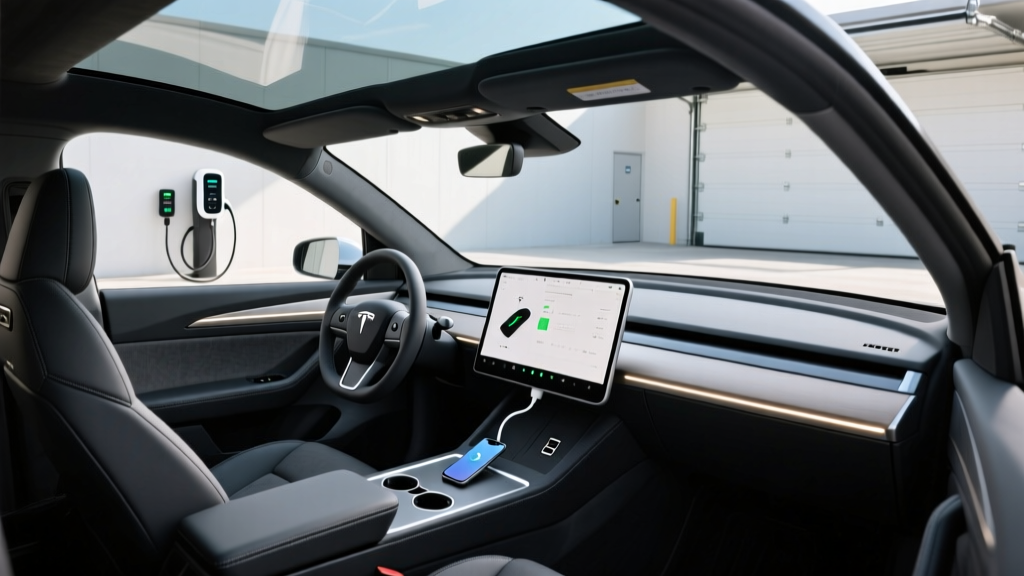
The driver faces a flat-bottom, yoke-style steering wheel (a conventional round wheel is available as a no-cost option on current builds). All vehicle controls — climate, mirrors, glovebox, drive mode, wiper speed — are accessed through the 18.5-inch center touchscreen or via steering-wheel scroll buttons. There is no separate instrument cluster; speed and range information appear in the upper-left corner of the main display. A slim LED light bar across the dash provides ambient lighting and turn-signal indicators.
Rear Row and Passenger Comfort
Rear passengers get a dedicated 9.4-inch touchscreen mounted on the back of the center console for climate controls and media playback. USB-C ports (up to 65W) are provided front and rear. Rear-seat headroom is adequate for most adults but compromised by the sloping roofline for passengers over 6'2". The rear bench is a 60/40 split that folds flat to extend interior cargo length.
Frunk, Bed, and Cargo Volume
The Cybertruck's enclosed interior cargo volume is modest for a truck: roughly 34 cubic feet behind the rear seat (rear seats up). However, total cargo capability is substantial when you include:
- Front trunk (frunk): ~7.1 cu ft, lockable, with a drain for use as a cooler
- Bede vault (under the powered tonneau): 67 cu ft, with a 4×8 sheet of plywood fitting between the wheel wells
- Rear seat folded: extends enclosed cabin length for longer items
| Spec | Measurement |
|---|---|
| Seating capacity | 5 passengers |
| Front headroom | 40.3 in |
| Front legroom | 41.2 in |
| Rear headroom | 38.2 in |
| Rear legroom | 38.4 in |
| Cabin cargo (rear seats up) | ~34 cu ft |
| Frunk volume | ~7.1 cu ft |
| Bed volume (under tonneau) | 67 cu ft |
| Bed length | 72 in (6 ft) |
| Tailgate width (between wells) | 48+ in (fits 4×8 sheet) |
Range, Efficiency, and Real-World Expectations
The 2026 Cybertruck is offered in AWD (dual-motor) and Cyberbeast (tri-motor) configurations. The Long Range AWD is the volume model and the efficiency leader of the lineup.
Real-world expectation: Expect 270–300 miles on mixed highway driving at 70–75 mph; 240–265 miles in sustained cold weather (below 30°F) due to battery thermal demands and cabin heating. The Cyberbeast tri-motor, with its higher curb weight and stickier tires, typically delivers 290–310 miles real-world on its 320-mile EPA sticker.
Efficiency on the AWD model is rated at approximately 67 MPGe combined (about 50 kWh/100 mi). That is notably less efficient than a sedan or crossover — the Cybertruck's angular shape and 6,600+ lb curb weight create substantial aerodynamic drag at highway speeds. If your commute is mostly city driving at lower speeds, efficiency improves and range stretches closer to the EPA figure. Sustained 80 mph highway travel will shrink range considerably.
| Trim | Drivetrain | Horsepower | 0–60 mph | EPA Range | Efficiency |
|---|---|---|---|---|---|
| AWD Long Range | Dual-motor AWD | 600 hp | 3.9 sec | 340 mi | 67 MPGe / 50 kWh/100mi |
| Cyberbeast | Tri-motor AWD | 845 hp | 2.6 sec | 320 mi | 62 MPGe / 54 kWh/100mi |
Battery: Chemistry, Capacity, and Longevity
The Cybertruck uses a structural battery pack with Tesla's 4680-format cells. Usable capacity is approximately 123 kWh. The chemistry is NMC (nickel manganese cobalt), optimized for energy density and high discharge rates — appropriate given the truck's mass and performance targets. Tesla provides an 8-year/120,000-mile battery and drive-unit warranty, guaranteeing at least 70% capacity retention over that period, consistent with Tesla's published warranty terms.
Charging Speed: DC Fast Charging and Home Level 2
The Cybertruck is equipped with a NACS (North American Charging Standard) port natively, giving it direct access to the Tesla Supercharger network — currently the most reliable public DC fast-charging infrastructure in the U.S. No adapter is required for Superchargers or other NACS-equipped networks.
| Charging Level | Power / Rate | Speed (Approx.) | Notes |
|---|---|---|---|
| Level 1 (120V household) | ~1.4 kW | ~3–4 mi/hr | Emergency/trickle only |
| Level 2 (240V home, 48A) | 11.5 kW | ~30–34 mi/hr | Full charge overnight (~10–12 hrs) |
| DC Fast (V4 Supercharger) | Peak 250 kW | 10–80% in ~30 min | Curve tapers above 60%; precondition via nav |
| DC Fast (CCS adapter) | Up to 250 kW | Varies by network | Adapter sold separately; Electrify America compatible |
Charging-curve reality check: The Cybertruck does not sustain its 250 kW peak for long. In testing, peak rates hold roughly from 10% to 35% state of charge, then taper progressively — dropping to ~120 kW by 60% and below 60 kW past 80%. For road trips, plan stops around the 15–75% window to minimize time at the charger. Always use the truck's navigation to precondition the battery before arriving at a Supercharger; skipping preconditioning can add 5–10 minutes to your stop in cold weather.
Technology, Driver Assistance, and Standout Features
The Cybertruck runs Tesla's latest vehicle software on a custom AMD Ryzen-based processor, delivering responsive navigation, media streaming, and over-the-air updates. Key tech features include:
- 18.5-inch center touchscreen — the largest in any production pickup, handling navigation, media, climate, vehicle settings, and a 360° camera view
- Rear 9.4-inch touchscreen for rear-seat passengers
- Autopilot (standard) — adaptive cruise control and lane-centering, SAE Level 2 driver assistance
- Full Self-Driving (Supervised) — optional upgrade; still SAE Level 2, requires active driver supervision at all times
- Steer-by-wire — no mechanical connection between the yoke/wheel and the rack; enables variable steering ratio (less than one full turn lock-to-lock)
- 48-volt electrical architecture — reduces wiring harness weight and enables higher-power accessories
- Powershare (V2L/V2H): 120V and 240V outlets in the bed and cabin; up to 11.5 kW output for job-site tools or home backup power
- Bioweapon Defense Mode: HEPA-grade cabin air filtration
Notable Drawbacks
- No physical buttons for core functions — adjusting mirrors, opening the glovebox, and changing wiper speed all require screen taps or steering-wheel menus
- Yoke steering learning curve — the less-than-one-turn ratio and lack of a top rim take weeks to habituate; the round wheel is a no-cost alternative
- Visibility — the thick A-pillars and angular rear window create larger blind spots than competitors; the camera-based rear view helps but isn't a full substitute
- Rear-seat comfort — firm, flat cushion; long-distance rear passengers will notice
- Cabin noise — tire and wind noise at highway speeds is higher than in the Rivian R1T or F-150 Lightning, likely due to the angular body and minimal sound deadening to save weight
Pricing, Trims, and Federal Tax Credit Eligibility
The 2026 Cybertruck is offered in two main trims. Pricing reflects Tesla's MSRP as of early 2026, before any incentives.
| Trim | Base MSRP | As-Tested (Typical Options) | §30D Credit Eligible? |
|---|---|---|---|
| AWD Long Range | $79,990 | $82,000–$85,000 | Yes, up to $7,500 (subject to rules) |
| Cyberbeast | $99,990 | $102,000–$108,000 | Yes, up to $7,500 (subject to rules) |
Federal tax credit rules (IRS §30D, current for 2026): The Cybertruck qualifies as a light truck under the §30D MSRP cap of $80,000. The AWD Long Range at $79,990 base MSRP clears this cap; the Cyberbeast at $99,990 does not qualify for the new-vehicle credit based on MSRP alone. Buyers must also meet income thresholds (modified AGI ≤ $150,000 single / $300,000 joint) and the vehicle must satisfy critical-mineral and battery-component sourcing requirements, which have tightened annually since 2024. The credit can be transferred to the dealer at point of sale as a purchase-price reduction. Consult IRS.gov §30D guidance and a tax professional to confirm your eligibility before purchase.
5-Year Ownership Snapshot
Charging the Cybertruck at home (national average $0.16/kWh) costs roughly $8.00 per 100 miles driven. That compares to approximately $18–22 per 100 miles for a gas F-150 at 20 mpg and $3.50/gal. Insurance premiums run 15–25% higher than comparable trucks due to repair costs for the stainless-steel body and structural pack. Depreciation on early Cybertrucks has been steep — resale values are still normalizing after the initial hype cycle.
Cybertruck vs. Key Competitors: Interior Comparison
| Attribute | Cybertruck AWD | Rivian R1T Dual-Motor | F-150 Lightning Lariat |
|---|---|---|---|
| Starting MSRP | $79,990 | $75,600 | $62,995 |
| EPA Range | 340 mi | 352 mi (Max Pack) | 320 mi (Ext. Range) |
| Rear legroom | 38.4 in | 37.3 in | 43.6 in |
| Main screen size | 18.5 in | 15.6 in | 15.5 in (portrait) |
| Physical controls | Minimal | Moderate | Extensive |
| Bed length | 72 in | 54 in (+ Gear Tunnel) | 67 in |
| Towing capacity | 11,000 lb | 11,000 lb | 10,000 lb |
| V2L / Home backup | Yes (11.5 kW) | Yes (limited) | Yes (Pro Power Onboard) |
Best rear-seat comfort: F-150 Lightning — significantly more legroom and a more traditional, cushioned bench.
Best material quality and finish: Rivian R1T — natural wood, premium textiles, and consistent build quality.
Best cargo flexibility: Tie — Cybertruck (6-ft bed + vault + frunk) vs. Rivian (Gear Tunnel is uniquely versatile).
Pros and Cons
- Massive 18.5-inch screen with responsive software
- Distinctive, futuristic cabin design
- Steer-by-wire enables extremely quick steering ratio
- Strong V2L/home-backup capability (11.5 kW)
- 6-ft bed fits 4×8 plywood between wheel wells
- AWD Long Range qualifies for §30D credit (MSRP cap)
- Supercharger network access (NACS native)
- No physical buttons — everything routes through the screen
- Yoke steering has a steep learning curve
- Rear seat firm and relatively tight for a truck this size
- Highway cabin noise exceeds key competitors
- Cyberbeast exceeds §30D MSRP cap ($80,000 for trucks)
- Early build-quality concerns (improving but watch for variance)
- Efficiency is poor by EV standards (~50 kWh/100 mi)
Is the Cybertruck Worth Buying in 2026?
The Cybertruck makes sense if you value a polarizing, tech-dense cabin and plan to use the bed actively — the powered tonneau, integrated 120V/240V outlets, and 11,000-lb tow rating make it a capable work and adventure platform. The AWD Long Range at $79,990 is the sweet spot: it clears the §30D MSRP cap, delivers 340 miles of EPA range, and provides 600 hp without the Cyberbeast's range and efficiency penalty.
If you want a quieter, more traditionally appointed cabin with physical controls and a roomier rear seat, the Ford F-150 Lightning or Rivian R1T are more refined daily drivers. If you need maximum towing and range in a proven platform, the Lightning Extended Range or R1T Max Pack are strong alternatives.
Frequently Asked Questions
What is the real-world range of the Cybertruck?
The AWD Long Range carries a 340-mile EPA sticker. In real-world mixed highway driving at 70–75 mph, expect 270–300 miles. In cold weather (below 30°F), that drops to roughly 240–265 miles due to battery thermal management and cabin heating demands. The Cyberbeast tri-motor returns about 290–310 real-world miles on its 320-mile EPA rating.
How fast does the Cybertruck charge?
On a V4 Tesla Supercharger, the Cybertruck peaks at 250 kW and charges from 10–80% in approximately 30 minutes. However, peak rates are sustained only briefly (roughly 10–35% SoC), with progressive tapering above 60%. At home on a 48A Level 2 charger (11.5 kW), you'll add about 30–34 miles of range per hour, filling the pack in roughly 10–12 hours.
How much does the Cybertruck cost after tax credits?
The AWD Long Range starts at $79,990. If you qualify for the full $7,500 federal §30D credit (income and sourcing requirements met), the effective price drops to ~$72,490. The Cyberbeast at $99,990 exceeds the $80,000 MSRP cap for trucks and does not qualify for the new-vehicle credit. State incentives vary — check your local DMV or energy office.
Does the Cybertruck qualify for the federal EV tax credit?
The AWD Long Range qualifies based on MSRP (under the $80,000 truck cap). Buyer eligibility requires modified AGI ≤ $150,000 (single) or $300,000 (joint), and the vehicle must meet critical-mineral and battery-component sourcing thresholds that tighten each year. The credit can be applied at point of sale. Verify current rules at IRS.gov.
Is the Cybertruck interior practical for families?
It's workable but not ideal. The rear seat fits two adults or children comfortably, with adequate legroom (38.4 in) and a rear screen for entertainment. However, the firm cushion, lack of built-in sunshades, and higher cabin noise make it less family-friendly than the F-150 Lightning or Rivian R1T for long road trips. The frunk and bed vault compensate with excellent exterior cargo options for strollers, gear, and groceries.
How does the Cybertruck interior compare to the Rivian R1T?
The R1T offers a more traditionally premium cabin — natural wood accents, more physical controls, a dedicated instrument cluster, and a unique Gear Tunnel for enclosed cargo. The Cybertruck counters with a larger screen, a longer bed, and a more futuristic design language. Choose the R1T for material quality and rear-seat comfort; choose the Cybertruck for screen real estate, bed utility, and Supercharger access.
What is the Cybertruck's warranty coverage?
Tesla provides a 4-year/50,000-mile limited vehicle warranty and an 8-year/120,000-mile battery and drive-unit warranty, guaranteeing a minimum of 70% battery capacity retention over the coverage period. This is competitive with the segment, though some competitors offer longer bumper-to-bumper coverage.