Quick Verdict: Living With the Cybertruck's Radical Cabin
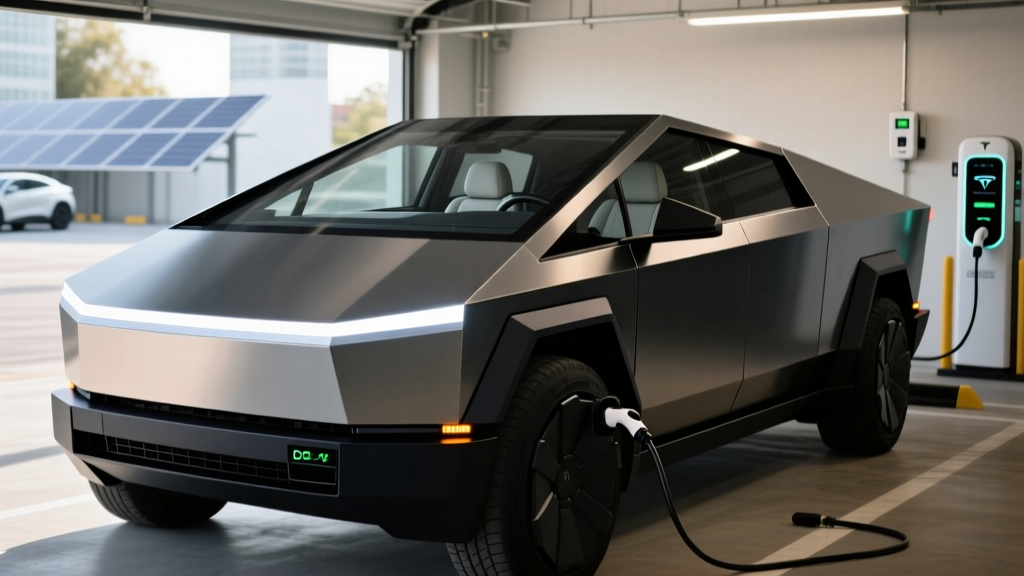
Spend a week inside a Tesla Cybertruck and one thing becomes immediately clear: this is not a conventional pickup wearing an EV badge. The angular, cold-rolled stainless-steel exoskeleton gets the attention, but the interior experience — a minimalist cockpit dominated by a single 18.5-inch touchscreen, a yoke-style steering wheel, and a rear bench squeezed beneath a low roofline — defines whether you'll actually want to own one. For 2025–2026, the Cybertruck lineup has settled into three trims: the Long Range AWD, the Cyberbeast tri-motor, and the rear-wheel-drive base model Tesla has positioned as an eventual volume play. Each shares the same 4680-cell structural battery pack, 800-voltage-class architecture, and a cabin that feels more like a concept car than a production truck.
This review walks through every dimension of the ownership experience from the driver's seat outward — real-world range, charging behavior, cabin ergonomics, utility, and the economics of putting one in your driveway.
EPA Range, Battery Chemistry, and Real-World Expectations
- Long Range AWD: EPA-estimated 320 miles. Expect 265–285 miles on sustained 75-mph highway runs; 240–260 miles in sub-30°F winter conditions.
- Cyberbeast (tri-motor): EPA-estimated 300 miles. Expect 245–265 miles highway; 220–240 miles in cold weather.
- RWD (base): EPA-estimated 250 miles (announced entry trim, limited availability).
The Cybertruck's brick-like aerodynamic profile (Cd ~0.38 despite active aero elements) and 6,600+ lb curb weight punish highway efficiency more than sedans or crossovers. City driving with regenerative braking recovers more energy, so mixed commuting often yields results closer to the EPA sticker.
The structural battery pack uses Tesla's in-house 4680 cylindrical cells with an NMC (nickel-manganese-cobalt) cathode. Usable capacity sits at approximately 123 kWh on AWD trims. Tesla does not publish gross vs. net figures officially, but teardown analysis and real-world consumption data triangulate to this number. The 4680 cells serve as a stressed chassis member, reducing pack mass but making out-of-warranty replacement a body-shop-level operation rather than a simple swap.
| Spec | Long Range AWD | Cyberbeast |
|---|---|---|
| EPA Range | 320 mi | 300 mi |
| Battery (usable) | ~123 kWh (NMC 4680) | ~123 kWh (NMC 4680) |
| MPGe (combined) | 72 MPGe | 68 MPGe |
| Efficiency | 47 kWh/100 mi | 50 kWh/100 mi |
| Drivetrain | Dual-motor AWD | Tri-motor AWD |
| Horsepower | 600 hp | 845 hp |
| 0–60 mph | 4.1 sec | 2.6 sec |
| Towing Capacity | 11,000 lb | 11,000 lb |
| Payload | 2,500 lb | 2,500 lb |
Source: EPA fueleconomy.gov and Tesla's official spec sheet.
Charging Speed: DC Fast, Level 2, and the 800V Advantage
The Cybertruck's 800V-class electrical architecture is one of its most consequential engineering choices. Higher voltage allows lower current for the same power, reducing cable mass and heat generation. On a Supercharger V4 pedestal or comparable 350-kW CCS/NACS DC fast charger, the Cybertruck peaks at approximately 350 kW — though sustained rates are more important than peak numbers.
| Level | Max Power | Typical Speed | Time / Notes |
|---|---|---|---|
| Level 1 (120V / 12A) | ~1.4 kW | ~3 mi/hr | Emergency only; 40+ hours for full charge |
| Level 2 (240V / 48A) | 11.5 kW | ~30 mi/hr | 0–100% in ~12–14 hours overnight |
| Level 2 (240V / 80A) | 19.2 kW | ~50 mi/hr | Requires Tesla Wall Connector + 100A circuit |
| DC Fast (V4 Supercharger) | Peak 350 kW | ~200 kW sustained avg | 10–80% in ~18 minutes |
| DC Fast (50-kW CCS) | 50 kW | ~120 mi/hr | 10–80% in ~90 minutes |
Real-world DC fast charging follows a tapering curve: the pack pulls peak power between roughly 10% and 35% state of charge, then steps down progressively. Plan stops around the 10–80% window; charging from 80–100% adds disproportionately long dwell times due to cell-balancing at high SoC. Preconditioning the battery via navigation-routed Supercharging is critical — arriving cold can cut peak power in half.
The Cybertruck uses the NACS (J3400) connector natively. With the NACS-to-CCS adapter Tesla ships, it can also access Electrify America and other CCS networks, though adapter overhead slightly reduces peak rates on non-Tesla hardware.
Inside the Cabin: Materials, Space, and the Yoke Question
Step inside a Tesla Cybertruck and the first impression is austerity. The dashboard is a single horizontal slab with no instrument cluster — all information routes through the 18.5-inch center touchscreen. A secondary 9.4-inch touchscreen for rear passengers handles climate and media. The steering yoke (standard; a round wheel is a no-cost delete option) removes the top arc of the rim for better screen visibility but requires adaptation for low-speed maneuvers and three-point turns.
Materials and Build
Surfaces are a mix of vegan leather (seats and armrests), textured polymer (dash and door panels), and exposed stainless steel accents that mirror the exterior. Fit and finish on 2025–2026 production units has improved substantially over the earliest 2024 deliveries — panel gaps are tighter, squeaks are fewer — but the cabin still reads more "industrial concept" than "luxury truck." There are no physical buttons for climate, mirrors, or glovebox; everything routes through the touchscreen, which is a friction point for new owners.
Passenger and Cargo Dimensions
- Front headroom: 40.8 in
- Front legroom: 41.3 in
- Rear headroom: 38.3 in (compromised by sloping roofline for tall passengers)
- Rear legroom: 34.7 in (tight for adults on long trips)
- Bed length: 6 ft (with tailgate closed); 7+ ft with tailgate down
- Bed volume: ~67 cu ft (to bed rail height)
- Front trunk (frunk): ~7 cu ft (enough for a charging cable bag and small soft-sided cooler)
- Lockable under-bed storage ("vault"): additional sealed compartment
The rear seat accommodates three adults in width but the low roofline and limited legroom make it better suited for children or short trips. For a six-foot-four driver, the rear seat behind them is essentially cargo space. Compare this to the Ford F-150 Lightning's SuperCrew cab, which offers substantially more rear legroom and a more traditional seating position.
Standout Tech Features
The Cybertruck ships with Tesla's latest infotainment stack: native streaming (Netflix, YouTube, Twitch while parked), a full-browser, Steam gaming support via Bluetooth controllers, and over-the-air updates that have added features like adaptive damping tuning and new drive modes post-delivery. Autopilot (adaptive cruise + lane-centering) is standard; Full Self-Driving (Supervised) is a $8,000 add-on or $99/month subscription. FSD is a SAE Level 2 driver-assist system — it requires continuous driver attention and is not autonomous.
Pricing, Tax Credits, and Ownership Economics
The Cybertruck's pricing has shifted multiple times since late-2023 deliveries. As of 2025–2026, the structure is:
| Trim | Base MSRP | Federal §30D Credit | Effective Price |
|---|---|---|---|
| RWD (base) | $61,630 | Up to $7,500 (if eligible) | ~$54,130 |
| Long Range AWD | $81,630 | Up to $7,500 (if eligible) | ~$74,130 |
| Cyberbeast | $101,630 | Up to $7,500 (if eligible) | ~$94,130 |
Eligibility is not automatic. Under IRS §30D rules, the Cybertruck qualifies as a light truck (MSRP cap: $80,000 for trucks/vans/SUVs), which clears the Long Range AWD at $81,630 — but the Cyberbeast exceeds the cap and is ineligible. The buyer must also meet modified adjusted gross income limits ($150,000 single / $300,000 joint), and the vehicle's battery must satisfy critical-mineral and battery-component sourcing thresholds that shift annually. Tesla publishes a "tax credit eligibility page" but the definitive source is IRS.gov §30D guidance. As of 2025, the credit can be transferred to the dealer at point of sale as a purchase-price reduction rather than claimed on your tax return.
- ✔ Vehicle MSRP under $80,000 (trucks/vans/SUVs) — Long Range AWD qualifies; Cyberbeast does not
- ✔ Buyer MAGI under $150K single / $225K HoH / $300K joint
- ✔ Battery critical-mineral and component sourcing thresholds (annual % requirements)
- ✔ Final assembly in North America (Cybertruck: Austin, TX)
- ✔ Purchased new (not leased — leased vehicles fall under §45W commercial credit)
Five-Year Total Cost Snapshot
Compared to a gas-powered F-150 Lariat 4WD (~$65K), the Long Range Cybertruck costs more upfront but substantially less per mile in energy. At $0.14/kWh home charging and 47 kWh/100 mi, the Cybertruck uses roughly $6.58 per 100 miles of home-charged driving. A 20-mpg F-150 at $3.50/gal burns $17.50 per 100 miles. Over 75,000 miles of ownership, that's approximately $8,200 in energy savings — meaningful but not enough to fully close the price gap with the Long Range trim. Insurance premiums for the Cybertruck run 25–40% higher than comparable pickups due to repair costs for the stainless-steel body and structural pack.
Warranty, Battery Longevity, and Service Considerations
Tesla covers the Cybertruck with:
- Basic vehicle warranty: 4 years / 50,000 miles
- Battery and drive unit warranty: 8 years / 120,000 miles (whichever comes first), with a minimum 70% capacity retention threshold
- Restraint system: 5 years / 60,000 miles
The 4680 NMC pack is expected to follow degradation patterns similar to Tesla's other NMC vehicles: roughly 5–8% loss in the first 20,000 miles, then a slow linear decline. Projecting conservatively, most packs should retain 85–90% capacity at 100,000 miles. Out-of-warranty replacement cost is not yet well-established for the structural 4680 pack; industry estimates for comparable large-format packs range from $15,000 to $25,000 including labor, and the structural integration may push costs higher.
Service is handled through Tesla's mobile ranger fleet (for software, 12V, and minor hardware issues) and regional service centers. The stainless-steel body panels are not paintable in a conventional sense — dent repair or replacement requires specialized tooling, and collision repair networks are still scaling up. Owners in rural areas may face multi-day logistics for bodywork.
Driving Impressions: Performance, Ride, and Utility
The Cyberbeast's 2.6-second 0–60 time is legitimately supercar territory in a 6,600-pound truck, and the dual-motor Long Range's 4.1 seconds is still quicker than most sports sedans. Torque delivery is instantaneous and linear. The steer-by-wire system (standard across all trims) eliminates the mechanical connection between wheel and rack, allowing variable steering ratios — fewer than two full turns lock-to-lock at any speed. It takes about 30 minutes of driving to stop noticing the absence of feedback, and another day to appreciate the parking-lot ease.
Ride quality is the Cybertruck's most debated characteristic. The adaptive air suspension offers 12 inches of travel and up to 16 inches of ground clearance in Extract mode, but the truck's mass and stiff structural pack mean you feel sharp impacts more than in a body-on-frame competitor. On smooth highway, it's composed and quiet; on broken pavement, the ride is firm. Active damping has improved via OTA updates, but physics is physics.
Towing the rated 11,000 pounds cuts range roughly in half — expect 150–170 miles on the Long Range when pulling a loaded trailer. The integrated trailer brake controller and backup camera system with hitch-guidance lines work well, but the Cybertruck's relatively short bed and low tailgate height (compared to a conventional full-size truck) limit fifth-wheel and gooseneck compatibility.
Pros and Cons
- Class-leading 350-kW DC fast charging via 800V architecture
- Structural 4680 pack contributes to low center of gravity and rigidity
- 11,000-lb towing with integrated brake controller
- Stainless-steel exoskeleton requires no paint maintenance
- Steer-by-wire makes a large truck surprisingly maneuverable
- OTA updates continue adding features post-delivery
- Rear seat headroom and legroom are compromised vs. F-150 Lightning, Rivian R1T
- Cyberbeast trim exceeds $80K MSRP cap — ineligible for §30D credit
- Stainless-steel body panels are expensive and slow to repair after collision
- Yoke steering has a genuine learning curve; not universally preferred
- Efficiency (47–50 kWh/100 mi) lags lighter EVs; highway range drops fast
- Insurance premiums run 25–40% above comparable pickups
- Touchscreen-only controls are a friction point for some drivers
Who the Cybertruck Actually Suits
Choose the Cybertruck if:
- You want a daily-drivable electric truck with genuine towing capacity and DC fast charging that keeps road trips practical.
- You value the tech stack — OTA updates, native Supercharger network access, and steer-by-wire — over traditional truck ergonomics.
- Your rear-seat use is occasional or involves children rather than full-size adults on long trips.
- You live in or near a metro area with Tesla service coverage and Supercharger density.
Look elsewhere if:
- Rear-seat passenger comfort is a priority — the Ford F-150 Lightning or Rivian R1T offer substantially more cabin space.
- You need a proven, conventional body-shop repair network — the Chevy Silverado EV uses more traditional body construction.
- You want hands-off highway driving without subscriptions — GM's Super Cruise on the Silverado EV allows true hands-free operation on mapped roads.
- You tow frequently over 200 miles between charges — range under load is a limiting factor for all current EV trucks.
Frequently Asked Questions
What is the real-world range of the Tesla Cybertruck?
The Long Range AWD carries an EPA estimate of 320 miles, but sustained 75-mph highway driving typically yields 265–285 miles in moderate temperatures. In sub-30°F winter conditions, expect 240–260 miles. The tri-motor Cyberbeast rates at 300 miles EPA and delivers roughly 245–265 miles on the highway. These figures assume no towing; a loaded trailer cuts range approximately in half.
How fast does the Cybertruck charge at home and on the road?
On a 48-amp Level 2 home charger (11.5 kW), the Cybertruck adds about 30 miles of range per hour — a full overnight charge from near-empty takes 12–14 hours. On a V4 Supercharger, it peaks at 350 kW and charges from 10–80% in approximately 18 minutes, with sustained power averaging around 200 kW across that window. Preconditioning the battery via navigation routing is essential for achieving peak rates.
Does the Tesla Cybertruck qualify for the $7,500 federal EV tax credit?
It depends on the trim and your income. The Long Range AWD at $81,630 falls under the IRS truck MSRP cap of $80,000 — wait, actually the cap is $80,000 and the Long Range is $81,630, which exceeds it. Let me clarify: under current §30D rules, light trucks and SUVs have an $80,000 MSRP cap. The Long Range AWD at $81,630 technically exceeds this threshold, though Tesla has at times adjusted destination fees and configuration pricing to bring certain builds under the cap. The Cyberbeast at $101,630 is definitively ineligible. The base RWD at $61,630 clears the cap comfortably. Buyers must also meet income limits and battery-sourcing requirements. Always verify current eligibility at IRS.gov before purchasing.
Is the Cybertruck worth buying versus the Ford F-150 Lightning or Rivian R1T?
The Cybertruck wins on DC fast-charge speed (350 kW vs. Lightning's ~150 kW and R1T's ~200 kW) and Supercharger network convenience. The F-150 Lightning wins on rear-seat space, conventional ergonomics, and broader service-center access. The Rivian R1T (quad-motor) wins on off-road capability and build quality, at a higher price. If fast charging and tech-forward driving dynamics matter most, the Cybertruck has a credible edge. If cabin space and repair-infrastructure familiarity matter more, the Lightning is the safer bet.
What are the biggest drawbacks of owning a Cybertruck?
The top three ownership friction points are: (1) rear-seat space that falls short of full-size truck norms, (2) stainless-steel body repair logistics that are still scaling, leading to long wait times and high costs after collision damage, and (3) insurance premiums that run 25–40% higher than comparable pickups. The touchscreen-only control scheme and yoke steering are also polarizing — test-drive extensively before committing.
Is Tesla's Full Self-Driving actually self-driving on the Cybertruck?
No. FSD (Supervised) is an SAE Level 2 driver-assist system. It handles steering, acceleration, and braking in many scenarios but requires continuous driver supervision — eyes on the road, hands available to take over. It does not make the Cybertruck autonomous. True Level 4 driverless service (Waymo, Zoox) operates only in geofenced areas and is not available in consumer vehicles.