If you've been searching for Tesla Cybertruck interior photos to understand what it's actually like to live with this angular electric pickup, you've come to the right place. After spending significant time behind the wheel of the 2026 Cybertruck — navigating highway commutes, hauling gear, and testing its 800-volt architecture on road trips — we can tell you the cabin is as polarizing and purpose-driven as the stainless-steel exoskeleton wrapping it.
This review pairs our interior walkthrough with the hard data every EV buyer needs: real-world range, charging curves, pricing after tax credits, and how the Cybertruck stacks up against the Ford F-150 Lightning and Rivian R1T.
Tesla Cybertruck Interior: Minimalism Meets Utility
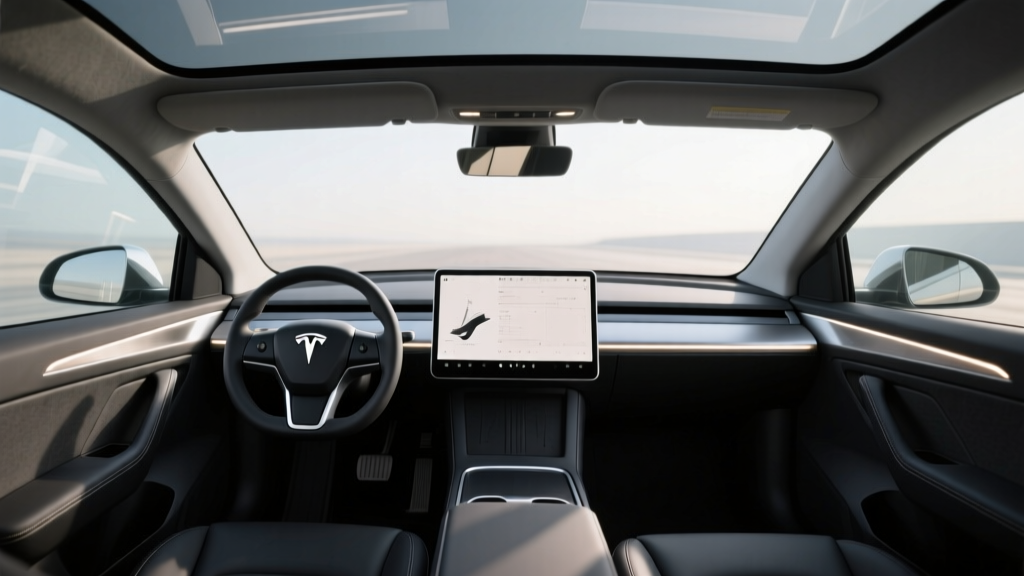
The Cybertruck's interior strips away nearly every physical button, leaning entirely on an 18.5-inch center touchscreen that dominates the dash. There is no instrument cluster behind the steering wheel — all speed, range, and navigation data renders on the central display, positioned slightly to the driver's side. The yoke-style steering wheel (a fixed design, not a round wheel option in 2026) takes getting used to, particularly during three-point turns and parking maneuvers.
Materials are a step above Tesla's Model 3 cabin: the dash features a textured microfiber and metal mesh surface, seats are wrapped in a durable vegan leather that resists scuffs well, and the center console includes a sliding cover revealing a deep storage bin with wireless phone charging. Rear passengers get a 9.4-inch touchscreen for climate and entertainment — a welcome addition for families — though legroom is tighter than the F-150 Lightning's back seat.
| Measurement | Cybertruck AWD | F-150 Lightning (Extended Range) |
|---|---|---|
| Front headroom | 40.2 in | 40.8 in |
| Front legroom | 41.5 in | 43.9 in |
| Rear headroom | 38.4 in | 39.6 in |
| Rear legroom | 35.2 in | 41.3 in |
| Bed volume | 67 cu ft (lockable vault) | 52.8 cu ft |
| Front trunk (frunk) | 7.1 cu ft | 14.1 cu ft |
| Max towing capacity | 11,000 lbs | 10,000 lbs |
The 6-foot lockable bed (Tesla calls it the "vault") features a motorized tonneau cover rated to 300 lbs of dynamic load, integrated 120V and 240V outlets, and built-in ramps. The powered frunk is modest at 7.1 cu ft — enough for a charging cable kit and a small bag, but not the grocery-capable space the Lightning offers.
Range, Battery, and Real-World Efficiency
The 2026 Cybertruck is offered in two trims: the Dual-Motor AWD and the tri-motor Cyberbeast. Both use a structurally integrated battery pack with a 4680-cell architecture and an estimated usable capacity of ~123 kWh. Tesla has not published the exact chemistry breakdown, but industry teardowns confirm an NMC (nickel manganese cobalt) formulation optimized for power delivery rather than the LFP chemistry found in the base Model 3 RWD.
Range Reality Check
EPA Estimated Range (AWD): 340 miles
EPA Estimated Range (Cyberbeast): 320 miles
Real-world highway (70 mph, 72°F): ~275–295 miles (AWD)
Real-world cold weather (30°F, mixed driving): ~230–255 miles
Towing (5,000-lb trailer, flat terrain): ~160–185 miles
The Cybertruck's slab-side aerodynamics and 6,800+ lb curb weight hit efficiency hard at highway speeds and in cold temperatures. Expect a 15–20% reduction from the EPA sticker on road trips, and up to 30% in sub-freezing conditions. Source: fueleconomy.gov
Efficiency lands at approximately 56 MPGe combined (AWD) and 52 MPGe (Cyberbeast), translating to roughly 58–62 kWh per 100 miles driven. That's thirsty by EV standards — the F-150 Lightning Extended Range achieves 70 MPGe combined — but expected for a vehicle this heavy and aerodynamically blunt.
Charging Speed: 800V Architecture in Action
The Cybertruck's 800-volt electrical architecture is its most significant charging advantage. At a V4 Tesla Supercharger, the AWD model peaks at approximately 350 kW, though sustained rates are more relevant for trip planning.
| Charging Level | Power / Rate | Time / Miles Added |
|---|---|---|
| Level 1 (120V household) | ~1.4 kW | ~3–4 miles per hour |
| Level 2 (240V, 48A Wall Connector) | 11.5 kW | ~37 miles per hour; full charge in ~12 hrs |
| DC Fast (V4 Supercharger, peak) | 350 kW (peak) | 10–80% in ~17 minutes |
| DC Fast (sustained avg. 10–80%) | ~225 kW avg | Adds ~175 miles in 15 min |
| DC Fast (CCS adapter, Electrify America) | ~175 kW (typical) | 10–80% in ~28 minutes |
The charge curve peaks early and tapers noticeably past 60% state of charge — a common pattern with large NMC packs. For road-trip planning, budget about 20 minutes per stop at a V4 Supercharger to move from 10% to 80%. Charging past 80% slows dramatically; a full 10–100% session takes roughly 40 minutes. On non-Tesla networks using Tesla's CCS adapter (included), expect slower rates due to handshaking and station limitations.
Preconditioning is critical: when you navigate to a Supercharger, the Cybertruck automatically warms or cools the battery for optimal charge acceptance. Skipping preconditioning in cold weather can cut peak charge rates in half.
Performance and Drivetrain
The dual-motor AWD Cybertruck produces 600 horsepower and launches to 60 mph in 3.9 seconds. The tri-motor Cyberbeast bumps output to 845 horsepower with a 2.6-second 0–60 time — supercar territory in a pickup that weighs over three tons. Both trims feature adaptive air suspension with up to 16 inches of ground clearance in Extract mode, and a four-wheel steering system that gives the 20-foot-long truck a surprisingly tight turning circle.
Towing capacity maxes out at 11,000 lbs (AWD), and the integrated trailer brake controller and camera system make hooking up straightforward. However, towing above 7,000 lbs cuts range nearly in half — plan charging stops accordingly.
Pricing, Trims, and Federal Tax Credit Eligibility
For 2026, Tesla offers the Cybertruck in two configurations:
- Cybertruck AWD: $79,990 MSRP (before destination)
- Cyberbeast (tri-motor): $99,990 MSRP (before destination)
| Trim | MSRP | §30D Credit Eligible? | Effective Price (if eligible) |
|---|---|---|---|
| AWD | $79,990 | Yes (meets MSRP truck cap of $80,000) | ~$72,490* |
| Cyberbeast | $99,990 | No (exceeds $80,000 truck MSRP cap) | $99,990 |
*Eligibility for the up-to-$7,500 federal tax credit under IRS §30D depends on buyer income caps ($300K joint / $150K single modified AGI), critical-mineral and battery-component sourcing requirements, and point-of-sale transfer rules. The Cybertruck AWD MSRP sits just under the $80,000 truck cap; adding options can push it over. Consult a tax professional before relying on credit eligibility. Credit may be transferred to the dealer at point of sale as an upfront discount under current IRS rules.
Options like the Foundation Series package, Full Self-Driving (Supervised) capability ($8,000), and accessories can push the AWD trim past the $80,000 MSRP cap, disqualifying it from the credit. Always verify the final MSRP on your build sheet before assuming eligibility.
Driver Assistance and Technology
The Cybertruck ships with Tesla's Basic Autopilot (lane centering + adaptive cruise control) as standard. Full Self-Driving (Supervised) is an $8,000 add-on that enables automatic lane changes, navigation on Autopilot, and city-street assisted driving.
SAE Automation Level: Level 2
Despite the "Full Self-Driving" name, Tesla's FSD (Supervised) is an SAE Level 2 driver-assistance system. The driver must keep hands on the wheel (or demonstrate attentiveness via the cabin camera) and remain fully responsible for vehicle operation at all times. This is not autonomous driving — Level 4 robotaxi services like Waymo operate without a driver present in geofenced areas. Never treat FSD as a substitute for active driving.
Other notable tech includes a steer-by-wire system (no mechanical connection between wheel and rack), which delivers variable steering ratios — fewer turns lock-to-lock at low speeds, more precision at highway speeds. The 18.5-inch display runs Tesla's latest infotainment software with Netflix, YouTube, and gaming while parked, plus a built-in dashcam and Sentry Mode surveillance system.
Drawbacks worth noting: the absence of physical buttons means simple tasks like adjusting mirrors or opening the glovebox require touchscreen taps. The rear-view camera replaces a traditional rearview mirror (the bed vault wall blocks a conventional mirror's view), and some drivers find the camera-only visibility limiting in heavy rain or glare. Build quality has improved since the 2024 launch, but panel-gap inconsistency remains a known issue on some units.
Warranty and Ownership Costs
Tesla provides the following warranty coverage for the 2026 Cybertruck:
- Basic Vehicle Limited Warranty: 4 years / 50,000 miles
- Battery & Drive Unit Warranty: 8 years / 120,000 miles (minimum 70% battery capacity retention)
- Rust-Through Warranty: Not applicable — stainless steel exoskeleton does not use traditional painted steel panels
Insurance premiums run significantly higher than comparable trucks. Owners report annual premiums between $3,500 and $5,200 depending on state and driving record, driven by the Cybertruck's high repair costs (stainless steel body panels require specialized service) and performance capability. Get quotes before ordering.
Maintenance costs are low by truck standards — no oil changes, no transmission fluid, and regenerative braking extends pad life to 100,000+ miles. Tire replacement is the primary recurring expense; the Cybertruck's 35-inch all-terrain tires run approximately $350–$450 per corner and typically last 25,000–35,000 miles given the vehicle's weight.
Who Should Buy the Cybertruck?
The Cybertruck suits buyers who want a high-performance electric truck with genuine towing and off-road capability, prioritize Tesla's Supercharger network for road trips, and can accept the interior minimalism and size compromises. It's less ideal for families needing maximum rear-seat space, buyers on a budget (the F-150 Lightning starts far lower), or anyone uncomfortable with touchscreen-only controls.
Pros
- 350 kW peak DC charging via V4 Supercharger — among the fastest in its class
- 11,000-lb towing capacity with integrated trailer tech
- Lockable 67 cu ft bed vault with 120V/240V power
- Tri-motor Cyberbeast performance (2.6s 0–60)
- Four-wheel steering and air suspension for off-road versatility
- Access to Tesla Supercharger network (17,000+ stalls in North America)
Cons
- Real-world range falls 15–20% below EPA on highways; worse when towing
- Rear legroom (35.2 in) trails F-150 Lightning by 6 inches
- Touchscreen-only controls frustrate some drivers
- High insurance premiums ($3,500–$5,200/yr)
- Efficiency of ~58 kWh/100mi makes it expensive to charge at public DC rates
- Cyberbeast trim does not qualify for federal tax credit
Cybertruck vs. the Competition
Against the Ford F-150 Lightning Extended Range (EPA 320 miles, ~$69,995 base), the Cybertruck offers faster charging, more towing capacity, and a lockable bed vault, but sacrifices rear-seat comfort and overall efficiency. The Lightning's larger frunk and more conventional interior layout appeal to traditional truck buyers.
The Rivian R1T Dual-Motor Max (EPA ~352 miles, ~$87,000) matches the Cybertruck on adventure capability with a more refined interior, a front trunk with 11 cu ft, and the innovative Gear Tunnel option. It charges slower (peak ~220 kW) but offers a more driver-friendly cabin.
Choose the Cybertruck if:
- You regularly tow and need 11,000-lb capacity with fast DC charging on road trips
- You value the Supercharger network for cross-country travel
- You want tri-motor performance (Cyberbeast) in a truck form factor
Choose the F-150 Lightning if:
- Rear-seat passenger comfort is a priority
- You want a lower starting price and broader dealer service network
- You prefer physical controls and a conventional truck layout
Choose the Rivian R1T if:
- You want a premium adventure truck with the best interior quality in the segment
- You value creative storage (Gear Tunnel, front trunk) over raw towing numbers
Frequently Asked Questions
What is the real-world range of the Tesla Cybertruck?
The EPA rates the AWD Cybertruck at 340 miles and the Cyberbeast at 320 miles. In real-world highway driving at 70 mph in mild temperatures, expect 275–295 miles (AWD). Cold weather (below freezing) reduces range to approximately 230–255 miles. Towing a 5,000-lb trailer drops range to roughly 160–185 miles. The Cybertruck's large frontal area and weight make it particularly sensitive to speed and temperature.
How fast does the Cybertruck charge at home and on the road?
At home on a 240V / 48A Tesla Wall Connector, the Cybertruck adds about 37 miles of range per hour, requiring roughly 12 hours for a full charge. On a V4 Tesla Supercharger, it peaks at 350 kW and charges from 10–80% in approximately 17 minutes. On non-Tesla DC fast chargers using the CCS adapter, expect 10–80% in about 28 minutes at typical 175 kW rates.
Does the Cybertruck qualify for the $7,500 federal EV tax credit?
The Cybertruck AWD at $79,990 MSRP falls under the $80,000 truck cap for §30D eligibility, but you must also meet income limits ($300,000 joint / $150,000 single modified AGI), and the vehicle must satisfy critical-mineral and battery-component sourcing requirements that change annually. The Cyberbeast at $99,990 exceeds the MSRP cap and does not qualify. Always verify current-year rules on IRS.gov and consult a tax professional.
Is the Cybertruck worth buying over the F-150 Lightning or Rivian R1T?
The Cybertruck wins on peak charging speed, towing capacity, and Supercharger network access. It loses on rear-seat space, overall efficiency, and insurance cost. If you prioritize road-trip charging convenience and towing, it's the strongest choice. If rear-seat comfort, interior quality, or lower pricing matter more, the Lightning or R1T are compelling alternatives.
What are the biggest drawbacks of the Cybertruck interior?
The touchscreen-only interface (no physical buttons for climate, mirrors, or glovebox), the yoke steering wheel requiring adaptation, the camera-based rearview system instead of a traditional mirror, and tight rear legroom (35.2 inches) are the most commonly cited interior complaints. The minimalist design appeals to some but frustrates truck buyers accustomed to tactile controls.
How much does it cost to charge a Cybertruck?
At the national average residential electricity rate of ~$0.17/kWh, a full home charge (123 kWh usable) costs approximately $21. At public DC fast chargers averaging $0.40–$0.55/kWh, a 10–80% session runs $25–$35. Given the Cybertruck's ~60 kWh/100mi consumption, expect fuel costs of about $0.10–$0.13 per mile at home and $0.24–$0.33 per mile at public chargers — roughly equivalent to a gas truck getting 12–15 mpg at $3.50/gallon.