The Tesla Cybertruck remains one of the most polarizing vehicles on the road, and nowhere is that polarization more evident than when you open the door and climb inside. The interior of Tesla Cybertruck strips away nearly every convention of what a pickup truck cabin should look like, replacing stitched leather and physical buttons with a monolithic stainless-steel dashboard, a single 18.5-inch touchscreen, and a yoke-style steering wheel. Whether that minimalism reads as futuristic elegance or spartan deprivation depends largely on your expectations — but in 2026, after two full years of customer deliveries, the real-world ownership picture is far clearer than it was at launch.
This review dissects the Cybertruck cabin in detail — materials, seating, technology, cargo utility, and daily livability — while also covering the powertrain, range, charging, pricing, and tax-credit picture that every serious buyer needs before signing a purchase agreement.
Cybertruck at a Glance: Core Specifications
| Spec | AWD (Dual Motor) | Cyberbeast (Tri-Motor) |
|---|---|---|
| EPA Range | 340 miles | 320 miles |
| Battery (usable, est.) | ~123 kWh (NMC) | ~123 kWh (NMC) |
| Horsepower | 600 hp | 845 hp |
| 0–60 mph | 4.1 sec | 2.6 sec |
| Max DC Fast Charge | 250 kW | 250 kW |
| 10–80% DC Charge | ~28 min | ~28 min |
| Level 2 Home Rate | 11.5 kW (~37 mi/hr) | 11.5 kW (~37 mi/hr) |
| MPGe (combined) | ~72 MPGe | ~68 MPGe |
| Efficiency | ~47 kWh/100 mi | ~50 kWh/100 mi |
| Towing Capacity | 11,000 lb | 11,000 lb |
| Base MSRP (2026) | $79,990 | $99,990 |
| Battery/Drive Warranty | 8 yr / 120,000 mi | 8 yr / 120,000 mi |
The Dashboard and Materials: Stainless Steel Meets Minimalism
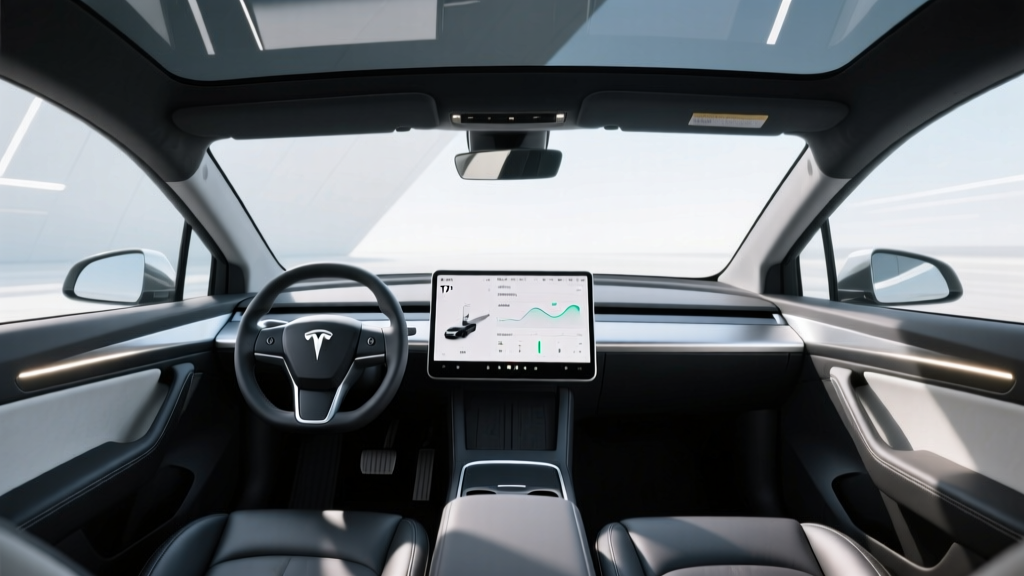
The moment you sit in the Cybertruck, the dashboard dominates your field of view. Tesla uses a single piece of brushed stainless steel that spans the entire width of the cabin, echoing the truck's exterior exoskeleton. There is no traditional instrument cluster behind the steering wheel; all driver information — speed, range, navigation, Autopilot visualization — is rendered on the left third of the 18.5-inch center touchscreen.
The material palette is deliberately limited. You will find:
- Stainless steel across the dash and door sills — visually striking but prone to fingerprints and reflective glare in direct sunlight.
- Vegan leather (synthetic) on the seats, steering wheel, and door armrests. Available in black; earlier promises of white and tan interiors have not materialized for the 2026 model year.
- Hard plastics on the lower door panels and center console base. At the Cybertruck's price point, the amount of visible hard plastic is a frequent criticism from reviewers accustomed to $80,000+ trucks like the Ford F-150 Lightning Platinum or Rivian R1T.
- Acoustic glass on the windshield and front windows, which does a commendable job of reducing wind noise at highway speeds — a necessary measure given the angular, slab-sided body creates more aerodynamic turbulence than a curved vehicle.
The yoke steering wheel remains standard. Tesla has not reintroduced a round wheel option for the Cybertruck as of early 2026. Most owners adapt to the yoke within a week, but low-speed maneuvers like three-point turns or parking-lot hand-over-hand steering require deliberate relearning. The yoke also exposes the upper portion of the screen fully, which aids visibility but means there is no shade to combat glare on bright days.
Seating, Space, and Cargo: Dimensions That Matter
The Cybertruck seats five across two rows. Front-seat comfort is generally good, with adequate bolstering and a flat floor that gives both driver and passenger generous legroom. The rear seat is where opinions diverge:
- Rear legroom: ~38.2 inches — competitive with midsize trucks but noticeably less than the full-size F-150 Lightning (~40.9 inches).
- Rear headroom: The sloping roofline cuts into headroom for passengers over 6 feet tall. The angular rear glass also creates a greenhouse effect in summer; Tesla's standard tint helps but does not eliminate the need for an aftermarket sunshade.
- Rear seat cushion: Relatively flat and thin compared to body-on-frame trucks. Long road-trip comfort for rear passengers is adequate but not exceptional.
Cargo volume is split between three zones:
- Bed (vault): 67 cubic feet with the tonneau cover closed. The bed is 6 feet long and 4 feet wide between the wheel wells, fitting standard 4×8 sheets of plywood only diagonally (a notable limitation for a truck marketed for utility).
- Frunk (front trunk): ~7.1 cubic feet — useful for groceries or a charging cable bag but smaller than the F-150 Lightning's 14.1 cu ft Mega Power Frunk.
- Under-bed storage (gear locker): An additional sealed compartment accessible from the bed, adding roughly 3 cubic feet of lockable space.
The EPA rates the Cybertruck AWD at 340 miles and the Cyberbeast at 320 miles. In real-world highway driving at 70–75 mph, expect 270–290 miles from the AWD and 250–275 miles from the Cyberbeast. The truck's large frontal area and ~6,800 lb curb weight hit efficiency hard at sustained speed. In cold weather (below 32°F), range drops an additional 15–25% depending on cabin heat usage and whether you precondition the battery. Towing a 7,000 lb trailer can cut range by 40–50%, bringing effective range to roughly 150–175 miles between charges.
Technology and Infotainment: One Screen to Rule Them All
The Cybertruck runs Tesla's latest vehicle software on a horizontally oriented 18.5-inch touchscreen with 2,200 nits of peak brightness. There are no physical buttons for climate, media, or vehicle settings — everything is touch-controlled or voice-activated.
Notable tech features include:
- Steer-by-wire: The Cybertruck is the first mass-market vehicle sold in the U.S. with a fully steer-by-wire system (no mechanical linkage between the yoke and the wheels). This enables the variable-ratio steering rack — less than a full turn lock-to-lock — and contributes to the surprisingly tight 35-foot turning circle.
- 48-volt electrical architecture: A first for a production vehicle, reducing wiring harness weight and enabling higher-power accessories. This is significant for upfitters and the aftermarket.
- Autopilot (standard): Lane centering, adaptive cruise, and automatic emergency braking. Note: Autopilot is an SAE Level 2 driver-assistance system — the driver must remain fully engaged at all times.
- Full Self-Driving (Supervised) — optional ($8,000): Adds city-street navigation, traffic-light recognition, and automated parking. Still Level 2. Despite the name, the driver is legally and practically responsible for all driving decisions.
- Rear 9.4-inch touchscreen: Mounted on the back of the center console for rear passengers to control climate and media — a welcome addition for family use.
- Powertrain & performance controls: The Cyberbeast trim includes launch-mode settings, adaptive damping adjustments, and a "Beast" drive mode accessible from the touchscreen.
The biggest tech drawback is the absence of Apple CarPlay and Android Auto. Tesla's native navigation and media apps are capable, but users heavily invested in Apple or Google ecosystems will find the lack of phone-mirroring a persistent frustration, especially for music and podcast playback.
Tesla Autopilot and Full Self-Driving (Supervised) are Level 2 driver-assistance systems per SAE International. The driver must maintain full attention and be ready to take over at any moment. These systems are not autonomous. True driverless operation (Level 4) is currently available only in limited robotaxi services like Waymo in select metro areas.
Charging Speed and Infrastructure: What to Expect
The Cybertruck uses the NACS (North American Charging Standard) connector natively — no adapter needed for Tesla Superchargers. This is a significant advantage in 2026, as the Supercharger network remains the most reliable DC fast-charging infrastructure in the U.S. The Cybertruck can also use Electrify America, EVgo, and other CCS-equipped networks with a NACS-to-CCS adapter (sold separately by Tesla for ~$250).
| Charging Level | Power | Speed (approx.) | Notes |
|---|---|---|---|
| Level 1 (120V) | 1.4 kW | ~4–5 mi/hr | Emergency/trickle only; impractical for daily use |
| Level 2 (240V, 48A) | 11.5 kW | ~37 mi/hr | Full charge in ~10–11 hours; recommended for daily |
| DC Fast (Supercharger V3) | Peak 250 kW | 10–80% in ~28 min | Peak rate sustained only to ~50% SoC; tapers significantly above 80% |
| DC Fast (V4 Supercharger) | Peak 250 kW (truck-limited) | Similar to V3 | Cybertruck architecture does not currently utilize V4's 350 kW capability |
Charging-curve reality: The Cybertruck's large ~123 kWh battery means that while peak charging hits 250 kW, the sustained average from 10–80% is closer to 140–155 kW. The charge rate tapers progressively above 50% state of charge and drops sharply past 80%. For road-trip planning, budget 25–30 minutes at each Supercharger stop to go from 15% to 80%.
Home charging setup: Tesla includes a Mobile Connector with the truck. For optimal Level 2 charging, install a Tesla Wall Connector on a 60-amp circuit (48A continuous). Expect installation costs of $500–$2,000 depending on your electrical panel's capacity and the run distance from panel to garage. Homes with older 100-amp panels may require a $2,000–$4,000 panel upgrade to support a dedicated 60-amp EV circuit.
Pricing, Trims, and Federal Tax Credit Eligibility
As of the 2026 model year, Tesla offers the Cybertruck in two configurations:
| Trim | Base MSRP | Federal §30D Credit | Effective Price (if eligible) |
|---|---|---|---|
| AWD (Dual Motor) | $79,990 | Up to $7,500 | ~$72,490 |
| Cyberbeast (Tri-Motor) | $99,990 | $0 (exceeds MSRP cap) | $99,990 |
Tax-credit caveats (IRS §30D, current for 2026):
- MSRP cap: Trucks must have an MSRP at or below $80,000 to qualify. The AWD at $79,990 squeaks under the cap; the Cyberbeast at $99,990 does not qualify.
- Income cap: Buyer's modified AGI must not exceed $150,000 (single), $225,000 (head of household), or $300,000 (joint filing).
- Battery sourcing: A percentage of critical minerals and battery components must be sourced from the U.S. or FTA-partner countries. Tesla has progressively increased domestic sourcing, but eligibility can shift mid-year. Always verify current eligibility at fueleconomy.gov before purchasing.
- Point-of-sale transfer: Eligible buyers can transfer the credit to the dealer at purchase, reducing the out-of-pocket price directly rather than waiting for a tax refund.
- One-time use: The §30D credit is available once per buyer per four-year period for new EVs.
For a complete breakdown of eligibility rules, consult IRS.gov §30D guidance and verify with a tax professional before relying on the credit in your purchase decision.
Pros and Cons: The Honest Assessment
- Stunning, conversation-starting design inside and out
- Steer-by-wire gives an impossibly tight turning circle for a 6.8K-lb truck
- Stainless-steel exoskeleton is dent- and corrosion-resistant
- 11,000-lb towing capacity rivals heavy-duty gas trucks
- NACS native — full Supercharger network access without adapters
- 48V architecture is genuinely forward-looking for upfitters
- Cyberbeast's 2.6-sec 0–60 is supercar territory in a pickup
- 8-year/120,000-mile battery warranty is above industry average
- Interior materials don't match the $80K–$100K price point
- No Apple CarPlay or Android Auto
- Bed cannot fit 4×8 sheets flat between wheel wells
- Rear-seat headroom is compromised by the roofline
- Real-world highway range falls 50–70 miles short of EPA
- Towing cuts range by 40–50%, limiting road-trip utility
- Stainless-steel dash attracts fingerprints and sun glare
- Cyberbeast does not qualify for the federal tax credit
- No round steering wheel option — yoke only
- Insurance premiums run 20–35% higher than comparable trucks
Who Should Buy the Cybertruck — and Who Should Look Elsewhere?
Buy the Cybertruck AWD if: You want a head-turning daily driver that can handle light-to-moderate truck duty, you have reliable home charging, you value Supercharger access for road trips, and you're comfortable with a minimalist, screen-centric cabin. At ~$72,500 after the potential tax credit, it undercuts the Rivian R1T Dual-Motor on price while offering more range.
Buy the Cyberbeast if: Performance is your priority and budget is flexible. The 845 hp and 2.6-second 0–60 are unmatched in the electric truck segment. Just know you're paying $100K without tax-credit help.
Look at the Ford F-150 Lightning if: You need a conventional truck cabin with physical controls, CarPlay/Android Auto, a massive frunk, and a bed that fits 4×8 sheets flat. The Lightning's extended-range battery offers 320 miles EPA at a lower starting price.
Look at the Rivian R1T if: You want a more premium interior, quad-motor performance options, a built-in camp kitchen available as an option, and a truck that fits more naturally on tight trails. The R1T's Dual-Motor starts lower and offers a more traditional driving experience.
Frequently Asked Questions
What is the real-world range of the Tesla Cybertruck?
The EPA rates the AWD at 340 miles and the Cyberbeast at 320 miles. In real-world highway driving at 70–75 mph, expect 270–290 miles (AWD) and 250–275 miles (Cyberbeast). Cold weather and towing reduce range substantially — plan conservatively for road trips.
How fast does the Cybertruck charge at home and on the road?
On a home Level 2 charger (11.5 kW / 48A), you gain roughly 37 miles of range per hour, fully recharging overnight. At a Tesla Supercharger, peak rate is 250 kW, with a 10–80% charge taking approximately 28 minutes. The large battery means the sustained average rate is closer to 140–155 kW.
Does the Cybertruck qualify for the $7,500 federal EV tax credit?
The AWD trim ($79,990 MSRP) qualifies under the $80,000 truck cap, assuming the buyer meets income limits and battery-sourcing requirements are satisfied. The Cyberbeast ($99,990) exceeds the MSRP cap and does not qualify. Always verify current eligibility at fueleconomy.gov and consult a tax professional.
Is the Cybertruck interior practical for families?
It works for families with older children. The rear seat accommodates two car seats, but the sloping roofline reduces headroom, and the hard-plastic lower panels show scuffs quickly from kids' shoes. The rear 9.4-inch screen is a plus for entertainment. Families needing maximum rear-seat comfort should test-drive the F-150 Lightning or Rivian R1T back-to-back.
Can the Cybertruck bed fit standard building materials?
A 4×8-foot sheet of plywood does not fit flat between the wheel wells (48 inches wide). It can be loaded diagonally or with the tailgate down. The 6-foot bed length and 67 cu ft of enclosed volume under the tonneau are adequate for most weekend projects but fall short of full-size truck utility.
What is the battery warranty on the Cybertruck?
Tesla covers the battery and drive unit for 8 years or 120,000 miles, whichever comes first, with a minimum 70% capacity retention threshold. This is slightly better than the industry-standard 8 years/100,000 miles seen on most competitors.
Is steer-by-wire safe?
Tesla's steer-by-wire system uses redundant motors and controllers — if one fails, the backup takes over instantly. The system has been certified by NHTSA for road use. Early-adopter owners report high satisfaction with the variable ratio, though there is a learning curve. No widespread safety incidents have been reported as of early 2026.
Sources: fueleconomy.gov, Tesla Cybertruck specifications, IRS §30D clean vehicle credits.