If you have been searching for a comprehensive Tesla Cybertruck interior 360 view, you already know this truck defies conventional pickup design. The angular stainless-steel exoskeleton grabs headlines, but it is the cabin, powertrain, and charging architecture that determine whether the Cybertruck actually works as a daily driver. This review covers every angle of the 2025/2026 Cybertruck — from the minimalist dashboard and 18.5-inch touchscreen to the 800-volt charging system and real-world range you can expect beyond the EPA sticker.
Cybertruck Interior 360 View: What the Cabin Actually Looks Like
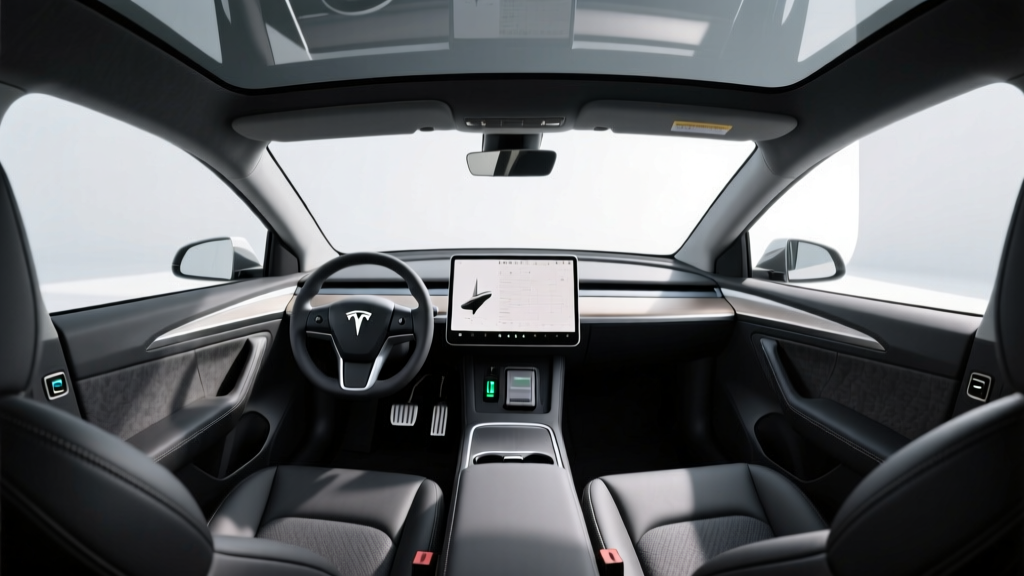
The Cybertruck interior strips away nearly every physical button, replacing them with a single 18.5-inch center touchscreen that dominates the dashboard. The yoke-style steering wheel (a rectangular design that Tesla has since offered a round alternative for) frames a slim LED instrument strip. Materials are vegan leather and a microfiber-like textile across the seats and door panels, with a stainless-steel dash accent that mirrors the exterior.
Front passengers get 41.0 inches of legroom, while the rear bench offers 38.5 inches — competitive with mid-size trucks like the Ford Ranger but tighter than a full-size F-150 Lightning's rear seat. The rear bench folds flat in a 60/40 split, expanding the covered cargo area behind the front seats.
Visibility is a mixed bag. The massive windshield provides a panoramic forward view, but the rear window is small and heavily raked, making the standard rear camera essential. The side mirrors are wide enough to compensate for the truck's 82-inch width, though the angular A-pillars create notable blind spots at intersections.
The 15-speaker audio system includes two subwoofers and delivers impressive bass response for a factory setup. Ambient lighting runs along the dash and door panels, and the glass roof panel lets in substantial light — though it lacks a retractable shade, which can make the cabin warm on sunny days.
Spec Table: Cybertruck AWD and Cyberbeast at a Glance
| Specification | Cybertruck AWD | Cyberbeast (Tri-Motor) |
|---|---|---|
| EPA Range | 340 miles | 320 miles |
| Battery Capacity (usable) | ~123 kWh (estimated), NMC | ~123 kWh (estimated), NMC |
| Drivetrain | Dual-Motor AWD | Tri-Motor AWD |
| Horsepower | 600 hp | 845 hp |
| 0-60 mph | 4.1 seconds | 2.6 seconds |
| Max DC Fast Charge | 350 kW (800V architecture) | 350 kW (800V architecture) |
| 10-80% DC Charge Time | ~18 minutes | ~18 minutes |
| Level 2 Home Charge Rate | 11.5 kW (~34 mi/hr) | 11.5 kW (~34 mi/hr) |
| MPGe (Combined) | 79 MPGe | 74 MPGe |
| Efficiency | 43 kWh/100 mi | 46 kWh/100 mi |
| Towing Capacity | 11,000 lbs | 11,000 lbs |
| Cargo Volume (Bed) | 67 cu ft (vault bed) | 67 cu ft (vault bed) |
| Front Trunk (Frunk) | 7 cu ft | 7 cu ft |
| Base MSRP | $79,990 | $99,990 |
| Battery/Drive Unit Warranty | 8 years / 120,000 miles | 8 years / 120,000 miles |
Sources: EPA Fueleconomy.gov, Tesla Cybertruck Design Page
Charging Speed: 800V Architecture and Real-World Charging Curves
The Cybertruck uses an 800-volt electrical architecture, the same platform approach found in the Hyundai Ioniq 5 and Porsche Taycan, which enables extremely fast DC charging. On a compatible V4 Supercharger or third-party 350 kW station (Electrify America, for example), the Cybertruck can peak at approximately 350 kW.
However, peak rate is not sustained rate. The charging curve is aggressive in the 10-50% state-of-charge (SoC) window, holding above 250 kW, then tapers progressively. From 50-80%, expect speeds closer to 120-150 kW. The total 10-80% time of approximately 18 minutes is competitive, but a 10-100% session will take closer to 35-40 minutes due to the steep taper above 80%.
| Charging Method | Power / Rate | Miles Added Per Hour | Notes |
|---|---|---|---|
| Level 1 (120V outlet) | ~1.4 kW | ~3-4 mi/hr | Emergency/trickle only |
| Level 2 (240V, 48A Wall Connector) | 11.5 kW | ~34 mi/hr | Full charge in ~11 hours |
| DC Fast (V4 Supercharger / 350 kW) | Up to 350 kW peak | ~130 mi in 10 min (peak) | 10-80% in ~18 min |
| DC Fast (150 kW station) | Up to 150 kW | ~70 mi in 10 min | 10-80% in ~30 min |
For home charging, Tesla's Wall Connector at 48 amps delivers 11.5 kW on a 240-volt circuit, adding roughly 34 miles of range per hour of charging. Most owners will need a NEMA 14-50 outlet (50-amp circuit) or a hardwired 60-amp circuit installed by a licensed electrician. Installation costs typically range from $500 to $2,000 depending on panel proximity and local permitting, with a full 200-amp panel upgrade adding $1,500–$3,500 if your home's electrical service requires it.
The Cybertruck ships with a NACS (North American Charging Standard) connector natively, giving it direct access to Tesla's Supercharger network — currently the most reliable DC fast-charging network in the U.S. by uptime metrics.
Real-World Range: Highway, Cold Weather, and Towing
The EPA's 340-mile estimate for the AWD model assumes a mix of city and highway driving under moderate temperatures. Real-world results diverge significantly based on conditions:
- Highway (70-75 mph, moderate weather): 270-295 miles. The Cybertruck's flat, angular body creates substantial aerodynamic drag at highway speeds, reducing efficiency to roughly 2.2-2.4 miles per kWh compared to the EPA's combined 2.3 mi/kWh.
- City / mixed driving (moderate weather): 310-335 miles. Regenerative braking recovers energy effectively in stop-and-go traffic.
- Cold weather (below 32°F): 230-260 miles. The NMC battery chemistry loses efficiency in cold temperatures, and resistive cabin heating draws substantial power. Preconditioning the battery while plugged in mitigates some of this loss.
- Towing (loaded trailer, ~8,000 lbs): 120-160 miles. Towing cuts range roughly in half, consistent with all electric pickups. Plan charging stops accordingly.
Preconditioning is critical. The Cybertruck's thermal management system will warm the battery before a scheduled navigation-routed Supercharger stop, which improves charge acceptance rates. If you skip preconditioning (for example, by driving to a charger without routing through the navigation), expect 10-80% times to stretch by 5-8 minutes in cool weather.
Pricing, Trims, and Federal Tax Credit Eligibility
The Cybertruck lineup currently includes the AWD dual-motor at $79,990 and the Cyberbeast tri-motor at $99,990 (both prices exclude the $1,995 destination fee). Tesla previously offered a rear-wheel-drive base model at $60,990, but as of 2025, that variant has been delayed and is not yet available for delivery.
| Trim | Base MSRP | With Destination | Estimated After §30D Credit* |
|---|---|---|---|
| Cybertruck AWD | $79,990 | $81,985 | $74,485 (if eligible) |
| Cyberbeast | $99,990 | $101,985 | $94,485 (if eligible) |
*Tax credit estimates assume full $7,500 eligibility. Actual credit depends on IRS §30D requirements.
Federal tax credit eligibility under IRS §30D involves several conditions that change periodically:
- MSRP Cap: Pickup trucks must have an MSRP at or below $80,000. The Cybertruck AWD at $79,990 qualifies; the Cyberbeast at $99,990 exceeds the cap and does not qualify.
- Buyer Income Limits: Modified adjusted gross income must not exceed $300,000 (joint filers), $225,000 (head of household), or $150,000 (single filers).
- Battery Component Sourcing: The vehicle must meet critical mineral and battery component requirements that phase in stricter thresholds each year. Tesla manufactures battery cells in the U.S., but specific mineral sourcing compliance must be confirmed at point of sale.
- Point-of-Sale Transfer: As of 2024, eligible buyers can transfer the credit to the dealer at purchase, reducing the out-of-pocket cost immediately rather than waiting for tax filing.
Because these rules are subject to change and depend on individual tax situations, consult a tax professional and verify current eligibility on fueleconomy.gov before purchasing.
Performance, Tech, and Driver Assistance
The dual-motor AWD Cybertruck produces 600 horsepower and reaches 60 mph in 4.1 seconds — quick for a 6,600-pound vehicle but not exotic by EV standards. The Cyberbeast's tri-motor setup (one front, two rear) delivers 845 hp and a 2.6-second 0-60 time, placing it in supercar territory. Both variants feature adaptive air suspension with up to 12.2 inches of ground clearance and a 35-degree approach angle for off-road capability.
The steer-by-wire system eliminates the mechanical connection between the steering wheel and the front wheels, using electronic signals instead. This allows the Cybertruck to achieve a tight 34.8-foot turning circle despite its 223.7-inch length — comparable to a compact sedan. The system takes approximately 20-30 miles of driving to acclimate to, as the steering ratio varies with speed more aggressively than a traditional rack.
Tesla's Autopilot comes standard, including Traffic-Aware Cruise Control and Autosteer (lane centering). The optional Full Self-Driving (Supervised) package adds automatic lane changes, traffic light and stop sign recognition, and Navigate on Autopilot for highway on-ramp to off-ramp driving.
The infotainment system runs on Tesla's proprietary OS and includes streaming media (Netflix, YouTube, Spotify when parked), a built-in web browser, and over-the-air software updates that periodically add features. Apple CarPlay and Android Auto are not supported — a notable drawback for buyers accustomed to phone-mirroring interfaces. The Cybertruck also includes a 120-volt bed outlet (up to 9.6 kW output via PowerShare) for running tools or camping equipment, and it supports vehicle-to-load (V2L) functionality.
Pros, Cons, and Who Should Buy the Cybertruck
Pros
- 350 kW DC fast charging on 800V architecture — among the fastest in the pickup segment
- Steer-by-wire enables an unusually tight turning circle for a full-size truck
- 11,000-lb towing capacity with integrated trailer brake controller
- Stainless-steel exoskeleton eliminates paint-related maintenance and minor dent concerns
- 9.6 kW V2L bed outlet for job-site or camping power
- Access to Tesla Supercharger network natively (NACS connector)
Cons
- Rear seat legroom (38.5 in) trails the F-150 Lightning and Rivian R1T
- No Apple CarPlay or Android Auto — Tesla-only interface
- Cold-weather range loss is significant (~25-30%) with NMC chemistry
- Cyberbeast exceeds the $80,000 MSRP cap for the federal tax credit
- Steer-by-wire requires an acclimation period and raises long-term service questions
- Cargo bed is shorter (67 cu ft) than traditional 6.5-foot pickup beds
Choose the Cyberbeast if: Performance is the priority, you do not need the tax credit, and the 2.6-second 0-60 time justifies the $20,000 premium.
Look at the Ford F-150 Lightning or Rivian R1T instead if: You need maximum rear-seat space, prefer CarPlay/Android Auto, or want a more traditional driving feel without steer-by-wire.
Frequently Asked Questions
What is the real-world range of the Tesla Cybertruck?
The EPA rates the AWD Cybertruck at 340 miles combined. Real-world highway driving typically yields 270-295 miles, while cold-weather driving can reduce range to 230-260 miles. City driving with regenerative braking can approach the EPA number under mild conditions.
How fast does the Cybertruck charge at home and on DC fast chargers?
On a Level 2 home charger (11.5 kW), the Cybertruck adds about 34 miles per hour, reaching a full charge overnight in roughly 11 hours. On a 350 kW DC fast charger, it peaks at 350 kW and charges from 10-80% in approximately 18 minutes, though sustained rates taper above 50% SoC.
Does the Cybertruck qualify for the $7,500 federal EV tax credit?
The AWD trim at $79,990 MSRP falls under the $80,000 truck cap and may qualify, pending buyer income limits (under $300,000 for joint filers) and battery-sourcing compliance. The Cyberbeast at $99,990 exceeds the MSRP cap and does not qualify. Always verify current rules at IRS.gov.
Is the Cybertruck worth buying vs. the F-150 Lightning or Rivian R1T?
The Cybertruck wins on DC charging speed (350 kW vs. the Lightning's ~150 kW and R1T's ~200 kW) and steer-by-wire maneuverability. The F-150 Lightning offers more rear-seat space, a larger bed, and CarPlay. The Rivian R1T provides a more refined ride and better off-road articulation. Your choice depends on whether charging speed and unique tech outweigh the cabin compromises.
What is the Cybertruck's battery chemistry and warranty?
The Cybertruck uses NMC (nickel-manganese-cobalt) battery chemistry with an estimated usable capacity of approximately 123 kWh. Tesla covers the battery and drive units with an 8-year / 120,000-mile warranty, guaranteeing a minimum of 70% capacity retention over that period.
Does the Cybertruck have a frunk?
Yes, the Cybertruck includes a 7 cu ft front trunk (frunk) suitable for charging cables, a small bag, or groceries. It is smaller than the F-150 Lightning's 14.1 cu ft Mega Power Frunk.