Quick Verdict: A Polarizing Truck With Serious Capability
The Tesla Cybertruck is unlike any pickup on the road—inside and out. Its angular stainless-steel exoskeleton grabs headlines, but it's the cabin, powertrain, and charging architecture that determine whether this truck actually works for daily life. With up to 340 miles of EPA-estimated range, an 800-volt electrical system capable of 350 kW DC fast charging, and a minimalist interior dominated by a single 18.5-inch touchscreen, the Cybertruck is a statement of engineering ambition. But ambition doesn't always translate to practicality. This review breaks down every spec that matters—from real-world range and charging curves to cargo dimensions and federal tax credit eligibility—so you can decide if the Cybertruck fits your driveway.
Tesla Cybertruck Full Spec Sheet
| Specification | AWD (Dual Motor) | Cyberbeast (Tri Motor) |
|---|---|---|
| EPA Range | 340 mi | 320 mi |
| Battery (usable est.) | ~123 kWh, NMC | ~123 kWh, NMC |
| Max DC Fast Charge | 350 kW (800V) | 350 kW (800V) |
| 10–80% DCFC Time | ~15 min (peak conditions) | ~15 min (peak conditions) |
| Level 2 Charge Rate | 11.5 kW (~44 mi/hr) | 11.5 kW (~44 mi/hr) |
| 0–60 mph | 4.1 sec | 2.6 sec |
| Horsepower | 600 hp | 845 hp |
| Drivetrain | Dual Motor AWD | Tri Motor AWD |
| Towing Capacity | 11,000 lbs | 11,000 lbs |
| MPGe (combined) | 67 MPGe | 65 MPGe |
| Efficiency | 50 kWh/100 mi | 52 kWh/100 mi |
| Base MSRP | $79,990 | $99,990 |
| Battery/Drive Unit Warranty | 8 yr / 120,000 mi | 8 yr / 120,000 mi |
Sources: EPA / fueleconomy.gov, Tesla Cybertruck specifications.
Range and Efficiency: EPA vs. the Real World
Real-World Expectation: ~260–290 mi highway at 70+ mph; ~220–250 mi in cold weather (below 32°F) with cabin heat; ~300–320 mi mixed city/suburban driving.
The Cybertruck's stainless-steel body is heavy—curb weight exceeds 6,600 lbs for the AWD and approaches 6,850 lbs for the Cyberbeast. That mass, combined with a large frontal area, means highway efficiency drops significantly at sustained speeds. On a flat, 75-mph interstate run in moderate temperatures, expect roughly 2.0–2.2 kWh/mi, which translates to around 270 miles before needing to plug in. In cold weather, battery thermal management and cabin heating can reduce usable range by 20–30%, a reality for any large-battery EV but especially impactful here given the truck's weight.
The Cybertruck's ~123 kWh usable battery pack uses NMC (nickel manganese cobalt) chemistry, chosen for its high energy density—necessary to push a vehicle this heavy past 300 miles EPA. Tesla's heat pump, standard across the lineup, helps mitigate cold-weather losses compared to resistive heating, but physics still wins in sub-freezing conditions.
Charging Speed: 800V Architecture Delivers
| Charging Level | Power / Rate | Miles Added per Hour | Notes |
|---|---|---|---|
| Level 1 (120V) | ~1.4 kW | ~3 mi/hr | Emergency/trickle only |
| Level 2 (240V, 48A) | 11.5 kW | ~44 mi/hr | Full charge in ~11 hr |
| DC Fast Charge | Up to 350 kW | ~730 mi/hr (peak) | 10–80% in ~15 min |
The Cybertruck's 800-volt architecture is its charging ace. At a V4 Tesla Supercharger or compatible 350 kW CCS/NACS station, the truck can accept peak power that translates to roughly 10–80% in 15 minutes under ideal conditions—battery preconditioned via navigation routing, moderate ambient temperature, and low starting state of charge.
However, the charge curve matters. Peak 350 kW is sustained only in the lower portion of the battery (roughly 10–40% SoC). Above 50%, power tapers progressively—dropping to ~150 kW by 70% and below 75 kW past 85%. This is normal for large NMC packs protecting cell longevity, but it means a 10–90% session will take closer to 25–28 minutes. For road trips, the practical strategy is to charge in short 10–80% bursts rather than topping off completely.
At home on a Level 2 Wall Connector (48 amps / 240V), the Cybertruck recovers about 44 miles of range per hour. A full overnight charge from 20% to 100% takes roughly 11 hours—manageable for daily use if you have a home charger installed.
Inside the Cybertruck: Cabin, Tech, and Cargo
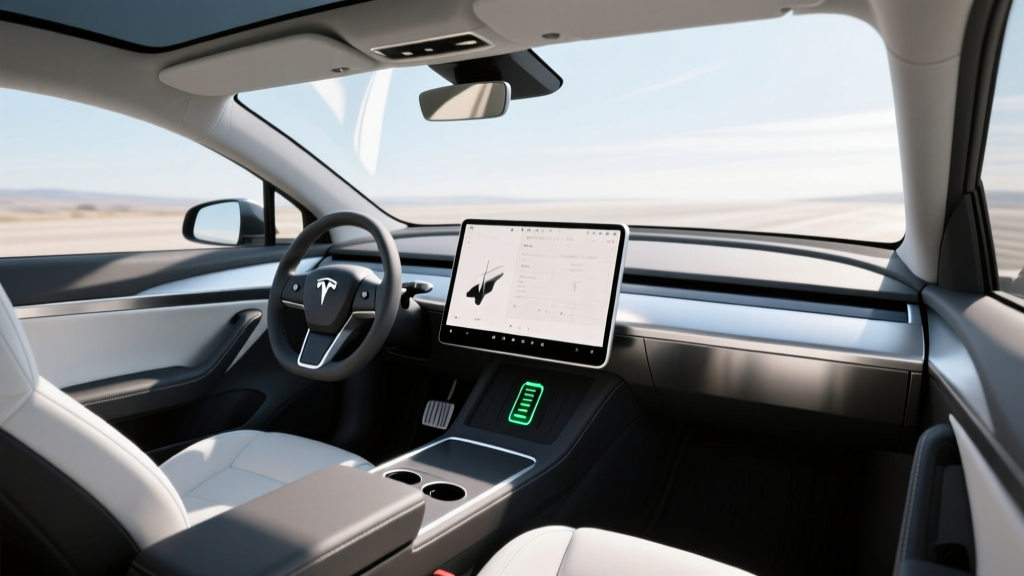
The keyword search "tesla cybertruck inside" reflects genuine curiosity about what this truck is actually like to live with. The cabin is unmistakably Tesla—minimalist, screen-centric, and devoid of traditional buttons.
Infotainment and Controls
A single 18.5-inch touchscreen dominates the dash, handling everything from climate controls and glovebox release to media and vehicle settings. There is no instrument cluster; all driving information appears on the central screen. A rear 9.4-inch touchscreen serves second-row passengers for climate and entertainment. The steering yoke (standard on Cyberbeast, optional on AWD) takes adaptation—there's no round-wheel option, and low-speed parking maneuvers require more hand-over-hand rotation than a traditional wheel.
Tesla's infotainment remains among the fastest and most responsive in the industry, with integrated navigation, streaming, and over-the-air updates that continuously add features. However, the lack of physical climate knobs or volume buttons is a friction point for some drivers, especially when wearing work gloves.
Driver Assistance: Autopilot and FSD (Supervised)
The Cybertruck ships with Tesla's Autopilot (adaptive cruise control and lane-keeping) and offers Full Self-Driving (Supervised) as an $8,000 add-on or $99/month subscription. FSD (Supervised) handles highway lane changes, on/off-ramp navigation, and city-street driving with active steering and braking.
Interior Space and Cargo
- Front headroom: 41.0 in | Front legroom: 41.8 in
- Rear headroom: 38.5 in | Rear legroom: 38.0 in
- Bed length: 6 ft (72 in) with tailgate closed; 8 ft with tailgate down
- Bed volume: ~67 cu ft (tailgate up)
- Front trunk (frunk): ~7.1 cu ft — useful for charging cables and small gear
- Vault (under-bed storage): Lockable, weather-sealed compartment behind rear axle
Second-row seats fold flat to extend interior cargo length. The powered tonneau cover is a standout—it's rated to support up to 300 lbs of distributed weight and seals the bed from weather. However, the tonneau's motorized operation is slower than a manual cover, and the angular bed walls limit the width available for flat sheet goods like plywood (a 4×8 sheet does not lay flat between the wheel wells).
Pricing, Trims, and Federal Tax Credit Eligibility
| Trim | Base MSRP | Federal §30D Credit | Effective Price (if eligible) |
|---|---|---|---|
| AWD (Dual Motor) | $79,990 | Up to $7,500 | ~$72,490 |
| Cyberbeast (Tri Motor) | $99,990 | Up to $7,500 | ~$92,490 |
The Cybertruck's pricing places it firmly in the premium truck segment. Both trims exceed the IRS §30D MSRP cap of $80,000 for pickup trucks—but here's the nuance: the AWD trim at $79,990 sits just under the cap, making it potentially eligible for the full $7,500 credit, while the Cyberbeast at $99,990 exceeds it and does not qualify for the new-vehicle credit.
- MSRP Cap (trucks): ≤ $80,000 — AWD qualifies; Cyberbeast does not
- Buyer Income Cap: AGI ≤ $150,000 (single) / $300,000 (joint)
- Battery Sourcing: Critical minerals and battery components must meet phased-in domestic/free-trade sourcing thresholds (verify current-year percentages on irs.gov)
- Point-of-Sale Transfer: Eligible buyers can transfer the credit to the dealer for an upfront price reduction
- Assembly: Must be assembled in North America (Cybertruck is built in Austin, TX — qualifies)
Eligibility is not guaranteed. Battery component and critical mineral sourcing rules tighten annually, and a vehicle that qualifies in January may lose eligibility if supply chains shift. Always verify on fueleconomy.gov before purchasing. Consult a tax professional for your specific situation.
How Does the Cybertruck Compare to Rivals?
The Cybertruck competes in a growing electric pickup segment. Here's how it stacks up against the Ford F-150 Lightning and Rivian R1T on the metrics that matter most:
| Metric | Tesla Cybertruck AWD | Ford F-150 Lightning (Ext. Range) | Rivian R1T (Dual Max) |
|---|---|---|---|
| EPA Range | 340 mi | 320 mi | 410 mi |
| Max DCFC | 350 kW | 150 kW | 220 kW |
| 10–80% Time | ~15 min | ~41 min | ~27 min |
| 0–60 mph | 4.1 sec | 3.8 sec | 3.5 sec |
| Towing | 11,000 lbs | 10,000 lbs | 11,000 lbs |
| Bed Length | 6 ft | 5.5 ft | 4.5 ft (+ Gear Tunnel) |
| Base MSRP | $79,990 | ~$77,495 | $89,900 |
The Cybertruck's clear advantage is DC fast charging—its 350 kW capability crushes the Lightning's 150 kW ceiling and significantly outpaces the R1T. On long road trips, that 15-minute 10–80% stop vs. a 40-minute stop is a meaningful difference. However, the Rivian R1T's 410-mile Max Pack range and the F-150 Lightning's more conventional truck ergonomics (round steering wheel, physical controls, larger bed) appeal to buyers who prioritize familiarity and maximum distance per charge.
Pros, Cons, and Who Should Buy
- Class-leading 350 kW DC fast charging
- 845 hp Cyberbeast performance is extraordinary for a truck
- Stainless-steel body resists dents and scratches
- Powered tonneau cover and sealed Vault storage
- OTA updates continuously improve functionality
- 11,000-lb towing capacity matches gas heavy-duty half-tons
- Heavy curb weight hurts real-world highway efficiency
- Yoke steering requires adaptation; no round-wheel option
- Bed width between wheel wells won't fit flat 4×8 sheets
- No physical climate or volume controls
- Cyberbeast exceeds §30D MSRP cap—no federal credit
- Polarizing styling limits resale predictability
- Choose the Cybertruck AWD if: You want the fastest-charging electric pickup, tow regularly, and your AGI qualifies for the §30D credit on a sub-$80k truck.
- Choose the Cyberbeast if: Performance is the priority, budget is flexible, and you accept the loss of the federal credit.
- Look elsewhere if: You need a conventional truck bed for construction materials, prefer physical controls, or need maximum range over charging speed (consider the Rivian R1T Max Pack).
Frequently Asked Questions
What is the real-world range of the Tesla Cybertruck?
EPA estimates are 340 miles (AWD) and 320 miles (Cyberbeast). In real-world highway driving at 70+ mph, expect roughly 260–290 miles. Cold weather below freezing can drop that to 220–250 miles. City driving with regenerative braking recovers more energy, yielding closer to 300+ miles in mild conditions.
How fast does the Cybertruck charge?
On a 350 kW DC fast charger with battery preconditioning, the Cybertruck achieves 10–80% in approximately 15 minutes. Peak power is sustained between roughly 10–40% SoC, then tapers. At home on Level 2 (11.5 kW), it recovers about 44 miles of range per hour, with a full charge taking around 11 hours.
Does the Cybertruck qualify for the federal EV tax credit?
The AWD trim at $79,990 MSRP falls under the $80,000 truck cap and may qualify for up to $7,500 under IRS §30D, subject to buyer income limits (≤$150k single / ≤$300k joint), battery sourcing requirements, and North American assembly (Cybertruck is built in Austin, TX). The Cyberbeast at $99,990 exceeds the MSRP cap and does not qualify. Always verify current eligibility on irs.gov and consult a tax professional.
Is the Cybertruck worth buying vs. the F-150 Lightning or Rivian R1T?
It depends on priorities. The Cybertruck wins on DC fast charging speed (350 kW vs. 150–220 kW for rivals) and has a competitive 11,000-lb tow rating. The F-150 Lightning offers a more traditional truck experience with physical controls and a wider bed. The Rivian R1T provides the longest available range (410 mi with Max Pack) and innovative Gear Tunnel storage. If fast charging and performance are paramount, the Cybertruck leads; if range or conventional ergonomics matter more, consider the alternatives.
What is the Cybertruck's battery warranty?
Tesla covers the battery and drive units for 8 years or 120,000 miles, whichever comes first, with a minimum 70% capacity retention threshold. This is competitive with the segment and provides meaningful long-term protection against degradation.
Can the Cybertruck tow a camper or boat?
Yes—both trims are rated for 11,000 lbs of towing. However, towing significantly impacts range. Expect a 40–50% range reduction when towing near maximum capacity at highway speeds, bringing effective range to roughly 170–200 miles between charges. Plan routes around Supercharger availability accordingly.