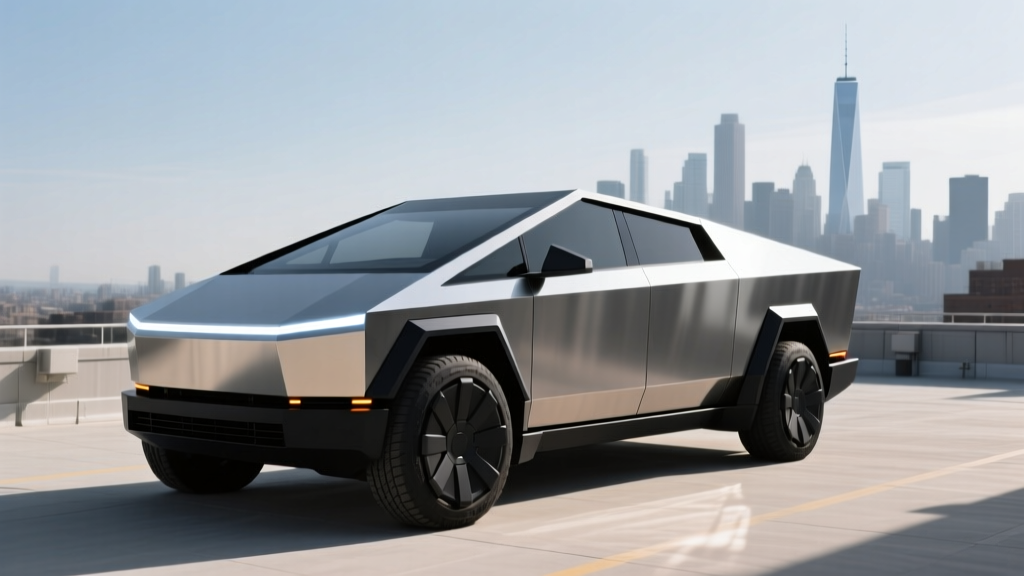
The Tesla Cybertruck entered production in late 2023 with bold promises: a stainless-steel exoskeleton, 800V architecture, and pricing that would undercut legacy pickups. Two model years later, the reality is more nuanced — and for buyers researching Tesla Cybertruck incentives, the picture is particularly complicated. The Cybertruck's MSRP, battery-sourcing rules, and vehicle-classification quirks all affect whether you'll see a federal tax credit at the point of sale or owe it back at tax time.
This review covers the 2026 Tesla Cybertruck lineup with exact numbers: EPA range, charging curves, real-world efficiency, cargo geometry, and a deep dive into which trims (if any) qualify for the IRS §30D clean vehicle credit. We'll also compare it head-to-head with the Rivian R1T and Chevrolet Silverado EV to help you decide whether the Cybertruck's incentives — or lack thereof — should drive your purchase.
2026 Tesla Cybertruck Trim Lineup and Pricing
Tesla simplified the Cybertruck lineup for 2026 after retiring the original "Foundation Series" bundling strategy. Three trims remain, all built on the same 48-volt electrical architecture and stainless-steel body:
| Trim | Drivetrain | MSRP | EPA Range | 0–60 mph |
|---|---|---|---|---|
| Long Range AWD | Dual Motor AWD | $79,990 | 340 mi | 4.1 s |
| All-Wheel Drive | Dual Motor AWD | $99,990 | 320 mi | 3.9 s |
| Cyberbeast | Tri-Motor AWD | $114,990 | 300 mi | 2.6 s |
All prices include destination. The Long Range AWD, introduced in late 2024, remains the volume leader and the most relevant trim for incentive analysis. Tesla no longer offers the rear-wheel-drive $60,990 variant originally announced — that configuration was quietly canceled before deliveries began.
Federal Tax Credit: Does the Cybertruck Qualify?
This is where most incentive searches hit a wall. Under current IRS §30D rules, the Cybertruck's eligibility depends on three moving targets: MSRP caps, buyer income limits, and battery-component/critical-mineral sourcing requirements that tighten annually through 2032.
- Vehicle MSRP cap: $80,000 for trucks/vans/SUVs — the Long Range AWD at $79,990 barely clears this; AWD and Cyberbeast do NOT qualify on price alone.
- Buyler AGI cap: $150k single / $225k HOH / $300k joint filers.
- Battery components: Must be manufactured or assembled in North America (phased thresholds increase yearly).
- Critical minerals: Must be sourced from the U.S. or FTA partners (separate phase-in schedule).
- Point-of-sale transfer: Eligible buyers can apply the credit at purchase, reducing out-of-pocket cost immediately.
- FEOC restriction: Vehicles with battery components from a "foreign entity of concern" (e.g., certain Chinese suppliers) are disqualified entirely.
The bottom line for 2026: The Long Range AWD at $79,990 is the only Cybertruck trim that can theoretically qualify, and only if Tesla's battery supply chain meets that year's critical-mineral and component thresholds — which Tesla does not publicly disclose by trim. Buyers should request a written eligibility confirmation from Tesla at order time and cross-check the fueleconomy.gov credit lookup before signing. Assume the $99,990 and $114,990 trims receive no federal credit.
Real-World Range: EPA vs. What You'll Actually See
| Trim | EPA | 70-mph Highway | Cold Weather (32°F) |
|---|---|---|---|
| Long Range AWD | 340 mi | ~270–290 mi | ~220–250 mi |
| AWD | 320 mi | ~255–275 mi | ~210–235 mi |
| Cyberbeast | 300 mi | ~235–255 mi | ~190–215 mi |
Highway and cold-weather estimates based on independent testing of large-format BEV trucks; cold figures assume no preconditioning and cabin heat active.
The Cybertruck's angular slab sides and ~6,600-lb curb weight work against highway efficiency. Expect 15–20% range loss at sustained 75–80 mph compared to the EPA sticker, and an additional 15–25% drop in sub-freezing temperatures without preconditioning. The tri-motor Cyberbeast loses the most range because its third motor adds mass and parasitic drag even when decoupled.
Efficiency lands around 54–58 MPGe combined (roughly 58–62 kWh/100 mi), placing the Cybertruck behind the Rivian R1T Dual-Motor (~65 MPGe) and far behind the Silverado EV 4WT (~70+ MPGe). If you commute in stop-and-go traffic where regen braking recovers energy, real-world numbers improve — but highway road trips will require more stops than the EPA sticker suggests.
Battery, Chemistry, and the 800V Architecture
Tesla does not publish usable kWh figures for the Cybertruck, but teardown analysis and EPA efficiency math point to a ~123 kWh usable pack in the Long Range and AWD trims, with the Cyberbeast likely using a slightly higher-output variant of the same 4680-cell architecture. The cells are Tesla's in-house dry-cathode 4680s in a structural battery pack that doubles as a stressed chassis member.
Chemistry is NMC (nickel-manganese-cobalt), chosen for energy density over the LFP chemistry Tesla uses in the Model 3/Y RWD. That means:
- Higher energy density (more range per pound) but a lower cycle-life ceiling than LFP.
- Tesla recommends charging to 80% for daily use and 100% only before long trips.
- The 800V pack architecture enables the fast-charge speeds below but requires Tesla's V4 Supercharger hardware to fully exploit.
Charging Speed: DC Fast, Level 2, and the Curve Reality
| Charger Type | Peak Power | 10–80% Time | Miles Added |
|---|---|---|---|
| Tesla V4 Supercharger | ~325 kW (peak) | ~22–26 min | ~150 mi in 15 min (ideal) |
| Non-Tesla 350 kW CCS/NACS | ~250 kW (sustained) | ~28–34 min | ~120 mi in 15 min |
| Home Level 2 (48A / 11.5 kW) | 11.5 kW | N/A (overnight) | ~35 mi/hr of charging |
| Level 1 (120V / 12A) | 1.4 kW | Multi-day | ~4 mi/hr |
The 800V architecture lets the Cybertruck accept higher peak power than 400V rivals, but the charge curve tapers sharply above 60% SoC — typical of NMC packs pushed hard. Expect the 325 kW peak to hold only through roughly 25–30% SoC before stepping down. On a road trip, plan stops around the 20–80% window; charging from 80–100% can take as long as 10–80%.
At home, the Cybertruck ships with a Mobile Connector but most buyers install a Tesla Wall Connector on a 60A circuit for 48A continuous delivery. That's roughly 35 miles of range per hour — enough to fully replenish any trim overnight. A 200A panel is usually sufficient, but homes with older 100A service may need a $1,500–$3,000 panel upgrade.
Performance, Towing, and Practicality
Even the base Long Range AWD hits 60 mph in 4.1 seconds with 600 hp — genuinely quick for a truck that weighs over three tons. The Cyberbeast's 845 hp and 2.6-second 0–60 time are supercar territory, though the 130-mph top speed reminds you this is still a heavy pickup.
Towing maxes out at 11,000 lbs on AWD and Cyberbeast trims (the Long Range AWD is rated slightly lower at 7,500 lbs in some configurations — verify by VIN). Payload capacity is ~2,500 lbs, and the 6.5-foot composite bed includes a powered tonneau, 120V/240V bed outlets, and a tailgate ramp.
Interior room is genuinely spacious: 41.4 inches of front legroom and 38.2 inches rear, with a flat floor thanks to the skateboard platform. The 18.5-inch center touchscreen handles nearly all vehicle controls — no physical stalks, no instrument cluster — which some buyers love and others find distracting. The yoke steering wheel is standard; a round wheel is a no-cost option.
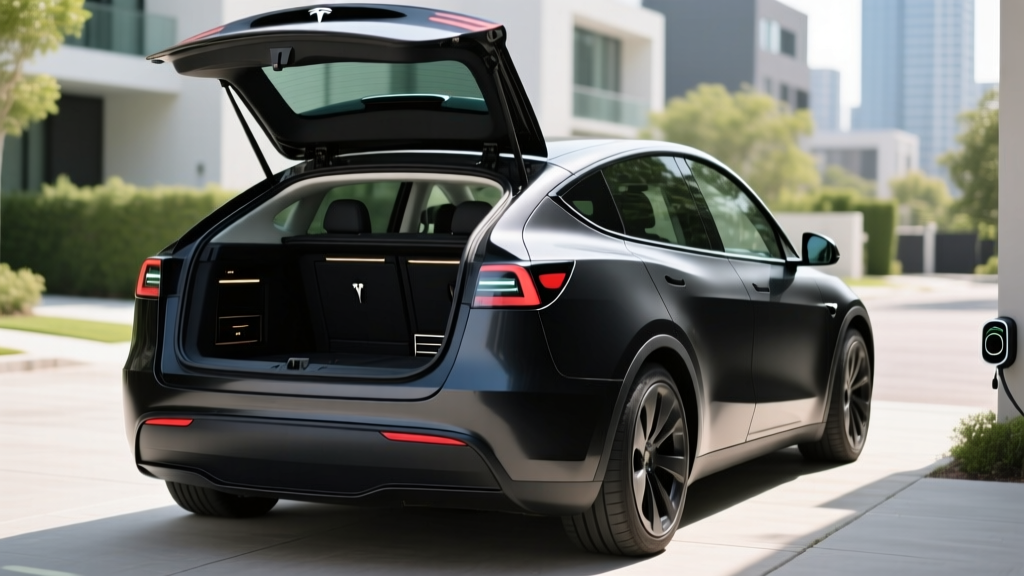
Cargo volume behind the rear seats is ~34 cu ft with the tonneau closed, plus a modest front trunk (frunk) suitable for charging cables and a soft bag. The powered sail-panel bed cover is a standout feature but eliminates traditional bed racks without aftermarket adapters.
Driver Assistance: Autopilot and FSD Supervised
Autopilot and Full Self-Driving (Supervised) are driver-assist systems. The driver must remain attentive, hands on the wheel (or torque-applied with the yoke), and ready to take over at any moment. This is not autonomous driving. Only Level 4 robotaxi services (Waymo, Zoox in mapped zones) operate without a human driver.
Standard Autopilot includes adaptive cruise and lane-centering on highways. FSD (Supervised), currently a $8,000 one-time purchase or $99/month subscription, adds city-street navigation, stop-sign/light recognition, and lane changes — but 2026 FSD still requires active supervision and has drawn NHTSA scrutiny for its crash-rate data in low-light and construction-zone scenarios.
Warranty, Ownership Costs, and Depreciation
Tesla covers the Cybertruck with a 4-year/50,000-mile basic warranty and an 8-year/120,000-mile battery and drive-unit warranty guaranteeing at least 70% capacity retention over that period. That battery warranty is competitive with Rivian (8/175k) and better than Ford's F-150 Lightning baseline, though Rivian's higher mileage cap matters for high-use owners.
Insurance is the hidden cost. Cybertruck premiums run 40–70% higher than a comparably priced F-150 Lightning due to stainless-steel repair complexity, parts cost, and early claim data. Get a quote before ordering — many buyers are surprised by a $3,500–$5,000/year premium in urban markets.
Depreciation remains a wildcard. Early Cybertrucks commanded markups; by late 2025, used examples were selling below MSRP in many markets. Expect steeper-than-average depreciation compared to a Rivian R1T, which has stronger brand loyalty and a more established owner community.
Cybertruck vs. R1T vs. Silverado EV: Incentive-Aware Comparison
| Metric | Tesla Cybertruck LR AWD | Rivian R1T Dual-Motor | Silverado EV 4WT |
|---|---|---|---|
| MSRP | $79,990 | $75,900 | $78,900 |
| EPA Range | 340 mi | 352 mi (Max Pack) | 385 mi |
| §30D Eligible | Trim-dependent | Yes (most trims) | No (MSRP/class rules) |
| Efficiency | ~56 MPGe | ~65 MPGe | ~70 MPGe |
| 10–80% DC | ~24 min | ~28 min | ~32 min |
| Towing | 7,500–11,000 lbs | 11,000 lbs | 10,000 lbs |
| Battery Warranty | 8 yr / 120k mi | 8 yr / 175k mi | 8 yr / 100k mi |
Choose the Rivian R1T if: you want broader federal-credit eligibility, a more conventional pickup layout with the Gear Tunnel, and a longer battery-warranty mileage cap.
Choose the Silverado EV if: maximum EPA range (385–440 mi) and GM's Ultium platform reliability matter more than charging speed — and you're not counting on a federal credit.
Pros, Cons, and the Final Verdict
Pros
- Class-leading DC fast-charge peak (325 kW on V4)
- Long Range AWD trim squeezes under the $80k §30D MSRP cap
- 800V architecture and 48V electrical system are genuinely advanced
- Access to the 55,000+ Tesla Supercharger network
- Cyberbeast performance is unmatched in any production pickup
- Stainless-steel body requires no paint and resists minor dents
Cons
- Only one of three trims may qualify for the federal credit
- Highway range falls 15–20% below EPA due to aerodynamics
- Insurance premiums 40–70% higher than comparable electric trucks
- No physical stalks or buttons — steep learning curve for some
- Powered tonneau limits aftermarket bed accessories
- Resale value has softened significantly since 2024 launch hype
Frequently Asked Questions
Does the 2026 Tesla Cybertruck qualify for the $7,500 federal tax credit?
Only the Long Range AWD trim at $79,990 clears the $80,000 truck MSRP cap. Even then, eligibility depends on the buyer's AGI and Tesla's battery-sourcing compliance with 2026 critical-mineral thresholds. Confirm with Tesla and fueleconomy.gov before ordering.
What is the real-world highway range of the Cybertruck?
Expect roughly 270–290 highway miles from the Long Range AWD at 70 mph in mild weather, dropping to 220–250 miles in freezing temperatures. The Cyberbeast's real-world highway range is closer to 235–255 miles.
How fast does the Cybertruck charge at home?
On a 48A Level 2 Wall Connector, the Cybertruck adds about 35 miles of range per hour — a full overnight charge for any trim. Level 1 (120V) adds roughly 4 miles per hour and is only practical as a trickle top-off.
Is the Cybertruck worth buying over the Rivian R1T?
If charging speed and Supercharger access are your priorities, yes. If you want broader tax-credit eligibility, a longer battery-warranty mileage cap, and a more conventional pickup layout, the R1T is the safer buy.
Can I transfer the federal tax credit to the dealer at purchase?
Yes — §30D allows point-of-sale transfer for eligible buyers, reducing the purchase price by up to $7,500 at signing. You must attest to income eligibility at transfer, and if your actual AGI exceeds the cap at tax time, you'll repay the credit.
Does the Cybertruck qualify for any state incentives?
State incentives vary widely and change frequently. California's CVRP, Colorado's innovative motor vehicle credit, and New York's Drive Clean Rebate have all treated the Cybertruck differently based on MSRP and classification. Check your state's energy-office website for current rules.