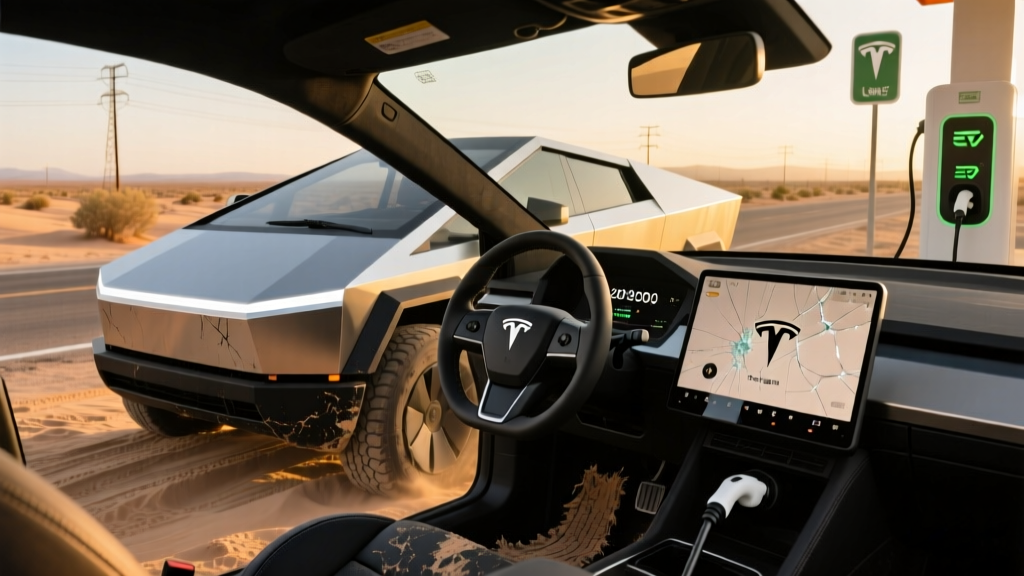
The Tesla Cybertruck was marketed as an indestructible workhorse — a stainless-steel electric pickup built for job sites, towing, and heavy hauling. But as early commercial fleet owners rack up serious miles, the reality of high-mileage EV ownership is surfacing. Recently, reports have emerged of a Tesla Cybertruck owner facing major expense after high-mileage commercial use, spotlighting the gap between warranty coverage and the real-world cost of maintaining a heavy electric truck under punishing duty cycles.
This isn't a reason to panic about EVs. It's a reason to understand them. Below, we break down the Cybertruck's full spec sheet, ownership economics, battery longevity data, and what commercial buyers — and private owners pushing their trucks hard — need to budget for once the warranty clock runs out.
2026 Tesla Cybertruck: Full Spec Overview
Before addressing the high-mileage expense issue, here's the complete picture of what you're buying. The 2026 Cybertruck lineup includes the Long Range AWD, the tri-motor Cyberbeast, and the fleet-oriented rear-wheel-drive model reintroduced for commercial buyers.
| Spec | Long Range AWD | Cyberbeast (Tri-Motor) | RWD (Fleet) |
|---|---|---|---|
| Base MSRP | $79,990 | $99,990 | $60,990 |
| EPA Est. Range | 340 mi | 320 mi | 250 mi |
| Battery Capacity | ~123 kWh usable (NMC) | ~123 kWh usable (NMC) | ~90 kWh usable (NMC) |
| Drivetrain | Dual-Motor AWD | Tri-Motor AWD | Rear-Wheel Drive |
| Horsepower | 600 hp | 845 hp | 315 hp |
| 0–60 mph | 4.1 sec | 2.6 sec | 6.5 sec |
| Max DC Fast Charge | 250 kW (V3 Supercharger) | 250 kW | 250 kW |
| 10–80% DC Time | ~30 min | ~30 min | ~22 min |
| Level 2 Rate (11.5 kW) | ~37 mi/hr | ~37 mi/hr | ~30 mi/hr |
| MPGe (Combined) | 65 MPGe | 58 MPGe | 75 MPGe |
| kWh/100 mi | 52 | 58 | 45 |
| Towing Capacity | 11,000 lbs | 11,000 lbs | 7,500 lbs |
| Payload | 2,500 lbs | 2,500 lbs | 2,500 lbs |
| Cargo Bed Length | 6 ft (72 in) | 6 ft (72 in) | 6 ft (72 in) |
| Cargo Volume (Bed) | ~67 cu ft | ~67 cu ft | ~67 cu ft |
| Frunk Volume | ~7 cu ft | ~7 cu ft | ~7 cu ft |
| Battery Warranty | 8 yr / 120,000 mi | 8 yr / 120,000 mi | 8 yr / 120,000 mi |
| Powertrain Warranty | 8 yr / 120,000 mi | 8 yr / 120,000 mi | 8 yr / 120,000 mi |
Real-World Range: The Sticker vs. The Job Site
The EPA posts one number. Commercial fleet operators see another. For the Long Range AWD, the EPA rates the Cybertruck at 340 miles. But that figure assumes a mixed driving cycle with moderate temperatures and no payload.
EPA Estimate: 340 miles (Long Range AWD)
Highway (70 mph, no payload): ~260–285 miles
Highway + 5,000-lb trailer: ~150–180 miles
Cold weather (below 32°F, highway): ~220–250 miles
Combined real-world expectation: ~250–290 miles for typical mixed use without towing
The Cybertruck's angular stainless-steel body has a drag coefficient of approximately 0.39 Cd — worse than the Ford F-150 Lightning (~0.36 Cd) and significantly worse than the Rivian R1T. That boxy shape punishes you at highway speeds and especially when towing. Fleet operators running highway routes with loaded beds or trailers are seeing energy consumption climb to 70–85 kWh/100 mi, cutting effective range roughly in half from the EPA sticker.
According to data compiled by fueleconomy.gov, the Cyberbeast variant drops to 58 MPGe combined, making it one of the least efficient EVs on the market. For commercial users billing by the route, that efficiency gap translates directly into more charging stops and higher electricity costs per mile.
Charging Speed: Can the Cybertruck Keep Up on a Work Schedule?
Charging speed matters more for commercial fleets than for any other buyer segment. A truck sitting at a charger is a truck not earning revenue.
| Charging Level | Power (kW) | Miles Added/Hour | Notes |
|---|---|---|---|
| Level 1 (120V) | 1.4 kW | ~3–4 mi/hr | Emergency/trickle only |
| Level 2 (240V, 48A) | 11.5 kW | ~30–37 mi/hr | Full overnight charge in ~10–12 hrs |
| DC Fast (V3 Supercharger) | 250 kW peak | ~190 mi in 15 min | 10–80% in ~30 min; tapers sharply above 80% |
| DC Fast (V4 Supercharger) | Up to 250 kW | Similar to V3 | CCS-compatible via NACS adapter |
The Cybertruck uses Tesla's NACS connector natively, giving it access to the full Supercharger network — currently over 6,000 stations and 60,000+ stalls in North America. That's a genuine commercial advantage: no adapter needed, and Tesla's network reliability consistently outperforms third-party CCS networks in uptime surveys.
However, the 250 kW peak charge rate is not sustained. Like all EVs, the Cybertruck follows a charge curve that tapers significantly above 60% state of charge. Expect roughly 190 miles added in the first 15 minutes, then a steep decline. For fleet operators, this means planning 25–35 minute charging stops at 20–30% SoC for maximum throughput — not charging to 100% at public stations.
At a depot with Level 2 (11.5 kW) chargers, a full overnight charge takes roughly 10–12 hours for the Long Range model. This is workable for fleet return-to-base operations but requires dedicated 60-amp circuits per charger. Commercial installations typically run $3,000–$8,000 per Level 2 stall including panel upgrades, trenching, and permitting.
The High-Mileage Expense: What Actually Breaks and What It Costs
So what happens when a Cybertruck crosses 100,000 miles under commercial use? The recent reports of major expenses center on three areas:
1. Battery Degradation Under Heavy Cycling
The Cybertruck uses NMC (nickel manganese cobalt) battery chemistry, which offers high energy density but is more susceptible to calendar and cycle degradation than LFP (lithium iron phosphate). Under commercial conditions — frequent DC fast charging, deep discharge cycles, heavy loads, and heat — NMC packs typically lose 10–18% capacity over the first 100,000 miles.
Tesla's battery warranty covers the pack for 8 years or 120,000 miles, retaining at least 70% of original capacity. If degradation drops below that threshold within the warranty window, Tesla replaces or refurbishes the pack at no cost. But commercial trucks covering 40,000–60,000 miles per year blow through 120,000 miles in 2–3 years, well before the 8-year time limit.
Once out of warranty, an out-of-pocket battery replacement for the Cybertruck's ~123 kWh pack is estimated at $18,000–$28,000 based on current Tesla service pricing for large packs and third-party analysis. That's the "major expense" that has commercial operators recalculating their total cost of ownership.
2. Drive Unit and Suspension Wear
The Cybertruck's steer-by-wire system and 48-volt architecture are engineering firsts in a production truck — impressive, but with limited long-term reliability data. Early reports from high-mileage owners note:
- Steer-by-wire actuator replacements: $2,500–$4,000 per unit (two actuators)
- Air suspension compressor and strut wear: $1,800–$3,500 per corner for adaptive air suspension models
- Drive unit (motor) replacement: $5,000–$8,000 per unit; Cyberbeast has three
- Stainless steel panel dent repair: Traditional body shops can't work cold-rolled stainless; Tesla-certified repairs run $800–$2,500 per panel
3. Tire Costs
The Cybertruck's weight (~6,600–6,800 lbs curb) and instant torque chew through tires faster than ICE trucks. Commercial operators report needing new tires every 20,000–30,000 miles — roughly twice as often as a comparable gas truck. At $350–$500 per tire for the specialized 35-inch all-terrain sizes, that's $1,400–$2,000 per set, or $5,600–$8,000 over 100,000 miles.
Federal Tax Credit and Purchase Economics
Under the current IRS §30D Clean Vehicle Credit rules, the Cybertruck's tax credit eligibility is complicated:
- MSRP Cap: Trucks/vans/SUVs must have an MSRP at or below $80,000 to qualify. The RWD Fleet ($60,990) and Long Range AWD ($79,990) meet this threshold. The Cyberbeast ($99,990) does not qualify.
- Buyer Income Cap: Modified AGI must not exceed $150,000 (single), $225,000 (head of household), or $300,000 (joint).
- Battery Sourcing: Critical minerals and battery components must meet phased-in domestic-sourcing percentages. Tesla sources some materials domestically, but the exact credit amount ($3,750 or $7,500) depends on current-year sourcing compliance. Check the IRS qualified vehicle list before purchasing.
- Point-of-Sale Transfer: Eligible buyers can transfer the credit to the dealer at purchase, reducing the out-of-pocket price directly.
- Commercial Clean Vehicle Credit (§45W): Businesses that purchase the Cybertruck for commercial use may qualify for up to $7,500 (under 14,000 lbs GVWR) under the separate §45W credit, which has different sourcing rules and no income cap. Consult a tax professional.
| Trim | Base MSRP | Max §30D Credit | Est. After Credit | Qualifies? |
|---|---|---|---|---|
| RWD (Fleet) | $60,990 | Up to $7,500 | ~$53,490 | Yes (under $80K cap) |
| Long Range AWD | $79,990 | Up to $7,500 | ~$72,490 | Yes (at $80K cap limit) |
| Cyberbeast | $99,990 | $0 | $99,990 | No (exceeds MSRP cap) |
Cybertruck vs. F-150 Lightning vs. Rivian R1T: Commercial Fleet Comparison
The Cybertruck doesn't exist in a vacuum. Commercial buyers cross-shop it against two proven alternatives:
| Attribute | Tesla Cybertruck LR AWD | Ford F-150 Lightning Ext. Range | Rivian R1T Dual-Motor Max |
|---|---|---|---|
| EPA Range | 340 mi | 320 mi | 352 mi |
| Battery (kWh) | ~123 (NMC) | ~131 (NMC) | ~141 (NMC) |
| Max Tow | 11,000 lbs | 10,000 lbs | 11,000 lbs |
| Max DC Charge | 250 kW | 150 kW | 200 kW |
| 10–80% Time | ~30 min | ~41 min | ~35 min |
| Bed Length | 6 ft | 5.5 ft | 4.5 ft (w/ tunnel) |
| Fleet Service Network | Tesla Service Centers | Ford Commercial Dealers | Rivian Service + Mobile |
| Starting MSRP | $79,990 | $76,995 | $87,000 |
| Battery Warranty | 8 yr / 120,000 mi | 8 yr / 100,000 mi | 8 yr / 120,000 mi |
Where the Cybertruck wins: Fastest DC charging (250 kW peak), longest bed (6 ft), lowest starting price for the AWD tier, and Supercharger network access. For fleet operators running highway corridors with Supercharger coverage, the charging advantage is real.
Where it loses: The Ford F-150 Lightning benefits from an established commercial dealer network with fleet service agreements, upfitter familiarity, and Pro Power Onboard for job-site power. The Rivian R1T offers more range and a more refined ride but at a higher price and with a smaller service footprint. Neither competitor has the Cybertruck's stainless-steel repair complications.
Interior, Tech, and Driver Assistance
The Cybertruck's cabin is minimalism taken to an extreme. A single 18.5-inch touchscreen dominates the dash, controlling everything from climate to glove-box release. Rear passengers get a 9.4-inch touchscreen. There are no physical buttons, no instrument cluster, and no traditional stalks — turn signals are on the yoke-style steering wheel.
Notable tech features:
- Autopilot (standard): SAE Level 2 driver assistance with adaptive cruise and lane centering. The driver must remain engaged at all times — this is not self-driving.
- Full Self-Driving Supervised ($8,000 option): Enhanced Level 2 system with intersection handling and lane-change automation. Still requires active supervision. Tesla has not achieved Level 3 or Level 4 in any consumer vehicle.
- 48-volt electrical architecture: Reduces wiring harness weight and enables higher-power accessories.
- Steer-by-wire: Variable steering ratio — fewer turns lock-to-lock at low speeds, more stability at highway speed. Impressive but unproven at high mileages.
- Powershare (V2L/V2H): Up to 11.5 kW of bi-directional power output — enough to run job-site tools or back up a home during outages.
Notable drawbacks:
- Yoke steering is polarizing and complicates low-speed maneuvering for some drivers.
- Rear visibility is poor; the truck relies heavily on camera feeds.
- Build quality inconsistencies (panel gaps, trim alignment) persist on some units.
- Bed access requires the powered tonneau cover — if it fails, bed access is blocked.
Who Should Buy the Cybertruck — and Who Shouldn't?
- You need a 6-foot bed and 11,000-lb towing on a Supercharger-routed corridor.
- You value V2L job-site power (11.5 kW Powershare) over traditional generator setups.
- Your fleet returns to base nightly for Level 2 charging and runs under 120,000 miles within the warranty window.
- You want the fastest DC charging in the electric truck segment.
- Your fleet exceeds 120,000 miles within 2–3 years — the out-of-warranty battery cost is a serious financial risk.
- You need an established commercial dealer service network with fleet agreements (Ford Pro is stronger here).
- You frequently tow heavy loads over long distances — real-world range drops to ~150–180 miles under load, requiring frequent charging stops.
- Body repair access matters — stainless steel panels require Tesla-certified shops, limiting rural or independent repair options.
Frequently Asked Questions
What is the real-world range of the Tesla Cybertruck?
The EPA rates the Long Range AWD at 340 miles, but expect 250–290 miles in mixed real-world driving without a trailer. Highway driving at 70 mph drops range to roughly 260–285 miles. Add a loaded trailer and effective range falls to 150–180 miles. Cold weather (below freezing) shaves another 15–25% off highway range.
How fast does the Cybertruck charge?
On a Tesla V3 Supercharger (250 kW peak), the Cybertruck charges from 10–80% in approximately 30 minutes, adding roughly 190 miles in the first 15 minutes. At home on a Level 2 (11.5 kW) charger, expect about 37 miles of range per hour, or a full overnight charge in 10–12 hours for the Long Range model.
Does the Cybertruck qualify for the federal EV tax credit?
The RWD Fleet ($60,990) and Long Range AWD ($79,990) are under the $80,000 MSRP cap and may qualify for up to $7,500 under IRS §30D, subject to buyer income limits and battery-sourcing requirements. The Cyberbeast ($99,990) does not qualify. Businesses may alternatively claim the §45W Commercial Clean Vehicle Credit. Always verify current eligibility on irs.gov before purchasing.
Is the Cybertruck worth buying versus the F-150 Lightning or Rivian R1T?
For commercial buyers on Supercharger-covered routes who need a long bed and fast DC charging, the Cybertruck is competitive. But the F-150 Lightning offers a more established fleet service network and Pro Power Onboard, while the Rivian R1T provides more range. If your trucks exceed warranty mileage quickly, the F-150 Lightning's broader dealer support may reduce long-term risk.
What are the biggest pros and cons of the Cybertruck for commercial use?
Pros: 250 kW DC fast charging, 6-foot bed, 11,000-lb towing, 11.5 kW V2L Powershare, Supercharger network, competitive starting price. Cons: Poor real-world range when towing, stainless-steel body complicates repairs, steer-by-wire long-term reliability unknown, high tire wear, battery replacement cost of $18K–$28K out of warranty, limited third-party service options.
How much does a battery replacement cost on the Cybertruck?
Based on current Tesla service pricing for large NMC packs, an out-of-warranty battery replacement for the Cybertruck's ~123 kWh pack is estimated at $18,000–$28,000. This is the primary financial risk for commercial operators exceeding 120,000 miles within the first 2–3 years. Tesla's warranty covers the pack for 8 years or 120,000 miles at 70% minimum capacity retention.
What battery chemistry does the Cybertruck use?
The Cybertruck uses NMC (nickel manganese cobalt) chemistry across all trims. NMC offers higher energy density than LFP, which is necessary for a heavy truck with a large pack, but it degrades faster under high-heat, high-cycle, and frequent fast-charging conditions. Tesla does not currently offer an LFP option for the Cybertruck.
Sources: EPA fuel economy data via fueleconomy.gov, Tesla official specifications, IRS §30D guidance via irs.gov. All pricing and specifications reflect 2026 model year data as of publication. Tax credit eligibility is subject to change; consult a tax professional for your specific situation.