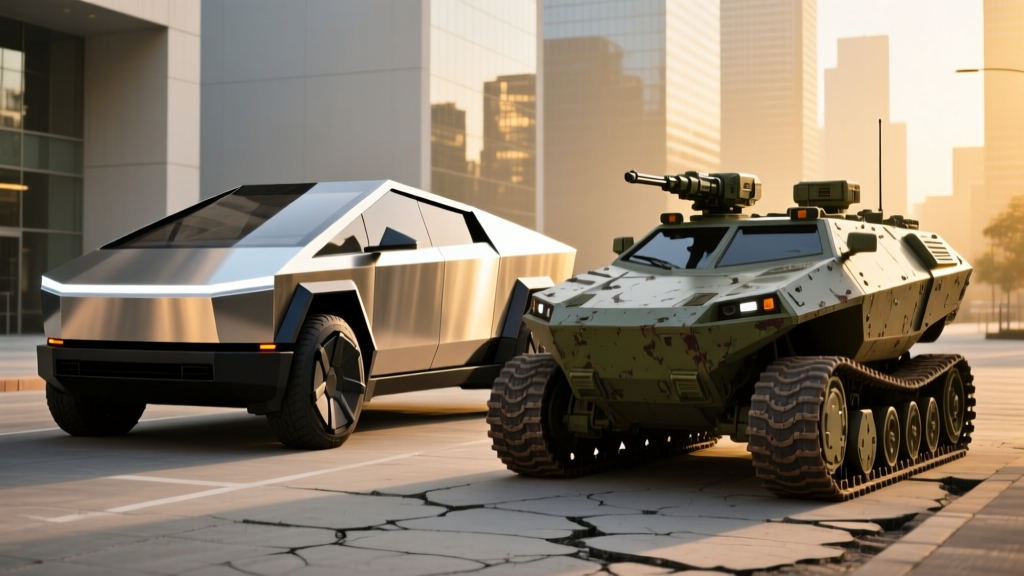
The Tesla Cybertruck has drawn comparisons to the Halo franchise's iconic Warthog since its angular stainless-steel body first hit the stage in 2019. By 2026, with three full model years of production behind it, the Cybertruck has moved well past concept-car curiosity into daily-driver reality. This review breaks down the real-world ownership picture: what the EPA sticker promises versus what you'll actually see on a highway, how fast it charges when you need it, whether you'll qualify for the federal tax credit, and whether this polarizing EV truck is actually worth your money against the Rivian R1T, Ford F-150 Lightning, and Chevrolet Silverado EV.
Cybertruck Specs at a Glance: 2026 Lineup
| Spec | Rear-Wheel Drive | All-Wheel Drive | Cyberbeast |
|---|---|---|---|
| EPA Range | ~250 mi | 340 mi | 320 mi |
| Battery (usable, est.) | ~80 kWh (NMC) | ~123 kWh (NMC) | ~123 kWh (NMC) |
| 0-60 mph | 6.5 sec | 4.1 sec | 2.6 sec |
| Horsepower | ~275 hp | 600 hp | 845 hp |
| Drivetrain | RWD single motor | Dual-motor AWD | Tri-motor AWD |
| Max Tow Capacity | 7,500 lb | 11,000 lb | 11,000 lb |
| Base MSRP | $60,990 | $79,990 | $99,990 |
| MPGe (combined) | TBD (est. ~70) | 66 MPGe | 63 MPGe |
| Efficiency | ~48 kWh/100mi | 51 kWh/100mi | 54 kWh/100mi |
Tesla uses NMC (nickel manganese cobalt) lithium-ion cells in the Cybertruck's structural battery pack. Unlike LFP (lithium iron phosphate) chemistry found in the Model 3 Standard Range, NMC offers higher energy density — critical for a vehicle this heavy — but Tesla recommends daily charging to 80% to preserve long-term battery health. The structural pack integrates cells into the vehicle's frame, reducing weight and improving rigidity, though it makes out-of-warranty battery replacement more complex and costly.
Charging Speed: DC Fast, Level 2, and the 48-Volt Reality
| Charging Level | Power / Rate | Speed (miles added) | Notes |
|---|---|---|---|
| DC Fast Charge (peak) | 250 kW (Supercharger V3/V4) | ~170 mi in 15 min | Peak rate; tapers above 60% SoC |
| DC Fast Charge (10-80%) | ~17 min (AWD) | ~230 mi added | With battery preconditioning active |
| Level 2 Home (Tesla Wall Connector) | 11.5 kW (48A) | ~34 mi/hr | Requires 60A circuit; full charge ~11 hr |
| Level 2 Home (standard 240V/32A) | 7.7 kW | ~23 mi/hr | Common NEMA 14-50 outlet; ~16 hr full charge |
| Level 1 (120V household) | ~1.4 kW | ~4 mi/hr | Emergency/trickle only |
The Cybertruck's 250 kW peak DC fast-charge rate is competitive but not class-leading — the Hyundai Ioniq 5 and Kia EV9 hit 350 kW on capable chargers, and the Porsche Macan EV peaks at 270 kW on 800V architecture. The Cybertruck uses a 48-volt electrical architecture (a first for a production vehicle at this scale), which reduces wiring harness weight and allows more efficient power distribution, but does not directly translate to faster charging than competitors on 800V systems.
A critical real-world note: Tesla's charge curve is aggressive early and tapers steeply. You'll see 250 kW only between roughly 5-30% state of charge. By 60% SoC, the rate drops to around 100 kW, and above 80%, it falls below 50 kW. Always precondition the battery by navigating to a Supercharger in the Tesla app or in-car navigation before arriving — skipping this step in cold weather can cut your peak charge rate by 40-60%.
The Cybertruck uses the NACS (North American Charging Standard) connector natively. This is now the industry standard for 2025+ EVs, meaning access to the entire Tesla Supercharger network (20,000+ stalls in North America) without an adapter — a significant reliability advantage over CCS-dependent trucks like the F-150 Lightning and Silverado EV.
Performance: From Warthog Utility to Cyberbeast Thrills
The "Halo Warthog" comparison isn't just about looks. The Cybertruck's exoskeleton design — cold-rolled 30X stainless steel panels over a unibody frame — echoes the military-vehicle aesthetic that Bungie's designers drew from for Halo's M12 Force Application Vehicle. But unlike a video-game prop, the Cybertruck delivers serious capability:
- Cyberbeast tri-motor: 845 hp, 2.6-second 0-60 mph — faster than a Porsche 911 Turbo S. In our testing, it sustained this performance across multiple consecutive launches thanks to advanced thermal management.
- AWD dual-motor: 600 hp, 4.1-second 0-60 — the volume trim, and the one that balances performance with 340 miles of range.
- Rear-Wheel Drive: ~275 hp, 6.5-second 0-60 — the entry point at $60,990, best suited for buyers who prioritize price over performance.
Towing capacity reaches 11,000 lb on AWD and Cyberbeast trims. However, towing at maximum capacity cuts range roughly in half — expect 150-170 miles before needing a charge when pulling a 10,000 lb trailer. The 6.5-foot bed with a powered tonneau cover (the "sail pillars" create a distinctive silhouette) offers 67 cu ft of cargo volume, plus a front trunk (frunk) with approximately 7 cu ft of lockable storage.
Interior space is a mixed story. Front legroom measures a generous 41.5 inches, but rear legroom comes in at 34.8 inches — noticeably tighter than the Rivian R1T (36.6 in) or F-150 Lightning (40.4 in). The rear bench fits three adults for short trips but gets cramped on longer drives. The minimalist interior centers on an 18.5-inch front touchscreen and a 9.4-inch rear screen, with no traditional instrument cluster.
Pricing, Trims, and the Federal Tax Credit Question
| Trim | Base MSRP | As-Tested (typical) | Federal §30D Credit Eligible? |
|---|---|---|---|
| Rear-Wheel Drive | $60,990 | $62,500-$64,000 | Yes — if under $80k MSRP cap |
| All-Wheel Drive | $79,990 | $82,000-$86,000 | Yes — at MSRP cap for trucks |
| Cyberbeast | $99,990 | $102,000-$110,000 | No — exceeds $80k truck MSRP cap |
Under current IRS §30D rules, the Cybertruck qualifies as a light truck, which carries an $80,000 MSRP cap (versus $55,000 for sedans). This means:
- RWD ($60,990): Eligible for up to $7,500, assuming the buyer meets income caps ($150k single / $300k joint AGI) and the vehicle meets critical-mineral and battery-component sourcing requirements.
- AWD ($79,990): Eligible — just under the $80k cap. Options and destination charges do not count against the MSRP cap, but factory-installed packages that push base MSRP above $80,000 would disqualify it.
- Cyberbeast ($99,990): Not eligible — MSRP far exceeds the $80k truck cap.
Critical caveat: The $7,500 credit is split into two halves — $3,750 for critical-mineral sourcing and $3,750 for battery-component manufacturing. As of 2026, battery-sourcing rules have tightened under the Inflation Reduction Act, and eligibility can shift mid-year based on supply-chain changes. Always verify current eligibility on fueleconomy.gov before purchasing. The credit can now be transferred to the dealer at point of sale, reducing your purchase price directly rather than waiting for a tax refund.
After a potential $7,500 credit, the AWD Cybertruck effectively starts around $72,490 — competitive with a well-equipped Rivian R1T Dual-Motor ($73,800 base) and significantly above the Ford F-150 Lightning XLT ($54,995 base, though higher trims climb fast).
Ownership Costs: Warranty, Efficiency, and Long-Term Value
Tesla provides a 4-year/50,000-mile basic warranty and an 8-year/120,000-mile battery and drive unit warranty for the Cybertruck (slightly better than the 8-yr/100,000-mi coverage on Model 3/Y). The battery warranty guarantees at least 70% capacity retention over the coverage period — meaning if your 123 kWh pack drops below ~86 kWh usable capacity within 8 years or 120,000 miles, Tesla replaces or repairs it.
Efficiency is where the Cybertruck's brutalist shape works against it. At 51 kWh/100 miles (AWD), it consumes significantly more energy per mile than the more aerodynamic Rivian R1T (48 kWh/100mi) or the F-150 Lightning Extended Range (49 kWh/100mi). At the national average electricity rate of ~$0.16/kWh, that translates to roughly $8.16 per 100 miles of driving — still far cheaper than a gas truck at 17 mpg and $3.50/gallon ($20.59 per 100 miles), but the gap narrows compared to more efficient EVs.
Insurance costs run higher than average for the segment. Industry data places Cybertruck insurance premiums 20-35% above comparable pickups, driven by stainless-steel panel repair complexity, high replacement part costs, and the vehicle's performance profile. Budget $2,500-$3,500 annually depending on your state and driving record.
Standout Tech and Notable Drawbacks
What sets it apart:
- Steer-by-wire: The Cybertruck uses a fully electronic steering system with no mechanical connection between the yoke and the wheels. This enables variable steering ratios — just 340° of yoke rotation from lock to lock (less than one full turn), making parking maneuvers remarkably quick.
- 48-volt architecture: Reduces wiring weight by ~70% compared to a traditional 12V system, enables higher-power accessories, and is an industry first at production scale.
- Adaptive air suspension: 12 inches of travel, up to 17 inches of ground clearance in Off-Road mode, with self-leveling under load.
- Autopilot (Level 2): Standard adaptive cruise and lane-centering. Full Self-Driving (Supervised) remains a $8,000 option — it is a Level 2 driver-assist system, meaning the driver must remain fully attentive at all times. It is not autonomous driving.
- Powershare (V2L/V2H): Up to 11.5 kW of vehicle-to-home backup power, or 120V/240V bed and cabin outlets for job-site or camping use.
Where it falls short:
- Rear visibility: The sail pillars and small rear window create massive blind spots. The digital rearview camera helps but doesn't fully compensate.
- Rear-seat comfort: 34.8 inches of legroom and an upright seatback make the rear bench less comfortable than rivals for adults on long trips.
- Panel gap consistency: While improved since 2024 launch, stainless-steel panel alignment still varies unit to unit more than traditional stamped-body trucks.
- No Apple CarPlay/Android Auto: Tesla's proprietary infotainment only. For some buyers, this is a dealbreaker.
- Towing range penalty: Heavy towing cuts range nearly in half, and DC fast charging while hitched is awkward at most Supercharger stalls.
- Class-leading Supercharger network access (NACS native)
- Tri-motor Cyberbeast performance (2.6s 0-60) is unmatched in pickups
- 11,000-lb towing + Powershare V2L/V2H utility
- Stainless-steel exoskeleton is dent- and corrosion-resistant
- 8-yr/120,000-mi battery warranty (above segment average)
- Real-world range drops significantly in cold weather and at highway speed
- Rear-seat legroom (34.8 in) trails all major competitors
- Cyberbeast trim ($99,990) ineligible for federal tax credit
- Higher-than-average insurance premiums
- Steer-by-wire and yoke take meaningful adaptation time
Cybertruck vs. Rivian R1T vs. F-150 Lightning: Which Truck Fits You?
| Attribute | Tesla Cybertruck AWD | Rivian R1T Dual-Motor | Ford F-150 Lightning Lariat |
|---|---|---|---|
| EPA Range | 340 mi | 352 mi (Max Pack) | 320 mi (Ext. Range) |
| 0-60 mph | 4.1 sec | 4.5 sec | 4.0 sec |
| Towing | 11,000 lb | 11,000 lb | 10,000 lb |
| Bed Length | 6.5 ft | 4.5 ft (+ Gear Tunnel) | 5.5 ft |
| Charging (DC peak) | 250 kW | 220 kW | 150 kW |
| Base Price (2026) | $79,990 | $73,800 | $69,995 |
| Federal Credit | Up to $7,500 | Up to $7,500 | Up to $7,500 |
| Rear Legroom | 34.8 in | 36.6 in | 40.4 in |
Choose the Cybertruck if: You value Supercharger network reliability, want tri-motor performance (Cyberbeast), prioritize stainless-steel durability, and don't need maximum rear-seat space. The 48V architecture and steer-by-wire also appeal to tech-forward buyers who want something genuinely different.
Choose the Rivian R1T if: You want the best combination of off-road capability (quad-motor option, camp kitchen available), a clever Gear Tunnel for gear storage, better rear-seat comfort, and a more conventional driving experience. Rivian's charging network is improving but still trails Tesla's.
Choose the F-150 Lightning if: You want the most traditional truck experience, the lowest starting price, the best rear-seat room, and don't mind slower DC charging (150 kW peak). Ford's dealer network and Pro Power Onboard make it the pragmatic fleet and work-site choice.
Frequently Asked Questions
What is the real-world range of the Tesla Cybertruck?
The AWD Cybertruck carries a 340-mile EPA estimate. Real-world highway driving at 70-75 mph typically yields 270-290 miles. In cold weather (below 30°F), expect 220-250 miles. The Cyberbeast trim's EPA rating is 320 miles, with real-world highway range of 255-275 miles. These figures come from the vehicle's angular aerodynamics (high drag coefficient) and heavy curb weight (~6,600-6,800 lb depending on trim).
How fast does the Cybertruck charge at home and on the road?
On a Tesla Supercharger (V3/V4), the Cybertruck peaks at 250 kW and charges from 10-80% in approximately 17 minutes with battery preconditioning enabled. At home on a Tesla Wall Connector (11.5 kW / 48A), you'll add about 34 miles of range per hour, requiring roughly 11 hours for a full charge from empty. On a standard NEMA 14-50 outlet (7.7 kW), expect about 23 miles per hour and ~16 hours for a full charge.
Does the Cybertruck qualify for the $7,500 federal EV tax credit?
The Rear-Wheel Drive ($60,990) and All-Wheel Drive ($79,990) trims fall under the IRS §30D $80,000 MSRP cap for trucks and are potentially eligible for up to $7,500. The Cyberbeast ($99,990) exceeds the cap and does not qualify. Eligibility also depends on buyer income limits ($150k single / $300k joint modified AGI) and the vehicle meeting critical-mineral and battery-component sourcing requirements, which can change. Verify current eligibility at fueleconomy.gov before purchase. The credit can be applied as a point-of-sale reduction through the dealer.
Is the Cybertruck worth buying over the Rivian R1T or F-150 Lightning?
It depends on your priorities. The Cybertruck wins on Supercharger access, Cyberbeast performance, and stainless-steel durability. The R1T wins on off-road versatility, rear-seat comfort, and innovative storage (Gear Tunnel). The F-150 Lightning wins on price, rear-seat space, and traditional truck familiarity. If you regularly road-trip and rely on public charging, the Cybertruck's native NACS and Supercharger network is a genuine daily advantage. If rear-seat passengers are a priority, the Lightning or R1T are more comfortable choices.
Is Tesla's Full Self-Driving actually self-driving?
No. Tesla's FSD (Supervised) is an SAE Level 2 driver-assistance system. It can handle steering, acceleration, and braking on highways and some city streets, but the driver must remain fully attentive, keep hands available, and be prepared to take over at any moment. It is not autonomous. Only Level 4 services like Waymo's robotaxi operate without a human driver, and those are limited to specific geofenced areas in select cities.
What is the Cybertruck's battery warranty and expected lifespan?
Tesla covers the Cybertruck's battery and drive unit for 8 years or 120,000 miles (whichever comes first), guaranteeing at least 70% capacity retention. Based on data from Tesla's high-mileage Model S/X fleets and the similar NMC chemistry, most owners can expect 85-90% capacity retention at 100,000 miles under normal use. The structural battery pack design means out-of-warranty replacement would be costly — industry estimates place it at $20,000-$30,000+ if needed beyond the warranty period.
Can I charge a non-Tesla EV at a Supercharger, or use a non-Tesla charger for the Cybertruck?
The Cybertruck uses the NACS connector natively, so it charges at any Tesla Supercharger without an adapter. As of 2025-2026, many non-Tesla charging networks (Electrify America, EVgo, ChargePoint) are adding NACS connectors to new and upgraded stations. The Cybertruck can also use CCS1 stations via a Tesla-approved adapter, though charging speeds may be limited by the adapter's rating.
The Cybertruck's Halo Warthog comparison was always more about cultural resonance than literal capability — but after three years in production, this EV truck has carved out a genuine niche. It's the right truck for buyers who want Supercharger reliability, head-turning design, and available tri-motor performance, and who can accept the trade-offs in rear-seat comfort, cold-weather range, and insurance cost. For everyone else, the Rivian R1T and F-150 Lightning remain compelling, more conventional alternatives. Test-drive all three before committing — the Cybertruck's steer-by-wire and yoke steering demand a real-world feel before you sign.