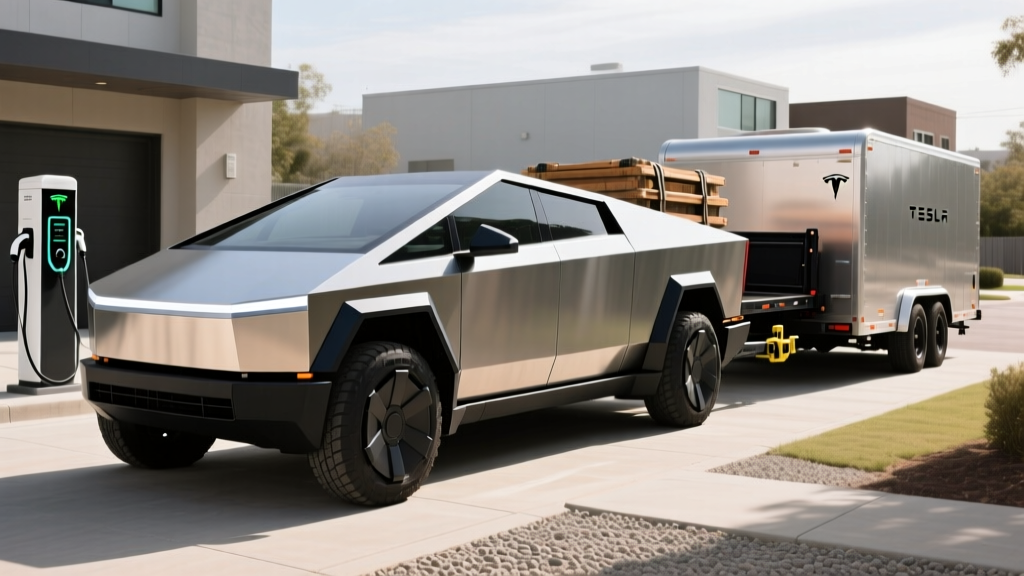
The Tesla Cybertruck is a polarizing vehicle, but beneath the stainless-steel exoskeleton and steer-by-wire system sits a serious electric pickup with real work-truck numbers — and real limitations. For buyers evaluating this truck for job-site duty, towing, or heavy cargo, one spec matters above almost everything else: the Gross Vehicle Weight Rating (GVWR). It dictates how much payload the Cybertruck can legally carry, influences registration class, and directly impacts real-world range when the bed is loaded.
In this review, we unpack the Cybertruck's GVWR across every available 2025–2026 trim, reconcile EPA range with what you'll actually see on the highway or with a loaded bed, break down its 250 kW DC fast-charging curve, and evaluate whether it qualifies for the §30D federal tax credit under current IRS rules.
Cybertruck GVWR, Payload, and Towing by Trim
GVWR is the maximum allowable total weight of the vehicle plus passengers, cargo, and any tongue weight from a trailer. Subtract the curb weight and you get the payload capacity — a critical number for contractors, overlanders, and anyone hauling gear regularly.
| Specification | RWD (Standard) | AWD | Cyberbeast |
|---|---|---|---|
| GVWR | ~8,900 lbs | ~9,100 lbs | ~9,100 lbs |
| Curb Weight | ~6,600 lbs | ~6,843 lbs | ~6,850 lbs |
| Payload Capacity | ~2,300 lbs | ~2,500 lbs | ~2,500 lbs |
| Max Towing | 7,500 lbs | 11,000 lbs | 11,000 lbs |
| Drivetrain | Single Motor RWD | Dual Motor AWD | Tri-Motor AWD |
| Horsepower | ~600 hp | ~600 hp | 845 hp |
| 0–60 mph | ~5.0 sec | 4.1 sec | 2.6 sec |
| Battery (usable, est.) | ~123 kWh | ~123 kWh | ~123 kWh |
| Battery Chemistry | NMC (2170 cells) | NMC (2170 cells) | NMC (2170 cells) |
The Cybertruck uses a 48-volt electrical architecture and a structural battery pack with Tesla's 2170-format NMC (nickel manganese cobalt) cells. Unlike the Ford F-150 Lightning's ~131 kWh Extended Range pack, the Cybertruck's pack is slightly smaller but compensates with the aerodynamic advantages of its angular, flat-panel design — though that aero benefit diminishes significantly at highway speeds with a loaded bed or trailer in tow.
Real ownership insight: The ~2,500-lb payload on AWD and Cyberbeast trims is competitive with mid-duty pickups but falls short of a heavy-duty F-250 or Silverado 2500. If your typical load exceeds 2,000 lbs regularly, you'll also see range drop by 15–25%, which matters for the already range-limited Cybertruck platform.
EPA Range vs. Real-World Expectations
Real-World Expectation: Plan for 260–290 miles on mixed highway driving in moderate temperatures. In cold weather (below 32°F), expect a 20–30% reduction — roughly 190–230 miles. When towing near max capacity (11,000 lbs), real-world range can drop to 130–160 miles depending on terrain and speed.
The EPA's official Cybertruck AWD rating sits at 340 miles, with the Cyberbeast rated at 320 miles due to its higher-output tri-motor drivetrain and wider rear tires. However, these figures assume moderate driving conditions with minimal cargo.
Independent real-world highway tests by multiple EV publications have consistently shown 280–300 miles at 70 mph in fair weather — a meaningful gap from the EPA sticker. The Cybertruck's stainless-steel panels are heavy, and the vehicle's ~6,850-lb curb weight means it consumes energy aggressively during acceleration and hill climbs. Regenerative braking recovers some of this in stop-and-go driving, but highway efficiency suffers.
Efficiency rating: The AWD model achieves approximately 56 MPGe combined (EPA), translating to roughly 54–58 kWh per 100 miles in real-world mixed driving. That's significantly less efficient than a Tesla Model Y (~28 kWh/100mi) but in line with other full-size electric trucks like the F-150 Lightning Extended Range (~49 kWh/100mi EPA).
Charging Speed: DC Fast, Level 2, and the Curve Reality
Charging speed is where the Cybertruck's 800-volt-class architecture matters. Tesla rates the Cybertruck for a peak DC fast-charge rate of 250 kW at V3 Superchargers and compatible third-party stations via the included NACS connector (or CCS adapter for non-Tesla networks).
| Charging Level | Power / Rate | Time / Speed | Notes |
|---|---|---|---|
| Level 1 (120V) | ~1.4 kW | ~3–4 mi/hr | Emergency/trickle only |
| Level 2 (240V, 48A) | ~11.5 kW | ~34–37 mi/hr | Full charge in ~11–12 hours |
| Level 2 (240V, 80A) | ~19.2 kW | ~55–60 mi/hr | Requires Tesla Wall Connector + 100A circuit |
| DC Fast (peak) | 250 kW | 10–80% in ~18–20 min | Peak rate sustained to ~50% SoC |
| DC Fast (sustained avg) | ~150–170 kW | 10–80% realistic avg | Curve tapers significantly above 80% |
The charge curve matters: The Cybertruck hits its 250 kW peak at low state-of-charge (roughly 10–35% SoC) and a preconditioned battery. Beyond 50%, the rate drops to approximately 150 kW, and above 80% it slows dramatically to protect the NMC cells — often below 50 kW. This means a 10–80% session takes about 18–20 minutes under ideal conditions, but a 10–95% session can stretch past 45 minutes.
For home charging, the Cybertruck's onboard charger supports up to 19.2 kW (80A) on a hardwired Tesla Wall Connector with a dedicated 100-amp circuit. Most homes will need an electrical panel upgrade to support this — budget $1,500–$3,000 for the panel work plus $500–$800 for the Wall Connector and installation by a licensed electrician. A more common 48-amp Level 2 setup on a 60-amp circuit delivers ~11.5 kW, adding about 35 miles of range per hour — sufficient for overnight replenishment of most daily driving.
Interior, Cargo, and Practical Usability
The Cybertruck seats five (six with the optional front bench on some configurations) and provides a 6-foot bed with a motorized retractable tonneau cover rated to support 300 lbs of distributed weight. The bed features a built-in ramp system and 120V/240V outlets — useful for powering tools on a job site.
| Dimension | Measurement |
|---|---|
| Bed Length | 72 inches (6 ft) |
| Bed Volume | ~67 cu ft (with cover closed) |
| Front Cargo (Frunk) | ~7 cu ft lockable |
| Front Legroom | ~41.5 in |
| Rear Legroom | ~37.2 in |
| Ground Clearance | Up to 16 in (with air suspension) |
| Approach / Departure Angle | 35° / 28° |
The Cybertruck's air suspension offers up to 12 inches of travel and a 16-inch maximum ground clearance — genuinely useful for off-road use. The rear steering system (up to 10°) gives it a turning circle of about 39 feet, tighter than its 20-foot length would suggest.
Drawbacks to note: The angular bed design and tonneau cover make loading tall items (lumber, furniture) awkward. The rear visibility is compromised by the bed sides and small rear camera view. And the stainless-steel panels, while dent-resistant, show fingerprints relentlessly and can be difficult to repair if deeply scratched.
Technology, Driver Assistance, and Safety
The Cybertruck comes standard with Tesla's 18.5-inch front touchscreen and a 9.4-inch rear touchscreen, running Tesla's latest vehicle software. Steer-by-wire replaces the traditional steering column, offering variable-ratio steering that reduces lock-to-lock turns to roughly one full rotation at low speeds — a genuine advantage in parking lots and tight trails.
Driver assistance includes Tesla Autopilot (adaptive cruise + lane-keeping) as standard, with Full Self-Driving (Supervised) available as an $8,000 add-on or subscription.
Both Autopilot and FSD (Supervised) are SAE Level 2 driver-assistance systems. The driver must remain fully engaged, hands on the yoke, and eyes on the road at all times. These systems do not make the Cybertruck self-driving. Only Level 4 services like Waymo operate without a human driver.
On safety, the Cybertruck's structural stainless-steel exoskeleton provides substantial crash protection, though as of early 2026, the NHTSA has published limited crash-test results, and IIHS has not yet completed a full evaluation. The vehicle's weight and rigidity are advantages in multi-vehicle collisions but increase stopping distances — expect roughly 130–140 feet in 60–0 mph braking tests.
Pricing, Trims, and Federal Tax Credit Eligibility
| Trim | Base MSRP | §30D Credit Eligible? | Est. After-Credit Price |
|---|---|---|---|
| RWD (Standard) | ~$60,990 | Yes (meets MSRP cap) | ~$53,490* |
| AWD | ~$79,990 | No (exceeds $80K truck cap) | ~$79,990 |
| Cyberbeast | ~$99,990 | No (exceeds $80K truck cap) | ~$99,990 |
*Credit eligibility caveat: The §30D federal EV tax credit provides up to $7,500, but for trucks, vans, and SUVs the MSRP cap is $80,000. The Cybertruck RWD, once available at ~$60,990, would fall under this cap and potentially qualify — but only if the buyer also meets income limits (AGI ≤ $150,000 single / $300,000 joint), the vehicle's battery components and critical minerals meet sourcing requirements that tighten annually, and the buyer has sufficient tax liability to use a non-refundable credit (or elects the point-of-sale transfer to a dealer). Always verify current eligibility at IRS.gov and consult a tax professional before purchasing.
The AWD and Cyberbeast trims, at $79,990 and $99,990 respectively, exceed the $80,000 MSRP cap for trucks and are not eligible for the §30D new-vehicle credit regardless of buyer income. This is a significant cost consideration versus the F-150 Lightning (starting ~$55,000) or Rivian R1T (starting ~$75,000, also over the cap on most trims).
Who Should Buy the Cybertruck?
- You need 11,000-lb towing and 2,500-lb payload with an electric powertrain
- You value the air suspension, rear steering, and off-road capability
- You want integrated bed power (120V/240V) for job-site tool use
- You're a Tesla ecosystem user who wants Supercharger network access
- Your budget is under $65,000 — the F-150 Lightning Pro offers more range and lower pricing
- You need a traditional 8-foot bed for full-sheet plywood
- You prioritize proven reliability track records over novel design
- You want a truck that qualifies for the $7,500 tax credit on higher trims
The Cybertruck makes the most sense for buyers who specifically want Tesla's charging network, tech ecosystem, and performance in a pickup form factor — and who accept the trade-offs in repairability, bed practicality, and polarizing design. For pure work-truck duty at a lower price point, the F-150 Lightning remains a more conventional and tax-credit-friendly choice.
Warranty and Long-Term Ownership
Tesla provides the following warranty coverage for the Cybertruck:
| Coverage | Term |
|---|---|
| Basic Vehicle | 4 years / 50,000 miles |
| Battery & Drive Units | 8 years / 120,000 miles (min 70% retention) |
| Stainless-Steel Body | 5 years / unlimited miles (corrosion) |
The 8-year/120,000-mile battery warranty with a 70% capacity retention threshold is slightly better than Tesla's standard 100,000-mile coverage on Model 3/Y, reflecting the Cybertruck's truck-duty classification. NMC chemistry typically degrades 1–2% per year under normal use, meaning most owners will retain 85–90% capacity at 100,000 miles — well within the warranty threshold.
Insurance costs for the Cybertruck run 30–50% higher than comparable gas pickups due to the vehicle's repair complexity, stainless-steel panel replacement costs, and high performance. Expect annual premiums of $3,500–$5,500 depending on your state, driving record, and coverage level.
- 11,000-lb towing and 2,500-lb payload (AWD/Cyberbeast)
- 250 kW peak DC fast charging, 10–80% in ~18–20 min
- Air suspension with 16" ground clearance, rear steering
- Integrated 120V/240V bed power outlets
- Access to Tesla Supercharger network (17,000+ stalls)
- 2.6-second 0–60 on Cyberbeast — fastest production pickup
- AWD/Cyberbeast exceed $80K MSRP cap — no §30D tax credit
- Real-world range 260–290 mi, drops to ~140 mi when towing max
- Stainless-steel panels difficult/expensive to repair
- 6-foot bed shorter than competitors; tall-item loading awkward
- Steer-by-wire and yoke steering polarizing; not for everyone
- Insurance premiums 30–50% above gas truck averages
Frequently Asked Questions
What is the Tesla Cybertruck's GVWR?
The Cybertruck GVWR is approximately 8,900 lbs for the RWD trim and 9,100 lbs for the AWD and Cyberbeast trims. This determines the maximum legal weight of the vehicle plus all passengers, cargo, and tongue weight.
What is the real-world range of the Cybertruck?
While the EPA rates the AWD at 340 miles and the Cyberbeast at 320 miles, real-world highway driving typically yields 260–290 miles. Cold weather (below 32°F) reduces range by 20–30%, and towing at max capacity (11,000 lbs) can drop range to 130–160 miles.
How fast does the Cybertruck charge?
At a V3 Supercharger or equivalent 250 kW DC fast charger, the Cybertruck charges from 10–80% in approximately 18–20 minutes. At home on a 48-amp Level 2 charger, it adds roughly 35 miles of range per hour (full charge in ~11–12 hours).
Does the Cybertruck qualify for the $7,500 federal tax credit?
Only the RWD trim (MSRP ~$60,990) potentially qualifies, as the AWD ($79,990) and Cyberbeast ($99,990) exceed the §30D MSRP cap of $80,000 for trucks. Even the RWD must meet buyer income limits (≤$300K joint AGI), battery sourcing requirements, and the buyer must have sufficient tax liability. Verify at IRS.gov.
Is the Cybertruck worth it vs. the F-150 Lightning or Rivian R1T?
The Cybertruck wins on performance (2.6-sec Cyberbeast), Supercharger network access, and integrated bed power. The F-150 Lightning wins on price, tax-credit eligibility, traditional bed utility, and dealer service network. The Rivian R1T offers a better quad-motor off-road setup and more refined interior, though at a premium. Your choice depends on whether Tesla's ecosystem and performance outweigh the Cybertruck's practicality gaps and credit ineligibility on higher trims.
What is the Cybertruck's battery chemistry and expected lifespan?
The Cybertruck uses NMC (nickel manganese cobalt) lithium-ion cells in Tesla's 2170 format. NMC offers high energy density but is more sensitive to sustained high state-of-charge than LFP chemistry. Expect 1–2% degradation per year under normal use. Tesla warranties the battery for 8 years/120,000 miles with a minimum 70% capacity retention.
Can the Cybertruck power my home or tools?
The Cybertruck offers 120V and 240V outlets in the bed and cabin for powering tools and equipment. Tesla has indicated vehicle-to-home (V2H) capability may come via future software/hardware updates, but as of early 2026, bidirectional home power is not yet a standard, supported feature like it is on the F-150 Lightning with Ford's Intelligent Backup Power system.