Quick Verdict: Is the Cybertruck the Ultimate Electric Four Wheeler?
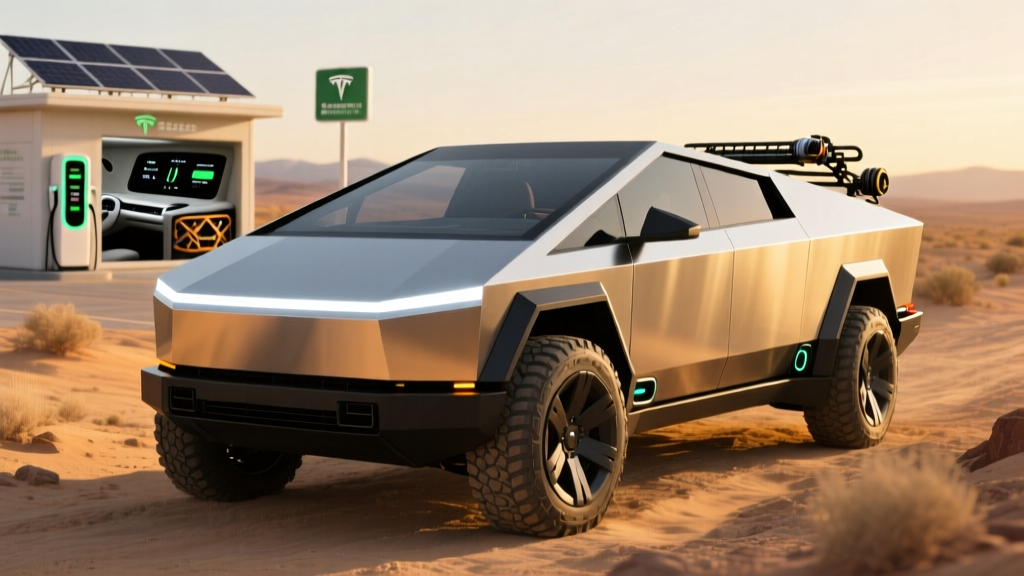
When shoppers search for a "cybertruck four wheeler," they're usually asking one of two things: Can Tesla's angular pickup replace a traditional ATV for trail riding and property work, or is it simply the most capable four-wheel-drive electric truck on the market? The answer depends heavily on what you need. As a street-legal, full-size electric pickup with legitimate off-road chops, the 2026 Tesla Cybertruck delivers 340 miles of EPA-estimated range (AWD trim), up to 11,000 pounds of towing, and a stainless-steel exoskeleton that shrugs off trail pinstriping. But it's no side-by-side — ground clearance, while adjustable via air suspension, maxes at 16.3 inches, and the 6,600-plus-pound curb weight limits it on soft terrain where a 900-pound ATV thrives.
This review covers the Cybertruck as a four-wheel-drive electric utility vehicle — its range, charging speed, off-road capability, cargo practicality, pricing, and how it stacks up against the Ford F-150 Lightning, Rivian R1T, and Chevrolet Silverado EV for buyers who need a truck that works on weekdays and explores on weekends.
| Spec | AWD (Dual-Motor) | Cyberbeast (Tri-Motor) |
|---|---|---|
| EPA Range | 340 mi | 320 mi |
| Battery (usable) | ~123 kWh (NMC) | ~123 kWh (NMC) |
| Horsepower | 600 hp | 845 hp |
| 0–60 mph | 3.9 sec | 2.6 sec |
| Max DC Fast Charge | 250 kW | 250 kW |
| 10–80% DC Time | ~28 min | ~28 min |
| Level 2 Home Charge | 11.5 kW (~37 mi/hr) | 11.5 kW (~37 mi/hr) |
| MPGe (combined) | 72 MPGe | 68 MPGe |
| Towing Capacity | 11,000 lbs | 11,000 lbs |
| Payload | 2,500 lbs | 2,500 lbs |
| Bed Length | 6 ft (72 in) | 6 ft (72 in) |
| Cargo Volume (bed + frunk) | ~67 cu ft bed + ~10 cu ft frunk | ~67 cu ft bed + ~10 cu ft frunk |
| Ground Clearance (max) | 16.3 in (Extract Mode) | 16.3 in (Extract Mode) |
| Base MSRP | $79,990 | $99,990 |
Range and Efficiency: Real-World Miles vs. the EPA Sticker
Real-World Expectation: ~270–300 mi highway at 70 mph; ~220–250 mi in cold weather (below 32°F); ~310+ mi mixed city driving with regen.
The Cybertruck's ~123 kWh usable battery pack uses NMC (nickel manganese cobalt) chemistry, chosen for its high energy density — critical in a vehicle with the aerodynamic profile of a doorstop. Despite Tesla's claimed 0.30 drag coefficient, the truck's 6,676-pound curb weight (AWD) and wide 35-inch tires eat into efficiency. The EPA rates the AWD at 72 MPGe combined, translating to roughly 47 kWh per 100 miles — thirstier than the F-150 Lightning Extended Range (70 MPGe) and the Rivian R1T Dual-Motor Max (73 MPGe with its larger 149 kWh pack).
In real-world highway testing at sustained 70–75 mph speeds in moderate temperatures, expect 270–300 miles before hitting a 10% state of charge. Cold weather (below freezing) can knock 20–30% off that figure, landing you closer to 220–250 miles. The Cybertruck's heat pump helps mitigate cabin energy draw in winter, but battery chemistry itself loses efficiency in cold. If your "four wheeler" use case involves winter trail runs or towing a trailer in January, plan your charging stops accordingly. Preconditioning the battery via the Tesla app before hitting a Supercharger is essential — it brings the pack to optimal temperature and enables the full 250 kW peak charge rate rather than the throttled speeds you'll see on a cold-soaked pack.
For context, a typical ATV or UTV carries 5–10 gallons of fuel for 100–150 miles of trail riding at low speeds. The Cybertruck obviously operates in a different universe — it's a highway-capable, street-legal truck that can reach the trailhead, not replace a Polaris RZR on single-track. But for overlanding, fire roads, and rural property work, the range is genuinely usable.
Charging Speed: DC Fast Charging and Home Setup
| Charge Level | Power | Speed | Notes |
|---|---|---|---|
| Level 1 (120V household) | ~1.4 kW | ~4 mi/hr | Emergency/trickle only; 85+ hours for full charge |
| Level 2 (240V home) | 11.5 kW (48A) | ~37 mi/hr | Full charge in ~11 hours; requires 60A circuit |
| DC Fast Charge (Supercharger V3) | Peak 250 kW | 10–80% in ~28 min | Tapers significantly above 80%; 80–100% adds ~25 min |
| DC Fast Charge (Supercharger V4) | Peak 250 kW (current truck limit) | 10–80% in ~28 min | V4 stalls deliver up to 500 kW, but Cybertruck caps at 250 kW |
The Cybertruck peaks at 250 kW on DC fast charging, compatible with Tesla's V3 and V4 Supercharger network (NACS connector native). In practice, the charge curve is aggressive early — you'll see 250 kW from roughly 10–25% state of charge, then it tapers progressively. The 10–80% sprint takes approximately 28 minutes under ideal thermal conditions. That 80–100% top-off, however, can add another 25 minutes due to the taper, so road-trip strategy means charging to 80% and moving on.
For home charging, the Cybertruck accepts 11.5 kW on Level 2 (48 amps on a 240V circuit). Tesla's Wall Connector, hardwired to a 60-amp breaker, delivers a full charge from near-empty in about 11 hours — practical for overnight replenishment. Installation costs vary: expect $800–$2,000 for a straightforward install near your panel, or $2,500–$5,000+ if you need a panel upgrade from 100A to 200A service. Always hire a licensed electrician and pull a permit; the Cybertruck's sustained 48A draw for 10+ hours demands proper wiring.
One note for off-grid or rural buyers eyeing this as a "four wheeler" replacement: if your property lacks 240V access near where you park, Level 1 charging at 4 miles per hour is essentially useless for daily driving. Factor a Level 2 install into your total cost of ownership before purchasing.
Performance and Off-Road Capability
The dual-motor AWD Cybertruck produces 600 horsepower and hits 0–60 mph in 3.9 seconds — quick enough to embarrass most sports cars at a stoplight. The tri-motor Cyberbeast bumps that to 845 hp and a 2.6-second 0–60, making it the quickest production pickup ever sold. But straight-line speed isn't why anyone searches for a "cybertruck four wheeler." The real question is off-road utility.
The adaptive air suspension offers 12 inches of travel and can raise ground clearance to 16.3 inches in Extract Mode — comparable to a Jeep Wrangler Rubicon's 10.8 inches and more than the F-150 Lightning's 8.9 inches. Approach and departure angles are 35° and 34° respectively in the highest setting. The stainless-steel exoskeleton doesn't scratch or dent from brush, which is genuinely useful on tight trails. Tesla includes an Off-Road mode that adjusts throttle mapping, regen behavior, and traction control for loose surfaces.
However, the Cybertruck's weight — over 6,600 pounds for the AWD and approaching 6,800 for the Cyberbeast — is a fundamental limitation on soft sand, deep mud, and steep loose climbs where a 1,500-pound UTV would float over the surface. The 35-inch all-terrain tires (available as a factory option) help, but physics is physics. The truck excels on fire roads, graded dirt roads, snow-covered passes, and rocky two-track — but it's not a rock crawler or dune buggy.
The 6-foot bed with a powered tonneau cover (rated to 300 lbs dynamic load on top) and integrated 120V/240V bed outlets (up to 9.6 kW of output via Powershare) make it a legitimate work platform. You can run power tools, a welder, or camp lighting directly from the truck's battery — a feature that genuinely replaces a generator on job sites and remote campsites.
Pricing, Tax Credits, and Total Cost
| Trim | Base MSRP | §30D Federal Credit | Effective Price (if eligible) |
|---|---|---|---|
| AWD (Dual-Motor) | $79,990 | $0 (exceeds $80,000 truck cap when options added; see rules below) | $79,990 |
| Cyberbeast (Tri-Motor) | $99,990 | $0 (exceeds $80,000 MSRP cap for trucks) | $99,990 |
This is where the Cybertruck story gets complicated for tax-credit seekers. Under IRS §30D rules, new clean vehicles classified as trucks (which the Cybertruck is) face an $80,000 MSRP cap. The base AWD at $79,990 technically squeaks under — but adding any factory options (Foundation Series package, FSD capability, all-terrain tires, wrap deletion) pushes the MSRP above $80,000 and disqualifies it. The Cyberbeast at $99,990 never qualifies.
Additionally, §30D imposes buyer income caps ($150,000 single / $300,000 joint modified AGI), battery critical-mineral sourcing requirements, and North American final-assembly rules. The Cybertruck is assembled in Austin, Texas, so assembly qualifies. Battery sourcing compliance shifts annually — check the latest fueleconomy.gov listings for the current model year's eligibility status before relying on the credit.
The point-of-sale transfer option (available since January 2024) lets eligible buyers apply the credit as an immediate dealer discount rather than waiting for tax filing — but only if the vehicle qualifies. For most Cybertruck buyers configuring anything beyond the bare-base AWD, expect to pay full MSRP without federal credit assistance. State incentives (California, Colorado, and others) may still apply — check your local DMV or energy office for current programs.
Cargo, Interior, and Daily Practicality
The Cybertruck seats five across two rows with a 6-foot bed and a front trunk (frunk) offering roughly 10 cubic feet of lockable storage. Rear legroom measures approximately 38 inches — adequate for adults on longer drives but not class-leading versus the F-150 Lightning's 43.5 inches. The 6-foot bed is shorter than a standard full-size truck bed (typically 6.5–8 feet), which matters if you haul lumber, motorcycles, or full-size pallets. The powered roller-tonneau cover is standard and supports up to 300 pounds on top — useful for rooftop tents or gear — but it limits loading tall items unless you roll it fully open.
Inside, the minimalist cabin centers on an 18.5-inch touchscreen with a new-generation Tesla infotainment system. There are no physical buttons or stalks — turn signals are on the steering wheel (a yoke-style wheel is standard, with a round wheel available). Rear passengers get a 9.4-inch touchscreen for climate and media controls. The steer-by-wire system (Tesla calls it "steer-by-wire with variable ratio") takes acclimation — low-speed parking requires minimal hand movement, while highway driving feels direct. Some drivers love it; others find it unnatural. Budget time for a thorough test drive.
The 2,500-pound payload and 11,000-pound towing capacity are competitive with the F-150 Lightning (10,000 lbs max) and exceed the Rivian R1T (11,000 lbs rated but with less range while towing). Towing at highway speeds will slash range roughly 40–50% — expect 160–190 real-world miles when pulling a 7,000-pound trailer at 65 mph. This is a universal EV-truck reality, not unique to the Cybertruck, but it demands trip planning.
Driver Assistance, Safety, and Warranty
Tesla's Autopilot (standard) includes adaptive cruise control, lane-keeping, and automatic emergency braking. Full Self-Driving (Supervised), a $8,000 add-on or $99/month subscription, adds automated lane changes, traffic-light recognition, and city-street navigation — but remains a Level 2 system requiring constant supervision. The Cybertruck's camera-only vision system (no radar or ultrasonic sensors) has drawn scrutiny; NHTSA has opened investigations into Tesla's Autopilot behavior in certain scenarios. As of early 2026, the Cybertruck has not been crash-tested by IIHS, and NHTSA ratings are pending — a notable gap for a vehicle at this price point.
Tesla's warranty covers the Cybertruck with a 4-year/50,000-mile basic limited warranty and an 8-year/120,000-mile battery and drive-unit warranty. The battery warranty guarantees retention of at least 70% of original capacity during the coverage period. Given the NMC chemistry and ~123 kWh pack, a 30% degradation scenario (unlikely under normal use but the warranty floor) would reduce range from 340 to ~238 miles. Real-world NMC degradation data from Tesla's fleet suggests 10–15% loss over the first 150,000 miles is more typical.
Cybertruck vs. Key Competitors: Which Electric Truck Wins?
| Attribute | Tesla Cybertruck AWD | Ford F-150 Lightning Lariat ER | Rivian R1T Dual-Motor Max |
|---|---|---|---|
| EPA Range | 340 mi | 320 mi | 410 mi |
| Battery | ~123 kWh NMC | ~131 kWh NMC | 149 kWh NMC |
| Max DC Charge | 250 kW | 150 kW | 220 kW |
| 0–60 mph | 3.9 sec | 5.0 sec | 4.5 sec |
| Towing | 11,000 lbs | 10,000 lbs | 11,000 lbs |
| Bed Length | 6 ft | 5.5 ft | 4.5 ft (+ Gear Tunnel) |
| Ground Clearance (max) | 16.3 in | 8.9 in | 14.9 in |
| Base MSRP | $79,990 | $69,995 | $89,900 |
| §30D Credit Eligible | Base AWD only (marginal) | Yes (select trims) | Yes (select trims) |
Choose the F-150 Lightning if: You prioritize tax-credit eligibility, a familiar truck interface with physical controls, Pro Power Onboard, and a lower entry price — and you don't need serious off-road clearance.
Choose the Rivian R1T if: Range is your top priority (410 miles with Max pack), you want the most refined off-road suspension and quad-motor torque vectoring (available on higher trims), and you accept the shorter bed and higher price.
Pros, Cons, and Who Should Buy the Cybertruck
- 340-mile EPA range is competitive for a full-size EV truck
- 250 kW DC fast charging (10–80% in ~28 min) beats most rivals
- 16.3 inches of max ground clearance leads the class
- Stainless-steel body resists trail scratches and dents
- 9.6 kW vehicle-to-load power output eliminates generator needs
- 11,000-lb towing and 2,500-lb payload are work-truck competitive
- Supercharger network access (NACS native) remains the most reliable DC network
- Federal §30D tax credit eligibility is marginal or nonexistent for most configurations
- 6,600+ lb curb weight limits soft-terrain capability vs. lighter UTVs/ATVs
- 6-foot bed is short for full-size truck work (lumber, pallets)
- No IIHS or NHTSA crash ratings published as of early 2026
- Steer-by-wire and yoke steering require significant acclimation
- Camera-only driver assist (no radar/ultrasonic) has drawn NHTSA scrutiny
- Real-world highway and cold-weather range drops 20–30% vs. EPA
- $80,000+ price puts it out of reach for many truck buyers
Who it suits: The Cybertruck works best for tech-forward truck buyers who need a daily-driver EV with genuine off-road clearance, bed power output for job sites or overlanding, and Supercharger road-trip capability. It's a strong fit for rural property owners who drive on fire roads and graded dirt — not for deep-sand dune running or tight single-track trails where a purpose-built ATV or UTV excels. If your "four wheeler" need is strictly recreational trail riding, a Polaris RZR or Can-Am Maverick (or their emerging electric counterparts) remains the right tool. If you need a street-legal electric truck that can also handle rough two-track and double as a mobile power station, the Cybertruck fills a niche nothing else matches exactly.
Frequently Asked Questions
What is the real-world range of the Cybertruck?
The EPA rates the AWD Cybertruck at 340 miles and the Cyberbeast at 320 miles. Real-world highway driving at 70 mph yields roughly 270–300 miles in moderate weather. In freezing temperatures, expect 220–250 miles. Towing a heavy trailer cuts range roughly in half.
How fast does the Cybertruck charge at home and on the road?
On DC fast charging, it peaks at 250 kW and charges from 10–80% in approximately 28 minutes. At home on Level 2 (240V, 48A), it charges at 11.5 kW, adding about 37 miles of range per hour — a full charge takes roughly 11 hours.
Does the Cybertruck qualify for the $7,500 federal EV tax credit?
Only marginally. The base AWD at $79,990 MSRP sits just under the $80,000 truck cap under IRS §30D, but adding any options pushes it over and disqualifies it. The Cyberbeast at $99,990 never qualifies. Income caps ($150K single / $300K joint) and battery-sourcing rules further restrict eligibility. Always verify current status at fueleconomy.gov and consult a tax professional.
Can the Cybertruck replace an ATV or UTV for off-road use?
For fire roads, graded dirt, snow, and rocky two-track, yes — its 16.3 inches of ground clearance and stainless body are genuine advantages. For soft sand, deep mud, or tight single-track trails, no — its 6,600+ pound weight is a fundamental disadvantage versus a 900–1,500 pound UTV. Think of it as a truck that can reach the trailhead and handle moderate trails, not a replacement for a purpose-built off-road vehicle.
Is the Cybertruck worth buying vs. the F-150 Lightning or Rivian R1T?
If you prioritize ground clearance, DC fast-charging speed, bed power output, and Supercharger network access, the Cybertruck wins. If you want tax-credit eligibility, a lower price, and a conventional truck experience, the F-150 Lightning is the pragmatic choice. If maximum range (410 miles) and refined off-road engineering matter most, the Rivian R1T Max Pack is the premium pick. Each has trade-offs — none is universally "best."
What is the Cybertruck's battery warranty?
Tesla covers the battery and drive units for 8 years or 120,000 miles (whichever comes first), guaranteeing at least 70% capacity retention. Real-world NMC degradation for Tesla packs typically runs 10–15% over 150,000 miles based on fleet data.