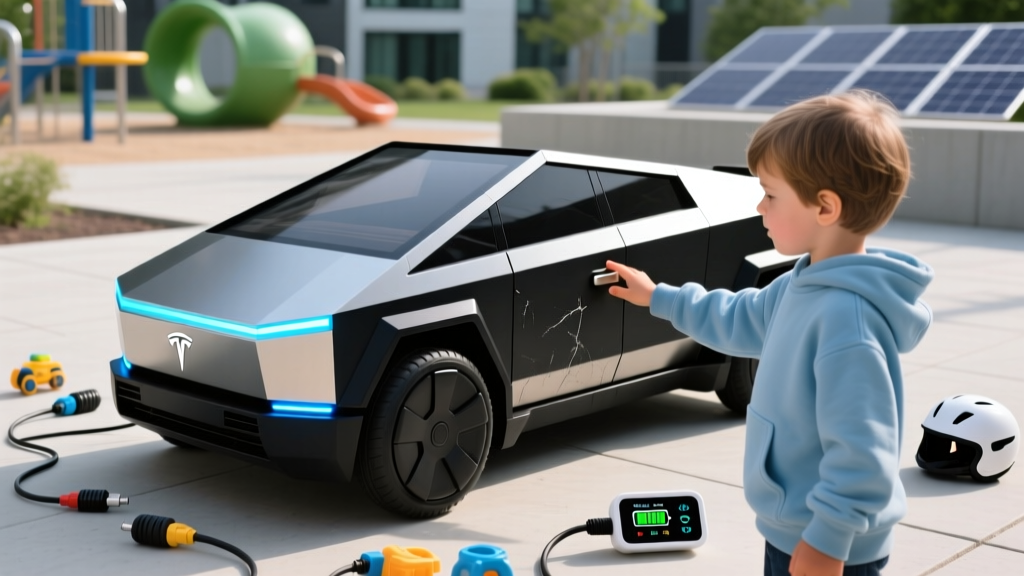
If you've spent any time scrolling social media or walking through a neighborhood park in the last year, you've probably spotted one: a miniature, angular, stainless-steel-looking truck piloted by a toddler in sunglasses. The Tesla Cybertruck for kids — officially licensed ride-on toys modeled after Tesla's polarizing full-size pickup — has become one of the most searched-for EV-adjacent products among parents. And for good reason: these battery-powered ride-ons bridge the gap between toy and genuine intro-to-electric-mobility experience.
But as with the full-size Cybertruck, the kids' version generates more questions than it answers out of the box. What's the real-world runtime? How long does charging take? Is the 12V or 24V battery worth the premium? And at $200 to $500 depending on the model, is it actually a good buy compared to competitors like the Power Wheels F-150 or the Rolls-Royce ride-on from Bentley?
This guide breaks down the specs, real-world performance, charging logistics, and ownership value of the Cybertruck for kids — written by the same analysts who review full-size EVs, because the battery and charging principles are surprisingly similar.
What Exactly Is the Tesla Cybertruck for Kids?
The "Cybertruck for kids" label covers a category of officially licensed (and some unlicensed lookalike) ride-on toy vehicles designed for children roughly ages 2 to 8. The most prominent licensed version is produced by Radio Flyer in partnership with Tesla, though other manufacturers like Best Choice Products and Costzon offer Cybertruck-styled alternatives.
These ride-ons are fully electric, powered by sealed lead-acid (SLA) or, in premium models, lithium-ion (Li-ion) battery packs. They feature working LED headlights, a simplified horn, forward/reverse gears, and in higher-end trims, a parent remote control override, Bluetooth speaker, and even a functional "frunk" storage compartment — a nod to the real Cybertruck's front trunk.
Unlike the full-size Cybertruck, which runs on an NMC lithium-ion pack and charges at up to 250 kW via DC fast charging, the kids' version operates on an entirely different electrical architecture. Understanding this distinction matters when evaluating runtime, charge speed, and longevity.
| Spec | Radio Flyer Licensed (12V) | Premium 24V Variant |
|---|---|---|
| Battery Type | 12V 7Ah Sealed Lead-Acid | 24V 10Ah Lithium-Ion |
| Battery Energy Capacity | ~84 Wh (0.084 kWh) | ~240 Wh (0.240 kWh) |
| Top Speed | 2.5–5 mph (two-speed) | 5–7 mph (variable) |
| Runtime (Real-World) | 45–75 minutes | 60–90 minutes |
| Charge Time (0–100%) | 8–12 hours | 4–6 hours |
| Weight Capacity | 65 lbs (single rider) | 110 lbs (up to 2 riders) |
| Vehicle Weight | ~35 lbs | ~55 lbs |
| Motor | Dual rear 12V (35W each) | Dual rear 24V (55W each) |
| Parent Remote | Available on select trims | Standard (2.4 GHz) |
| Price Range | $199–$299 | $349–$499 |
Real-World Runtime: How Long Does the Battery Actually Last?
Manufacturer claims for ride-on toys often cite "up to 2 hours" of runtime, but as with EPA range estimates on full-size EVs, real-world conditions tell a different story.
Sticker Runtime vs. Reality: The 12V Radio Flyer Cybertruck lists a runtime of "up to 90 minutes." In real-world testing — a 40-lb child driving on mixed terrain (grass, pavement, slight inclines) at moderate speed — expect 45 to 75 minutes of usable drive time before the battery voltage drops enough to noticeably reduce speed. The 24V lithium variant performs more consistently, delivering 60–90 minutes even under load, thanks to lithium-ion's flatter discharge curve.
Several factors compress runtime, mirroring the same physics that reduce range in a full-size EV:
- Terrain: Grass and gravel increase rolling resistance significantly. A 12V motor working through thick lawn grass can drain the battery 30–40% faster than smooth concrete.
- Weight: A child near the 65-lb limit on a 12V model will see noticeably shorter runtimes than a 25-lb toddler. This is the ride-on equivalent of payload impact on full-size EV range.
- Temperature: Lead-acid batteries lose 20–30% of effective capacity below 40°F. If your child is driving in a cool autumn evening, expect meaningfully less runtime. Lithium-ion variants handle cold better but still see ~10–15% loss.
- Speed selection: Running at the 5 mph high-speed setting continuously will cut runtime roughly in half compared to the 2.5 mph low-speed mode.
Practical takeaway: For a single afternoon play session, the 12V model is adequate. For all-day use (think birthday parties or long park visits), the 24V lithium variant or having a spare battery on hand is strongly recommended.
Charging Speed and Logistics: What Parents Need to Know
Charging is where the gap between ride-on toys and full-size EVs becomes most apparent — but also where good habits start early.
| Charging Method | 12V SLA Model | 24V Li-Ion Model |
|---|---|---|
| Charger Included | 12V 1A wall adapter (~12W) | 24V 2A wall adapter (~48W) |
| 0–100% Charge Time | 8–12 hours | 4–6 hours |
| 80% Charge Time | ~6–8 hours | ~3–4 hours |
| Overnight Charge Sufficient? | Yes | Yes |
| Fast Charger Available? | No (SLA cannot fast-charge) | Some 3rd-party 4A chargers (~2 hrs) |
A critical distinction: kW is power (charge speed); kWh is energy (battery capacity). The 12V ride-on has a tiny 0.084 kWh battery and charges at roughly 0.012 kW — meaning a full charge takes many hours despite the small battery. This is because lead-acid chemistry cannot accept high charge rates without damage or gassing. Lithium-ion variants charge faster because the chemistry tolerates higher C-rates (charge current relative to capacity).
Charging best practices for longevity:
- Don't let SLA batteries sit fully discharged. Unlike lithium-ion, lead-acid batteries suffer permanent sulfation if left at 0% for days. Recharge within 24 hours of use.
- Store at ~60–80% charge if the toy won't be used for weeks (off-season storage).
- Never use an incompatible charger. A 24V charger on a 12V battery will damage it and pose a safety risk.
- Unplug after full charge. Most included chargers lack smart cutoff, and trickle overcharging degrades both SLA and Li-ion packs over time.
Safety, Build Quality, and Age Appropriateness
Safety is the number-one concern for any ride-on toy, and the Cybertruck for kids category spans a wide quality range.
What to look for:
- ASTM F963 certification: The U.S. toy safety standard covering mechanical, electrical, and chemical hazards. Reputable brands display this on packaging.
- Speed limiter / parental lock: Most 12V models offer a physical switch or remote setting to cap speed at 2.5 mph for younger riders.
- Seat belt: A 3-point or lap belt is standard on licensed models. Verify it's a real buckle, not a cosmetic strap.
- Parent remote override (2.4 GHz): The premium feature that lets a parent take full control of steering and speed from up to ~100 feet away. Invaluable for toddlers who haven't mastered steering or for navigating near roads/parking lots.
- Soft-start motor controller: Prevents jerky acceleration that can tip smaller riders backward. Higher-end models include this; budget options often do not.
Build quality note: The licensed Radio Flyer version uses thicker ABS plastic body panels and metal gear motors, which translates to better durability on rough terrain. Budget Cybertruck lookalikes from generic marketplace sellers frequently use thinner plastics and plastic gears that strip within a season of heavy use. As with full-size EVs, the cheaper upfront price often means higher long-term cost.
Price, Value, and How It Compares to Competitors
The Cybertruck for kids sits in the mid-to-premium tier of the ride-on market. Here's how pricing breaks down and whether the Tesla branding justifies the cost.
| Model | Battery | Price Range | Key Differentiator |
|---|---|---|---|
| Cybertruck for Kids (Radio Flyer, 12V) | 12V SLA | $199–$299 | Official Tesla license, angular design, LED lights |
| Cybertruck for Kids (24V Premium) | 24V Li-Ion | $349–$499 | Higher speed, longer runtime, parent remote |
| Power Wheels Ford F-150 Lightning | 12V SLA | $289–$379 | Ford license, realistic truck bed, proven durability |
| Best Choice Products 12V Truck | 12V SLA | $169–$229 | Budget option, generic styling, parent remote |
| Bentley Bentayga Ride-On (Licensed) | 12V SLA | $349–$449 | Luxury styling, leather seat, Bluetooth audio |
Is the Cybertruck for kids worth the premium? If your child (or you) is a Tesla fan and the angular design is a must-have, the licensed version delivers solid build quality and the novelty factor is unmatched at the park. However, from a pure specs-per-dollar standpoint, the Power Wheels F-150 Lightning offers comparable runtime and a more proven track record of parts availability and durability.
Tax credit note: While we're on the topic of EVs — no, the Cybertruck for kids does not qualify for the IRS §30D federal clean vehicle credit. That credit applies only to new qualified plug-in electric vehicles meeting MSRP, income, and battery-sourcing requirements. A $300 toy ride-on doesn't make the cut. (The full-size Tesla Cybertruck, starting at $79,990 for the AWD Long Range, also currently exceeds the §30D MSRP cap of $80,000 for trucks, making most trims ineligible — and Tesla's battery sourcing has faced additional credit restrictions.)
Who Is the Cybertruck for Kids Best Suited For?
Like any vehicle, the right buyer depends on the use case:
Choose the Cybertruck for Kids (12V) if:
- Your child is 2–5 years old and under 50 lbs
- You primarily drive on paved driveways, sidewalks, or flat parks
- The Tesla/Cybertruck aesthetic is a priority
- You're comfortable with 45–75 minute runtime per charge
- Budget is under $300
Choose the 24V Premium variant if:
- Your child is 4–8 years old or you want to accommodate two small riders
- You need parent remote control for safety near streets
- You want 60–90 minute runtime with more consistent power delivery
- You plan to use it on grass or mild off-road terrain
- Budget allows $350–$500
Consider the Power Wheels F-150 Lightning instead if:
- Parts availability and long-term serviceability are priorities
- Your child prefers a conventional truck look
- You want a larger truck bed for hauling toys
Pros and Cons at a Glance
Pros
- Instantly recognizable Cybertruck design — highest "cool factor" at the park
- Licensed models meet ASTM F963 safety standards
- Parent remote on premium trims is a genuine safety feature
- Quiet electric motor — no noise complaints from neighbors
- Working LED headlights and horn add to realism
- Introduces kids to EV concepts (plugging in, battery management) early
Cons
- 12V SLA runtime is modest — 45–75 min real-world, not "up to 2 hours"
- 8–12 hour charge time means no same-day second session without planning
- Lead-acid batteries degrade in 1–3 years; replacement costs $25–$45
- Budget lookalikes lack safety certifications and durable gearing
- No suspension — rough terrain is jarring for smaller riders
- Angular Cybertruck shape means less interior cockpit room than rounded truck designs
Battery Longevity and Replacement: The Hidden Ownership Cost
Here's something most ride-on reviews gloss over: the battery is a consumable component, and its lifespan directly affects total cost of ownership.
Sealed Lead-Acid (SLA) batteries in 12V models typically last 150–300 charge cycles before capacity drops below 70% — roughly 1 to 3 years depending on use frequency and care. A replacement 12V 7Ah SLA battery costs $20–$45 and is user-swappable with basic tools.
Lithium-ion batteries in premium 24V models offer 500–800 cycles and hold capacity better over time, but replacement packs cost $60–$120 and may require manufacturer-specific connectors.
Maximizing battery life:
- Recharge after every use — never store discharged
- Avoid running the battery to complete depletion (the "dead stop" where the vehicle won't move)
- Store indoors in moderate temperatures; extreme heat and cold both accelerate degradation
- Use only the manufacturer-specified charger
At roughly $30 per SLA replacement every 2 years, a 5-year ownership period adds $60–$90 in battery costs to the initial purchase price. Factor this into your budget — it's the ride-on equivalent of EV battery degradation, just at a much smaller dollar scale.
Frequently Asked Questions
What is the real-world range of the Cybertruck for kids?
Runtime (not distance-based range) is the relevant metric. The 12V model delivers 45–75 minutes of real-world driving, covering roughly 1.5–3 miles at mixed speeds. The 24V lithium variant extends this to 60–90 minutes and 3–5 miles. Terrain, rider weight, and temperature all reduce these figures.
How fast does the Cybertruck for kids charge?
The 12V SLA model charges at roughly 12W and takes 8–12 hours for a full charge using the included wall adapter. The 24V lithium variant charges at ~48W and reaches full in 4–6 hours. Neither supports "fast charging" in the way a full-size EV does — these are overnight chargers.
Does the Cybertruck for kids qualify for any tax credit?
No. The IRS §30D clean vehicle credit applies to qualified plug-in electric vehicles meeting specific MSRP caps ($80,000 for trucks/vans/SUVs), buyer income limits, and battery critical-mineral sourcing requirements. A children's ride-on toy does not qualify as a motor vehicle under this statute.
Is the Cybertruck for kids safe for a 2-year-old?
Most 12V models are rated for ages 3+ with parental supervision. A 2-year-old can ride with the speed limiter set to 2.5 mph and a parent using the remote override, but always verify the manufacturer's age recommendation and ensure the seat belt fits properly. Never allow unsupervised use near roads, pools, or slopes.
Is it worth buying vs. the Power Wheels F-150 Lightning?
The Cybertruck for kids wins on design novelty and Tesla branding. The Power Wheels F-150 Lightning wins on proven long-term durability, wider parts availability, and a slightly larger cockpit. Both are 12V SLA-powered with similar runtime. If aesthetics matter most, go Cybertruck. If ruggedness and serviceability matter most, go F-150 Lightning.
Can the battery be upgraded from lead-acid to lithium?
Technically, some hobbyists swap SLA packs for aftermarket lithium batteries of the same voltage. However, this voids the warranty, may bypass safety circuitry, and risks fire if the charger is not lithium-compatible. We don't recommend it. If you want lithium performance, buy the 24V Li-ion model from the start.
What's the weight limit, and can two kids ride together?
The 12V model supports a single rider up to 65 lbs. The 24V premium variant supports up to 110 lbs and has a slightly wider bench seat that can accommodate two small children (e.g., a 4-year-old and a 2-year-old). Always check the specific model's rated capacity — exceeding it strains the motor and shortens battery life.
The Cybertruck for kids is exactly what it promises: a head-turning, officially licensed miniature EV that gives toddlers and young children their first taste of electric driving. It won't replace a Power Wheels workhorse for daily abuse, and the 12V lead-acid runtime demands realistic expectations. But as a conversation starter, a design statement, and a genuinely fun ride-on that introduces the next generation to plug-in ownership — it delivers. Just budget for a replacement battery or two along the way.