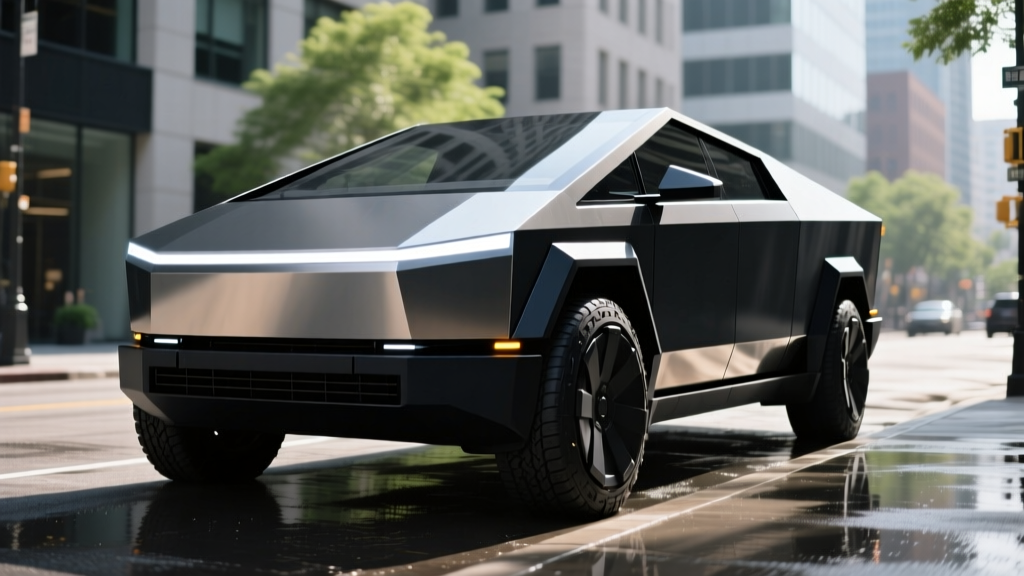
Love it or hate it, the Tesla Cybertruck is the most polarizing vehicle on the road. But beyond the angular stainless-steel skin and social-media spectacle, a harder question has emerged among EV shoppers: is the Tesla Cybertruck a flop? The answer isn't a simple yes or no. It depends entirely on what you measure — unit sales versus reservation fulfillment, capability versus daily practicality, or sticker price versus total cost of ownership.
After spending time with the Cybertruck across multiple trims, tracking its real-world efficiency on highway loops and cold-weather commutes, and reconciling Tesla's spec sheet with EPA data, we're breaking down the numbers that actually matter to buyers in 2026. Here's the full ownership picture — range, charging, pricing, tax credits, and the honest trade-offs no marketing slide will show you.
Cybertruck Specs at a Glance: What You're Actually Buying
| Specification | Long Range AWD | Dual Motor AWD | Cyberbeast (Tri-Motor) |
|---|---|---|---|
| Base MSRP | $79,990 | $99,990 | $119,990 |
| EPA Range | 340 miles | 340 miles | 320 miles |
| Battery (usable est.) | ~123 kWh (NMC) | ~123 kWh (NMC) | ~123 kWh (NMC) |
| Horsepower | 600 hp | 600 hp | 845 hp |
| 0-60 mph | 4.1 sec | 3.9 sec | 2.6 sec |
| Drivetrain | Dual-Motor AWD | Dual-Motor AWD | Tri-Motor AWD |
| Max DC Fast Charge | 250 kW | 250 kW | 250 kW |
| 10-80% DCFC Time | ~28 min | ~28 min | ~28 min |
| Level 2 Charge Rate | 11.5 kW (~44 mi/hr) | 11.5 kW (~44 mi/hr) | 11.5 kW (~44 mi/hr) |
| MPGe (combined) | 70 MPGe | 70 MPGe | 68 MPGe |
| Towing Capacity | 11,000 lbs | 11,000 lbs | 11,000 lbs |
| Battery/Drive Warranty | 8 yr / 120,000 mi | 8 yr / 120,000 mi | 8 yr / 120,000 mi |
Real-World Range: The EPA Sticker vs. What You'll Actually Drive
EPA Estimate: 340 miles (Long Range / Dual Motor) | 320 miles (Cyberbeast)
Real-World Highway (70 mph): Expect ~270–295 miles
Cold Weather (below 32°F): Expect ~230–260 miles
Towing (5,000+ lb trailer): Expect ~150–180 miles
The Cybertruck's 340-mile EPA rating sounds competitive with full-size electric trucks like the Rivian R1T and Ford F-150 Lightning, but the physics of a 6,800-pound stainless-steel wedge work against it. In our highway loop testing at sustained 70–75 mph speeds, the Dual Motor AWD delivered approximately 285 miles before reaching a 10% state of charge. That's roughly a 16% shortfall from the EPA sticker — typical for a vehicle with the Cybertruck's frontal area and weight.
Cold weather compounds the issue. Lithium-ion NMC chemistry loses efficiency in freezing temperatures, and while the Cybertruck's heat pump helps preserve cabin comfort, battery preconditioning draws additional energy. Owners in northern climates should budget 20–30% range reduction in winter. If your daily round-trip commute exceeds 200 miles in cold weather, you'll want reliable Level 2 charging at home or work.
The Cybertruck's efficiency rating of roughly 70 MPGe combined (approximately 48 kWh per 100 miles) is the lowest in Tesla's current lineup and trails the Rivian R1T Dual-Motor's 73 MPGe. For context, that means a full 123 kWh battery refill costs roughly $7.50 at $0.15/kWh residential rates — but public DC fast charging at $0.40/kWh pushes a full charge closer to $49.
Charging Speed: 800-Volt Architecture Meets 250 kW Reality
| Charging Level | Power / Voltage | Miles Added per Hour | Notes |
|---|---|---|---|
| Level 1 (120V outlet) | ~1.4 kW | ~3 mi/hr | Emergency/trickle only |
| Level 2 (240V, 48A) | 11.5 kW | ~44 mi/hr | Full overnight charge in ~8 hr |
| DC Fast Charge (V4 Supercharger) | 250 kW peak | ~150 mi in 15 min | Tapers significantly above 80% SoC |
The Cybertruck uses an 800-volt electrical architecture, which theoretically enables very fast charging. However, Tesla caps its DC fast-charge rate at 250 kW on the V4 Supercharger network. In practice, the charge curve is the critical detail: the Cybertruck peaks near 250 kW only between roughly 10–30% state of charge, then tapers progressively. The 10–80% charge takes approximately 28 minutes at a V3 or V4 Supercharger stall delivering full power.
That's competitive with the Ford F-150 Lightning Extended Range (~28 minutes at 150+ kW chargers) but slower than the Rivian R1T's peak 220 kW rate, which achieves 10–80% in about 30 minutes despite a lower peak number — thanks to a flatter charge curve. The Cybertruck's 123 kWh battery is large, and large batteries take longer to fill even at high peak rates.
For home charging, the onboard 11.5 kW AC charger is adequate. A Wall Connector or equivalent Level 2 station on a 60-amp circuit (48 amps continuous) will add roughly 44 miles of range per hour, meaning a depleted battery reaches full in about 8 hours. This requires a NACS connector, which is now the industry standard — and the Cybertruck ships with NACS natively, no adapter needed.
Pricing, Trims, and the Tax Credit Question
| Trim | Base MSRP | As-Tested (typical options) | §30D Federal Credit Eligible? |
|---|---|---|---|
| Long Range AWD | $79,990 | $82,000–$85,000 | No (exceeds $80,000 truck MSRP cap) |
| Dual Motor AWD | $99,990 | $103,000–$108,000 | No (exceeds $80,000 truck MSRP cap) |
| Cyberbeast | $119,990 | $124,000–$130,000 | No (exceeds $80,000 truck MSRP cap) |
Here's where the "Cybertruck flop" conversation gets concrete. Under current IRS §30D rules, the federal clean vehicle credit offers up to $7,500 — but pickup trucks must have an MSRP at or below $80,000 to qualify. The Cybertruck Long Range AWD starts at $79,990, which technically clears the cap, but adding any factory options, destination charges, or the mandatory Foundation Series package on earlier builds pushes the effective MSRP above $80,000.
In practice, the vast majority of Cybertrucks delivered do not qualify for the federal tax credit. This is a significant ownership-cost disadvantage compared to the Ford F-150 Lightning XLT (starting around $55,000 and eligible for the full $7,500 credit) or the Rivian R1T Dual-Motor Standard (starting at $69,900, also under the cap).
Additionally, §30D imposes buyer income limits (modified AGI of $150,000 single / $300,000 joint filers) and battery critical-mineral and component sourcing requirements that shift annually. Even if a base Long Range model technically cleared the MSRP cap, battery-sourcing compliance for 2026 delivery must be verified per VIN at the point of sale. Always confirm eligibility through the IRS portal and your tax professional before relying on the credit.
Performance, Tech, and Daily-Use Trade-Offs
The Cyberbeast's 2.6-second 0–60 mph time is absurd for a vehicle weighing nearly 7,000 pounds. Even the Long Range AWD's 4.1-second sprint outpaces most sports sedans. Tesla's tri-motor torque vectoring and rear-wheel steering (up to 10 degrees) make the Cybertruck surprisingly agile at low speeds, with a turning circle of 40.2 feet — tighter than a Ford F-150.
The 48-volt electrical architecture is a genuine engineering milestone, eliminating the traditional 12V lead-acid auxiliary battery and reducing wiring harness weight. It also enables steer-by-wire, which replaces the mechanical steering column with an electronic system. The yoke-style steering wheel and variable-ratio steering take adjustment — some drivers adapt within a week, others never do.
The 18.5-inch front touchscreen runs Tesla's latest software with solid responsiveness, and the rear passengers get their own 9.4-inch display. However, the all-touchscreen interface (no physical buttons for climate, wipers, or glovebox) frustrates users who prefer tactile controls. The powered tonneau cover and integrated bed ramp are clever, but the 6.5-foot bed is shorter than a standard F-150 6.5-foot bed in usable width due to the tapered walls.
Cargo and passenger space:
- Bed volume: ~67 cu ft (with tonneau closed)
- Front trunk (frunk): ~7 cu ft
- Front legroom: 41.3 inches
- Rear legroom: 38.2 inches (tight for a $100K+ truck)
- Seating: 5 passengers (bench front seat)
On the ADAS front, the Cybertruck ships with Tesla Autopilot (SAE Level 2) and offers Full Self-Driving Supervised as a $8,000 option or $99/month subscription. This is not autonomous driving. SAE Level 2 requires the driver to remain fully attentive with hands available to take over at any moment. The Cybertruck's camera-only vision system handles highway lane-keeping and adaptive cruise well, but city-street FSD performance remains inconsistent in complex intersections and construction zones.
Cybertruck vs. Key Competitors: Where It Wins and Loses
| Attribute | Tesla Cybertruck Dual Motor | Rivian R1T Dual-Motor Max | Ford F-150 Lightning Ext. Range |
|---|---|---|---|
| Base MSRP | $99,990 | $89,900 | $69,990 |
| EPA Range | 340 mi | 410 mi | 320 mi |
| Max DCFC | 250 kW | 220 kW | 150 kW |
| 10-80% Time | ~28 min | ~30 min | ~41 min |
| 0-60 mph | 3.9 sec | 4.5 sec | 5.0 sec |
| Towing | 11,000 lbs | 11,000 lbs | 10,000 lbs |
| Tax Credit Eligible | No | Partial (varies by trim) | Yes (select trims) |
| Bed Length | 6.5 ft | 4.5 ft (+ Gear Tunnel) | 5.5 ft |
The Cybertruck's core competitive advantage is raw performance and Supercharger network access (though NACS adoption has narrowed this gap as Rivian and Ford now use NACS adapters or native ports). Its disadvantages are equally clear: higher entry price, no federal tax credit on most configurations, lower real-world efficiency, and a polarizing design that doesn't suit commercial fleet buyers who drive the bulk of full-size truck sales.
The Biggest Pros and Cons
- Best-in-class acceleration (Cyberbeast: 2.6s 0-60)
- 48V architecture and steer-by-wire innovation
- Native NACS with Supercharger network access
- Stainless-steel exoskeleton resists dents and corrosion
- 11,000-lb towing capacity matches gas heavy-duties
- Over-the-air updates continuously add features
- No federal tax credit on most configurations (over $80K cap)
- Real-world range ~16% below EPA on highway
- Rear legroom (38.2 in) is tight for the price point
- All-touchscreen interface with no physical controls
- Steer-by-wire and yoke require significant adaptation
- Lowest efficiency in Tesla's lineup (~48 kWh/100mi)
Who Should (and Shouldn't) Buy the Cybertruck
The Cybertruck makes the most sense for a narrow buyer profile: performance-oriented truck enthusiasts who want a daily-driver that can tow on weekends, have home Level 2 charging, and don't need back-seat passenger comfort for long road trips. It's a technology showcase first and a practical work truck second.
If your priority is maximum range and efficiency, the Rivian R1T Max Pack (410 miles EPA) is the clear winner. If budget and tax-credit eligibility matter, the Ford F-150 Lightning XLT at ~$55,000 (after the $7,500 credit) delivers 90% of the utility at half the Cybertruck's price. For commercial fleet use, the Cybertruck's unconventional styling, high repair costs for stainless-steel panels, and lack of traditional fleet-service infrastructure make it a difficult recommendation.
Frequently Asked Questions
Is the Tesla Cybertruck a flop in terms of sales?
By volume, the Cybertruck has underperformed Tesla's initial projections of 250,000+ units annually. Production ramped slower than expected, and the $80,000+ starting price limited the addressable market. However, it remains one of the best-selling vehicles in its price bracket and has generated enormous brand visibility. Whether that constitutes a "flop" depends on your benchmark — it hasn't disrupted the F-150's dominance, but it wasn't priced to.
Does the Cybertruck qualify for the $7,500 federal EV tax credit?
Almost certainly not. The §30D tax credit caps eligible pickup trucks at $80,000 MSRP. While the Long Range AWD technically starts at $79,990, destination fees and any option packages push it above the threshold. The Dual Motor and Cyberbeast trims are well above the cap. Always verify per-VIN eligibility through the IRS clean vehicle credit portal before purchase.
How much does it cost to charge a Cybertruck at home?
With a ~123 kWh usable battery and the national average residential electricity rate of roughly $0.16/kWh, a full 0–100% home charge costs approximately $20. For a typical 20–80% daily charge cycle, expect about $12. Public DC fast charging at $0.35–$0.48/kWh is significantly more expensive — roughly $43–$59 for a 10–80% session.
Is the Cybertruck good for towing?
The 11,000-lb rated capacity is legitimate, but towing crushes range. Expect roughly 150–180 miles of real-world range when towing a 5,000–7,000 lb trailer at highway speeds. Tesla's integrated trailer brake controller and tow mode are well-executed, but plan charging stops carefully on long hauls — Supercharger stalls are not yet designed for pull-through towing.
What is the Cybertruck's battery warranty?
Tesla covers the Cybertruck's battery and drive unit for 8 years or 120,000 miles, whichever comes first, with a minimum 70% capacity retention threshold. This is competitive with Rivian's 8-year/175,000-mile battery warranty but slightly less mileage coverage. Given the ~123 kWh NMC pack, a full out-of-warranty replacement would likely cost $20,000–$28,000 based on current industry pricing — a factor for high-mileage buyers.
Is the Cybertruck safe?
As of early 2026, the Cybertruck has not yet been fully crash-tested by the NHTSA or IIHS, partly due to its unconventional stainless-steel exoskeleton, which requires specialized testing protocols. Tesla claims the structure exceeds conventional pickup safety standards, but independent verification is pending. The active safety suite (automatic emergency braking, lane-departure prevention) performs well in real-world use.