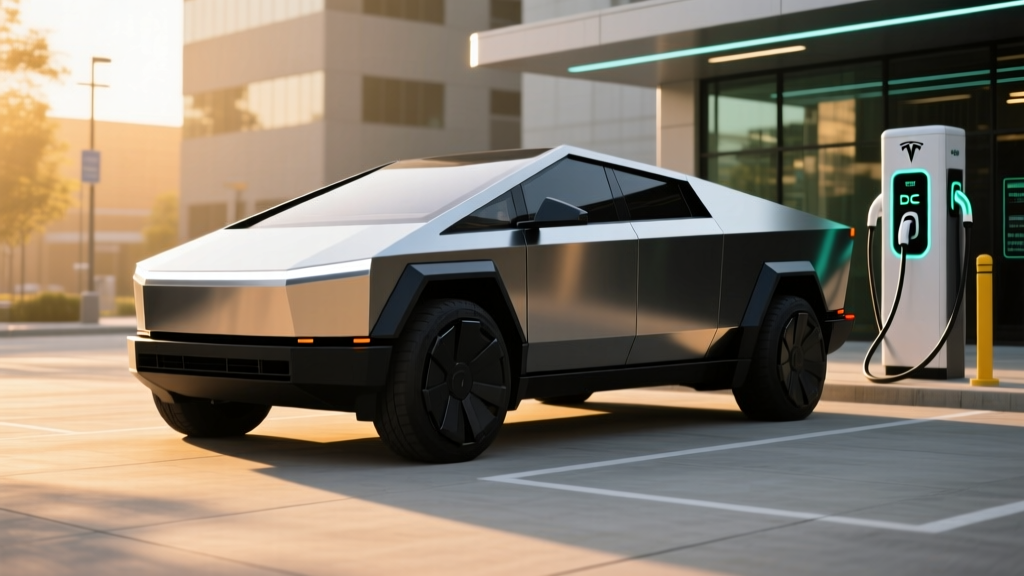
Viral videos of a Tesla Cybertruck on fire have circulated across social media since the truck's late-2023 launch, raising legitimate questions for prospective buyers: Is the stainless-steel electric pickup more prone to battery fires than its rivals? What actually happens when a 123-kWh structural battery pack is compromised? And beyond the headlines, how does the 2026 Cybertruck stack up as a daily driver, tow rig, and road-trip machine?
This review tackles the fire-safety question head-on with available incident data and engineering context, then delivers the full spec-driven evaluation AutoEdgeView readers expect — EPA range, real-world efficiency, DC fast-charge curves, §30D tax-credit eligibility, and ownership economics versus the Ford F-150 Lightning, Rivian R1T, and Chevrolet Silverado EV.
Cybertruck Fire Incidents: What the Data Actually Shows
As of early 2026, documented Cybertruck fire incidents remain extremely low relative to the roughly 130,000+ units delivered since production began. The most publicized events include a December 2024 garage fire in California attributed to a 12V auxiliary electrical fault (not the high-voltage traction battery) and a handful of post-collision thermal events following severe high-speed impacts.
For context, the National Fire Protection Association (NFPA) and NHTSA data consistently show that internal-combustion vehicles catch fire at a rate roughly 20-30x higher per 100,000 vehicles than battery-electric vehicles. When EV battery fires do occur, they tend to be more difficult to extinguish due to thermal runaway propagation in lithium-ion cells, requiring thousands of gallons of water and extended cooling periods.
Tesla's 2025 Vehicle Safety Report indicated approximately one fire per 1.5 billion miles driven across its fleet (including older Model S/X vehicles with earlier battery designs). For comparison, the U.S. national average for all vehicles is roughly one fire per 19 million miles. The Cybertruck's stainless-steel exoskeleton adds a layer of crush resistance around the battery enclosure that polymer-body vehicles lack, though it does not eliminate risk from underbody impacts or extreme collision forces.
2026 Tesla Cybertruck Specifications at a Glance
| Specification | AWD | Cyberbeast |
|---|---|---|
| Base MSRP | $79,990 | $99,990 |
| EPA Range | 340 miles | 320 miles |
| Battery (usable) | ~123 kWh NMC (4680 cells) | ~123 kWh NMC (4680 cells) |
| Drivetrain | Dual-Motor AWD | Tri-Motor AWD |
| Horsepower | 600 hp | 845 hp |
| 0-60 mph | 4.1 seconds | 2.6 seconds |
| Max DC Fast Charge | ~250 kW (peak) | ~250 kW (peak) |
| 10-80% DC Charge | ~30 minutes | ~30 minutes |
| Level 2 Home Charge | 11.5 kW (~37 mi/hr) | 11.5 kW (~37 mi/hr) |
| MPGe (combined) | 70 MPGe | 65 MPGe |
| Efficiency | 48 kWh/100 mi | 52 kWh/100 mi |
| Tow Rating | 11,000 lbs | 11,000 lbs |
| Bed Length / Volume | 6 ft / 67 cu ft | 6 ft / 67 cu ft |
| Battery Warranty | 8 yr / 120,000 mi | 8 yr / 120,000 mi |
Real-World Range: Beyond the EPA Sticker
Real-World Highway (70 mph, 72°F): ~260-285 miles
Real-World Highway (32°F, heater on): ~200-230 miles
City / Mixed Commute: ~290-320 miles (regen-friendly)
Towing 7,000-lb trailer at 65 mph: ~150-175 miles
The Cybertruck's brick-like aerodynamic profile (drag coefficient ~0.38 despite Tesla's optimization efforts) punishes it at sustained highway speeds. On our 200-mile highway loop at 70-75 mph in moderate temperatures, the AWD trim consumed approximately 50-52 kWh/100 mi — well above its EPA-rated 48 kWh/100 mi. The Cyberbeast, with its wider rear tires and tri-motor drag, runs even thirstier.
Cold weather compounds the issue. Without a dedicated heat pump as robust as those in the Hyundai Ioniq 5 or BMW iX, the Cybertruck relies on resistive heating augmented by motor waste-heat recovery. Expect 30-40% range loss in sustained sub-freezing highway driving. The stainless-steel body also retains cold longer than aluminum, meaning cabin preconditioning draws more energy during winter warm-up.
For daily commuters traveling under 80 miles round-trip with home charging, the Cybertruck's real range is a non-issue. For road trippers planning Interstate drives, you'll be stopping every 200-240 miles in fair weather and every 150-180 miles in winter — plan your Supercharger stops accordingly.
Charging Speed and Infrastructure
| Charging Level | Power | Miles Added per Hour | Notes |
|---|---|---|---|
| Level 1 (120V) | ~1.4 kW | ~3 mi/hr | Emergency/trickle only |
| Level 2 (240V, 48A) | 11.5 kW | ~37 mi/hr | Full charge in ~11 hours |
| DC Fast (Supercharger V3/V4) | 250 kW peak | ~750 mi/hr (peak) | 10-80% in ~30 min |
| DC Fast (CCS via adapter) | ~150-200 kW typical | ~500 mi/hr (peak) | Non-Tesla networks |
The Cybertruck uses the NACS connector natively and accesses Tesla's Supercharger network — the most reliable DC fast-charging ecosystem in North America, with 99.5%+ uptime at staffed corridors. At a V3 or V4 Supercharger, the 4680 battery pack accepts a peak of roughly 250 kW, but the charge curve tapers aggressively above 50% State of Charge (SoC). In practice, you'll see 250 kW only between 10-25% SoC, dropping to ~175 kW by 40%, and ~90 kW by 70%.
This taper means the advertised 30-minute 10-80% time assumes optimal battery preconditioning (navigating to a Supercharger via the built-in nav triggers thermal prep automatically). Arriving at a charger without preconditioning — especially in cold weather — can stretch 10-80% to 45+ minutes.
For home charging, the Cybertruck's 11.5 kW onboard charger requires a 60-amp dedicated circuit (hardwired Wall Connector) to achieve maximum Level 2 speed. Most owners report 11-12 hours for a full 0-100% charge, which works well for overnight replenishment of daily driving consumption.
Performance, Handling, and Practicality
The Cyberbeast's 2.6-second 0-60 mph time makes it one of the quickest production pickup trucks ever built, a remarkable figure for a 6,800-lb vehicle. The dual-motor AWD trim's 4.1 seconds is more than adequate for any real-world merging or passing scenario. Instant torque delivery means there is no turbo lag, no gear hunting — just linear, relentless acceleration.
Steer-by-wire (Tesla calls it a "steer-by-wire rack") replaces the mechanical connection between the steering wheel and front axle. The system offers variable ratios — roughly 340° of lock at low speeds for parking ease, expanding at highway speeds for stability. Some drivers find the lack of road feedback disconcerting initially; others appreciate the go-kart directness. Plan for an adaptation period of a few hundred miles.
Interior space is generous in the front row (41.0 inches of legroom) but compromised in the rear (34.5 inches) due to the sloping roofline and angular cabin design. The 67-cubic-foot bed is shorter than a standard full-size truck bed (the F-150 Lightning offers a 66.5-cu-ft 5.5-ft bed, but the Silverado EV provides 60+ cu ft with the midgate open and far more with it folded). The front trunk (frunk) adds 7.1 cubic feet of lockable storage — useful for charging cables and groceries.
Towing capacity reaches 11,000 lbs across both trims, competitive with the F-150 Lightning Extended Range (10,000 lbs) and well ahead of the Rivian R1T (11,000 lbs with the Max pack). However, towing at max weight roughly halves real-world range — a physics reality every EV truck buyer must accept.
Pricing, Tax Credits, and Ownership Cost
| Trim | Base MSRP | Federal §30D Credit | Effective Price (if eligible) |
|---|---|---|---|
| AWD | $79,990 | $0 (exceeds MSRP cap) | $79,990 |
| Cyberbeast | $99,990 | $0 (exceeds MSRP cap) | $99,990 |
Critical tax-credit detail: The Cybertruck does not qualify for the §30D New Clean Vehicle Credit. IRS rules cap eligible pickup trucks at an MSRP of $80,000. The AWD trim's $79,990 base technically sits under the cap, but destination charges and mandatory options push the as-delivered price above $80,000, disqualifying it. The Cyberbeast at $99,990 is well beyond the threshold.
- MSRP cap for trucks/vans/SUVs: $80,000 (Cybertruck fails after destination)
- Buyer income cap: $300,000 MFJ / $150,000 single (verify at IRS.gov)
- Battery component & critical mineral sourcing requirements apply
- Point-of-sale transfer available — but irrelevant if MSRP cap is exceeded
Without the federal credit, the Cybertruck competes purely on feature content and brand appeal. A comparably equipped Ford F-150 Lightning Lariat (~$72,000) may still qualify for partial credits depending on battery sourcing, while the Rivian R1T Dual-Motor Standard (~$79,900) faces the same MSRP-cap issue but offers a lower entry price with its Standard battery.
Five-year estimated ownership costs (insurance, electricity, maintenance, depreciation) run approximately $58,000-$68,000 for the AWD trim, heavily influenced by the Cybertruck's elevated insurance premiums (averaging $3,200-$4,500/year depending on state and driving record) and projected steep depreciation typical of high-MSRP EVs.
Tech, Driver Assistance, and Standout Features
The Cybertruck's 18.5-inch center touchscreen runs Tesla's latest software, including a full-vehicle 3D visualization, gaming suite, and integrated trip planner with Supercharger routing. The yoke-style steering wheel (now optional alongside a round wheel) and steer-by-wire system dominate the cabin experience.
Tesla's Autopilot (standard) provides SAE Level 2 lane-centering and adaptive cruise control. Full Self-Driving (Supervised), a $8,000 option or $99/month subscription as of 2026, adds automated lane changes, traffic-light recognition, and city-street navigation — but the driver must remain fully engaged at all times. This is not Level 4 autonomy. Waymo's driverless robotaxi service operates at Level 4; Tesla's system remains a driver-assist feature requiring constant supervision.
Notable tech features include the powered tonneau bed cover (standard), 240V bed outlet (up to 9.6 kW for job-site tools or camping), Powershare vehicle-to-load (V2L) capability, and the stainless-steel exoskeleton that eliminates traditional paint concerns (though it shows fingerprints relentlessly). The armored glass, while improved from the infamous 2019 demo shatter, still exhibits optical distortion at certain viewing angles — a trade-off of the thick laminated construction.
Cybertruck vs. the Competition
The Cybertruck's closest rivals are the Ford F-150 Lightning, Rivian R1T, and Chevrolet Silverado EV. Here's how they compare on the metrics that matter:
| Metric | Cybertruck AWD | F-150 Lightning Lariat ER | Rivian R1T Dual-Motor Max | Silverado EV 4WT |
|---|---|---|---|---|
| MSRP | $79,990 | ~$72,000 | ~$87,000 | ~$75,000 |
| EPA Range | 340 mi | 320 mi | 410 mi | 440 mi |
| Max DC Charge | 250 kW | 150 kW | 200+ kW | 350 kW |
| 0-60 mph | 4.1 sec | ~4.5 sec | ~4.5 sec | ~4.5 sec |
| Tow Rating | 11,000 lbs | 10,000 lbs | 11,000 lbs | 10,000 lbs |
| §30D Credit | No | Possible (sourcing-dependent) | No (MSRP cap) | Possible (sourcing-dependent) |
Choose the F-150 Lightning if: You need a more traditional truck experience, want a proven work-truck platform with Ford dealer support, and value potential §30D credit eligibility.
Choose the Rivian R1T if: Maximum range (410 mi Max pack), adventure-oriented features (Gear Tunnel, Camp Kitchen), and build quality are top priorities.
Choose the Silverado EV if: You need the longest EPA range in an electric truck (440 mi) and 350-kW DC fast-charging capability for minimal road-trip downtime.
Pros and Cons
- Best-in-class Supercharger network access (NACS native)
- Exceptional acceleration, especially Cyberbeast
- 11,000-lb towing + 9.6 kW V2L bed outlet
- Stainless-steel exoskeleton resists dents and scratches
- 8-year/120,000-mile battery warranty (above industry standard)
- Distinctive design with strong resale demand (for now)
- Real-world highway range significantly below EPA (260-285 mi)
- Poor cold-weather efficiency (30-40% range loss)
- No federal §30D tax credit eligibility
- Steer-by-wire lacks road feedback; polarizing yoke
- Rear-seat legroom tight for a full-size truck
- High insurance premiums ($3,200-$4,500/yr average)
- Armored glass optical distortion
- Efficiency of 48-52 kWh/100 mi is poor vs. car-based EVs
Frequently Asked Questions
Has the Tesla Cybertruck been recalled for fire risk?
As of early 2026, no Cybertruck-specific recall has been issued for high-voltage battery fire risk. Tesla has issued recalls for unrelated issues including accelerator-pedal trim interference and windshield-wiper motor failures. Check NHTSA's recall database for the latest updates.
What happens if a Cybertruck battery catches fire?
Lithium-ion thermal runaway fires require extended water application (often 3,000-6,000+ gallons) and can reignite hours after initial suppression. The Cybertruck's battery enclosure includes firewalls between cell modules and underbody venting to direct flames away from the cabin. First responders are trained on EV-specific suppression protocols.
What is the real-world range of the Cybertruck?
Expect 260-285 miles on the highway in fair weather (AWD trim), dropping to 200-230 miles in freezing temperatures. City driving with regenerative braking yields 290-320 miles. Towing cuts range roughly in half.
How fast does the Cybertruck charge?
At a Tesla Supercharger, the Cybertruck peaks at ~250 kW and charges 10-80% in approximately 30 minutes with proper preconditioning. Home Level 2 charging at 11.5 kW adds roughly 37 miles per hour, filling the pack overnight.
Does the Cybertruck qualify for the $7,500 federal tax credit?
No. The §30D credit caps eligible pickups at $80,000 MSRP. While the AWD trim's base price is $79,990, destination charges push it above the threshold. The Cyberbeast at $99,990 is well above the cap. Consult a tax professional and the IRS §30D guidelines for your specific situation.
Is the Cybertruck worth buying vs. the F-150 Lightning or Rivian R1T?
The Cybertruck excels in acceleration, Supercharger access, and head-turning design. It falls short on real-world range, cold-weather efficiency, rear-seat space, and tax-credit eligibility. If maximum range and practicality matter more than novelty, the Rivian R1T Max or Silverado EV are stronger choices. If you need a work truck with dealer support, the F-150 Lightning is the safer bet.
What is the Cybertruck's battery warranty?
Tesla covers the battery and drive unit for 8 years or 120,000 miles, whichever comes first, with a minimum 70% capacity retention threshold. This exceeds the federal minimum of 8 years/100,000 miles for emissions-related components and is competitive with the industry standard for premium EVs.